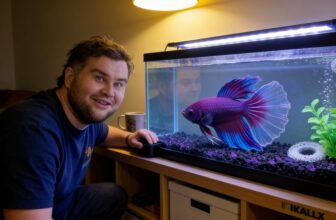
So, your betta’s blowing a foamy bubble raft at the surface? That’s a bubble nest, a saliva-coated nursery for future eggs.
He builds it since his breeding instinct kicks in, not since he’s thrilled or stressed—just instinct. Healthy nests look like thick meringue, layered and anchored in calm corners.
You don’t need to remove it, and building it without a female is totally normal. If he suddenly stops, check your water—ammonia or poor temps kill the urge.
Stick around for water fixes that get him bubbling again.
At A Glance
- Male bettas blow bubbles to build a saliva-coated nest for fertilized eggs.
- Bubble nests serve as a nursery, anchored to floating plants or calm corners.
- Frequent nest building signals health, maturity, and stable water conditions.
- A sudden nesting stop with lethargy may indicate stress or illness.
- Females may also blow bubbles due to hormones, not breeding instinct.
What Exactly Is a Betta Bubble Nest and Why Do Males Build It?
So you’ve spotted a frothy little raft of bubbles at the top of your betta’s tank—don’t worry, your fish hasn’t suddenly taken up soap‑blowing as a hobby.
That’s a bubble nest, a nursery your male betta builds from his own saliva‑coated air bubbles. He gulps air using his maze organ, then spits out these sticky spheres, anchoring them near floating plants or a quiet corner.
It’s his way of saying, “I’m ready for breeding.” He’ll guard that nest like a tiny, bubble‑obsessed dad. No need to remove it; it’s totally natural. To ensure your betta’s health, maintain stable water conditions to prevent stress and swim bladder issues. Provide a tight-fitting lid to prevent jumping, as bettas are known to leap from their tanks.
Does Blowing Bubbles Mean Your Betta Is Happy or Stressed?
Though you might want to read bubble-blowing as a mood ring for your betta, it’s actually more of a biological reflex than an emotion meter—he’s not throwing a party for himself.
He’s doing what his genes tell him to: build a nest for eggs he hopes to fertilize.
He’s just following his genes—building a nest for eggs he hopes to fertilize.
So, no, it’s not happiness or stress, really. It’s just instinct.
A healthy male in decent water will blow bubbles since that’s what he does.
Don’t overthink it.
You’re not a fish psychologist.
Maintaining stable output pressure helps ensure consistent water quality for your betta.
Enjoy the show, and remember: if he’s eating and swimming fine, you’re both doing okay.
Using a magnetic fish tank cover can prevent jumpers while preserving light and airflow.
The Secret Ingredient: How Saliva Makes These Bubbles Stick
Since without that saliva, you’d have a bunch of useless air bubbles that pop the second they hit the surface.
Your betta’s saliva is the glue—a glycoprotein coating that lowers surface tension and bonds bubbles together into a stable raft.
He mixes it with air from his maze organ, then spits out each bubble, layer by layer.
That’s why his nest doesn’t dissolve.
- Coats each bubble in a thin, durable film
- Prevents bubbles from merging or popping
- Creates a sticky matrix for structural integrity
- Allows multi-layer nests with depth
- Keeps eggs cradled and fry safe until hatching
Think of it as nature’s superglue, but fishy.
Without it, you’d just have foam.
This glycoprotein coating is chemically similar to the eco-friendly PLA material used in 3D-printed aquatic structures.
For outdoor ponds that support breeding fish, a pond filter with UV clarifier helps maintain water clarity by eliminating algae that can trap or disrupt the nest.
What Does a Healthy Bubble Nest Look Like?
If you’re looking at a bunch of scattered, half‑popped bubbles and calling it a nest, you’ve got a problem—not a breeding chamber.
A healthy one? It’s dense, foamy, and holds together like good meringue.
You’ll see clusters of bubbles, some dime‑sized, others tinier, stacked in layers.
It usually sits in a calm corner, anchored by floating plants or debris.
The edges appear crisp, not deflating.
Your betta patrols it, adding fresh bubbles daily.
No mold, no rancid smell.
That’s a nest built with purpose—not a sad, half‑hearted attempt.
Welcome to the club.
Providing territories roughly 8 inches of floor space per fish helps reduce stress that might otherwise disrupt nest maintenance.
Maintain stable water parameters to support nest building, as constant changes discourage this natural behavior.
Why Your Betta Builds Nests Even Without a Female Around
Why does your betta go through the whole bubble‑building ritual when there’s not a female in sight? Simple—he’s practicing his craft, like a carpenter building birdhouses in winter. It’s instinct, pure and simple, a sign he’s healthy and ready.
- He’s signaling he’s mature, a big, strong fish.
- It shows his water’s clean and he feels secure.
- A nest means he’s got low stress; no predators lurking.
- He’s just born to bubble, like you’re born to binge‑watch shows.
- It’s his way of saying, “I’m a capable guy,” even if no lady’s watching.
In fact, his instinct to build is so strong that the same reef‑safe chemistry used in aquarium glues can be applied to safely anchor plants or decorations in his tank. A betta kept in a tank with a tight‑fitting canopy will feel more secure and less likely to jump in sudden fright.
How Nests Help Male Bettas Attract a Mate
A bubble nest is basically the betta version of a flashy sports car parked in a puddle—it’s a visual status symbol. When a female cruises by, she’s checking out your male’s craftsmanship. A big, foamy nest says he’s strong and ready to be a dad. She’ll destroy a shabby one, demanding better. Maintaining stable pH and temperature with a reliable meter helps ensure your male’s nest-building hormones stay optimal. Using a quiet acrylic skimmer stand can reduce vibrations that might disturb his nest-building efforts.
| Nest Feature | What It Signals to a Female |
|---|---|
| Large size | High stamina, good genes |
| Thick foam | Strong saliva coating, dedication |
| Anchored to plants | Smart builder, safe home |
| Fresh bubbles | Active, attentive partner |
You’re not just a fishkeeper; you’re his wingman. Give him floating plants and calm water. He’ll show off his masterpiece, and she’ll know he’s worthy.
Watch a Male Betta Build His Bubble Nest, Step by Step
You’re about to see a master builder at work, and he doesn’t even use tools. He starts by gulping air at the surface, coating each bubble with sticky saliva from his mouth. Then, he swims down, releases a single bubble, and it floats up to join the cluster. Repeat, repeat, repeat—he’s relentless.
- He’ll surface every few seconds, never tiring.
- Each bubble pops except when sealed quickly with that special spit.
- He anchors the nest under floating plants or in calm corners.
- The structure grows layer by layer, foamier by the hour.
- He guards his masterpiece constantly, no breaks allowed.
You’ll see him fanning, adjusting, adding—his tiny obsession is contagious.
Unlike bamboo shrimp, which use fan‑shaped claws to filter‑feed in moderate currents, bettas build their nests entirely from surface bubbles. If your betta stops building, check for illness with API General Cure Diagnostic Chart to identify common parasites or infections.
How Often Should Your Betta Build a Bubble Nest?
Watching your male betta obsess over building a bubble nest is entertaining, but you might wonder if he should be doing it constantly.
Truth is, there’s no set schedule—some males rebuild weekly, others monthly, and some only when a female’s near.
If he’s building often, that’s fine; it just means he’s healthy, mature, and feeling frisky. Adding plants like Java Fern provides gentle background foliage that can make him feel more secure and encourage natural nesting behavior.
No nest? Don’t panic. Many content bachelors skip it entirely. You’re not failing.
The real red flag? Sudden stops after regular building, paired with lethargy or clamped fins—that signals stress or illness.
Otherwise, let him be; he’ll nest when he’s ready.
If you want to enhance his environment, consider adding a floating plant island from an embroidery hoop to provide shade and resting spots, which can encourage natural behavior.
Can Female Bettas Build Bubble Nests Too?
- It’s driven by hormones, not breeding instinct.
- She won’t guard eggs or care for fry—ever.
- Remove the nest if it gets moldy; otherwise, let her be.
- It’s a normal, harmless quirk, not a health issue.
- No male required—she’s just being extra, similar to how a pleco benefits from stable water conditions for overall wellbeing.
- This playful behavior can spark shared smiles among aquarists without needing any training.
Do Other Fish Build Bubble Nests Like Bettas Do?
So you’ve figured out that your male betta’s bubble nest is a classic dad move, but don’t worry, he’s not alone in his foamy ambitions. Other fish build them too, and you’re part of a club that gets the whole bubble‑nesting thing.
| Fish Species | Nest Type | Parental Care |
|---|---|---|
| Dwarf gourami | Thick, anchored foam | Male guards eggs |
| Túngara frog | Foam raft on water | Male stays nearby |
| Thin‑shelled snail (Janthinidae) | Bubble float for eggs | No care |
You’ll see dwarf gouramis puffing out similar nests, as túngara frogs whip up foam rafts. It’s a shared, secret skill—your betta’s just the flashy one. This behavior relies on consistent water quality to prevent stress and disease, as poor conditions can shorten a fish’s lifespan and reduce breeding activity. Weekly water testing for ammonia, nitrite, and nitrate is essential to maintain a healthy environment for bubble‑nesting species.
Should You Remove Your Betta’s Bubble Nest or Leave It?
If you’re staring at a foamy clump of bubbles wondering whether to scoop it out or salute it, here’s the short answer: leaving it alone is usually the best call, but removal isn’t a crime. Your betta built that nest as a sign of happiness and health—a little trophy of his breeding instincts. Taking it out won’t break his heart, but he’ll just rebuild it anyway, which is fine if you enjoy the rerun. For example, if your betta is in a tank as small as a 2‑gal smart tank, the nest area overlaps with essential equipment, so managing it may be simpler if you remove it. You could also use food‑grade quick connectors to safely reroute filter tubing and preserve the nest area.
- Leaving the nest shows you respect his natural behavior.
- Removing it prevents mold if the nest sits empty for days.
- It won’t stress him—just scoop gently with a cup.
- A destroyed nest triggers rebuilding, which keeps him active.
- Either way, you’re not harming him; you’re just managing your tank.
Bottom line: you can leave it for pride or remove it for peace—your call, no guilt.
Your Betta Stopped Nesting? Here’s What to Do
When your betta suddenly stops building bubble nests, it’s not always a crisis, but it’s worth a quick checkup. Usually, he’s just stressed or feeling lazy—maybe from a recent water change or a tank move. Check these common culprits:
| Common Cause | Why It Matters | Quick Fix |
|---|---|---|
| Temperature drop | Bettas need 78–80°F; cold slows metabolism. | Use an adjustable heater, $15–$25. |
| Lack of cover | Open water feels unsafe. | Add floating plants like hornwort, $5–$10. |
| Boredom or age | Young males nest more; older ones slack off. | Offer a mirror for 10 min daily. |
If none apply, don’t panic. Give him a week; many restart on their own. You’ve got this. Ensuring stable calcium and carbonate levels in the tank water can also support your betta’s overall health and scale development. A heavy-duty aquarium stand is essential for distributing the weight of your tank safely and preventing structural issues.
How Water Quality Affects Bubble Nest Building
Since your betta’s bubble nest is basically a floating nursery, water quality is the single biggest factor in whether he’ll bother building one. Dirty water stresses him out, and a stressed betta doesn’t nest—period.
- Ammonia or nitrite above 0 ppm instantly shuts down nesting behavior.
- Nitrates over 20 ppm signal a dirty tank; keep them under 10 ppm for prime nesting.
- pH below 6.0 or above 8.0 messes with his slime coat, making bubble saliva weak.
- Temperature under 78°F makes him sluggish; 80°F is the sweet spot for nest-building energy.
- Hard, high‑TDS water (over 300 ppm) prevents bubbles from sticking together.
Bottom line: test weekly with a liquid kit. Clean water equals confident nesting, plain and simple.
Using a water clarifier can help maintain crystal-clear conditions, but ensure it is safe for freshwater aquarium species and won’t interfere with your betta’s sensitive slime coat.
3 Proven Ways to Trigger Bubble Nest Building
So you’ve cleaned the tank, dialed in the parameters, and your betta still acts like a unemployed artist with no ambition.
Time to light a fire under him.
First, float a clean, broad leaf—like an Indian almond leaf—right at the surface. That anchor gives him a nest foundation.
Second, nudge the temp to 80-82°F; that’s his sweet spot for romance.
Third, offer a mirror five minutes daily. He’ll flare, feel manly, then bubble up instinct.
You’re not forcing him, you’re giving him the tools.
If he still won’t build, maybe he’s just a free spirit.
Frequently Asked Questions
Can a Bubble Nest Be Too Large or Too Small?
Yeah, a bubble nest can be too small or too large—but it’s rarely a problem.
A tiny nest (just a few bubbles) might mean your betta’s stressed, young, or the water’s off.
A massive, multi‑layer nest? That’s a healthy, ambitious guy showing off. He’ll rebuild if you clean it up.
Relax, let him do his thing.
Bottom line: except your betta looks sick, size doesn’t matter—his bubble art is just fine.
Does Bubble Nest Size Indicate Male Quality or Health?
Nope, bubble nest size isn’t a reliable gauge of male quality or health. A huge nest doesn’t mean he’s a super-fish—it’s more about breeding drive and instinct.
You can have a sickly betta building a tower of bubbles, or a healthy one ignoring nest-building entirely.
Instead, watch his color, appetite, and activity. Those tell you far more about his condition.
Why Does My Betta Sometimes Ignore His Completed Bubble Nest?
Your betta isn’t ignoring his nest—he’s just done with the hard part.
Once it’s built, he’ll guard it, not constantly add bubbles.
He’s waiting for a female; if you’re not introducing one, that nest’s just a bachelor pad.
He may additionally eat and investigate elsewhere.
No worries—he’s fine, just bored.
Don’t remove it; let him maintain it himself.
Can Bubble Nest Building Occur at Night in the Dark?
Yes, you bet your betta can build nests at night in total darkness.
Your boy isn’t picky about lighting—he’s following instinct, not a schedule.
He’ll gulp air, coat each bubble with saliva, and add to his floating masterpiece whenever the mood strikes.
Think of it like midnight snack cravings; hours don’t matter.
If your tank’s water quality is solid and he’s healthy, this nighttime construction is perfectly normal.
Just don’t expect him to work by lamp—he’s got it covered in the dark.
Do Betta Fry Need the Nest After They Become Free-Swimming?
No, once your betta fry are free‑swimming, you don’t need the nest anymore—they’ve outgrown it, like a teenager ditching a crib.
The nest was for egg incubation and early protection, but now you’ll see the fry zipping around on their own, hunting microfood like infusoria.
Your job? Pull out the empty nest to prevent moldy buildup—it’s a quick, easy cleanup.
Bottom line: ditch the nest, keep the tank stable, and watch your fry thrive solo.
Rounding Up
So, that bubble nest? It’s proof you’re doing something right. Your betta feels safe enough to practice being a dad—even without a lady around.
- Leave it alone except it gets smelly or moldy.
- Nest disappeared? Check your filter flow and water temp (78–80°F works best).
- Want more bubbles? Drop in a floating plant or an Indian almond leaf ($5 online).
Bottom line: A healthy nest means a happy, less-bored fish. Don’t pop his hard work—literally.