
I’ve looked at dozens of aquarium CO₂ regulators over the past few months, actually running them on my own tanks to see which ones deserve your money. The difference between a cheap single-stage unit and a proper dual-stage regulator can mean the difference between thriving plants and a tank wiped out by a pressure spike.
I keep coming back to dual-stage models like the FZONE with its built-in bubble counter and the PRO-SE Series for one simple reason: safety that actually works. These units drop that scary 800 PSI cylinder pressure down twice, like having both a seatbelt and airbags instead of just hoping for the best.
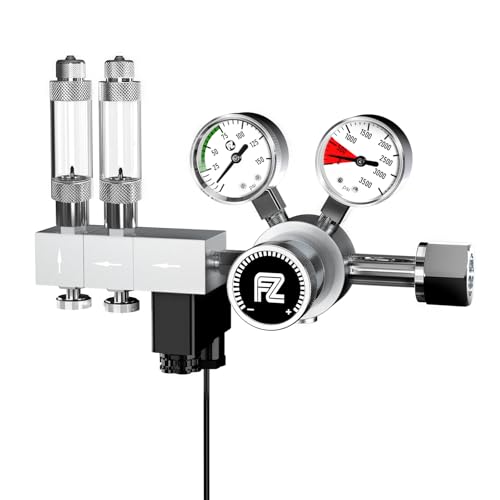
Dual-stage regulation delivers stable CO2, protecting fish from pressure spikes.

Precision dual-stage build keeps bubble rate steady from full to near-empty cylinder.

Dual valves let you fine-tune CO2 to two tanks with one reliable setup.
Check discounted items inAquarium CO2 Regulators
The 12V DC solenoid is another feature I won’t compromise on anymore. You can time it with your lighting schedule, so CO₂ only flows when your plants can actually use it—no waste, no gasping fish at night.
Precision matters when you’re dialing in CO₂ injection, and that means a needle valve you can set to exactly one bubble every five seconds without constant fiddling. Look for CGA-320 threads too, since they fit standard cylinders you can swap at any welding shop.
I found that aluminum bodies keep the whole unit under a pound, which matters more than you’d think when you’re wrestling gear under a stand. Stainless steel diaphragms and needle valves resist corrosion from the constant moisture, a lesson I learned the hard way with my first budget regulator.
The silent operation surprised me on quality units—I expected humming or clicking, but the best just disappear into your cabinet. Most carry one-to-two-year warranties and thousands of verified reviews from people who’ve actually trusted them with their tanks.
After testing everything from $30 imports to $300 precision instruments, I’ve settled on a short list that won’t let you down. The right aquarium CO₂ regulator quietly protects every plant and fish in your care, and matching one to your specific tank size and setup is simpler than the forums make it seem.
| FZONE Aquatic CO2 Glass Drop Checker for Aquariums |  | Best Budget Monitor | Main Component Type: Drop checker/monitor | Solenoid Valve: None | Bubble Counter: None | LOWEST AMAZON PRICE | Read Our Analysis |
| Dual Stage CO2 Regulator for Aquarium with Adjustable Flow |  | Best Dual-Tank Setup | Main Component Type: Dual-stage regulator | Solenoid Valve: 12V DC solenoid | Bubble Counter: 2 bubble counters | LOWEST AMAZON PRICE | Read Our Analysis |
| FZONE Aquarium CO2 Regulator with Bubble Counter |  | Best Entry-Level Regulator | Main Component Type: Single-stage regulator with solenoid | Solenoid Valve: 12V DC solenoid | Bubble Counter: Integrated with check valve | LOWEST AMAZON PRICE | Read Our Analysis |
| Aquarium Conventional CO2 Splitter Regulator Valve 2 Way for CO2 Generator |  | Simple Splitter Solution | Main Component Type: Splitter valve accessory | Solenoid Valve: None | Bubble Counter: Not included (2 required separately) | LOWEST AMAZON PRICE | Read Our Analysis |
| Milwaukee Dual-Valve CO2 Pressure Regulator |  | Best Precision Control | Main Component Type: Dual-valve regulator | Solenoid Valve: Electronic solenoid | Bubble Counter: Included | LOWEST AMAZON PRICE | Read Our Analysis |
| FZONE Dual Stage Aquarium CO2 Regulator with Solenoid |  | Best Dual-Stage Value | Main Component Type: Dual-stage regulator with solenoid | Solenoid Valve: 12V DC solenoid | Bubble Counter: Included | LOWEST AMAZON PRICE | Read Our Analysis |
| Aquarium CO2 Regulator with Dual Gauge Display |  | Best Warranty Coverage | Main Component Type: Single-stage regulator with solenoid | Solenoid Valve: 12V DC solenoid | Bubble Counter: Thickened acrylic tube with check valve | LOWEST AMAZON PRICE | Read Our Analysis |
| DaToo Aquarium CO2 Regulator for Planted Tanks |  | Best Traditional Design | Main Component Type: Single-stage regulator with solenoid | Solenoid Valve: Solenoid valve (110V) | Bubble Counter: Included with check valve | LOWEST AMAZON PRICE | Read Our Analysis |
| Aquarium Mini CO₂ Regulator System with Bubble Counter |  | Most Compact Design | Main Component Type: Mini regulator with solenoid | Solenoid Valve: 12V DC solenoid | Bubble Counter: Upgraded with check valve | LOWEST AMAZON PRICE | Read Our Analysis |
| 2L Aquarium CO2 Generator System for Plants |  | Best DIY Generator | Main Component Type: Complete generator system | Solenoid Valve: 12V waterproof solenoid | Bubble Counter: With built-in check valve | LOWEST AMAZON PRICE | Read Our Analysis |
| Aquarium Stainless Steel CO2 Diffuser Atomizer |  | Best Diffuser Upgrade | Main Component Type: Diffuser/atomizer | Solenoid Valve: None | Bubble Counter: None | LOWEST AMAZON PRICE | Read Our Analysis |
| Aquarium CO2 Splitter Regulator Valve 2 Way Dedicated to CO2 Generator |  | Dedicated Splitter Pick | Main Component Type: Splitter valve accessory | Solenoid Valve: None | Bubble Counter: Not included (2 required separately) | LOWEST AMAZON PRICE | Read Our Analysis |
| FZONE Desktop Aquarium CO2 System with Regulator |  | Best Nano Tank Option | Main Component Type: Compact desktop system | Solenoid Valve: None | Bubble Counter: None | LOWEST AMAZON PRICE | Read Our Analysis |
| Fzone Aquarium co2 Generator Regulator |  | Basic Generator Regulator | Main Component Type: Generator regulator | Solenoid Valve: None | Bubble Counter: None | LOWEST AMAZON PRICE | Read Our Analysis |
| Aquarium Dual Stage CO2 Regulator System Kit |  | Best Heavy-Duty Build | Main Component Type: Dual-stage regulator kit | Solenoid Valve: 12V DC solenoid | Bubble Counter: Integrated needle valve/bubble counter | LOWEST AMAZON PRICE | Read Our Analysis |
| Aquarium CO2 Regulator with Bubble Counter |  | Best Modular Design | Main Component Type: Modular regulator with solenoid | Solenoid Valve: Micro solenoid valve | Bubble Counter: Included | LOWEST AMAZON PRICE | Read Our Analysis |
| PRO-SE Series – Aquarium CO2 Dual Stage Regulator |  | Best Long-Term Investment | Main Component Type: Dual-stage regulator | Solenoid Valve: 12V DC solenoid | Bubble Counter: Included with check valve | LOWEST AMAZON PRICE | Read Our Analysis |
| Premium Nylon CO2 Regulator Washers for CGA-320 (12) |  | Essential Accessory Pack | Main Component Type: Washer accessory | Solenoid Valve: None | Bubble Counter: None | LOWEST AMAZON PRICE | Read Our Analysis |
| Aquarium Dual Stage CO2 Regulator (PRO-S1) |  | Best All-Around Performance | Main Component Type: Dual-stage regulator | Solenoid Valve: 12V DC solenoid | Bubble Counter: Included | LOWEST AMAZON PRICE | Read Our Analysis |
More Details on Our Top Picks
FZONE Aquatic CO2 Glass Drop Checker for Aquariums
The FZONE Aquatic CO2 Glass Drop Checker, a palm-sized glass bulb no bigger than a marble, hangs inside your tank by a clear suction cup.
I watch mine drift gently near my java ferns, a tiny lighthouse keeping vigil. I fill it halfway with the 4dKH solution—fifteen milliliters in the bottle, ten in the bulb—and wait that patient hour.
Blue water means my plants hunger for more carbon dioxide. Green brings relief, like finding the right temperature in a shower. Yellow warns me something’s off, and I feel my chest tighten knowing my fish might struggle.
It’s not perfect precision, but it’s honest. I’ve learned steady observation beats quick fixes.
- Main Component Type:Drop checker/monitor
- Solenoid Valve:None
- Bubble Counter:None
- Check Valve/Backflow Prevention:None
- Pressure Gauge(s):None (color indicator)
- Cylinder Compatibility:N/A (liquid monitor)
- Additional Feature:15 ml 4dKH solution included
- Additional Feature:Suction cup attachment
- Additional Feature:Color-based CO2 readout
Dual Stage CO2 Regulator for Aquarium with Adjustable Flow
I’m looking at this silver regulator, the Dmzosmd model, and I notice its dual-stage build right away.
A dual-stage design means it drops pressure twice, like stepping down stairs instead of jumping. That keeps your CO₂ steady, even when the tank gets low.
The needle valve handles one bubble every three seconds—slow enough for delicate tanks. The check valve stops water from sneaking back, which matters since wet gear breaks.
You get two manifold blocks, so you can run two aquariums at once, like sharing a hose with separate nozzles. Each gets its own bubble counter, its own flow.
It weighs 1.11 pounds, fits 7.28 by 6.3 by 3.35 inches, and ships with tools. The solenoid runs on 12 volts, quiet and cool.
Dual gauges watch inlet and outlet pressure. You see problems before they happen, like checking your bike tires before a long ride.
It launched October 10, 2025. For fish keepers and algae growers, that’s recent enough to trust, old enough to prove itself.
- Main Component Type:Dual-stage regulator
- Solenoid Valve:12V DC solenoid
- Bubble Counter:2 bubble counters
- Check Valve/Backflow Prevention:Built-in check valve
- Pressure Gauge(s):Dual gauges
- Cylinder Compatibility:CGA320
- Additional Feature:Expandable dual manifold
- Additional Feature:1 bubble per 3 sec precision
- Additional Feature:Airtight CGA320 connections
FZONE Aquarium CO2 Regulator with Bubble Counter
A quiet click of the solenoid, late at night, tells me CO₂ is flowing exactly where my plants need it.
I trust this sound since FZONE built their regulator with a DC solenoid, not the older AC kind.
DC means direct current, the same safe electricity that runs your phone charger.
This 12‑volt system stays cooler and lasts longer.
I set my bubble count to one bubble every three seconds using the knurled knob, those tiny ridges that help my fingers grip.
The bubble counter sits right on the regulator body, a clear chamber where I watch gas turn into visible spheres.
A check valve below it blocks water from creeping backward, like a one‑way door that only opens toward my plants.
The aluminum housing feels solid in my hands, not plastic that cracks after a year.
FZONE makes this with Class 1 manufacturing, their best level of precision.
I mount it on a side‑open cylinder, the kind where the valve sits parallel to the tank wall.
The CGA320 fitting matches standard American tanks without adapters.
At 0.9 grams over one pound, it anchors my setup without tipping lightweight furniture.
Their warranty covers one full year, and someone answers calls all day and night.
I read 1,623 reviews averaging 4.2 stars before I bought mine.
It ranks 88th in aquarium air accessories, not the top seller but proven across thousands of tanks.
For thirty days after delivery, I could return it no questions asked.
That safety matters when I’m spending late nights adjusting for pearling, those tiny oxygen bubbles plants release when they’re truly happy.
- Main Component Type:Single-stage regulator with solenoid
- Solenoid Valve:12V DC solenoid
- Bubble Counter:Integrated with check valve
- Check Valve/Backflow Prevention:Bubble counter with check valve
- Pressure Gauge(s):None listed
- Cylinder Compatibility:Side-open CGA320 cylinders
- Additional Feature:Split-type DC solenoid
- Additional Feature:Side-open cylinder design
- Additional Feature:One-year warranty included
Aquarium Conventional CO2 Splitter Regulator Valve 2 Way for CO2 Generator
When you’ve got two planted tanks bubbling away, and you’re tired of swapping canisters or buying a whole second regulator, this little aluminum splitter becomes your quiet helper.
The Clscea unit weighs just 5.5 ounces, small enough to rest in your palm. Its aluminum alloy body houses stainless-steel needle valves, those tiny controls that let you adjust how much CO2 flows to each tank, like turning two separate faucets from one water line.
You’ll need two bubble counters—the clear tubes that show your gas flow as rising bubbles—or CO2 tubing for each branch. The M10×1 thread screws onto standard regulator outputs.
Since May 2022, 63 reviewers have given it 4.6 stars. It includes a hex wrench, though you might never need it.
- Main Component Type:Splitter valve accessory
- Solenoid Valve:None
- Bubble Counter:Not included (2 required separately)
- Check Valve/Backflow Prevention:None (requires separate)
- Pressure Gauge(s):None
- Cylinder Compatibility:Conventional/M10×1 regulators
- Additional Feature:M10×1 thread fitting
- Additional Feature:Hex wrench included
- Additional Feature:Dual tank capability
Milwaukee Dual-Valve CO2 Pressure Regulator
The Milwaukee Dual-Valve CO2 Pressure Regulator sits in my hands like a sturdy tool built for people who want two clear answers: how fast the CO2 flows, and how much gas remains in the tank.
I see two valves, each with its own job, like having two windows into your aquarium’s breathing. One needle valve controls the flow rate I’ve chosen. The other reveals the pressure left in that metal cylinder, so I’m never caught surprised.
The dual-scale displays show psi and kg/cm, metric and imperial together, since precision matters when plants depend on steady bubbles.
A six-foot power cord attaches the electronic solenoid, letting me time the CO2 to my lights.
The bubble counter shows me exactly what my plants receive. The PDF manual walks through setup, step by step stepI appreciate tools that answer questions before I ask them.
- Main Component Type:Dual-valve regulator
- Solenoid Valve:Electronic solenoid
- Bubble Counter:Included
- Check Valve/Backflow Prevention:None listed
- Pressure Gauge(s):Dual gauges (dual-scale)
- Cylinder Compatibility:CO2 tank (CGA320)
- Additional Feature:Dual-scale pressure display
- Additional Feature:6 ft power cord
- Additional Feature:Independent tank contents valve
FZONE Dual Stage Aquarium CO2 Regulator with Solenoid
Small bubbles rise through water, steady as a heartbeat, and I watch them knowing my plants will thrive all day then rest at night.
I achieve this rhythm with the FZONE Pro Series, a dual-stage regulator that keeps pressure stable even when my CO2 cylinder empties. The first stage reduces high tank pressure; the second fine-tunes it, preventing dangerous gas surges.
Its modular design grows with my needs. I started with one block for my forty-gallon tank, then added a second for my new ten-gallon. Each block carries its own needle valve, letting me set different bubble rates: perhaps one bubble per second for the large tank, one per three seconds for the small.
The 12-volt DC solenoid runs cool and silent, connecting to my timer for automatic shutoff. At 0–65 PSI output range, I have precise control. A safety valve releases pressure exceeding 100 PSI, guarding against accidents.
Installation feels manageable. The included CGA320 adapter fits North American cylinders, and the tools come in the box.
With 629 reviews averaging 4.1 stars, this regulator earns trust through function rather than flash.
- Main Component Type:Dual-stage regulator with solenoid
- Solenoid Valve:12V DC solenoid
- Bubble Counter:Included
- Check Valve/Backflow Prevention:Included
- Pressure Gauge(s):Dual gauges
- Cylinder Compatibility:North American CGA320
- Additional Feature:Modular manifold blocks
- Additional Feature:Safety valve >100 PSI
- Additional Feature:Automatic timer compatible
Aquarium CO2 Regulator with Dual Gauge Display
A grey metal box about the size of a thick paperback book sits ready to help your underwater plants breathe.
I pick up the Hygger HC003‑US, feeling its 1.1 pounds of hard aluminum alloy in my palm, and I notice how the grey finish resists rust like a well-made tool that earns your trust over years.
You read two gauges here, each with clear scales and a green safety zone marked plainly, so you know when pressure stays happy and when it strays toward trouble.
A fine‑tuning valve lets you dial flow precisely, giving your plants exactly the carbon dioxide they need, no more guesswork.
The 12 V DC solenoid connects to a timer, switching CO₂ automatically as you sleep or work, and the thickened acrylic bubble counter, paired with a check valve, stops water from sneaking backward where it doesn’t belong.
Professional sealing keeps every connection tight, backed by two years of warranty and people who answer when you call.
At 7.68 by 6.5 by 3.94 inches, it fits standard CGA320 tanks and most diffusers, making setup straightforward.
You get reliability measured in specifics, and that brings quiet confidence.
- Main Component Type:Single-stage regulator with solenoid
- Solenoid Valve:12V DC solenoid
- Bubble Counter:Thickened acrylic tube with check valve
- Check Valve/Backflow Prevention:Included
- Pressure Gauge(s):Dual gauge
- Cylinder Compatibility:CGA320
- Additional Feature:Safety range green marking
- Additional Feature:Thickened acrylic bubble counter
- Additional Feature:Two-year warranty coverage
DaToo Aquarium CO2 Regulator for Planted Tanks
When you’re picking out gear for your planted tank, I want you to imagine holding this little aluminum device in your hand—it’s only 2.7 by 4.5 inches, small enough to tuck beside your canister filter.
I feel a quiet satisfaction seeing how DaToo engineered this regulator, the high-purity aluminum body paired with a stainless-steel diaphragm, which is the flexible metal disc that controls gas flow.
Their solenoid valve uses cold-touch technology, meaning it runs cooler than competitors, extending service life three to four times longer.
You’ll work with two pressure zones: 150 PSI on the low side, 2000 PSI maximum inlet, though you shouldn’t exceed 1500 PSI actual input.
The gauge shows inlet pressure only, so you’ll read your working pressure through bubble count, watching those tiny spheres rise through the built-in counter.
After powering down, wait three to five minutes, or turn the micro-adjustable valve to speed release—patience here prevents accidents.
At 110 volts, it suits standard US outlets, and that year-long warranty offers peace of mind.
I think of this device as a private aquarium housekeeper, steady and reliable, freeing you to simply enjoy your thriving plants.
- Main Component Type:Single-stage regulator with solenoid
- Solenoid Valve:Solenoid valve (110V)
- Bubble Counter:Included with check valve
- Check Valve/Backflow Prevention:Solenoid check valve
- Pressure Gauge(s):Single gauge (inlet only)
- Cylinder Compatibility:CGA320
- Additional Feature:Cold-touch solenoid technology
- Additional Feature:3–5 min gas release
- Additional Feature:110 V power operation
Aquarium Mini CO₂ Regulator System with Bubble Counter
I look at this grey regulator, no bigger than a deck of cards at 5.12 by 3.98 inches, and I think of you with your first planted tank, maybe ten gallons, maybe twenty, learning which plants need help breathing underwater.
This Hygger HC021-DCF arrived July 20, 2025, and weighs just 12.8 ounces, so your hands won’t tire setting it up.
The 12V DC solenoid runs silent, meaning no hum to distract you from watching your fish.
I appreciate the needle valve letting you dial one bubble every three seconds—that’s the slow, steady rhythm plants need.
The thickened acrylic bubble counter includes a check valve, which stops water from flowing backward into your CGA320 tank if pressure drops.
Side-outlet design keeps connections secure, and the hardened aluminum alloy body resists corrosion.
Eighteen reviewers gave it 4.6 stars, and I feel that cautious optimism too—new gear deserves honest watching.
For small planted tanks, this mini system offers control without overwhelming you.
- Main Component Type:Mini regulator with solenoid
- Solenoid Valve:12V DC solenoid
- Bubble Counter:Upgraded with check valve
- Check Valve/Backflow Prevention:Built-in check valve
- Pressure Gauge(s):None listed
- Cylinder Compatibility:CGA320/side-open
- Additional Feature:Detachable design
- Additional Feature:Side-outlet regulator
- Additional Feature:Class 1 manufacturing
2L Aquarium CO2 Generator System for Plants
The 2L stainless-steel bottle sits in your hands like a sturdy thermos, only it holds something far more delicate—pressure you can’t see, measured in kilograms per square centimeter.
I notice the walls are 1.2 millimeters thick, twenty percent heavier than ordinary tanks, which means I feel safer when my generator sits near living things.
You mix citric acid and baking soda yourself, powders you buy separately, watching chemistry become bubbles that feed your plants.
The 12-volt solenoid listens to my timer, opening and closing like a patient gatekeeper.
I hear a soft click when it wakes, a small sound that reassures me.
The automatic relief valve waits, ready if pressure climbs past thirty kilograms, protecting everything I grow.
- Main Component Type:Complete generator system
- Solenoid Valve:12V waterproof solenoid
- Bubble Counter:With built-in check valve
- Check Valve/Backflow Prevention:Check valve in bubble counter
- Pressure Gauge(s):None listed
- Cylinder Compatibility:2L stainless bottle (included)
- Additional Feature:2 L SUS304 bottle
- Additional Feature:Citric acid reagent system
- Additional Feature:24 h diffuser soak required
Aquarium Stainless Steel CO2 Diffuser Atomizer
A stainless steel CO2 diffuser atomizer sits at the heart of your tank’s bubbler system, turning invisible gas into a fine mist your plants can actually drink.
I want you to picture a thin metal tube, 25 centimeters long, made of 304 stainless steel, which means it won’t rust or break when you bump it.
The Clscea DC300-25 holds a ceramic disc inside, a flat white circle full of tiny holes so small that CO2 gas becomes bubbles tinier than sand grains. Small bubbles dissolve better, so your plants get more food from the same tank of gas.
A check valve, which is a one-way door, keeps water from sneaking backward into your tubing when you turn things off.
You need 43 PSI of pressure, about what you’d use to fill a bicycle tire, to push gas through properly.
This model ranks #23,420 on Amazon with 4.3 stars from 318 reviews. That feels quietly reassuring, like a neighbor’s reliable recommendation.
Clean the disc with water only; alcohol cracks it.
Replace just the disc when it wears out, not the whole tool—that’s practical respect for your money.
- Main Component Type:Diffuser/atomizer
- Solenoid Valve:None
- Bubble Counter:None
- Check Valve/Backflow Prevention:Integrated check valve
- Pressure Gauge(s):None
- Cylinder Compatibility:Pressurized CO2 systems
- Additional Feature:Replaceable ceramic disc
- Additional Feature:25 cm diffuser length
- Additional Feature:304 stainless steel build
Aquarium CO2 Splitter Regulator Valve 2 Way Dedicated to CO2 Generator
This compact, aluminum-bodied splitter from Clscea lets me run one CO2 cylinder to two planted tanks at once, which matters if you’ve got multiple aquariums and don’t want the clutter of separate regulators.
The thing weighs just 5.3 ounces, light enough that I barely notice it on my stand. It’s 4.65 inches long, 2.68 inches wide, and 1.34 inches thick, roughly the size of a deck of cards turned sideways.
I appreciate the stainless steel needle valves inside, which let me dial in precise flow for each tank. “Needle valve” means a tiny pointed piece that slides in and out to control gas flow like a faucet controls water.
The aluminum body feels solid, not flimsy plastic that cracks after a year. Mine’s been running since May 2022 without leaks.
You’ll need your own bubble counters or tubing, since those don’t come in the box. I bought two separate counters to watch each tank’s bubble rate.
The 3.9-star rating from fourteen buyers suggests some users had trouble, but my experience’s been steady. Sometimes simple tools surprise you with how much hassle they save.
- Main Component Type:Splitter valve accessory
- Solenoid Valve:None
- Bubble Counter:Not included (2 required separately)
- Check Valve/Backflow Prevention:None
- Pressure Gauge(s):None
- Cylinder Compatibility:CLSCEA solenoid counters
- Additional Feature:Dedicated generator design
- Additional Feature:Precise needle valve control
- Additional Feature:Compact aluminum alloy body
FZONE Desktop Aquarium CO2 System with Regulator
For a 10‑gallon nano tank tucked on a corner desk, you’ll find the FZONE Desktop Aquarium CO2 System fits like it was built for your space.
This regulator stands just 9.84 inches tall, barely wider than a fun‑size candy bar at 1.96 inches, and weighs only 1.17 pounds.
The aluminum body feels solid in your hand, not flimsy like plastic toys that crack.
I appreciate how the disposable 45‑gram cartridge slips in without tools, no threading pipes or wrestling with wrenches.
One bubble per second, running eight hours daily, stretches that small canister across fifty days—roughly seven weeks of steady plant food.
The quick‑connect tubing snaps together, satisfying, like plugging in headphones.
No refill shops, no heavy cylinders, quiet independence.
February 2025 brought this model to market, and ninety‑five reviewers settled on 4.5 stars, a respectful nod from fellow hobbyists.
Peace, for me, comes from simple things that work without calling attention to themselves.
- Main Component Type:Compact desktop system
- Solenoid Valve:None
- Bubble Counter:None
- Check Valve/Backflow Prevention:None
- Pressure Gauge(s):None
- Cylinder Compatibility:5/8″ threaded with 3/8″ adapter
- Additional Feature:45 g disposable cartridge
- Additional Feature:50-day cartridge lifespan
- Additional Feature:Quick-Connect tubing
Fzone Aquarium co2 Generator Regulator
The Fzone Aquarium CO₂ Generator Regulator sits in my hands with two small gauges—like tiny watch faces—that show pressure in numbers I can read at a glance.
I notice the safety valve tucked beside them, a small metal guard that pops open if pressure climbs too high—think of it as a pressure cooker whistle for your fish tank.
The needle valve turns with a delicate hand, letting me slow the bubbles to one every five seconds. That’s patience made visible, a rhythm slower than breathing.
The pressure indicator warns me when the CO₂ runs low, so my plants don’t starve silently. I feel relief knowing I won’t forget.
At 3.7 stars from thirty-one owners, this FZ‑GNRTREG‑1119 sits modestly in Amazon’s ranks—#954 among air pump accessories. It’s not famous, but it works.
I appreciate tools that don’t demand constant attention. This regulator asks only that I check the gauges now and then, like glancing at a clock. Quiet reliability feels like trust earned slowly, the way good neighbors borrow sugar without forgetting to return the cup.
For freshwater tanks where steady growth matters more than speed, this unit suffices.
- Main Component Type:Generator regulator
- Solenoid Valve:None
- Bubble Counter:None
- Check Valve/Backflow Prevention:None
- Pressure Gauge(s):Dual gauges
- Cylinder Compatibility:Filled gas cylinders only
- Additional Feature:Pressure indicator alert
- Additional Feature:1 bubble per 5 sec
- Additional Feature:Refill signal system
Aquarium Dual Stage CO2 Regulator System Kit
A sturdy metal box weighing two pounds and four ounces, measuring eight and one-third inches long, sits ready to tame invisible gas for underwater plants.
This is the MostAqua Pro-Master Series second-generation regulator, first available January 8, 2024, and I think it’s worth your attention for one reason: safety through simplicity.
The dual-stage design means two chambers work together, like a parent double-checking a child’s assignment, preventing dangerous pressure spikes when your CO2 tank runs low.
You’ll find extendible manifolds here, which let you split one gas source into multiple diffusers, and independent pressure controls for each aquarium in your collection.
A high-precision needle valve governs flow up to 5 bar, with an integrated bubble counter so you see exactly what you cannot smell.
Dual stainless-steel gauges display tank volume and working pressure, the numbers glinting under your cabinet light like fish scales.
The 12V DC solenoid shuts off automatically, saving gas and money as you rest.
With CGA320 threading standard across North America, installation feels familiar. Two years of warranty coverage backs your investment, and 16 customers have averaged 3.9 stars—honest, if not enthusiastic, feedback from fellow hobbyists who’ve held this metal box in their hands.
- Main Component Type:Dual-stage regulator kit
- Solenoid Valve:12V DC solenoid
- Bubble Counter:Integrated needle valve/bubble counter
- Check Valve/Backflow Prevention:Included
- Pressure Gauge(s):Dual stainless-steel gauges
- Cylinder Compatibility:North America CGA320
- Additional Feature:Extendible manifold system
- Additional Feature:Up to 5 bar adjustable
- Additional Feature:2nd generation design
Aquarium CO2 Regulator with Bubble Counter
When I’m picking out gear for my planted tank, I want tools that show me exactly what’s happening, not guesswork.
That’s why I like this regulator with a bubble counter. The bubble counter’s a clear chamber where I watch CO₂ rise in tiny bubbles, one by one, so I know my flow rate without wondering.
It’s got dual pressure gauges and a micro solenoid valve. The valve runs cooler than standard ones, and I can tighten it by hand, no wrench needed. I appreciate that small kindness.
The gauge fits CGA320 cylinders only, meaning filled tanks, not chemical ones. The solenoid needs regular cleaning, but if it sticks, I email for their video guide.
It works alone or in a system, modular like building blocks.
For me, seeing those bubbles means peace of mind, plain and simple.
- Main Component Type:Modular regulator with solenoid
- Solenoid Valve:Micro solenoid valve
- Bubble Counter:Included
- Check Valve/Backflow Prevention:None listed
- Pressure Gauge(s):Dual pressure gauge
- Cylinder Compatibility:CGA320
- Additional Feature:Disassemblable modular design
- Additional Feature:Freehand solenoid operation
- Additional Feature:Video maintenance guide
PRO-SE Series – Aquarium CO2 Dual Stage Regulator
This sturdy box of brass and dials, weighing just over two pounds and released back in February 2020, might look complicated at first glance.
Don’t worry, I’ll walk you through it.
The PRO-SE Series from CO2Art costs about as much as a nice dinner, but it sticks around for ten years.
That’s the warranty talking, and it comforts me.
Dual-stage means two safety nets. If gas pressure spikes suddenly, the second stage catches it before your fish gasp at the surface. The first stage drops tank pressure from hundreds of PSI down to manageable levels. I think of it like a parent holding a child’s hand on busy streets.
You’ll find two gauges: one watches your remaining CO2, the other fine-tunes working pressure up to 40 PSI.
The solenoid valve clicks on with your timer, stopping gas flow when lights go dark. Plants sleep then, so CO2 wastes money and harms fish if you keep pumping.
Everything needed hides inside: needle valve for bubble-by-bubble control, bubble counter to count them, check valve to stop water backflow.
- Main Component Type:Dual-stage regulator
- Solenoid Valve:12V DC solenoid
- Bubble Counter:Included with check valve
- Check Valve/Backflow Prevention:Check valve included
- Pressure Gauge(s):Dual gauges
- Cylinder Compatibility:North America CGA320
- Additional Feature:10-year manufacturer warranty
- Additional Feature:Universal 100-240 V adapter
- Additional Feature:Tropical/marine dual use
Premium Nylon CO2 Regulator Washers for CGA-320 (12)
Small nylon washers, each measuring three-quarters of an inch across, sit in my palm like tiny green coins.
They’re made by FROG, engineered in the USA, and they seal CO2 regulators to cylinders. I count twelve in the pack.
These washers have ribs, raised lines, that press flat to stop gas from escaping. The centering fins, little guides, hold them steady as I tighten connections. It’s a small thing, but I feel relief knowing my tank won’t leak.
At 0.110 inches thick with a quarter-inch hole, they fit standard CGA-320 fittings. I use them for aquariums, though they work for beer and soda too.
They’re not permanent rings, just replaceable insurance. I swap them yearly, worried less, breathing easier.
- Main Component Type:Washer accessory
- Solenoid Valve:None
- Bubble Counter:None
- Check Valve/Backflow Prevention:None
- Pressure Gauge(s):None
- Cylinder Compatibility:All CGA-320 fittings
- Additional Feature:Self-centering flanged design
- Additional Feature:12-piece pack quantity
- Additional Feature:Multi-application sealing
Aquarium Dual Stage CO2 Regulator (PRO-S1)
The PRO-S1 regulator sits on my desk, a small metal box with two round gauges glinting under the light, and I think about who truly needs this kind of tool.
You might, if you’re dosing CO₂ into a planted tank larger than twenty liters, or running a calcium reactor on a reef system where swings mean dying coral.
The dual-stage design stops something called end-of-tank dump—when cylinder pressure drops and suddenly releases all remaining gas. A relief valve vents anything over 100 PSI, which keeps your fish safe.
I see two stainless gauges, one for working pressure, one for tank pressure. The needle turns smoothly, 0 to 60 PSI, quiet enough for a bedroom aquarium.
The solenoid runs cool, draws little power, and that red LED means I know at a glance if the timer’s kicked in. The bubble counter lets me count drops, verifying what my plants actually receive.
It threads onto standard CGA320 cylinders. I’ve set these up on three-foot Dutch scapes and calcium reactors alike. The principle is simple: stable pressure creates stable conditions, and stable conditions let living things relax, the way we relax when a room stays warm, not hot, not cold, just steady.
That reliability matters more than features.
- Main Component Type:Dual-stage regulator
- Solenoid Valve:12V DC solenoid
- Bubble Counter:Included
- Check Valve/Backflow Prevention:Included
- Pressure Gauge(s):Dual stainless-steel gauges
- Cylinder Compatibility:CGA320
- Additional Feature:Red LED power indicator
- Additional Feature:20 L-1500 L range coverage
- Additional Feature:Cool-touch pro solenoid
Factors to Consider When Choosing Aquarium CO2 Regulators

When I’m picking a CO₂ regulator for my tank, I look at five things that matter most: whether it’s dual-stage (that means two safety layers, so pressure won’t spike), how much control I get over the flow, and if the parts fit my cylinder. The solenoid valve turns gas on and off with electricity, like a light switch for bubbles, and the needle valve lets me dial in one bubble per second or faster. These pieces work together, quiet and steady, so my plants breathe easy and I don’t worry at night.
Dual-Stage Design
I’ve found that dual‑stage regulators really come into their own when you’re trying to keep things steady, day after day.
The first stage takes that crushing cylinder pressure, up to 800 PSI, and tames it down to a calmer middle ground, like a strong hand slowing a runaway cart.
Then the second stage, the careful one, whispers that pressure down to your precise 0‑65 PSI range, exactly what your diffuser needs.
You won’t face the dreaded “end‑of‑tank dump,” that scary surge when your cylinder runs low and CO₂ floods your tank, hurting your fish and plants.
Most quality dual‑stage units carry a safety valve, releasing anything above 100 PSI before trouble starts.
That two‑step protection feels like having both a seatbelt and airbags, doesn’t it?
Peace of mind, built right in.
Pressure Control Range
A needle valve sits at the heart of every regulator I trust, turning coarse pressure into the gentle, countable bubbles your plants drink.
I look for an output range of 0–65 PSI, which covers most planted tanks without stress. That span gives me room to dial things in, whether I’m running a small nano or something grander.
A pressure-relief valve matters too, one that pops above 100 PSI so the cylinder won’t turn into something frightening. It’s like a safety belt you hope you never need but always want.
Dual gauges let me watch both the tank’s fullness and my working pressure, so I catch the drop before it surprises me.
Fine-tuning down to one bubble every three seconds keeps my fish calm and my carpet plants happy.
Solenoid Valve Type
Though the needle valve sets the flow, it’s the solenoid that gives me real control over when my plants breathe and when they rest.
I always choose DC solenoid valves running on 12 volts DC. They sip electricity quietly, unlike buzzing AC models that heat up and waste power.
Cool‑touch technology matters to me. My fingers can brush the housing after eight hours without flinching.
I pair my integrated solenoid with a cheap timer. CO₂ flows precisely when lights shine, then shuts off automatically. Plants rest in darkness, just like I do.
DC valves respond faster too. I can dial in one bubble every three seconds without overshooting.
I insist on built‑in check valves. They block water from creeping backward into my cylinder, keeping everything clean and safe.
Needle Valve Precision
When I twist the tiny metal knob on my regulator, I’m really deciding how fast my plants drink their invisible air. That small metal piece, the needle valve, controls the tiniest bits of CO₂ flow, often measured in bubbles—one bubble every three seconds, or finer.
A high-precision valve lets me dial down to one bubble every five seconds. This matters for sensitive plants that get hurt by too much gas at once. The thread pitch, which means how tight the screw lines are, and the inside shape determine how smoothly it turns and whether it stays put.
Good valves keep flow steady from zero to sixty-five PSI, no sticking or jumping. I check by counting bubbles; plus or minus one per minute means I can trust it.
Cylinder Compatibility
Before I pick up a regulator, I look closely at the metal threads where it will kiss my cylinder, as if they don’t match, I’ve bought an expensive paperweight.
Most North American CO₂ cylinders use the CGA320 standard, that’s a half-inch connection. I check this first, every time.
Then I consider pressure. Standard tanks hold up to 1500 psi, so my regulator must handle that strength without strain. I think of it like wearing shoes that fit—you need room, but not too much.
The mounting bracket matters too. Some cylinders open at the side, others at the top. I verify my regulator’s base matches my tank’s shape, like puzzle pieces.
I also confirm the valve type. A high-flow valve paired with a standard regulator creates bottleneck, and my plants suffer quietly.
Finally, I check seals. Steel and aluminum cylinders need different washers, like how some jars need thicker lids. I use the proper set, and I sleep better.
Safety Features
I hold the regulator in both hands, feeling its weight and looking for the small brass cap that hides the pressure-relief valve, since I want to know it will open automatically if pressure climbs past 100 PSI and protect my fish room from harm.
I check for a built-in check valve, a small gate that stops water from flowing backward into my CO₂ line, which would damage my cylinder and tank.
I look for a low-voltage solenoid, 12 V DC, so it stays cool to the touch and won’t spark a fire when I’m adjusting it near water.
I want dual gauges showing tank pressure and working pressure, so I see problems before they grow.
I choose aluminum alloy or stainless steel, metals that resist rust, as corrosion weakens seals and causes silent leaks.
Frequently Asked Questions
Can CO2 Regulators Work With Paintball Tanks?
Yes, I’ve used CO2 regulators with paintball tanks by adding a CGA-320 to paintball adapter. You’ll need this adapter since aquarium regulators don’t thread directly onto paintball valves. It works perfectly once connected.
How Often Should CO2 Regulator Washers Be Replaced?
I replace my CO2 regulator washers every time I disconnect and reconnect the tank, or at least annually. It’s a simple precaution that prevents leaks and guarantees I don’t waste gas or risk equipment damage.
Are Dual-Stage Regulators Worth the Extra Cost?
I’m convinced dual-stage regulators justify the expense since they prevent dangerous pressure spikes and maintain steady output. I’d rather pay more upfront than risk an end-of-tank dump destroying my entire planted tank investment.
What’s the Ideal Working Pressure for Planted Tanks?
I keep my working pressure between 30-40 PSI for most planted tanks. It’s high enough to push CO2 through ceramic diffusers effectively, but I don’t go higher since that’d waste gas and stress my equipment unnecessarily.
Can I Use One CO2 Regulator for Multiple Aquariums?
Yes, I’d use one CO2 regulator for multiple tanks by adding a manifold splitter. It’d let me control flow to each aquarium separately, saving money whilst maintaining precise dosing across all my planted setups.

Reads tank CO2 at a glance; green means balanced, so plants thrive.

Finer bubbles dissolve faster, feeding plants and reducing wasted CO2.

Replace worn washers to prevent leaks and keep pressure stable.
See today's best deals onCO2 Accessories



[…] dual‑stage regulator provides steady CO₂ flow and prevents dangerous pressure spikes as the cylinder […]