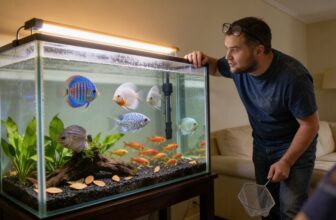
Discus are picky roommates—they need hot (80–85°F), soft, acidic water and zero bullies.
Skip aggressive fish entirely. Pair them with German Rams (30-gallon minimum for a single, 40 for a pair), or calmer Bolivian Rams in groups of six.
Add schooling dithers like Cardinal or Rummy-nose Tetras (10+ school) to lower stress. Yo-Yo Loaches work in 40-gallon groups of 4–5, but watch their energy.
For bottom duty, Sterbai Corys or Amano shrimp clean without hassle. Stick to these, and your discus keep their color—and their dignity.
Stick around, the list of tank-wreckers is worth a glance.
At A Glance
- German Rams and Bolivian Rams are peaceful, temperature-compatible discus tank mates.
- Schooling Cardinal, Rummy-nose, and Lemon tetras provide dithering and reduce stress.
- Sterbai Corys and Kuhli Loaches are bottom-feeders that thrive in discus water conditions.
- Amano shrimp and Malaysian trumpet snails clean algae without disturbing discus.
- Fancy Plecos like Zebra L046 are calm, nocturnal, and suit warm discus tanks.
5 Water Parameters for Discus Tank Mates
Before you even start shopping for discus tank mates, you need to nail the water parameters first—because if the chemistry’s off, nobody’s happy. You’re aiming for a warm 80–85°F, soft pH around 6–7, and hardness near 2 dKH. That’s the discus sweet spot, and your future tank mates better dig it too.
Before you even shop for discus tank mates, nail the water parameters first—if the chemistry’s off, nobody’s happy.
Stick with species from their South American home waters; non-natives just don’t thrive long.
- Temperature: 80–85°F, non-negotiable.
- pH: 6–7, soft and stable.
- Hardness: ~2 dKH, gentle on gills.
- Match region: South America for best fit.
- Peaceful temperaments only.
Bottom line: get the water right first, then pick your crew. Remember that a robust filtration system is critical since discus produce a heavy bioload similar to goldfish. A three-stage filtration setup, such as the one found in premium kits, effectively handles mechanical, chemical, and biological waste.
Why Aggressive Fish Ruin Discus Communities
You’ve dialed in that warm, soft South American water—nice work. Now don’t let a bully ruin it.
- Chronic stress: Aggressive fish like Oscars or Roseline Sharks constantly chase discus, weakening their immune system. You’ll soon see clamped fins, dark colors, and loss of appetite. Peaceful species such as Cory Catfish never turn aggressive and forgive small mistakes, keeping the tank calm.
- Territorial wars: Discus need calm zones to graze. A territorial cichlid corners them, blocking feeding and breeding. Your community splits into a battlefield.
- Predation risk: Larger species, like Silver Arowana, view discus as easy snacks. You’re not building a community; you’re stocking a lunch buffet.
Discus require water parameters far from the cooler temperatures and higher flow that Denison Barbs need to thrive.
Stick to peaceful tank mates. Your discus deserve a safe, thriving home.
German Rams: Best Dwarf Cichlid for Discus Tanks
One dwarf cichlid stands out as the ideal companion for discus: the German Ram. This 2-3 inch beauty thrives in your warm, soft water (80-85°F, pH 6-7), needing ample plant cover. Keep one or a bonded pair, but double the tank to 40 gallons for two—they’re inquisitive, not pushy. They require a minimum 30 gallon tank size for a single fish, so plan accordingly. Providing at least three hiding spots for security reduces conflict and keeps them comfortable.
You’ll love their calm curiosity. They won’t compete for food or bully your discus. Just give them hides, and you’ll have a peaceful, colorful community that fits right in. A tank that feels like home.
Bottom line: German Rams are your safest dwarf cichlid bet—no drama, just belonging.
Bolivian Rams: Calmer Alternative for Group Settings
What if you want a dwarf cichlid that’s even more laid-back than the German Ram? Then you’re looking at the Bolivian Ram, your calm, reliable buddy for group settings. Think less flash, more chill. You can keep a group of six, and they’ll barely ruffle your discus’s fins.
Looking for a dwarf cichlid even more laid-back than a German Ram? Meet the Bolivian Ram.
- Minimum tank size: 30 gallons—gives everyone enough personal space.
- Peace factor: They’re milder than German Rams, not territorial at all.
- Tank zone: Middle-to-bottom level means zero column clashes with your discus.
Bottom line: You want a stress-free cichlid that fits in with the crew? Bolivian Ram’s your guy. No drama, just vibes. For healthy development, feed them golden flakes and frozen bloodworms twice daily in small amounts.
A heavy resin weighted base keeps these plants stable without floating.
Apistogramma: Safe With Discus or Too Territorial?
Can you keep Apistogramma with discus without turning your tank into a tiny warzone? Yes, but you’re walking a tightrope.
These dwarf cichlids, at 2–8 cm, are territorial—your discus are bigger, though, so you’ve got size on your side.
Keep a single bonded pair in a 20-gallon-plus with dense hiding spots, like caves or driftwood.
No males duking it out. They’ll claim the bottom; discus own the mid-water.
Just don’t overcrowd. If you give them space and structure, you’re part of the club that pulls it off. Otherwise, skip it.
Maintain a pH 6.0–7.5 to keep both species stable and reduce stress that might trigger territorial aggression.
To support your Apistogramma and discus, choose a filter with adequate flow and quiet operation to keep water quality high without stressing either species.
Sterbai Corys: Bottom Scavengers That Love Warm Water
Apistogramma done, now onto something way less likely to make you lose sleep: Sterbai corys. These bottom scavengers love warm water too, making ’em perfect discus roommates.
- Temperature twins: They thrive in your 80–85°F range, no stress, just vibes.
- Schooling squad: Keep 4–6 together in a 20‑gallon minimum; they’ll patrol the substrate without bothering your kings.
- Dusk diners: They feed at night, so they won’t compete for discus food. Less drama, more cleanup.
You’ll get 15–20 years of these peaceful, armored cuties. Bottom line: they’re chill, warm‑water, born discus buddies. Grab a squad. Stable water parameters and adequate filtration support oxygen levels and waste removal, keeping both species healthy. A reliable feeder with dual power options ensures feeding schedules remain uninterrupted during power outages.
Kuhli Loaches: Shy Cleaners for Soft Substrates
Why settle for surface-level clean-up when you can have a living, wiggly vacuum that works the substrate? Kuhli loaches—those eel-like, shy cleaners—thrive in soft sand where they burrow and scavenge leftover discus food.
They’re nocturnal, so you’ll see them most at dusk, wiggling like happy noodles.
Keep these in mind:
- Minimum 15-gallon tank for a small group.
- Need hiding spots—driftwood, caves, dense plants.
- Thin-scaled means pristine water quality is non-negotiable.
They won’t compete with your discus for food, and their calm, shy nature fits perfectly.
Bottom line? If you love quirky, low-key tank cleaners, Kuhli loaches are your guys.
Siamese Algae Eaters: Effective but Watch Their Waste
- Efficient algae munchers—they’ll tackle green spot and hair algae, saving your plants from a fuzzy takeover.
- Active but not hyper—they cruise the bottom without bullying your discus, just minding their own business.
- Poop machines—expect to up your filtration and vacuuming game; they’re messy eaters, no joke.
- For pond setups housing Siamese algae eaters, consider using IP68 waterproof lights to safely illuminate their environment without electrical risk. A clear polypropylene mesh lid can be custom-trimmed to fit the pond, allowing high light transmission while preventing jumpers.
Bottom line: they’re effective, but you’ve gotta manage that bioload. Keep an eye on your parameters.
Fancy Plecos: Which L-Numbers Thrive With Discus?
So, which fancy plecos actually work with discus? Zebra pleco (L046) is your best bet—warm water lovers like discus, topping out at 4 inches. You’ll pay $100–$200, but they’re calm, nocturnal, and won’t pester your kings.
Avoid common Gibbiceps (L083)—they hit 18 inches, need cooler currents, and produce heavy waste that nukes your water.
Try Gold Nugget (L018) or Queen Arabesque (L260) instead.
- Stake claim with proven L‑numbers, not affordable mistakes.
- Keep it simple: smaller plecos, warmer temps, peaceful vibes.
Bottom line: Zebra or Gold Nugget plecos let you join the club without breaking the tank.
Always remove activated carbon before dosing any medications to prevent absorption and maintain treatment potency.
For isolation or treatment, a magnetic acclimation box provides gentle water flow through 2.5 mm slits to match main-tank filtration.
Best Schooling Tetras for Discus Tank Mates
Let’s call them the backbone of your discus tank. Tetras provide dithering, making your shy kings feel secure. You’ll want large schools of calm, mid‑water swimmers. Here’s your shortlist:
Let’s call them the backbone of your discus tank. Tetras provide dithering, making your shy kings feel secure.
- Cardinal Tetra: Brighter than neons, hardy, and perfect for 80‑85°F water. A school of 10+ creates a stunning river‑effect, costing around $3‑5 each. For best coloration, maintain a water temperature above 75°F and soft, slightly acidic conditions.
- Rummy‑nose Tetra: Their red noses signal water quality; if they fade, you’ve got trouble. Peaceful and tight‑schooling, they’re the tank’s canary.
- Lemon Tetra: Slightly larger, less nippy, with a subtle yellow glow. They’re bulletproof, forgiving your beginner mistakes.
Bottom line: Stick with these three. Your discus will thank you.
All tetras share this trait: maintain groups of six or more to reduce stress and prevent pale coloration.
Harlequin Rasboras: Can Southeast Asian Fish Live With Discus?
Harlequin rasboras are a solid maybe, not an automatic yes, for your discus tank. You want that dither effect—those tiny fish swimming calmly, telling your discus “hey, it’s safe”—but these guys come from Southeast Asia, not South America.
They handle 80-85°F, certainly, but their lifespan may suffer.
- Pros: Hardy, easy-care, $3-5 each, perfect 2-inch size.
- Cons: Different origin means potential stress long-term.
If you keep a group of 8-12, larger groups of 15 or more enhance iridescence and reduce stress.
Your call: If you prioritize a proven setup, stick with tetras. If you’re flexible and want something unique, they’ll likely work. You’re part of the club either way—just know the trade-off.
You can pair them with other gentle community species like Corydoras to create a soft-bottom sifting group that stays out of the discus’ territory.
Yo-Yo Loaches: Active but Test for Discus Temperament
Since yo-yo loaches aren’t your typical discus tank mate, you’re basically adding a hyperactive middle-schooler to a library. They’re lively, bottom-dwelling scavengers from Southeast Asia, not South America, so you’re testing waters—literally.
Adding a yo-yo loach to a discus tank is like dropping a hyperactive middle-schooler into a library.
- Size & Space: They top out around 2.5 inches, but need a 40-gallon minimum—they’re social, so keep 4–5 together. Loach groups smaller than four lack a proper hierarchy and may fight among themselves. Dim lighting helps reduce stress for both species by mimicking their natural habitats.
- Activity Level: These guys dart around daytime, which can stress shy discus. Watch your discus’ reaction; if they hide, the loaches gotta go.
- Water Needs: They tolerate discus’ warm, soft water, but it’s not ideal long-term—expect reduced lifespan due to suboptimal tank conditions and cramped spaces.
Bottom line: They’re a gamble. Only try if your discus are bold.
Amano Shrimp and Snails: Tiny Cleaners That Won’t Stress Discus
Why not let tiny invertebrates handle your cleanup? Amano shrimp, up to 2 inches, are transparent, active omnivores that devour leftover food and algae.
They’ll need a heavily planted tank with hiding spots for molting—think of it as their tiny armor swap. For optimal foraging, they benefit from a moderate current that delivers food particles without causing stress.
Malaysian trumpet snails, under half an inch, burrow to aerate your substrate while eating detritus.
Both occupy different water levels, so they won’t bug your discus.
Just watch your bioload; overstocking raises nitrates.
For zero stress and low maintenance, these little guys are your crew.
These invertebrates thrive in tanks backgrounded with non‑glare, static‑cling PVC to maintain a calm environment for both them and your discus.
The 4 Fish That Will Wreck Your Discus Tank
Four fish will wreck your discus tank, and I’ve seen every single one do it.
Four fish will wreck your discus tank, and I’ve seen every single one do it.
You’re building a calm community, not a Thunderdome.
Don’t let these troublemakers in:
- Oscar: That cute 2‑inch baby becomes a 12‑inch bully. It’ll eat your discus’ food, stress them out, and eventually attack. Hard water, hard pass.
- Silver Arowana: A 3‑foot predator that sees discus as snacks. Even a young one outgrows your tank fast, leaving you with a wet, expensive mistake.
- Roseline Shark: Fast, schooling, and cool‑water—everything your discus hate. They’ll dart and spook your kings into hiding.
Skip the chaos.
Your discus deserve peace.
Using an acrylic stand helps reduce resonance noise and creates a quieter, less stressful environment for sensitive discus.]
Frequently Asked Questions
Can You Keep Discus With Cherry Shrimp?
You can keep discus with cherry shrimp, but it’s a gamble.
Those shrimp are tiny—adults hit 1.5 inches—and discus might snack on them, especially if hungry.
Cherry shrimp need stable, warm water (80-85°F, pH 6-7), matching discus perfectly.
They’re great cleaner crew, grazing algae and leftovers without bothering your discus.
Nonetheless, they’re vulnerable during molting. Provide dense plants (Java moss) for hiding spots.
Expect some losses; it’s not a guaranteed pairing, but doable with careful tank scaping.
Do Discus Eat Neon Tetras?
Yes, discus will eat neon tetras.
Those tiny tetras are just bite-sized snacks to a full-grown king.
You’re basically serving dinner.
Neons max out at 1.5 inches—easy prey.
Discus, with their big mouths, won’t hesitate.
Stick with larger dither fish like cardinal or rummy-nose tetras instead.
They’re similar but big enough to avoid becoming lunch.
Bottom line: skip neons or watch them vanish.
Your discus won’t feel guilty.
What Is the Ideal Tank Size for Discus?
You’re looking at a 55-gallon tank as your absolute minimum for a single discus.
Truth is, discus are social—they need a group of 4-6 to feel secure, so bump that to a 75-gallon or larger. Crowding them stresses the king, and that’s a fast track to illness.
A 100-gallon gives you room for dither fish and bottom dwellers, keeping everyone calm.
Bottom line? Go big—your discus will thank you with better color and lifespan.
How Many Discus Should Be Kept Together?
You’ll want a group of at least 5 to 6 discus. They’re social, schooling fish, so keeping fewer than that makes them stressed and skittish.
A smaller group? They’ll hide, lose color, and bully each other.
For a 55-gallon tank, 5 is your max; a 75-gallon comfortably holds 6 to 8.
Remember, they need space to grow—each adult hits 6 to 8 inches.
Bottom line: bigger groups are calmer, healthier, and way more fun to watch.
Can Discus Live With Other Angelfish?
You can keep discus with angelfish, but you’re playing with fire. They’re both South American cichlids, so parameters match—80-85°F, pH 6-7—but angelfish can get pushy.
Introduce discus first in an 80-gallon minimum tank; a small school of 4-6 angels works best. Watch for occasional aggression, especially during feeding.
Bottom line: it’s possible if you’re diligent, but don’t expect a peaceful kingdom. Your call.
Rounding Up
So, you’re building a kingdom for your discus. Here’s the bottom line: stick with calm, soft‑water lovers like German rams ($15‑$25 each) or Sterbai corys ($5‑$8), and you’ll win. Skip the tiger barbs or yo‑yo loaches—they’ll wreck that peace fast. I’ve learned this the hard way, watching a $50 discus sulk for weeks. Your goal’s a quiet tank, not a soap opera. Keep it simple, keep it soft. Your king will thank you.