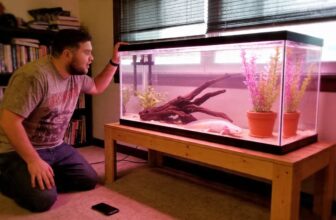
You need a 55‑gallon minimum, ultra‑fine sand, and a current strong enough to ruffle your hair. Congo puffers are ambush predators that spend hours buried like potatoes with googly eyes.
Feed hard‑shelled foods weekly—snails, clams, crayfish—or their teeth overgrow. Skip tank mates entirely; they’ll eat anything.
Smooth rocks and Mopani wood reduce stress. Strong flow, stable 74‑80°F water, and a steel‑frame stand are non‑negotiable.
Get the flow, substrate, and diet right first. The rest fills in the gaps.
At A Glance
- Minimum 55‑gallon tank with soft sand substrate for burrowing.
- Strong water flow mimics Congo River; use powerhead or canister filter.
- Hard‑shelled foods like snails and crayfish prevent tooth overgrowth.
- Solitary setup required; no tank mates due to aggression and predation.
- Ambush predator; enrichment includes natural décor and live prey hunting.
Why Is the Congo Puffer Called the “Potato Pufferfish”?
Why do people call the Congo puffer a “potato pufferfish”? Take one look at this lumpy, malformed fish, and you’ll get it.
Its body’s a misshapen blob, perfectly camouflaged for ambush hunting. It buries itself in soft sand, waiting for prey, with those eyes perched on top of its head—like a potato with goggles.
You’ll never mistake it for a sleek swimmer. This isn’t a fish you buy for looks; you buy it for personality. It’s rare in the trade, but that quirky shape? Pure wild evolution. Adopt the weird. A magnetic aquarium lid with cut‑to‑size mesh helps prevent this ambush hunter from jumping out during feeding. For cleaning the thick glass of a large tank, a N52 rare‑earth magnet provides a strong hold while removing algae.
What Is the Minimum Tank Size for a Congo Puffer?
Since you’re looking at a Congo puffer, you need at least a 55‑gallon tank—200 liters—and that’s the bare minimum, not a suggestion.
You’re joining the club of people who know these little potato-shaped ambush predators demand space.
They’re aggressive, solitary, and territorial, so a cramped tank spells disaster.
- Why 55 gallons? It provides enough water volume to dilute waste and gives your puffer room to establish a burrow.
- What about smaller tanks? Don’t do it. Stress leads to sickness, and you’ll lose your fish.
Bottom line: stick with 55 gallons or larger. A 55-gallon tank will weigh approximately 460 lb before adding décor, gravel, and water, so you need a stand rated to handle that total load. Opt for a steel-frame stand with X‑bracing to prevent wobble and ensure stability under the heavy weight. Your puffer will thrive, and you’ll feel like a real insider.
The Best Substrate for a Congo Puffer
Now, you’ve got your 55-gallon tank squared away, but your Congo puffer won’t care about the glass—it cares about the floor. Go with very soft sand, at least 2–3 inches deep. Anything sharp like gravel or crushed coral will scratch its belly and stress it out. Your puffer’s an ambush predator, so it needs to bury itself completely, eyes poking out like a periscope. For a durable, natural look similar to riverbeds, consider triple‑washed natural stone like Aqua Natural Midnight Pearl, which supports stable cycling and beneficial bacteria. For added natural structure and hiding spots, consider placing dense Mopani wood on top of the sand to create caves and anchor plants.
| Substrate | Pros | Cons |
|---|---|---|
| Pool filter sand | Smooth, cheap (~$10/50lb), easy to clean | Dusty at first, requires rinse |
| Play sand | Soft, fine texture | Can compact, traps debris |
| CaribSea Super Naturals | Pre‑rinsed, natural look | $$, but worth it |
| Aragonite | Buffers pH | Wrong for freshwater; avoid |
| Crushed coral | Sharp, injures skin | Hard no; skip entirely |
Stick with fine sand; your puffer’ll thank you by not sulking.
Why Your Congo Puffer Needs a Strong Current
Since your Congo puffer evolved in the fast‑moving rivers of the Congo, it expects a hearty current—no stagnant backwater for this potato. A strong flow, from a powerhead or canister filter, delivers two things: constant oxygen and exercise. Look for models with UV-stabilized thermoplastic housings that resist sun damage when placed near a bright tank.
In the wild, it’s an ambush hunter; current keeps its cover fresh and its metabolism pumping. Without it, he’ll get sluggish, fat, and bored. Trust me—you don’t want a bored puffer. He’ll take it out on your decor.
Aim for enough turbulence to rustle the sand slightly. He’s not a lapdog; he’s a river beast.
Bottom line: Find a quality powerhead (like a Hydor Koralia, ~$40) and point it across the tank. He’ll thank you by not redecorating.
For larger tanks, a pump like the Hygger Cross-Flow Pump delivers wide, ocean-mimicking currents that prevent dead spots.
Ideal Water Temperature and pH for a Congo Puffer
While your Congo puffer doesn’t demand a chemistry degree, getting the water temperature and pH wrong is like serving him a flat soda—it just won’t do.
While your Congo puffer doesn’t demand a chemistry degree, serving flat soda just won’t do.
You’re part of a crew that nails the basics, so keep these parameters locked in:
- Temperature: 74‑80 °F (23‑26 °C)—a stable heater and thermometer are non‑negotiable. I’ve seen drift cost a puffer its appetite.
- pH: 6.5‑7.8—neutral water works fine. Test weekly with a liquid kit, not strips. To ensure accuracy, choose a lab‑accurate certified kit that includes multiple parameters.
- Consistency: Sudden swings stress him out more than a bad joke from your uncle. Use a digital thermometer and drop‑checker.
Stick to these specs, and you’ll belong to the crew that keeps a happy, burrowing potato.
For precise readings, consider a model with three‑point calibration for higher reliability.
What to Feed Your Congo Puffer for Healthy Teeth
Since your Congo puffer’s teeth never stop growing—think of them as eternal, crunchy little daggers—you’re the one in charge of filing them down, and the only tool that works is food.
You need hard-shelled meals, plain and simple. Snails, clams, mussels, or crab legs—these aren’t just treats, they’re dental floss and a toothbrush rolled into one.
- Snails: ramshorn or pond snails, cheap and easy to culture
- Scallops: in-shell only; no shell, no grind
- Crayfish: small, whole, and crunchy
You can also culture sterile tissue culture snails to ensure your feeder stock is free of pests and algae.
You’re not just feeding a pet; you’re maintaining a living tool. Forget that, and you’ll face a puffer with overgrown beak problems. Stick to hard foods, and you’re part of the club that keeps them healthy.
Using a reef-safe epoxy putty to attach large snail shells to rocks can create a slow-release feeding station that also trims teeth.
Live Prey vs. Frozen Foods: What Works Best
You’re not running a pufferfish spa, so let’s cut straight to it: live prey wins for triggering natural behavior, but frozen foods save your sanity.
- Live prey—like feeder shrimp or ghost shrimp—costs around $4 a bag but sparks instant pounces, keeping your Congo puffer sharp and engaged.
- Frozen options, such as bloodworms or mussels, run $6–$10 per pack and store easily, but they lack the movement that triggers feeding instincts.
- Rotate both to balance mental stimulation with convenience, ensuring your puffer stays active without you chasing escapees.
To prevent buoyancy issues, avoid excessive dry foods that can cause bloating.
For planted tanks housing live prey, use a phosphate‑free iron supplement to avoid fueling algae growth.
Bottom line: mix ’em weekly for a happy, crunchy friend.
How to Prevent Overgrown Teeth With a Hard-Shelled Diet
If your Congo puffer’s teeth keep growing, you’re not just in for a vet bill—you’re in for a dead fish. You need a hard-shelled diet, plain and simple. It grinds down those ever-growing chompers naturally. Regular feeding of Ramshorn snails also supports strong shell formation in your puffer through their high calcium content. For optimal viewing of your puffer during feeding, lights should use a multi-color spectrum to mimic natural light cycles without causing stress.
| Food | Effect on Teeth | Feeding Tip |
|---|---|---|
| Ramshorn snails | Crack and file | Drop 3-5 weekly |
| Frozen crabs | Scrape growths | Once a week |
| Freshwater clams | Heavy grind | Crush shell first |
| Ghost shrimp | Light wear | Daily treat, not staple |
| Crayfish (small) | Serious abrasion | Remove uneaten bits |
Hard shells aren’t optional—they’re your puffer’s dental insurance. Skip ’em, and you’re stuck with an expensive, fatal problem.
Congo Puffer Behavior: What to Expect From an Ambush Predator
Hard-shelled meals keep your Congo puffer’s teeth in check, but that won’t stop it from being a lazy, lethal ambush predator.
You’ll rarely see it swim; instead, it buries in soft sand, eyes peeking out like a periscope, waiting.
Strike happens in a blink—anything moving becomes prey. No chasing, just pure, patient ambush.
- Stays buried for hours, only moving to eat or defend territory.
- Inflation is last resort—risks death, so don’t ever provoke it.
- Needs strong current to feel at home, mimicking its Congo River origins.
- Fine sand or soft gravel substrate supports its natural burying and digging behavior.
You’re keeping a living trap, not a fish. That’s the deal.
A leveling mat under your aquarium prevents pressure points and ensures the tank glass remains stable and stress-free.
Can You Keep a Congo Puffer With Tank Mates?
Since you’re basically signing up for a one‑fish show, absolutely not—Congo puffers are aggressive and solitary, so tank mates are a disaster waiting to happen. You’d be tossing a snack in with a predator. They’ll strike at anything moving, from tetras to snails. It’s not personal; it’s instinct. Stick to a solo setup, or you’ll watch your tank mates vanish faster than your paycheck on fish supplies. Cardinal tetras would be eaten within hours if introduced as tank mates. A reliable undergravel filter system supports solo setups by providing hidden biological filtration that keeps water clean without disturbing aggressive fish like puffers.
| Tank Mate Type | Likely Outcome | Why It Happens |
|---|---|---|
| Small fish | Eaten within hours | Ambush predator sees them as prey |
| Large, slow fish | Nipped to death | Puffer’s territorial aggression |
| Snails/shrimp | Crunched for teeth | Hard‑shelled meals—dental necessity |
| Other puffers | Fatal fights | Solitary by nature; no sharing space |
Bottom line: no tank mates equals no funerals.
Tank Décor That Reduces Stress and Encourages Hunting
A carefully arranged tank is your best defense against a bored, puffed-up serial killer. You’re part of the club that knows a stressed puffer is a problem.
Here’s what works:
- Fine sand substrate – at least 2‑3 inches deep. He’ll burrow fully, feeling safe while ambushing prey. No sharp edges, no injuries.
- Smooth, flat rocks – create caves and overhangs. They break line of sight and give him launch points for strikes. Scatter them loosely. To enhance his security, consider adding a black paper background to boost contrast and reduce outside reflections.
- Tannin‑rich driftwood – lowers pH gently and darkens water, mimicking his Congo home. Aim for one large piece with hiding nooks.
This setup turns your tank into a hunting ground, not a panic room. Adding a planted area with a bubble counter can help you monitor CO₂ levels for healthy plant growth.
Top 5 Beginner Mistakes With Congo Puffers
Even though you’ve read the care guide cover to cover, the first few months with a Congo puffer often feel like a game of “what did I just break?”—and yeah, that includes your confidence. You’re not alone. Here’s where most of us trip up.
Those first few months with a Congo puffer feel like a game of “what did I just break?”—including your confidence.
- Skimping on tank size. Fifty-five gallons minimum isn’t a suggestion; it’s survival. Going smaller spikes aggression fast.
- Using sharp gravel. That soft sand you skipped? It shreds their belly when they burrow. Rookie move.
- Forgetting strong current. No powerhead means low oxygen, and your puffer sulks.
- Feeding only soft foods. Without hard-shelled snails, their teeth overgrow. That’s a vet bill you don’t want.
- Adding tankmates. They aren’t community fish. Solitary keeps everyone alive.
- Neglecting water stability. Unlike Chili Rasboras, which thrive with weekly 25 % water changes and stable parameters, Congo puffers require even stricter monitoring to prevent stress-induced disease.
- Choosing the wrong filter. A gentle bubble flow from a dense foam sponge filter protects your puffer from suction stress while maintaining crystal-clear water.
Avoid these, and you’re already ahead of the pack.
Why Handling Your Congo Puffer Can Be Fatal
You might think scooping up your Congo puffer for a tank move or a closer look is no big deal—but it’s actually one of the fastest ways to kill them. Their stress response triggers fatal inflation, and rough handling can damage internal organs. You’re not a vet, and they’re not a toy.
- Fatal inflation — When scared, they gulp water, swell up, and often can’t deflate, causing suffocation or torn organs.
- Mucus stripe damage — Your hands strip their protective slime coat, leading to deadly infections fast.
- Shock-borne death — Sudden temperature or pressure changes from nets or bare hands cause heart failure.
You love your puffer, so don’t touch it. Simple.
A smart alternative is to use pre‑filter cylinders on your intake to prevent small fauna ingestion and reduce stress during maintenance.
What Supplies You Need Before Bringing Home a Congo Puffer
Before you even *think* about adding a Congo puffer to your cart, you need the gear that keeps them alive—not just the bare minimum.
Start with a 55-gallon tank minimum; bigger’s better for this burly ambush predator.
You’ll need very soft sand substrate—no sharp gravel, or you’ll bury an injured fish.
A powerful canister filter and a powerhead create the strong current and high oxygen they crave.
Don’t forget smooth rocks for hiding spots; line-of-sight breaks reduce stress.
Grab frozen crustaceans and hard-shelled snails for dental health.
Skip tankmates—solitary’s safer.
Ready your setup, then welcome your potato puffer home.
Frequently Asked Questions
How Long Do Congo Puffers Live in Captivity?
You’re looking at about 5–8 years with good care, though 10 isn’t unheard of.
These guys aren’t built for longevity if you cut corners—skimp on tank size, skip hard‑shelled foods for teeth health, or house them with tankmates, and you’ll stress ’em out fast.
Stick with a 55‑gallon minimum, soft sand to burrow in, and strong current. They’re ambush predators, not social butterflies. Feed snails or shrimp regularly. Bottom line: you get what you give.
Can Congo Puffers Be Trained to Eat From Your Hand?
Can you train a Congo puffer to eat from your hand? Honestly, probably not. They’re ambush predators, not social swimmers. Your hand looks like a threat, not a snack.
These fish bury in sand, then strike fast—they don’t do gentle nibbles.
You’ll risk a startled puff, which can kill them. Stick to long tweezers or a feeding stick. It’s safer, and they’ll still get that live shrimp they love.
Bottom line: don’t push it—your fish’s stress isn’t worth the party trick.
Do Congo Puffers Need a Varied Diet Beyond Hard-Shelled Foods?
Absolutely. You need to vary their diet beyond just hard-shelled foods.
During crunchy snails and shrimp keep those teeth ground down, your potato-like predator also craves soft, meaty treats.
Think bloodworms, white worms, or even small pieces of scallop.
This isn’t just about dental health; it’s about preventing boredom and mimicking their wild buffet.
A mix of hard and soft foods? That’s how you keep a puffer happy and healthy without the fuss.
How Often Should You Feed a Congo Puffer?
Feed your Congo puffer every other day—that’s 3-4 times a week.
You’re not trying to overstuff that potato-shaped ambush predator; obesity is a real risk.
Offer one or two hard-shelled items per meal, like snails or shrimp, to keep those teeth trimmed.
Mix in frozen treats like bloodworms or mussels occasionally.
Think of it as a dinner schedule, not an all-you-can-eat buffet—your puffer’s a lone hunter, not a glutton.
Stick to this, and you’ll avoid dental dramas and a chubby, grumpy fish.
Can Congo Puffers Recognize Their Owners?
Yeah, they can—but don’t expect a puppy.
Congo puffers recognize you as the food source, not a friend.
They’ll surface, watch your hands, even flare when you approach the tank.
That’s not affection; it’s anticipation.
Their brains are wired for ambush, not bonding.
You’re just the giant delivering snails.
Don’t take it personally.
Feed consistently, watch for that expectant stare, and enjoy the show.
Just remember: any movement near the glass triggers their hunting instincts—including your face.
Rounding Up
So, the Congo puffer isn’t a fish; it’s a grumpy, toothy potato with a murderous streak. You can’t keep tankmates, you must feed it snails (about $5 per dozen), and triggering its inflation reflex is a fast track to a dead fish.
For a 55-gallon tank, a strong canister filter (like a Fluval FX4, $200), and a deep sand bed you’ll spend $400–$600 upfront. The payoff? Watching a living fossil ambush a crab.
Bottom line: skip this puffer unless you love a high‑maintenance, solitary predator that will eat your wallet and judge your decor.