You’ll want a single male pleco per tank—fighting kills spawning vibes. Keep one male with two or three females, drop the temperature 3–5°F, and crank up flow into a snug cave.
For Corydoras, spot the round-bellied females, then trigger spawning with cooler water changes and a powerhead. They’ll lay eggs on broad leaves; remove adults within 24 hours to stop predation.
Pleco eggs hatch in 5–10 days, Corydoras in about five. Stick the landing and there’s more to nail.
At A Glance
- Use a temperature drop and 50% daily cool water changes to trigger spawning.
- Maintain a 1:2 or 1:3 male-to-female pleco ratio with a single breeding male.
- Provide a snug, single-entrance cave for plecos and broad leaves for corydoras eggs.
- Remove adult fish within 24 hours after spawning to prevent egg predation.
- Keep stable pH near 7.0 and temperature 70-78°F for healthy egg development.
Why Corydoras and Plecos Thrive in the Same Breeding Tank
Since corydoras and plecos share similar water chemistry needs and occupy different tank zones, they can peacefully coexist in the same breeding setup.
Corydoras are bottom-dwelling egg-layers, whereas plecos are cave-spawners—they won’t compete for space.
This means you can trigger spawning in one tank, saving you cash on separate setups.
Your pH stays steady around 6.5–7.0, and temps hold at 76–80°F.
No territorial drama, just two species doing their thing.
For example, a 40-gallon breeder with one pleco cave and some broad leaves? Perfect.
You’re maximizing your tank’s potential without extra hassle.
Stable water conditions, including multiple driftwood pieces for hiding spots and dim lighting, support their natural behaviors. A natural temperature drop over several months can help initiate breeding rhythms for both species.
Spotting Male vs. Female Corydoras: Belly Shape Tells All
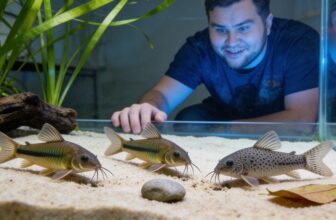
Since you’re looking down into a tank at a group of corydoras, the quickest way to tell males from females is to check their belly shape when viewed from above.
Females look rounder, like a plump teardrop—that’s where the eggs go.
Females look rounder, like a plump teardrop—that’s where the eggs go.
Males? They’re sleeker, tapering sharply from belly to tail.
See a chunky one? That’s your girl.
A lean, pointy one? That’s the boy.
You’ll nail it every time once you spot the difference.
No guesswork needed, just a top‑down glance.
It’s that simple.
Welcome to the club—you’re already ahead of most.
For best health and color, keep a group of 15 or more to reduce stress and enhance iridescence. A proper leveling stand prevents wobbling that can stress spawning fish in the tank.
What Triggers Corydoras to Start Spawning?
What gets corydoras in the mood to spawn? You’ll trigger their breeding instincts with a seasonal shift, mimicking the rainy season. Dropping the water temperature by 3–5°F does the trick, then slowly raising it back over a few days. Add frequent, large water changes—about 50% daily—with cooler, soft water. This signals “time to reproduce” to your shy bottom-dwellers. You can also use a Floating Breeding Box mounted on the glass to capture and protect eggs after spawning. Maintaining pristine water quality is essential to prevent stress and disease during this sensitive period.
| Trigger | Action |
|---|---|
| Temperature drop | Cool by 3–5°F, then warm up slowly |
| Large water changes | 50% daily with cooler, soft water |
| Increased flow | Boost filtration or add a powerhead |
You’ll notice erratic chasing; that’s your cue. Belonging to this group means learning these signals—your cories will reward you with eggs.
The T-Position: How Corydoras Fertilize Eggs
Once a female corydoras has her eggs ready—nestled safely between her pelvic fins—the male steps in to do his part with a move that looks more like a clumsy shuffle than a precise act of reproduction. He’ll press his snout against her belly, then twist his body into a perfect T. That’s his cue.
From this angle, he releases milt directly onto the clutch, fertilizing each egg on contact. It’s an awkward movement, but it works.
You’ll see it repeated for hours, building trust as a pair. You’re part of the club now—witnessing this quiet, coordinated teamwork. That’s the T-position, pure and simple. A soft, fine sand substrate protects her sensitive barbels during this close interaction.
Some keepers trigger spawning by raising the temperature near 80°F and softening the water.
Where Corydoras Lay Eggs (Up to 300 at a Time)
Female corydoras lay their eggs in plain sight, usually on broad plant leaves, aquarium glass, or even the intake tube of your filter. They’re not sneaky—they want you to see their work, and you’ll feel part of their little world.
- You’ll spot clusters on Java fern leaves, looking like tiny pearls.
- They stick eggs to smooth surfaces, so your filter’s intake pipe becomes a nursery.
- Broad-leaved Anubias plants are prime real estate—easy to spot, hard to miss.
- Even your tank’s glass walls host eggs, right where you can admire them.
This simplicity makes you a proud observer, not just a fish keeper. Consistent water chemistry is more important for shrimp health than chasing exact numbers, just as stable conditions support corydoras spawning success. Using a cover net with small 5 mm holes ensures ventilation while preventing fry or jumping fish from escaping.
Remove Adults Within 24 Hours to Save Corydoras Eggs
You’ve watched your female corydoras lay dozens of tiny pearls on the glass and leaves—but now the real test begins. Within 24 hours, remove those adults. They’re hungry, and eggs are an easy snack. Don’t assume your fish are above it; they’re not.
| Wait Too Long | Act Fast |
|---|---|
| Eggs vanish overnight | You save 200+ |
| Fry never hatch | Happy babies swim |
| You’re cleaning alone | Your crew thrives |
| Heart sinks | You belong—winning |
Gently net parents out. Use a soft-mesh net to avoid damaging delicate fins during transfer. Use a separate tank or a bucket with tank water. No drama, just done. You’re protecting your future school, and that’s what good breeders do. Stick together. Always keep anti-slip ridged grips on your tweezers steady when transferring delicate eggs or moss to a safe container.
Build a Simple Breeder Box That Keeps Corydoras Eggs Safe
When adults are safely removed, a breeder box keeps those eggs from disappearing before your eyes. You’ll build this simple box from a plastic container, a mesh screen, and an air stone. Cut holes in the container’s sides for water flow, then glue the mesh over them—fine enough to block fry. Add the air stone inside for gentle circulation.
- Use a 2-quart container, about $3 at a dollar store.
- Attach suction cups (another $2) to keep it stable.
- Float it in your tank or hang it on the rim.
- Place a small sponge filter inside to prevent mold.
That way, you’re part of the crew who doesn’t lose eggs. Consider using fine pore density foam as the mesh to capture microscopic particles while maintaining water clarity. Because dense foam traps debris while supporting robust beneficial bacteria, it ensures high water quality for developing eggs.
Choosing the Right Cave Setup for Plecostomus Breeding
A proper cave mimics the male’s instinct to guard, so size and placement are everything.
You’ll want a single entrance, roughly three inches tall—just enough for a hefty pleco.
Dark, snug, and closed at the back.
Clay flowerpots work, but custom PVC “pleco caves” run $8–$12 and fit better.
Place it low, against the back glass, where current flows in.
The male needs to hover inside, blocking the opening.
Too big, and he won’t feel secure.
Too small, and he’ll stress.
Get it right, and you’re practically handing him a done deal.
Three-stage filtration systems used in modern gravel cleaners can also help maintain the pristine water conditions that breeding plecos require.
For example, tanks with adjustable water flow allow precise control of current strength to suit pleco preferences.
Water Flow and Temperature That Trigger Pleco Spawning
Since temperature and flow are the actual on‑switches for pleco spawning, getting them wrong means that perfect cave is just an expensive hidey‑hole. You’re trying to mimic a spring rain—cooler water rushing through their cave. That drop signals “time to breed” to their ancient fish brains.
- Drop the temp 3–5°F over a few hours—a 50% water change with cooler water does it.
- Increase flow into the cave entrance; a small powerhead or sponge filter aimed right works.
- Use a digital thermometer to monitor; cheap stick‑ons lie like a fish about its size.
- Keep pH stable near 7.0; sudden swings stress them out, ruining the mood fast.
To prevent unintended salinity changes during a top-off, consider using an auto top-off system that employs dual optical sensors for sub-millimeter precision.
A temperature controller with alarms can alert you if the water gets too warm or too cold during the process.
Get this right, and you’re part of the pleco‑breeding club, not just a cave decorator.
Best Male-to-Female Ratio for Pleco Breeding Success
What’s the magic number for pleco breeding success? One male to two or three females. That’s it, plain and simple. You’ll get faster, more reliable spawns this way, trust me. To maintain reproductive health, regular water testing helps prevent ammonia spikes that can stress your fish and halt spawning. A single male can handle the duty without stress, and the females compete just enough to keep everyone motivated. One-on-one pairs work, too, but they’re slower—like watching paint dry. Stick with the trio. It’s the sweet spot for your tank, your time, and your sanity. No fighting, just fat, happy females and a busy male. A stainless‑steel needle valve on your CO₂ regulator prevents corrosion and ensures precise dosing for planted tanks that support fry. You’ll belong to the breeding club in no time.
One Male Pleco Per Tank: Why Fighting Hurts Spawning
Sticking with one male per tank isn’t just a suggestion—it’s a rule if you want eggs, not bruises. Territorial fighting stresses both fish, halting spawning for weeks. You’ll see torn fins, not fertilized clutches.
- Males waste energy on combat, not courtship.
- Females hide, delaying egg-laying for safety.
- Damaged fish become susceptible to infection.
- One dominant male claims the cave, blocking all breeding attempts.
Keep it simple: one male, two to three females. That’s your ratio for calm caves and full spawns. No drama, just eggs. And you, my friend, finally get that fry you’ve been dreaming about. A quiet HOB filter with adjustable flow reduces tank noise and keeps water parameters stable for spawning. Additionally, providing ample caves with vertical crevices in the rockwork helps reduce stress and supports breeding behavior.
What Happens After the Female Pleco Lays Eggs?
Once the female pleco drops her eggs inside the cave, her job is done, and she gets the boot.
You’ll see the male chase her out, then take over as the sole bodyguard.
He fans the egg mass with his fins, keeping oxygen flowing and debris off.
Don’t intervene—he’s fiercely protective, and you’ll blow the spawn if you peek too often.
Keep water conditions pristine, stable, and warm, with a stable temperature between 70–78 °F to support healthy development.
To prevent stress and disease during this sensitive period, weekly water changes of 30–50% are critical for maintaining pristine conditions.
Your role? Just back off, let the dad do the work, and enjoy the quiet pride of a job well done.
Corydoras vs. Pleco: How Many Days Until Hatching?
You’ve watched the male pleco guard the eggs like a grumpy bouncer, but now you want to know the wait time.
For Corydoras, you’ll see tiny wigglers in about five days. Pleco eggs take longer, hatching in five to ten days, depending on temperature.
- Corydoras eggs hatch faster, around day five, so you’re not waiting long.
- Pleco dads guard their clutch for up to ten days, a real commitment.
- Warmer water speeds things up, but don’t exceed 78°F for either.
- Keep stress low—no sudden changes—so those eggs stay viable.
- Using NSF certified epoxy putty can help build safe, stable spawning caves for plecos.
Bottom line: Corydoras win the speed race, but both need your patience.
Daily Water Changes to Prevent Egg Fungus in Both Species
Since fungus loves stale water, daily water changes are your best bet for keeping both Corydoras and Pleco eggs clean and healthy.
Swap out 20–30% each day, using a siphon to gently remove debris without disturbing the clutch.
Swap out 20–30% each day, using a siphon to gently remove debris without disturbing the clutch.
This keeps oxygen high and bacteria low—your eggs’ worst enemies.
Don’t skip a day; even a brief pause can invite that gross fuzz.
You’re not just maintaining water; you’re building a safe nursery.
Stick with it, and you’ll see far fewer fuzzy failures.
That routine? It’s your secret weapon for eggs that hatch strong.
Frequently Asked Questions
Can Corydoras Breed in a Community Tank With Other Fish?
Yes, they can, but you’re rolling the dice. Corydoras will spawn in a community tank—jumpy males chase rounder females, she releases eggs, he does a T‑position tango—but those eggs? Snacks for tankmates.
You’ve gotta act fast. Remove adults or eggs to a breeder box within hours. Otherwise, tetras, barbs, even snails treat ’em like buffet.
Separate them if you want fry, not just a show.
How Often Do Plecos Spawn if Conditions Are Ideal?
If conditions are ideal, you’ll see plecos spawning every 4 to 6 weeks.
Honestly, it feels like they’re showing off.
That’s a solid rhythm—once you dial in the perfect cave, pristine water, and that slight temperature drop, they hardly ever miss a beat.
The male guards eggs for 5–10 days, then sits back for a short break before the whole cycle starts again.
Pretty reliable little workers.
Do Corydoras Need a Specific Water pH to Trigger Breeding?
You don’t need a specific pH to trigger spawning, just stable water.
Corydoras breed in a range from 6.0 to 8.0.
What really gets them going is a cool water change—drop it by a few degrees. That mimics rainy season.
Test your tap water first, match it closely, and you’ll see action.
It’s not rocket science, just a good, gentle shock.
Keep it simple, keep it clean, and your fish will do the rest.
Will Pleco Eggs Hatch if the Male Is Removed Early?
No, they likely won’t.
Removing the male pleco early usually kills the eggs since he constantly fans them—that water flow provides oxygen and prevents fungus.
Without him, you’d need to replicate that current manually, and it’s a pain.
I’ve tried, failed, and learned the hard way.
For best results, leave him on guard duty until fry hatch, which takes 5–10 days.
It’s his job, not yours.
How Do You Prevent Corydoras Eggs From Developing Fungus Naturally?
You’ll prevent fungus naturally by keeping water clean—do a small daily water change and remove uneaten food.
Add a handful of Indian almond leaves; their tannins fight mold like a pro.
Cram eggs into a mesh breeder box with an air stone for gentle flow.
No chemicals needed—just good hygiene and a leaf or two.
It’s low-effort, high-reward.
Save the copper treatments for algae.
Rounding Up
So, you’ve done it. You’ve tricked fish into having kids—congratulations, you’re basically a fishy Yoda. Now, don’t get cocky. Those eggs (up to 300 per Cory spawn) are a buffet waiting to happen. Pull adults or remove the eggs, stat. For Plecos, just let that grumpy dad guard his cave—he’s got it. Daily water changes stop fungus. Fry hatch in 3–7 days. Trust the process, keep your hands steady, and don’t name them yet. Bottom line: patience, clean water, and a little luck. You’ll be drowning in baby catfish before you know it.