The Christmas Wrasse needs a 250‑gallon tank minimum – anything smaller courts disaster, honestly – with medium‑grade aragonite sand about 1–1.5 inches deep for burrowing.
Plus four small meals daily of frozen Mysis, chopped shrimp, and occasional snails.

Protein-rich mysis supports natural feeding behavior and bright colors.

Easy-to-eat protein pieces for daily feedings; no fillers.

Tiny granules drift to feeding zones; support steady growth.
Check discounted items inMarine Fish Food
Water stays at 76°F, pH 8.1–8.4, the usual saltwater drill.
Tankmates? Clownfish, rabbitfish, dwarf angels work; skip firefish, small shrimp, and other ladder wrasses unless you enjoy turf wars.
They’re protogynous hermaphrodites – females switch to males when the boss vanishes – though home breeding basically never pans out, too finicky.
Watch for color fading, fin rot, or rock scraping as early stress flags.
There’s more to unpack below if this fish has hooked your curiosity.
At A Glance
- Requires 250+ gallon tank with 1–1.5 inches medium aragonite sand for essential burrowing behavior.
- Feed four pea-sized meals daily of frozen Mysis, chopped shrimp, and slow-sinking micro-granules.
- Keep water parameters stable: pH 8.1–8.4, temperature 76°F, and test weekly with rapid-result kits.
- Compatible with clownfish, rabbitfish, and dwarf angelfish; avoid small shrimp-sized fish and other wrasses.
- Female-to-male sex change occurs when dominant male is lost, requiring stable water and weeks of patience.
Christmas Wrasse Identification: Key Markings and Surge Wrasse Look-Alikes
The trouble, since there’s always trouble, comes from the Surge Wrasse (*Thalassoma purpureum*). Both fish share green bars, red lines, that reef-dwelling vibe aquarium people chase. But look closer, I mean really look.
The trouble, since there’s always trouble, comes from the Surge Wrasse. But look closer, I mean really look.
Nose marking – Surge Wrasse carries a V-shaped smudge on its snout; Christmas Wrasse (*Halichoeres claudia*) doesn’t. Simple, but easy to miss when you’re rushing.
Color tips – Males deepen to richer hues, though exact shades shift with mood, lighting, your luck that day.
Habitat range – Christmas Wrasse favors Indonesia to Japan, calmer waters. Surge Wrasse tolerates, well, surges. Now you know where yours belongs.
When keeping either species, a Magnet Acclimation Box with its gentle 2.5 mm water flow and coral feeding tube proves ideal for initial isolation and observation before introducing them to display tanks.
Lifespan and Full-Grown Size
Once you’ve sorted whether you’re holding a Christmas Wrasse or its surge-loving doppelgänger, the practical questions arrive, and they arrive fast – how long will this fish live, and how much tank will it eventually need?
- Lifespan. Five to eight years, realistically. Some keepers whisper about ten, but that’s lottery-ticket territory. Pr reef longevity means solid water, not wishes.
- Growth rate. Moderate, steady. They start charming and palm-sized; they end at eleven inches, twelve if you’re feeding generously and the fish feels like showing off.
- Tank sizing. Start large, stay large. A 250-gallon minimum isn’t boasting – it’s futures thinking. With water alone pushing a fully stocked system past 700 LB overall – before live rock, sand, and equipment – you’ll need a purpose-built stand with genuine load capacity, not optimistic particleboard and crossed fingers.
Reef-Safe? Corals and Inverts Compatibility
Most keepers, when they hear “reef-safe,” picture a fish that ignores corals entirely – no polyp-nipping, no base-scratching curiosity, no midnight buffet raids on the infrastructure.
The Christmas Wrasse obliges, mostly. Coral placement stays sensible, and it patrols without destruction. Now, invert interactions? That’s where keepers belong to the anxious club.
| What Survives | What Vanishes |
|---|---|
| Sturdy LPS, soft corals, clams | Tiny ornamental shrimp, decorative crabs |
| Snails (the pest kind, thankfully) | Feather dusters, small worms |
| Large hermits, urchins | Juvenile shrimp, anything bite-sized |
| Established coral colonies | Fragile polyps near substrate |
For those housing this species in acrylic slot design sumps with integrated refugiums, the additional water volume and biological filtration can help offset the bioload while maintaining stable parameters for sensitive tankmates.
Minimum Tank Size: 250 Gallons (and Why Less Fails)
Start smaller, and you’re not just cramped on swimming room; you’re signing up for a fish that’ll either jump ship, bully tankmates into hiding, or waste away from the sheer psychological exhaustion of circling the same twelve square feet every waking hour.
Two hundred fifty gallons, minimum. Any less and tankmate posture turns hostile – the Christmas Wrasse gets twitchy, starts side-eyeing neighbors, becomes that guy at the party who stands too close.
Lighting preferences matter too; these fish want room to shift between bright patches and shadow without bumping glass.
Now, the math: at eleven inches fully grown, this wrasse needs roughly twenty gallons per inch to establish territory, hunt, and not lose its mind. Less space means stress hormones, fin-nipping, early death.
Skip the “maybe it’ll work” experiment. The 250 is non-negotiable, and honestly? Go bigger if you can.
A 250-gallon system also leaves adequate room for reef-safe coral glue applications when securing live rock structures against the powerful digging behavior of mature Christmas Wrasses.
Build Burrow-Friendly Substrate Zones
Where does a fish like this actually sleep? It’s not glamorous – Christmas wrasses burrow, plain and simple.
Now, substrate texture matters more than you’d think. Too coarse, and they’ll scrape themselves raw; too fine, and the whole thing collapses mid-dream. Aim for medium-grade aragonite sand, maybe 1–1.5 inches, though some swear by 2.
The perfect burrow starts with medium-grade aragonite sand – coarse enough to hold its shape, fine enough to sleep through the night.
Burrow depth? That’s the negotiation. They want enough cover to feel invisible, not enough to get stuck. Think shallow grave, not tunnel system.
And certainly, you could skip this. But then you’re the jerk who bought a wrasse and stole its bed. Don’t be that person.
Build zones. Let them dig. Everybody rests easier – fish and keeper alike.
Consider placing a static-cling background on the rear glass to reduce visual stress while your wrasse settles into its burrow routine.
Water Parameters for Healthy Christmas Wrasses
Christmas Wrasses tolerate narrow chemistry windows, so stable beats perfect.
- pH: 8.1-8.4 (watch for pH variations – sudden drops stress them)
- Temperature: 72-78°F, though 76°F keeps everyone content
- Alkalinity: 8-12 dKH
- Salinity: 1.020-1.025 SG
Test levels weekly. I mean, actually test them.
Calcium and magnesium matter too – roughly 400-450 ppm and 1250-1350 ppm – if you’re keeping corals alongside. But the wrasse? It just wants consistency.
Avoid fluctuations. These fish burrow, they sleep, they tolerate your imperfect maintenance schedule, but swinging parameters? That’s where trouble starts.
For reliable monitoring, use a saltwater test kit covering pH, carbonate, nitrate, nitrite, and general hardness, with results that appear in roughly 30 seconds.
What Christmas Wrasses Eat: Natural Prey and Hunting Behavior
Most Christmas Wrasses would eat roughly anything slower than a current, which is handy, since they’re built like little aquatic vacuum cleaners with opinions.
Their feeding patterns follow daylight – probing crevices, nipping pyramid snails, vacuuming flatworms, crushing shrimp with those oversized lips. They’re opportunists, not strategists.
But here’s the thing: nocturnal foraging isn’t really their game. Come dusk, they submerge into sand, sleep like stones, leave the night shift to others. Their tiny stomachs can’t handle fasting, so evolution cut them a deal – hunt hard, sleep harder.
Small mouths, big appetites, zero patience. Typical.
In a mature reef system, maintaining carbonate alkalinity with a reef-specific buffer like Brightwell Alkalin8.3-KH or Seachem Reef Buffer ensures the stable pH these fish need for optimal daytime hunting behavior.
Feeding Schedule: Four Small Meals Daily
Since their stomachs are laughably tiny – think pea-sized, maybe smaller, nobody’s really measured – Christmas Wrasses can’t handle the standard aquarium routine of one heavy dump-and-go meal.
Feeding frequency matters enormously here. I mean, these fish evolved grazing all day, not gorging like it’s Black Friday.
Now, portion sizing: each meal should disappear in under two minutes. If food hits the sand, you’ve overdone it.
Stick to this rhythm –
- Morning (lights on)
- Midday
- Late afternoon
- Evening (pre-bed)
Frozen Mysis, chopped table shrimp, maybe a snail if you’re feeling generous. Four meals keeps metabolism steady, aggression absent, and your wrasse actually visible instead of sulking behind rocks, hungry and plotting.
For protein-rich alternatives, consider slow-sinking micro-granules that match the natural grazing behavior of small-mouthed tropical fish.
Why Hunger Triggers Sudden Aggression
A Christmas Wrasse with an empty stomach is, frankly, a jerk. Hunger aggression transforms this reef-safe darling into something you’d rather not know. Now, the tiny stomach (seriously, it’s small) demands four meals daily, and skipping one? That’s among the worst stress triggers going.
| Empty Belly Stage | Behavioral Shift | Your Move |
|---|---|---|
| 2 hours missed | Restless pacing, flashier colors | Toss Mysis, watch relief |
| 4 hours missed | Nipping at cleanup crew | Emergency snack, stat |
| 6 hours missed | Chasing firefish, territory wars | Split tomorrow’s portions smaller |
| 8+ hours | Full aggression, ornamental shrimp at risk | Reassess your entire schedule, friend |
I mean, nobody wants to be that aquarist whose “peaceful” fish turned monster. Feed consistently, or prepare for drama. Poor water quality from missed feedings and resulting aggression stress can compound issues, making anaerobic denitrification a valuable backup solution for maintaining stable parameters in busy aquarist schedules.
Best Christmas Wrasse Tank Mates
Three species groups, maybe four if you’re feeling generous, define the sweet spot for Christmas Wrasse companionship – peaceful, mid-sized, and unbothered by a fish that treats the water column like a personal highway. Your community, basically.
Clownfish make solid neighbors, ditto rabbitfish and dwarf angelfish. Eels work too, surprisingly, provided nobody’s bite-sized.
Conspecifics? Absolutely, harems thrive given space and that inch-deep sand bed everyone forgets to measure properly.
Now, aquarium lighting matters – think moderate reef PAR, nothing surgical. Too bright stresses tankmates; too dim, everyone’s cranky. Filtration maintenance keeps the chemistry stable, since nothing ruins fellowship like ammonia spikes.
When selecting a tank, consider that low-flow filtration prevents fin stress in delicate community members, much like the gentle 55–80 gph pump capacity recommended for betta habitats.
Fish to Avoid: Size and Temperament Incompatibilities
Small fish disappear into the risk column fast. Firefish, fairy wrasses, flasher wrasses – anything shrimp-sized – become expensive snacks, especially under dim aquarium lighting that lets the Christmas Wrasse hunt shadows.
Now, filtration methods matter here too. Weak flow means sluggish water, stressed fish, and a hungry wrasse with time on his fins.
| Risk Factor | Problem Species | Why It Fails |
|---|---|---|
| Size gap | Firefish, gobies | Swallowed whole, usually at night |
| Temperament | Dottybacks, dwarf angels | Constant chasing, stress deaths |
| Competition | Other ladder wrasses | Territorial sparring over sand beds |
| Diet overlap | Shrimp-dependent fish | Starvation when the wrasse wins |
How Christmas Wrasses Change Sex: Female-to-Male Transition
Christmas Wrasses rewrite their own biology with the casual confidence of someone switching dinner reservations.
The mechanism runs on hormonal triggers, social hierarchy, and behavioral cues – females convert when dominant males vanish. Environmental factors, genetic mechanisms, and endocrine system remodeling complete the transformation.
This sex change serves reproductive timing, population dynamics, and evolutionary advantage across coral ecosystems.
Three things matter for keepers:
- Group structure determines who changes
- Water quality affects physiological remodeling
- Patience is required – this takes weeks, not days
Research into comparative species, molecular pathways, and hormone assays continues revealing how temperature influence, light cycle impact, and genetic expression guide the process.
Why Home Breeding Attempts Fail
So let’s break down why your living room isn’t a coral reef, and why that matters more than you’d hope.
Captive Christmas Wrasse breeding collapses on logistics, not passion. The harem structure demands precise female-to-male ratios, spatial volume most tanks cannot provide, and cue systems – light, current, lunar cycles – that home equipment mimics poorly. Bonding fails, spawning misfires, eggs scatter without recovery protocols.
| Hurdle | Why Your Tank Loses |
|---|---|
| Space | 250+ gallons for one harem, minimum |
| Chemistry | pH swings of 0.1 can abort entire spawns |
| Timing | Daylight spawning needs spectrum precision |
| Recovery | No larval rearing infrastructure exists |
These captive‑spawn challenges separate reef from replica.
Early Signs of Stress and Disease
Three behaviors, maybe four, separate a Christmas Wrasse having an off day from one that’s quietly circling the drain.
A Christmas Wrasse having an off day isn’t circling the drain – yet.
Now, color fading – that washed-out look, like someone left the saturation slider too low – means stress, probably water chemistry gone sideways. Fin rot shows up as ragged edges, tissue dissolving like bad paper. And scraping against rocks? That’s the fish asking for help, not scratching an itch.
- Color fading – dull hues signal environmental distress
- Fin rot – bacterial infection eating the margins
- Prolonged hiding – withdrawal from the community it needs
Catch these early, and you’re still part of the club. Miss them, well, membership expires.
Frequently Asked Questions
Do Christmas Wrasses Recognize Their Owners?
Christmas wrasses demonstrate subtle owner recognition through learned association rather than genuine social bonding. Their personality traits – curiosity, boldness during feeding – create an illusion of familiarity. Fish perceive consistent movement, vibrations, shadow patterns.
Yet “knowing” implies too much; they respond to stimuli, not identity. The wrasse greets hands bearing food, not faces. Warmth projected, not reciprocated.
Still, enthusiasts report individual quirks: a lingering pause, anticipatory posture, perhaps preference. Anthropomorphism? Undoubtedly. But harmless. And kind of nice. seventy words.
Can Christmas Wrasses Jump Through Mesh Lids?
Standard mesh lids, roughly quarter‑inch weave, typically contain Christmas wrasses – though smaller mesh, say eighth‑inch, removes doubt entirely.
Tank design matters: rimless setups with raised mesh frames beat flush lids that tempt escape behavior at feeding time.
Enclosure safety demands checking lid integrity weekly, since these fish are persistent, not genius Houdinis, but persistent enough.
Will Christmas Wrasses Clean Parasites off Other Fish?
No, parasite cleaning isn’t their thing. Not a cleaner wrasse, not a symbiotic groomer.
Christmas wrasses hunt pests – pyramid snails, flatworms – sure, but that’s predator-prey, not mutualism. They don’t set up stations, don’t move rhythmically for fish clients.
Now, if you’re hoping for a mobile skin clinic? Get a cleaner wrasse, a shrimp, maybe a goby. The Christmas wrasse will just… eat your problems dead. Different service entirely.
Do Christmas Wrasses Need Moonlight for Nighttime Burrowing?
No, Christmas wrasses don’t need moonlight for nocturnal burrowing – they’re built for total darkness.
Their moonlight behavior? Completely optional. These fish rely on sensory memory, not lunar cues, to navigate back to buried sleeping spots. In fact, excessive nighttime lighting can actually disrupt their rest cycle.
Now, the burrowing itself – it’s instinctive, hardwired, a reflex triggered by fading light rather than any celestial schedule. They’ll dig just fine in pitch black. So skip the moonlights, keep the tank dark, and let them snooze.
Can Christmas Wrasses Be Trained to Hand-Feed?
Yes, Christmas wrasses respond well to hand feeding techniques and reward conditioning. Their curious, active nature and large lips make them ideal candidates.
Start with target training – hold tweezers with Mysis shrimp near the surface, wait, repeat.
Within days, they’ll associate your hand with food. Patience matters; some take weeks.
But once conditioned, they’ll eagerly surface, making feeding interactive and reducing aggression from competition.

Buffers pH and lets your wrasse burrow and rest naturally.

Medium-grade aragonite gives the wrasse a safe, stable burrow.
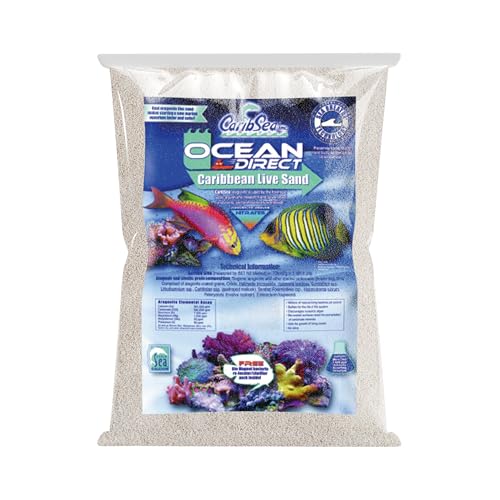
Live sand jump-starts biological filtration and stabilizes water.
See today's best deals onAquarium Sand