Breed Black Moor Goldfish: Tank Setup & Care Guide
Start with 20+ gallons per fish—crowding causes stress that fades their velvety black to gold. Install a canister filter rated for double your tank volume (SunSun HW-304B works well) to handle heavy bioload from these messy eaters.
Water Parameters
- Temperature: 68–74°F (breeding: slowly raise to 75°F)
- pH: 7.0–7.4
- Zero ammonia/nitrites; nitrates <20 ppm
Diet for Color & Health
Feed color-enhancing pellets with spirulina daily. Add blanched peas twice weekly—this prevents digestive blockages common in fancy goldfish.
Spawning Steps
- Lower water to 6 inches, increase aeration
- Add flat spawning surfaces (anacharis, mop heads, or slate)
- Remove parents after 3–6 hours (they eat eggs)
- Feed fry infusoria → brine shrimp nauplii → crushed flakes
Tankmate Rules
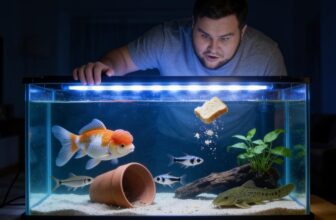
Compatible with: Other fancy goldfish (orandas, ryukins), dojo loaches, large snails
Avoid: Fin-nippers (tiger barbs), tropicals needing >76°F, common goldfish (outcompete for food)
Quarantine newcomers 4 weeks. Velvet and ich hit black moors hardest—catch early under blue light.
At A Glance
- Provide a minimum of 20 gallons and gentle filtration to protect delicate eyes and swim bladders.
- Keep water temperature stable between 68–74°F and pH at 6.5–7.5 for optimal health.
- Ideal tank mates include other fancy goldfish, Cory catfish, and mystery snails in groups.
- Feed high-quality pellets with spirulina, supplemented by blanched peas and live daphnia.
- Trigger breeding by raising temperature to 75°F and providing flat spawning surfaces.
Why Your Black Moor Turns Gold (and How to Prevent It)
Since you’re here, you’ve probably noticed your once‑velvety black moor is sporting a suspicious orange tint—like it’s trying to audition for a goldfish commercial.
Don’t panic—that glow isn’t a new party trick. It’s a distress signal, usually from warm water or poor water quality.
Don’t panic—that glow isn’t a party trick, it’s a distress signal from warm water or poor quality.
Black moors fade when ammonia creeps above 0 ppm or temps exceed 75°F (24°C).
Keep that thermometer steady between 50–75°F, test your water weekly, and stick with a canister filter.
Strong filtration is critical because goldfish produce heavy bioload that can overwhelm undersized setups.
If you struggle to maintain safe temperatures in warmer months, consider adding a compact aquarium chiller to keep the water cool without disrupting your filter.
Good habits keep that deep black hue intact.
You’ve got this—your moor belongs with you.
Why 20 Gallons Is the Minimum for Black Moors
You might think a 10‑gallon tank looks cute on your desk, but for a black moor it’s basically a prison cell with a filter.
Here’s the deal: they grow 6‑8 inches and live up to 15 years. That’s a long time in a cramped box.
- Waste load: Black moors are messy; 20 gallons dilutes toxins better without constant water changes.
- Swim space: They’re slow, clumsy swimmers. They need room to turn without bumping into glass or décor.
- Social sanity: Keep three together? You’ll need that 20 gallons plus 10 extra per fish—no shortcuts.
Bottom line: skip the desktop tank. Join the 20‑gallon club; your moor will thank you with healthier color and fewer crashes. For temporary isolation, a Magnet Acclimation Box can mount directly to the quarantine tank glass for stress‑free observation.
When setting up the tank, a gradual brackish water acclimation over 7‑10 days can help maintain stable pH and hardness for sensitive species.
Best Filtration, Décor, and Lighting for Black Moors
Since your black moor’s eyes are basically fragile bubbles with a fish attached, sharp décor and bright lights are a disaster waiting to happen.
Go with a canister filter—it handles their heavy waste without creating strong currents.
Consider an option like the SUNWEN Ultra-Quiet Canister Filter to keep noise levels typically below 40 dB and your fish calm.
Avoid plastic plants and pointy rocks.
Choose smooth, rounded river stones or soft silk plants instead.
Choose smooth, rounded river stones or soft silk plants, keeping your setup gentle and safe.
For lighting, stick to dim, natural-spectrum LEDs.
Bright spotlights stress them out and can make their color fade.
Keep it gentle.
Your setup should feel safe, not flashy.
You’re building a peaceful home where these clumsy little comedians can thrive without bumping into trouble.
A quieter option for small tanks is the BlueYu 4‑in‑1 internal filter, which operates below 35 dB for a peaceful environment.
Water Parameters Your Moor Needs (Temp, pH, Hardness)
What’s the secret to keeping your black moor’s color deep and its swim bladder happy? You’ve got to nail the water parameters—or your fish will sulk like a teenager asked to vacuum.
Keep temps between 50–75°F (10–24°C); stable is key, so ditch the heater if your room’s comfy.
pH? 6.5–7.5 works, no fussing.
Hardness: 5–19 dH (that’s degrees of hardness, just a measure of minerals).
Bottom line? You’re aiming for steady, not perfect. That consistency is what keeps your moor’s velvet black intact, its swim bladder balanced, and its stress low.
Belong to the club that gets it right.
A stable aquarium environment can be maintained with a dual‑stage regulator to prevent sudden pressure spikes that might stress fish.
Regular water changes of 25‑30 % help maintain stable parameters and remove waste that could harm your moor.
How Zero Ammonia Keeps Your Moor Deep Black
That solid pH range you’re carefully maintaining? It’s useless if ammonia sneaks in.
Even 0.25 ppm stresses your moor, turning that deep black into a faded bronze or orange.
Ammonia burns delicate gills and triggers melanin loss—your fish literally loses its color.
Test weekly. Use a liquid kit, not strips. No exceptions.
Your moor’s hue is a billboard for water quality.
Zero ammonia means zero stress, and zero stress means thundercloud‑black fish.
A 20-gallon tank and a canister filter keep you there.
You’re not just avoiding sickness; you’re preserving that signature darkness.
Keep it pristine, and the black stays strong.
A magnetic aquarium lid prevents jump-stressed fish from escaping, preserving your stable water conditions.
Trace amounts of ammonia invite secondary fungal infections that further dull your fish’s color.
Health Issues Every Black Moor Owner Should Know
Why do your black moor’s eyes look clouded over, or why’s it swimming upside-down like a tiny, confused submarine?
Cloudy eyes often mean poor water quality—check your ammonia and nitrites stat.
That upside-down swim? Classic swim bladder disease from overfeeding or temperature swings.
Feed blanched peas as a fix.
Watch for velvet disease too; rusty dust on its body means you need copper treatment fast.
These guys’ delicate eyes scratch easily on sharp decor—use smooth gravel only.
You’re not alone dealing with this; every black moor owner hits these snags.
Stay on top of water changes—weekly, 25%—and you’ll keep your buddy healthy and deep black.
To maintain consistent water quality, record your weekly test measurements to prevent parameter shifts.
Swollen bellies with raised scales indicate fluid buildup from dropsy, requiring immediate quarantine and salt treatment.
Why You Should Keep at Least Three Black Moors Together
Since black moors are social fish that genuinely need company, keeping at least three together isn’t just a suggestion—it’s the bare minimum for their mental health. A lone moor gets stressed, stops eating, and fades to gold. You won’t see their best, most confident personality without a shoal—a group swimming together for safety. Stable water parameters and dim lighting further reduce stress and help maintain their deep black coloration. A dense planting setup in the tank provides essential hiding spots and sight breaks to reduce aggression among the group.
| Number of Moors | Behavior Outcome |
|---|---|
| 1 | Lethargic, hiding, color loss |
| 2 | Occasional bullying, still stressed |
| 3 | Calm, confident shoaling |
| 4+ | Thriving, active, social |
Three fish fit a 30‑gallon tank, running about $15–$30 total. You’re buying their happiness for less than a pizza night. Don’t let them be lonely—join the three‑plus club.
Best Tank Mates for Your Slow-Swimming Black Moor
What happens when you put a torpedo in a room full of sloths? That’s a fast fish with your Black Moor. You want tank mates that don’t outcompete for food or stress your delicate-finned buddy.
Good picks:
- Other fancy goldfish like Ryukins or Orandas—same slow pace, same vision trouble.
- Kuhli loaches and mystery snails—bottom-dwellers that won’t race past.
- Cherry barbs and neon tetras—peaceful and small, they’ll school above.
Stick with species that wouldn’t win a sprint. Your Moor’s eyes are fragile; sharp fins or fast swimmers cause panic. Bottom line: choose calm, avoid chaos, and you’ve found your fish-family. For a bottom-dwelling loach that stays small and peaceful, consider kuhli loaches which thrive in groups with gentle tank mates. Use stainless steel aquarium tweezers for precise feeding or plant placement without startling your slow-swimming Black Moor.
Tank Mates to Avoid for Black Moors
How do you ruin a peaceful tank? You toss in a bully, that’s how. Your Black Moor’s poor vision and slow pace make it an easy target.
Avoid these troublemakers:
- Cichlids – Aggressive, territorial terrors that’ll nip fins and steal food. They’re like the tank’s schoolyard bully.
- Tiger Barbs – Fast, fin‑nipping nightmares. They’ll chase your Moor until it’s stressed and sick.
- Goldfish (commons or comets) – Speedy, competitive eaters who outrace your slow pal for every pellet.
- Large, predatory fish – Oscar, jack dempsey? They see your Moor as a snack, not a friend.
Stick with calm company. Instead, consider peaceful species like Cory catfish which are slow and non‑aggressive tank mates. Red eye tetras, for instance, require schooling groups of six or more to feel secure and will not bully slow tankmates. Your Moor’s a gentle spirit—don’t turn its home into a war zone.
What to Feed Your Black Moor for Vibrant Color
Your Black Moor’s color isn’t just genetic—it’s a direct reflection of what you feed it.
You’re part of a proud club now, so feed like it.
Start with color‑enhancing pellets; Hikari’s “Lionhead” formula costs $12, packs spirulina and astaxanthin, which boost that deep black hue.
Add blanched spinach or peas twice a week—they’re fiber‑rich and keep digestion smooth.
Skip cheap flakes; they fade color fast.
A weekly treat of live daphnia or bloodworms (about $5) brings out iridescent sheen.
For an immune‑boosting alternative, try Tetra Goldfish Flakes enriched with Vitamin C and omega‑3.
Bottom line: Quality food equals show‑stopping, velvet‑black fish you’ll be proud to call yours. This has scaled up the shared joy of feeding your fish right—just like a good pun connects everyone at the tank.
How Often to Feed (Plus High-Fiber Treats)
Twice a day, every day, that’s the rhythm you’ll want to lock in for your Black Moor. Offer only what they can scarf in a few minutes; overfeeding fouls water fast.
- You’re part of the club now, so drop a pinch of sinking pellets each morning and evening.
- Toss in blanched broccoli or spinach twice a week—their swim bladders will thank you.
- Peeled peas, gently squished, act like a gentle flush for their digestion.
- Skip feeding one day a week; it mimics their natural ebb and flow, keeping them lean and happy.
- To ensure your air pump line stays safe during power outages, install a one-way check valve for backflow prevention.
- An automatic feeder with precision portion control can help you stick to this schedule while you’re away.
Stick with this schedule, and you’re golden—literally, they’ll stay black and thriving.
How to Breed Your Moors (Without Losing the Fry)
Before you can call yourself a Black Moor grandparent, you’ll need to trigger spawning—a process that’s surprisingly straightforward if you’ve got a mature pair and a little patience.
Watch for tubercles, those white pimples on males’ pectoral fins, plus a plump female carrying eggs.
Confirm she’s heavy from above; she’ll look like a little water balloon.
Parents? They’ll eat every egg if you blink—so lift them out after a few hours.
Fry hatch in about a week.
Start them on infusoria or liquid fry food, and ensure they receive adequate protein to support vibrant coloration. Provide stable water conditions to support stress-free growth and development.
Stay calm; you’ve got this.
Soon enough, you’ll see tiny black specks swimming.
Raise Temperature and Provide Spawning Surfaces
To get those fancy black moors to spawn, you’ll want to slowly raise the water temperature by about 3°F per day until you hit a cozy 75°F (24°C)—think of it as a gentle springtime nudge. They’ll get the hint, trust me.
- Place flat, smooth surfaces like slate tiles or plastic spawning mats near the tank’s bottom.
- Use a bare-bottom tank or cover the gravel; you don’t want eggs lost in the cracks.
- Add a handful of fine-leaved plants—java moss works wonders for egg adhesion.
- Guarantee all surfaces are securely positioned; a shifting tile can scare off the pair.
You’re setting the stage for their big moment. Using a pH meter helps maintain precise water chemistry during the temperature shift.
Caring for Fry: High-Protein Diet and Growth Tips
Once the eggs hatch—about a week after spawning—you’ve got tiny fry that need a serious protein boost.
These babies can’t eat standard flake; you’ll need infusoria or liquid fry food for the first few days.
After that, switch to baby brine shrimp or microworms offered three to four times daily. They’re ravenous little machines.
Keep water clean with gentle daily changes; skip filters that suck them up.
Expect 30–50 percent loss—that’s normal, not your fault.
For iron, add boiled spinach puree.
By two months old, they’ll eat crushed pellets.
Stick with this routine, and you’ll belong to the keepers who raise healthy black moors.
Frequently Asked Questions
Can Black Moors Live in a Pond?
Yes, black moors can live in a pond, but it’s not a simple yes.
You’ll need at least 20 gallons per fish, a canister filter for their heavy waste, and stable temps between 50‑75°F.
Avoid sharp décor—those delicate eyes don’t bounce back. They’re slow, peaceful, and need buddies (three minimum) to feel secure.
If your pond meets those specs, you’re golden—literally. Otherwise, stick to a tank. No fuss, just facts.
How Long Do Black Moor Goldfish Typically Live?
You’re looking at a solid 10 to 15 years, often up to 20 with stellar care.
That’s a long-term buddy, not a temporary pet.
They’re hardy if you keep the water pristine—ammonia at zero, temp stable.
Skip the heater-warmer water messes with their color.
Feed them quality flakes and veggies, change the water regularly, and you’ve got a sleek, black swimmer for over a decade.
Bottom line: don’t slack on the tank cleanup, or you’ll lose them early.
Do Black Moors Need a Heater in Their Tank?
Do you need a heater? Probably not.
Black Moors thrive in 50‑75°F, and most rooms sit right in that sweet spot.
A heater’s only useful if your home dips below 50°F at night—then grab a small adjustable one ($15‑$25) to keep temps stable.
Sudden chills stress them, causing color loss or swim‑bladder issues.
Bottom line: skip the heater unless you’re in a drafty basement or freezing garage. Your fish will thank you.
Can Black Moors See Well With Their Telescoping Eyes?
No, they don’t.
Those telescoping eyes give Black Moors famously poor vision—think looking through murky glasses.
It’s not a joke; they’ll bump into decor and miss food right in front of them.
Their eyes are delicate, too; sharp edges can easily scratch or infect them.
You’ll need smooth tank decor and slow, predictable movements.
Feed them in the same spot each time, and they’ll learn to find it.
It’s like caring for a tiny, aquatic friend who’s constantly squinting—they rely on you to make their world safe and simple.
Why Is My Black Moor Floating Sideways or Upside Down?
Your black moor’s floating sideways or upside down. That’s swim bladder disease—a buoyancy problem from its compact body. It’s common, but you can fix it.
- Stop feeding for 24 hours; constipation often causes this.
- Then offer a blanched, deshelled pea—high fiber helps.
- Check your water parameters; ammonia spikes make it worse.
Keep temps stable at 65-72°F. If it persists, try a shallow quarantine tank. You’ve got this—they usually bounce back quick.
Rounding Up
So, you’ve got the tank, the filter, and a black moor that’s actually black. Nice work. Keep that ammonia at zero—it’s not a suggestion, it’s the law—and your fish won’t turn gold on you. Feed high-fiber pellets, twice daily, and skip the sharp decor. These slow-mo goofballs with giant eyes deserve a soft, stable home. Master the basics, and you’ll have a decade-long buddy who’s weird, wonderful, and worth every water change.