A pair of long tweezers rests beside a ten-gallon tank, waiting. Rotala Indica, a stem plant with delicate leaves, needs gentle hands. The cutting must enter the substrate at a slight angle, pressed two inches deep into fine gravel. Light measures matter here: twenty to thirty micromoles bring green, fifty to eighty coax out pink-ruby tips. Water stays between seventy-two and eighty-two degrees, pH near six to seven-point-five. Something surprising happens when trimmings begin, but that wait feels patient, like watching a garden decide its color.
At A Glance
- Plant cuttings one inch above a node, strip lower leaves, bury at slight angle in stable substrate.
- Provide 20-30 µmol m⁻² s⁻¹ light for green growth or 50-80 µmol m⁻² s⁻¹ for red coloration.
- Maintain temperature 72-82°F, pH 6.0-7.5, and general hardness 3-8 KH with regular testing.
- Use nutrient-rich substrate or liquid fertilizers; pale leaves indicate iron or nitrogen deficiency.
- Trim every 7-10 days under moderate light or twice weekly under high light for propagation.
How to Plant Rotala Indica Without Breaking Stems
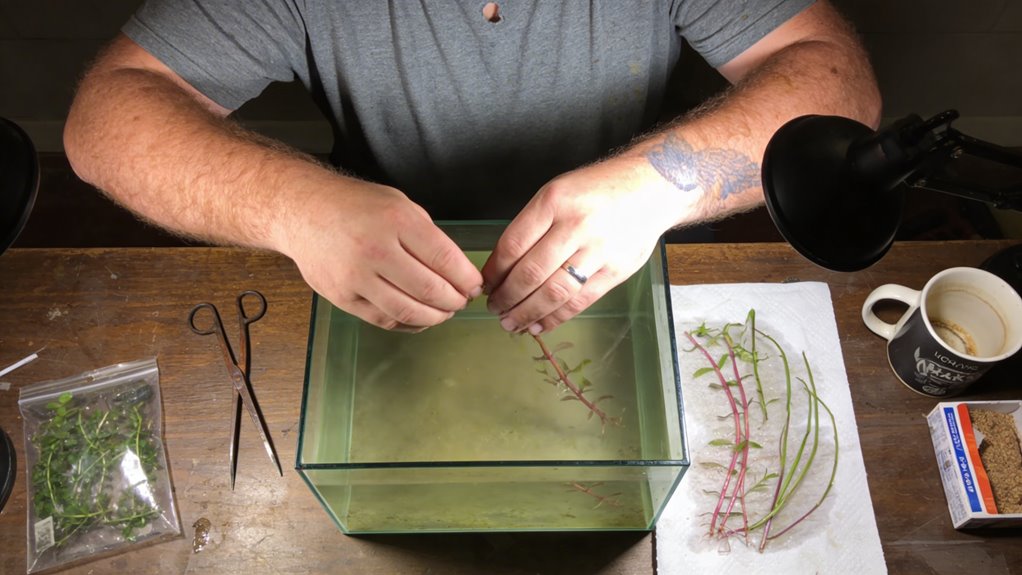
Long tweezers, those slender metal tools sold in most pet stores, make the first and simplest difference when handling Rotala Indica, as fingers, even careful ones, tend to pinch and snap stems that bend like dry spaghetti.
The stem fragility demands patience, like threading a needle.
For stem propagation, one cuts one inch above a node, strips the lower leaves—those soft, almost fuzzy disks—and buries the bare stem at a slight angle, never straight down.
The leaf texture, delicate and thin, bruises easily, so touch gently.
In aquascape design, this careful placement builds the dense green walls beginners dream of growing.
What Rotala Indica Looks Like Under Different Light
Once the stems stand planted and secure, the water above them becomes a canvas painted by bulbs and tubes.
Under low light, the leaves stay deep green, wide and welcoming, like open palms offering rest. The plant grows slowly, compact, seeking closeness rather than height.
Moderate light brings gentle change, stems stretching taller, leaves narrowing slightly, a quiet anticipation building.
Under bright light, pigment variation emerges as a response to shade light stress. The tips blush pink, then deepen to ruby, a signal that the plant is working hard, protecting itself as reaching higher.
Water Parameters for Healthy Rotala Indica
A thermometer dips into the water, revealing numbers that guide the grower’s hand.
- Soft light filters through, turning leaves from pale green to whispered pink, a signal the plant feels at home.
- Roots thread through invisible chemistry, trading waste for nourishment in quiet nutrient cycling.
- Watchful eyes spot trouble early, knowing p pest control begins with balance, not force.
The keeper maintains 72-82°F, pH 6.0-7.5, hardness 3-8 KH. These boundaries create safety. Regular testing builds trust between grower and plant. When conditions hold steady, Rotala Indica responds with growth, offering the caretaker a sense of place, of being needed, of belonging to something living.
Best Substrate and Tank Size for Rotala Indica
The grains settle first, before any green thing takes hold, forming the quiet foundation that roots will later trust.
For Rotala Indica, the substrate texture matters more than one might suppose. Fine sand or plant-specific soil, at least two inches deep, allows delicate roots to anchor without struggle. The surface should feel soft between imagined fingers, not sharp or loose like gravel that shifts with every current.
Tank volume shapes possibility. Ten gallons serves as minimum, though larger vessels—twenty gallons, forty—invite fuller expression. In spacious water, stems reach upward unhurried, finding their natural height, and the aquarist belongs to something growing.
Lighting Tips: Green Growth vs. Red Coloration
Roots hold their own quiet victory beneath the water, yet leaves answer to something higher.
Light intensity shapes what the eye receives: low beams, around 20-30 micromoles, feed modest green growth, leaves broad and sensible, content with simple existence. Brighter doses, 50-80 micromoles or more, trigger pigment response, anthocyanins blooming like quiet applause across each leaf, shifting emerald toward rose, coral, flame.
Light alone decides: dim green patience, bright red applause.
The choice belongs to the keeper, not the plant.
Consider:
- Dim corners where green leaves rest like folded hands, patient and calm
- Bright surfaces where red tips catch morning light, alert and burning
- The middle path, where both colors live as neighbors, speaking in turn
Does Rotala Indica Need CO₂ and Fertilizers?
Bubbles rise from a ceramic disk at the tank’s edge, each one a small question about what living things truly need.
Rotala indica survives without injected CO₂, though growth slows. CO₂ alternatives, such as liquid carbon supplements added twice weekly, bridge the gap between austerity and abundance. The plant grows fertilizer free in nutrient-rich substrates, drawing nitrogen from fish waste and detritus. Yet spare, pale leaves signal hunger: a whisper of iron deficiency, a yellow edge asking for care. Belonging in this aquatic community means recognizing limits, then choosing where to set them. Patience rewards the observant keeper.
How to Propagate and Trim Rotala Indica
Green stems lean against the glass, waiting. Propagation begins with sharp scissors, cutting one inch above a node where new leaves meet the stem. The trimmed piece becomes a fresh start.
- A clean cut releases milky sap, evidence of life still flowing.
- Fingers strip lower leaves, exposing bare stem to bury like a secret.
- Roots emerge within days, white threads grasping substrate for belonging.
Regular trimming maintains aquarium aesthetics, preventing the dense wall from becoming chaos. This practice doubles as nut pest control, removing decay before it invites unwanted guests. Each cutting extends the colony, offering gardeners membership in an endless cycle of growth.
Rotala Indica Trimming Schedule: How Often to Cut
A single pair of scissors rests on the tank’s rim, waiting for its weekly duty.
Pruning frequency depends on lighting schedule and nutrient cycles. Under moderate light, trimming every seven to ten days keeps nut growth dense and compact. High light demands twice-weekly cuts. Watch the stems: when they reach the surface, it is time. Cut one inch above any node, then replant the top. This rhythm, steady as a heartbeat, honors how the plant feeds and rests. The aquarist who learns this pattern belongs among those who understand that care is simply showing up, again and again.
Why Is My Rotala Indica Melting? Quick Fixes
The scissors have done their work, yet now pale strands drift downward like tired ribbons, and the aquarist feels the small, hollow worry of watching something soften into ruin.
Melting—the plant’s cells collapsing like wet paper—strikes when conditions falter.
Temperature shock, that jolt of water too cold or too sudden, freezes the plant’s chemistry; keep change within two degrees daily, never below 72°F or above 82°F.
Nutrient deficiency starves the stems from within; test weekly, dose iron and nitrogen when leaves yellow at their edges.
- White roots, thin as thread, loosening their grip on dark grains
- Leaves turning transparent, like windows showing nothing behind
- Stems bending, soft as overcooked noodles, no longer reaching upward
Trim melting portions immediately, move gently, feed patiently.
Keeping Rotala Indica Safe From Aggressive Fish
Place your hand flat against the glass, and watch how the leaves shiver when a bold fish passes too close. Fragile stems bruise easily, and uprooted plants cloud the water with debris.
Fish selection control means choosing companions who drift rather than chase. Fancy goldfish glide peacefully; cichlids fracture stems with their mouths. The aquarist must observe, then decide who belongs.
Choose fish who drift, not chase. Observation decides who belongs.
Torn leaves release nutrients that feed algae, so protection doubles as algae control. Dense planting helps, too—safe havens for the shy, and less open water where filaments spread.
Peace in the tank means peace for the plant.
Weekly Rotala Indica Maintenance Checklist
How does one tend something that grows faster than memory can track?
- Test water parameters—nitrogen, pH, hardness—like checking a friend’s temperature, gentle and regular.
- Adjust lighting, trim with pruning shears where stems grow thin, where color fades to pale longing.
- Press new cuttings into substrate, feeling soil naming each root’s home, adding CO₂ like breath shared between neighbors.
This checklist binds keeper to tank, light to leaf, growth to patience. Maintenance becomes ritual, not burden. The plant responds, and one belongs to something living.
Frequently Asked Questions
Can Rotala Indica Grow Emersed Above Water?
Yes, Rotala indica grows emersed above water. Its em-water growth allows stems to climb toward light while roots remain submerged. This aerial adaptation lets it thrive in rice paddies and riverbanks, forming dense clumps on land. Leaves become rounder and more concave when exposed to air. The plant shifts easily between worlds, much like people who feel at home in multiple places, belonging wherever they root.
Is Rotala Indica Safe for Shrimp Breeding Tanks?
Yes, Rotala indica is safe for shrimp breeding tanks.
The plant offers excellent shrimp compatibility, providing dense hiding spots for vulnerable juveniles. Water parameters suit both species: temperatures of 72-82°F, pH 6.0-7.5, and soft to moderate hardness match shrimp needs precisely. Delicate leaves harbor biofilm, a primary food source. Shrimp graze peacefully among stems without damage. No toxins release into the water. Regular trimming maintains open swimming paths, preventing stress. Stable conditions nurture both plant and colony growth.
How Fast Does Rotala Indica Grow per Week?
Rotala indica exhibits moderate to fast growth, typically extending one to two inches weekly under ideal conditions.
This pace depends heavily upon light intensity, carbon dioxide availability, and nutrient demand—the plant’s hunger for nitrogen, phosphorus, and iron. With bright illumination and rich fertilizer, stems race upward quickly. In dimmer tanks, growth slows to a patient crawl, perhaps half an inch, teaching aquarists that abundance speeds life’s momentum while scarcity invites stillness.
Will Rotala Indica Carpet if Left Untrimmed?
No, Rotala Indica will not carpet if left untrimmed.
This stem plant grows straight upward, reaching twelve to twenty-four inches, forming dense vertical thickets rather than spreading horizontally across the substrate. Without regular pruning, individual stems compete fiercely for light and nutrients—a struggle botanists call nutal competition. This unchecked upward growth depletes the nutrient balance throughout the water column, favoring tallest shoots while shading lower leaves to yellow and decay. The result resembles an untended orchard, not a living rug. Carpeting demands horizontal growth habits found in plants like Monte Carlo or Dwarf Baby Tears. Resembling community members who each need their own space, Rotala Indica thrives through mutual respect of boundaries, not entanglement. Trimming every seven to fourteen days maintains collective harmony and shared resource distribution.
Can Rotala Indica Survive in Outdoor Ponds?
A small glass thermometer floats in outdoor water, reading 72‑82°F. Rotala indica can survive in ponds within this range, though pondala maintenance grows more demanding in open air. Sunlight shifts unpredictably, so aquatic biodiversity benefits from shade cloth to prevent overheating, much like a child needs a hat at noon. Hardy companions—guppies, shrimp—share the space, creating gentle community. Expect slower growth than in tanks; patience rewards the keeper.
Rounding Up
A small cluster of rotala indica, standing firm at the tank’s corner, reminds growers that patience yields color. Light, water, and steady hands build the plant’s strength, just as careful practice builds any skill. Check parameters weekly, trim with purpose, and trust the slow work of roots. The reward is patience made visible, green turning ruby, quiet proof that attention matters.