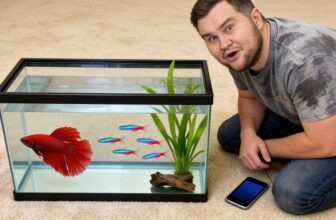
For a 10-gallon, you’ve got some solid but picky options. Bumblebee gobies (under 1 inch) need live bloodworms and 1.002-1.006 salinity—slow acclimation is the boring key.
Orange chromides (3 inches) work, but they get territorial when breeding. Guppies handle 1.003-1.010, need a 4-gallon minimum, and breed like you won’t believe—just quarantine them first.
Mollies need 20 gallons and 1.005-1.020, so skip them here. Figure-8 puffers (15-gallon solo) are snail-murdering machines, but require 1.005 salinity and crunchy food for their teeth.
Stay patient, and you’ll actually enjoy these quirky fish. Keep going to match them to the right tank size.
At A Glance
- Bumblebee gobies are excellent nano brackish fish needing 10 gallons and live foods.
- Mollies and guppies are hardy beginner choices thriving in community brackish tanks.
- Figure-8 puffers are engaging solo fish for 15-gallon tanks with crunchy diets.
- Orange chromides stay small and peaceful, suitable for 10-gallon setups.
- Scats and monos require large 100+ gallon tanks and open swimming space.
Which Brackish Fish Are Right for Your Tank Size?
If you’re diving into brackish fish, tank size basically decides what you can keep before anything else.
A 10-gallon lets you host bumblebee gobies or a trio of guppies, but you’re cramped for anything bigger.
Want mollies? You’ll need 20–30 gallons minimum—they’re messy eaters, so strong filtration’s non-negotiable.
For schooling species like scat fish, think 120 gallons or more; they’re active swimmers that need open space.
Your tank’s volume isn’t just a number—it’s the fish’s whole world.
Underestimate it, and you’re setting yourself up for stress.
Match size to species, and you’ll fit right in with the brackish crew.
Whether choosing large schooling fish or small gobies, remember that shared smiles require no translation among fellow brackish enthusiasts.
Bumblebee Goby and Other Live-Food Specialists for Small Tanks
Since bumblebee gobies are picky eaters that refuse flake food, you’ll need to commit to live or frozen meals like bloodworms and brine shrimp.
Since bumblebee gobies are picky eaters that refuse flake food, commit to live or frozen meals like bloodworms and brine shrimp.
That’s your new normal, and honestly, it’s part of the charm.
You’re not just keeping fish; you’re running a tiny seafood diner.
- Stick to a 10-gallon tank—perfect for a small group.
- They stay under an inch, so don’t blink or you’ll miss them.
- Keep salinity around 1.002–1.006, steady as she goes.
- Acclimate them gradually over 7-10 days to avoid stress from sudden salinity shifts.
These little guys reward your effort with bold stripes and big personality.
You’re in on a secret: picky eaters build better keepers.
Welcome to the club.
Guppies and Endlers: Hardy Beginners for Low-Salinity Setups
Guppies and Endlers are the gold standard for anyone dipping a toe into brackish water—literally and figuratively. You’ll find them forgiving when your salinity fluctuates, which it will. Endlers tolerate SG up to 1.022; guppies thrive at 1.003–1.010. Both need groups of three or more, and they’re low‑bioload champs perfect for nano tanks.
- Guppies: 4‑gallon minimum, survive 50–84°F
- Endlers: 10‑gallon minimum, neon colors, active
You won’t mess this up. They breed like rabbits, so expect fry. Stick to commercial marine salt. You’ve got this—and you’re in good company.
You should also quarantine new fish for two weeks to prevent introducing disease to your tank.
Mollies: Social Tank Mates for Brackish Communities
Bottom line: If you want a friendly, active community member that fits right in, mollies deliver without drama. A school of five or more Black Skirt Tetras thrives in similar conditions, provided the tank maintains soft, stable water and gentle flow.
Orange and Green Chromides: Cichlids That Love Brackish Water
Even though you’ve got mollies being the friendly neighborhood fish, chromides are more like that interesting couple down the street—a little territorial but full of personality.
You’ll want the Orange Chromide for smaller tanks, while the Green needs serious space.
- Orange Chromide (Etroplus maculatus): Stays around 3 inches, perfect for a 10-gallon. SG 1.002-1.010, peaceful unless breeding—then they get bossy.
- Green Chromide (Etroplus suratensis): Hits 12 inches, needs 100 gallons minimum. SG 1.005-1.012, schools together, turns territorial when pairing up.
- Both thrive in groups but watch for spawning aggression—they’re like that couple who redecorates every weekend, intense but rewarding.
To maintain health, ensure water conditions are stable with regular testing and slow adjustments to temperature and pH levels.
Large Schoolers: Catfish, Scat, and Mono for 100+ Gallon Tanks
If you’re scaling up to a 100‑gallon tank or beyond, you’re ready for the big leagues—schooling fish that need serious swim room and turn your tank into a moving wall of silver.
You want Mono, Scat, and Colombian Shark Cats. These guys are the team you’ve been waiting for.
Mono needs SG 1.002‑1.007 and groups of six or more.
Scat needs SG 1.020‑1.025—higher salinity—and lots of open space.
Both hit 10‑11 inches.
Colombian Shark Cats? They need 250 gallons minimum, SG around 1.010, and they’ll top 14 inches.
You’re building a community; they’ll fill it with synchronized motion. Just don’t crowd them. Note that red eye tetras can leap out of tanks, so tight-fitting glass lids prevent escapes without restricting airflow.
Paludarium Setups for Mudskippers and Archerfish
When you’re ready to build a tank that’s half water, half land, and all attitude, you’re looking at a paludarium—a setup that mixes shallow water with exposed mudflats or perches for fish that treat air like it’s no big deal. Mudskippers and archerfish thrive here, and you’ll feel like part of an exclusive club—one that gets how cool a fish that walks or shoots is.
- Mudskippers need shallow water with sandy banks to haul out on; they’re territorial, so give each one its own prime real estate.
- Archerfish require tall paludariums with above-water plants or sticks to blast insects from—aim for 110 gallons minimum.
- Use marine salt to hit SG 1.002–1.015; you’ll test weekly with a refractometer—no shortcuts if you want them to thrive.
For reliable water circulation and filtration in these brackish setups, a quiet water pump rated below 30 dB ensures the fish remain undisturbed during nighttime hours.
Green Spotted and Figure 8 Puffers in Brackish Tanks
Don’t let their pouty faces fool you—brackish puffers are basically tiny underwater bulldogs with dental issues. You’ll need hard-shelled snails or crustaceans weekly to keep their ever-growing beaks ground down.
Green Spotted Puffers hit 6 inches and need a 30-gallon tank minimum, with SG 1.005–1.020.
Figure 8s stay half that size, content in 15 gallons for one, but they’re fin-nippers, so keep ‘em alone.
Both are carnivorous, semi-aggressive, and absolutely worth the attitude—they’ll recognize you, begging like a puppy with gills. You’re in the club now. Also, such puffers benefit from the same tight‑fitting lid that prevents jumping in community setups.
Stars and Stripes Puffer: Gentle Giant, Big Tank
Although the Green Spotted Puffer is a pugnacious little bruiser, the Stars and Stripes Puffer (*Arothron hispidus*) is more like that one gentle giant who’s terrifyingly big but just wants a hug—and a snail to crunch.
You’ll need a massive 200‑gallon tank for this 18‑inch behemoth. It’s surprisingly calm, even sharing space with fast‑swimming tankmates, but its heavy waste demands serious filtration.
- Diet: Crunchy snails and crustaceans keep its beak worn down—no crunch, no lunch.
- Salinity: Keep it at SG 1.020‑1.025, nearly full marine.
- Tankmates: Stick with large, speedy species; avoid anything small or slow.
You belong to the elite club keeping this gentle giant. For such a large system, consider an auto top‑off system with triple safety protection to maintain stable water levels and prevent pump damage.
Siamese Tiger Fish: Semi-Aggressive Brackish Predator
Why would you want a fish that looks at you like you’re lunch? Since you’re ready for a true predator, that’s why. The Siamese Tiger Fish (*Datnioides pulcher*) isn’t a community pet; it’s a statement. You’ll need a 100-gallon tank minimum and strong filtration—this fish loves clean water and hates shy tankmates. For long-term health, it is vital to avoid temperature extremes and maintain stable parameters to prevent stress and disease.
| Requirement | Specs |
|---|---|
| Salinity | SG 1.002–1.007 |
| Adult Size | 9–12 in (23–30.5 cm) |
| Temperament | Semi-aggressive, predatory |
Feed it high-protein live or frozen foods, and keep it with fish too big to swallow. You’re not just keeping a fish; you’re keeping a hunter. Join the club.
Brackish Crustaceans and Snails That Help Clean
Four clean‑up crew members that won’t judge your messy tank—just eat it. You’re not lazy; you’re efficient. These invertebrates handle algae, detritus, and leftover food without complaint.
- Olive Nerite Snail (Neritina reclivata) – SG 1.004–1.007, min 5 gal. A tiny, hardworking algae eater under 1 inch. Can’t breed in fresh water, so no population explosions. Around $4.
- Zebra Nerite Snail – Same specs, but with striking black‑and‑gold stripes that pop against green algae. Both species clean glass and decor tirelessly, never nibbling plants.
- Lava Snail (Faunus ater) – SG 1.002–1.025, min 10 gal. A 2‑3.5 inch bottom feeder that plows through mulm. Won’t reproduce unless your tank’s brackish enough.
- Magnetic Aquarium Lid Fish Tank Anti‑Jump Cover – This net uses cut‑to‑size adjustability to protect jump‑prone fish in odd‑shaped tanks.
Your clean‑up squad, ready to work for algae snacks.
Kribensis: A Dwarf Cichlid for Slightly Brackish Blackwater
Kribensis is the dwarf cichlid that proves you don’t need full saltwater to get that big‑personality fish vibe, but it’s similarly a bit of a niche player—most keepers don’t realize how little salt it actually wants.
We’re talking SG under 0.0002—barely a whisper of salinity.
You’ll need a 20‑gallon minimum, some caves, and soft, acidic blackwater.
They’re territorial but manageable, topping out at four inches.
Feed them flake and frozen foods.
- Requires minimal salt—perfect for a conversion tank
- Blackwater setup is a must
Bottom line: you get the cichlid attitude without the marine hassle. It’s your secret entry into brackish belonging.
For soft-water setups, Seachem Acid Buffer can help lower pH quickly by converting excess hardness to CO₂.
Keep Brackish Fish Healthy With Stable Salinity
Although you can get away with a lot in a freshwater tank, brackish setups demand a certain respect for the salt—mostly since your fish will let you know if you mess it up. Messing with salinity is like poking a bear; you’ll regret it. Here’s how you stay in your fish’s good graces:
- Invest in a refractometer — it’s the only accurate way to measure specific gravity (SG). Hydrometers are cheap and unreliable, don’t risk it.
- Adjust salinity slowly — never change SG more than 0.002 per day. Fast shifts stress gills, and stressed fish get sick fast.
- Top off with freshwater — salt doesn’t evaporate, only water does. Topping with saltwater spikes salinity, so stick with RO or dechlorinated tap.
A digital thermometer with a ±0.1 °C precision helps you monitor temperature alongside salinity for sensitive brackish species.
Keep it steady, and your brackish friends will thrive.
Match Filtration to Your Brackish Fish’s Waste Load
Since your fish are basically little poop factories, you need a filtration system that keeps up with their output without turning your living room into a swamp.
Mollies, puffers, and schooling species dump heavy waste—aim for a canister filter rated at least 4–5x your tank’s volume per hour.
For small tanks with guppies or gobies, a simple HOB (hang-on-back) works fine.
Mudskippers? Go big with a sump.
You’re not just filtering water; you’re building a home that won’t crash.
Match hardware to bioload, and you’ll join the club of individuals with crystal-clear brackish setups.
A reliable stand with 1,100 lb capacity ensures your heavy filtration and full tank remain secure.
Best Brackish Fish for Beginners: Top Picks
If you’re dipping your toes into brackish water for the first time, you’ll want fish that forgive rookie mistakes—like that time you forgot to top off evaporation and your salinity went on a rollercoaster. Use 8‑in‑1 Water Test Kits to monitor ammonia and pH spikes that can harm beginner fish.
These three picks are basically the ****“starter pack” of the brackish world, letting you feel like a pro without the stress.
- Guppies – Hardy, cheap, and breed like crazy at SG 1.003–1.010. A 4‑gallon tank’s all you need for three, and they’ll still forgive a few salinity swings.
- Mollies – Social and adaptable at SG 1.005–1.020. Just give ’em a 20‑gallon tank and strong filtration—they’re messy but loyal.
- Figure 8 Puffer – Under 3 inches, needs only 15 gallons solo at SG 1.005. He’ll keep your snail population in check with that beak—just feed him crunchy stuff.
Pick these, and you’re part of the brackish club.
Frequently Asked Questions
Can I Breed Brackish Fish in Freshwater?
You can, but it’s a risky gamble. Most brackish species won’t breed in freshwater—they need that specific salinity to trigger spawning. Guppies and mollies are the exception, since they’re adaptable livebearers.
For truly brackish fish like bumblebee gobies or scats, fresh water won’t work; eggs won’t hatch, or fry won’t survive. Stick to their natural SG range if you want baby fish. Otherwise, you’re just keeping them alive, not breeding them.
Bottom line: For reliable breeding, match the salt level.
What Plants Are Safe for Brackish Aquariums?
You’ve got limited options here—brackish water is tough on most plants. Stick with Java fern, anubias, or mangrove propagules; they handle low to moderate salinity (SG 1.002–1.010) without melting.
Vallisneria and hornwort can work too, but expect slower growth. Avoid java fern? Actually, it’s fine—just not with scat fish, which nibble it.
Use commercial marine salt, not table salt, and test salinity weekly.
Your best bet: anubias tied to driftwood. It’s forgiving, looks great, and won’t die on you.
How Do I Cycle a Brackish Tank?
You cycle a brackish tank just like a freshwater one, but with salt added.
First, set up your tank with sand, rocks, and a filter. Add dechlorinated water mixed to your target salinity—say SG 1.005 for mollies. Dose with pure ammonia to 2-4 ppm, then wait.
Beneficial bacteria will convert it to nitrite, then nitrate. Test every few days; it’ll take 4-8 weeks.
Don’t rush it—this isn’t a race you’ll win without patience.
Can I Mix Different Species of Puffers Together?
You can, but you really shouldn’t mix different puffer species. They’re territorial, fin-nipping jerks.
The Figure 8 (needs 15 gal, 3 inches) or Green Spotted (needs 30 gal, 6 inches) will bully each other, or you’ll house a massive Stars & Stripes (needs 200 gal, 16-18 inches) with a tiny one—disaster.
They also need different salinity levels, from SG 1.005 to 1.025.
Keep puffers alone or with fast, large tankmates, not their own kind.
Bottom line: stick to one puffer species per tank.
What Happens if Salinity Drops Suddenly?
If salinity drops suddenly, your fish will go into shock. Their bodies can’t regulate salt fast enough, causing stress, bloating, and possible death.
Guppies handle it better than mollies or puffers—those guys are sensitive. You’ll see rapid gill movement, erratic swimming, or lethargy.
Keep your specific gravity (SG) stable with a refractometer; swings are the enemy. It’s not a panic move you want to make—slow changes are your only safe path.
Rounding Up
So, here’s the deal: brackish fish aren’t for the lazy. You’ll chase salinity (that’s salt level), not just dump flakes in a tank. But you’ll get weirdos like archerfish that shoot you if you stare too long.
Start with mollies—they’re bulletproof, cheap ($5 each), and breed like rabbits. Or a single green spotted puffer ($15) if you want a psycho with teeth.
Skip the mudskipper except you’re okay with a paludarium (half land, half water). Pick your weirdo, salt the water right, and you’re golden.