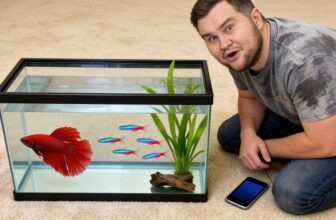
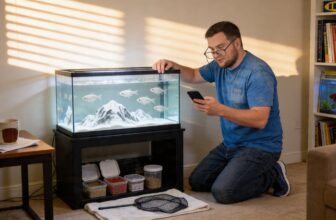
So you’ve got a pregnant guppy—she’ll drop 10 to 400 fry every month for years, no joke.
You need a bulletproof 10‑gallon tank with a sponge filter, heater at 80°F, and dense java moss for hiding.
Zero ammonia, 50% water changes twice weekly, and powdered fry food right after birth.
Wait six to eight weeks before moving them—mouth size matters.
Stick around for the full setup guide.
At A Glance
- Female guppies can produce 10–400 fry monthly for 2–3 years.
- Use a minimum 10‑gallon tank with sponge filter and dense live plants.
- Maintain zero ammonia and nitrite, 80°F, and perform 50% water changes twice weekly.
- Move fry to main tank only after reaching 1 inch (6–8 weeks).
- Compatible tank mates include cherry shrimp, pygmy corydoras, and nerite snails.
Why Guppy Fry Are Called the “Millions Fish
They aren’t called the “Millions Fish” for nothing.
One female gives birth monthly for 2–3 years, dropping 10–400 fry per batch.
One female pumps out 10 to 400 fry every month for two to three years.
That’s up to 14,400 babies from a single mom.
You’re not just keeping guppies; you’re running a tiny fish factory.
Your 10‑gallon tank fills fast.
That’s why you join the club—we all scramble for extra tanks.
The name isn’t hype; it’s math.
So when your female pops, don’t panic.
You’re part of the millions now.
Welcome to the chaos.
If you suddenly have too many babies, a 10‑gallon tank for guppies works well but you must avoid overstocking and maintain stable water quality.
How to Set Up a Breeding Tank for Guppy Fry
Since you’re already running a tiny fish factory, you might as well build it a proper nursery.
Grab a 10‑gallon tank—anything smaller is a death sentence for growth. Add a heater, set it to 80°F, and toss in an air stone for oxygen. Skip fancy filtration; a gentle sponge filter works best.
Now, the secret sauce: dense plants. Stuff it with java moss, hornwort, and guppy grass. These aren’t just decorations—they’re hideouts that save fry from mom’s appetite and boost survival. No bare tanks, period.
For maximum root uptake and steady growth, bury slow‑release root tabs beneath the plants.
Bottom line: spare ten bucks on plants and watch your fry thrive. You’re building a safe, cozy home, not a lab.
Maintain Ideal Water Parameters for Guppy Fry
While you might think clean water is obvious, keeping it truly fry‑safe is where most beginners accidentally pull a Houdini on their guppy babies. You’re aiming for zero ammonia and nitrite—plain and simple. A drop of waste, and you’ve got dead fry. You’re part of the crew that gets this right.
- Keep temperature at 80 °F (26 °C)—any lower, and their metabolism slows like an old dial‑up modem.
- Maintain pH around 7.2—stable as a good chair, not a wild rollercoaster.
- Use a sponge filter—gentle flow, no sucked‑up babies, and bacteria heaven.
- Change 50% water twice weekly—think of it as their weekly bath.
- Test with a liquid kit, not strips—those strips lie like a fisherman’s tale.
Bottom line: stable water equals healthy, fast‑growing fry. Nail this, and you’re golden.
Use a DaToo Large LCD Floating Thermometer for accurate, instant temperature readings to keep the water precisely at 80 °F.
4 Signs Your Pregnant Guppy Will Give Birth to Fry
Now that you’ve got the water dialed in like a pro, it’s time to spot the big event—your guppy dropping fry.
You’ll see her boxy, squared-off belly, looking like she swallowed a marble.
Her gravid spot darkens near the anal fin, turning almost black.
Her gravid spot darkens near the anal fin, turning almost black as birthing nears.
She’ll hide near plants or the heater, avoiding tank mates.
Finally, she shivers or shimmies, restless and breathing fast.
That’s your cue—fry are coming within hours.
Don’t stress; you’ve got this.
Watch those signs, and you’ll catch the action like the rest of us guppy geeks.
Female guppies store sperm from a single mating, enabling multiple litters without a male present.
What to Do Immediately After Guppy Fry Are Born
As soon as you spot that first tiny fry uncoil and start swimming—usually within a couple hours of birth—your job shifts from spectator to survival coordinator.
You’ll need to act quickly, but don’t worry—we’re all in this together, and you’re now part of the fry‑raising crew.
- Test water for zero ammonia and nitrite—a cheap kit keeps them all safe.
- Crumble a pinch of powdered fry food into dust; their mouths are tiny.
- Add dense guppy grass or java moss so they can hide when spooked.
- Do a gentle 50% water change with aged, temperature‑matched water to cut down toxins.
- Dim lights for a few hours—bright glare stresses newborns, but they adapt.
A clear mesh lid can be trimmed to size and installed to prevent fry from jumping out while maintaining light and airflow.
Why You Must Separate Mother Guppy From Her Fry
You might think a mother guppy certainly wouldn’t eat her own babies—nope, she absolutely will, no hard feelings, just pure instinct.
She’s not a monster; she’s a fish, and those tiny fry look like snacks.
You’ve got to separate her immediately after birth, whether into a breeding box or a separate tank.
A simple floating nursery (like the Marina Breeder Box, $8) works wonders.
Don’t give her the chance.
Maintaining a calm environment reduces jump triggers for adult tetras, though guppy fry also benefit from low stress.
You’re part of the inner circle of guppy keepers who know better—you protect the babies, not the bond.
That’s the rule.
Feeding Baby Guppies: Best Foods and How Often
The first meal you offer newborn guppy fry will likely be the most important one they ever eat—their mouth is just 0.6 mm wide, and their digestive system works in about thirty minutes, so they’re basically tiny, hungry machines cruising for food.
When you feed them five to ten times daily, you’re setting the table for rapid growth.
You’ll belong to the “super-feeder” club if you stick to these top choices:
- Hikari First Bites – powder so fine it’s practically dust; they swallow it instantly.
- Crushed high-protein flakes – rub them between fingers; your fry will inhale the particles.
- Micro worms – wiggly, protein-packed; they’re like a wriggling McDonald’s for your fry.
- Vinegar eels – sour but irresistible; your babies chase them like tiny sharks.
- Baby brine shrimp nauplii – gold standard; costs about $8 per hatch kit.
Feed small pinches, and watch them fatten.
That’s your new ritual, friend.
For securing live foods or decorations in the tank, you can use a reef-safe epoxy putty that cures underwater without harming your fry.
Speed up Guppy Fry Growth With Live Foods
Want to turbocharge your guppy fry growth without spending a fortune on fancy gear? Live foods are your shortcut.
Baby brine shrimp, microworms, and vinegar eels pack more protein than flakes, fueling rapid size gains. Your fry’ll hit sexual maturity faster, usually within 3 months instead of 5, no exaggeration.
Culture your own—it’s dirt cheap. A starter microworm culture costs like $5 and lasts forever. Feed them 5 times daily, and watch those tiny bellies swell.
It’s the secret the pros won’t admit: live foods aren’t optional; they’re indispensable. Join the club, your fry’ll thank you.
Consistent CO₂ dosing with a dual‑stage regulator provides planted tanks the stable environment that accelerates plant growth, creating more grazing surfaces for fry.
Set Up Lighting and Aeration for Guppy Fry Tanks
Set lighting to 12–16 hours a day with an automatic timer—guppy fry really dig consistent day‑night cycles, and you get to stop flipping a switch like a caveman. You’re building a stable little world, and fish that feel safe grow faster.
- Use a low‑watt LED strip, around $15, so you don’t fry your fry with heat.
- Place a small sponge filter—gentle bubbles, no sucking up babies.
- Add an air stone for diffused aeration, not jet‑engine turbulence.
- Point filter outflow at the glass, not the fry—they’re not pro swimmers.
- Keep a dim corner with floating plants; fry need shady hideouts.
Bottom line: simple, cheap equipment gives you calm, fast‑growing fry that act like they own the tank. A quiet HOB filter under 40dB can gently circulate water without stressing the fry.
Prevent Common Health Problems in Guppy Fry
Now, with that cozy, well‑lit nursery set up, let’s talk about keeping your fry from dying on you—because nothing kills the vibe like a tank full of sick babies.
Now that your fry nursery is set up, let’s keep those babies from dying on you.
You’re part of the careful-guardian club now, so focus on water quality. Fry have zero immune system, so ammonia or nitrite spikes = fin rot, fungal infections, or dropsy.
Test weekly; keep ammonia at 0 ppm. Stable temps around 80°F prevent ich.
Don’t medicate—it’s impractical for tiny fry. Instead, quarantine any pale or clamped-fin babies immediately.
Clean water beats any cure. For accurate results, use a dip‑strip format that includes iron detection to monitor trace elements. Stick to that, and you’ll raise a tough, thriving crew.
How Often to Change Water for Guppy Fry (and Why)
Since guppy fry digest food in about thirty minutes and spend most of their day cruising for a meal, they eat constantly—and all that eating creates a ton of waste. You’re changing 50% of their water twice a week, no excuses. Ammonia spikes kill fry fast. Don’t risk it.
- You see cloudy water by day two? That’s bacterial bloom, screaming “change me.”
- Fry hovering near the bottom listlessly? Dirty water’s stealing their oxygen.
- You spot tiny white fuzz on a fry? Too much leftover food, not enough clean water.
- The water smells a little funky? That’s ammonia, and it’s already burning their gills.
- You feel proud your tank seems clear? Surprise—nitrates are still building up silently.
You’re part of the crew that doesn’t let fry swim in their own mess. Stick to the schedule. Consistent water changes maintain proper filtration, which supports digestion and healthy appetite.
When Can You Move Guppy Fry to the Main Aquarium?
Before you start dreaming of a full community tank reunion, hold up—those fry need to be big enough not to become a live snack.
Wait until they’re at least 1 inch long, usually around 6–8 weeks old.
At that size, an adult guppy’s mouth can’t swallow them.
Test your main tank’s water first; fry can’t handle parameter swings like adults do.
If your ammonia or nitrite reads anything above zero, don’t move them.
You’re protecting your hard work here, and patience pays off.
Once they’re big and your water’s stable, introduce them slowly.
Slow acclimation of new fish preserves water stability and reduces stress.
You’ve got this.
Best Tank Mates for Growing Guppy Fry
Why risk your fry’s growth by tossing in just any tank mate? You’re building a community, not a buffet. Pick peaceful, fry‑safe buddies that won’t nip or compete for food.
These fish share your water parameters—72‑82°F, pH 6.5‑8.0—and stay small enough to leave your guppies alone.
- Cherry shrimp – red janitors that graze leftover food, never harass fry, and cost around $4 each.
- Pygmy corydoras – tiny bottom‑dwellers, 1‑inch max, that sift sand and ignore mid‑water fry.
- Nerite snails – shell‑packed algae eaters, $3 each, harmless mouthparts.
- Otocinclus – sucker‑mouthed cleaners, 1.5‑inch adults, stick to glass or plants.
- Stiphodon gobies – dwarf algae scrubbers, 2‑inch max, peaceful bottom hiders.
Stick with these, and you’re part of the “smart fry parent” club. For growing fry, a 10-Piece Plastic Aquarium Grid can serve as a safe divider to protect them from larger tank mates.
When Do Guppy Fry Reach Breeding Age?
Guppy fry reach breeding age at 3–5 months old, males maturing faster than females. You’ll spot a male’s gonopodium—that long, narrow anal fin—around week 6. Females develop a dark gravid spot near their rear, signaling they’re ready. For a natural and low-maintenance nursery setup, you can use small-tank driftwood to provide safe hiding spots for fry. Don’t let them breed too early. Separate sexes by month 2 if you’re not planning a fry explosion.
Guppy fry reach breeding age at 3–5 months, with males maturing faster than females.
It’s a waiting game, but you’re part of the club now—timing it right means healthier, happier guppies.
Frequently Asked Questions
Can Pregnant Guppies Store Sperm From Multiple Mates?
Yes, pregnant guppies can store sperm from multiple mates.
That’s right—after one mating session, a female holds onto that sperm for up to four months, fertilizing batches of fry without another male.
It’s a survival trick; she doesn’t need constant male attention.
So if you see her giving birth weeks after isolation, don’t be surprised.
Blame her hidden stash, not bad timing.
It makes breeding unpredictable but efficient—your tank could get a mixed batch from one lady.
How Can You Tell Male Fry Apart From Female Fry Early?
You can’t reliably tell male from female fry until they’re about 3–4 weeks old. Before that, they all look identical—tiny, grey, and hungry.
At around 4 weeks, you’ll see males developing a gonopodium, that skinny, rod-like anal fin, while females keep a fan-shaped one.
Males also grow more colorful faster, a trait you won’t miss.
Patience pays off; rushing this just leaves you guessing.
Do Guppy Fry Need a Separate Tank if Born in a Community?
Yes, you absolutely do.
Guppy fry need a separate tank if born in a community tank, or Mom will snack on them—she sees babies, not buffet.
No filter can save them from her hunger.
A simple 10‑gallon setup, $20 for a bare tank, gives them hiding spots and zero predators.
Use a breeding box if you’re cheap, but separate’s safer.
Bottom line: fry need isolation to survive.
What Causes Sudden Death in Seemingly Healthy Guppy Fry?
Sudden death in healthy-looking guppy fry usually hits from three sneaky causes: unstable water parameters—ammonia spikes or pH swings stress their fragile immune systems.
You’re not overfeeding? Leftover food rots fast, fouling the tank.
Temperature drops below 72°F shock them, too.
The cruelest? A hidden disease like columnaris, showing no signs until it’s too late.
Keep those 50% water changes strict, temp steady at 80°F, and don’t let leftovers linger.
It’s boring but life-saving.
Can You Feed Adult Flakes Directly to Newborn Guppy Fry?
No—don’t feed adult flakes to newborn guppy fry. Their mouths are only 0.6 mm wide, so those big flakes won’t fit.
You’ll waste food and risk starving them.
Instead, crush flakes into a fine powder or buy a fry-specific meal, like Hikari First Bites, for $7–$10.
Better yet, offer baby brine shrimp or micro worms for a protein punch.
They’ll grow faster, you’ll enjoy fewer funerals, and your guppy gang stays thriving.
Stick with tiny bites for tiny tykes.
Rounding Up
So, you’re now a fry god. Keep the heater at 80°F, feed tiny meals constantly, and change half the water twice a week. Skip any step, and you’ll get dead fish instead of generations of color. It’s simple, not easy. But get it right, and your colony explodes. That’s the payoff for hovering like a nervous parent over a shoebox aquarium. Bottom line? Master the boring basics. Then watch those sand‑sized specs turn into your own swimming rainbow.