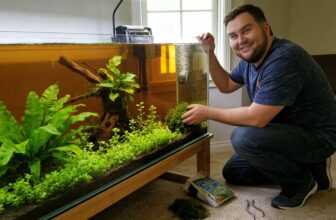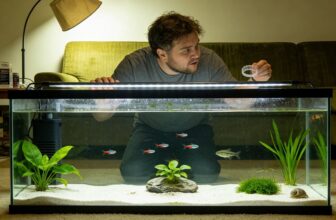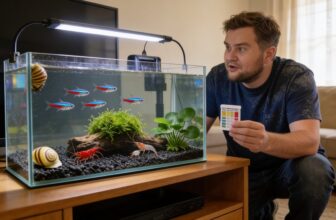
You don’t need the fanciest label—just the fertilizer that matches your CO₂ and light.
For high-tech tanks, NilocG Thrive hits the 100:20:4 N-P-K ratio with chelated iron, about $20 for 500ml.
Low-tech setups? Tropica Premium offers micronutrients only, no risk of algae blooms.
Root tabs help swords and crypts.
Avoid copper above 0.3 ppm for shrimp.
Skip fluff formulas; match your gear first.
Stick around for dosing tricks that save your plants.
At A Glance
- NilocG Thrive matches the ideal 100:20:4 N:P:K ratio for high‑tech tanks.
- Tropica Specialized Nutrition offers precise macros for high‑light, CO₂‑injected setups.
- API Leaf Zone supplies potassium and iron but lacks nitrogen and phosphorus.
- Brightwell Shrimp Florin is a copper‑free gel fertilizer safe for shrimp tanks.
- Seachem Flourish requires daily dosing due to non‑chelated ferrous gluconate iron.
Why Aquarium Plant Fertilizers Matter Beyond Light and Water
So you’ve got the light dialed in and your CO₂ rig humming like a well‑fed cat, but your plants still look like they’re on a hunger strike.
That’s since light and CO₂ are just the stage; nutrients are the script. Without nitrogen, phosphorus, and potassium—plus micronutrients like iron—your plants can’t build cells or photosynthesize properly.
Think of fertilizer as a balanced meal.
Think of fertilizer as a balanced meal.
API Leaf Zone gives potassium and iron but skips nitrogen and phosphorus—fine for low-growth tanks.
Tropica Specialized Nutrition nails the 100:20:4 ratio for high-tech setups.
Don’t guess; match your fertilizer to your plants’ appetite.
That’s how you join the thriving tank club.
A consistent dosing schedule delivers repeatable results for pH and nutrient stability in any system.
What Happens When You Skip Fertilizer in a Planted Tank
Say you spend weeks getting your lighting perfect, your CO₂ dialed in, only to watch your plants turn pale or melt away. You’re not doing anything wrong—you’re just skipping fertilizer. Without it, your plants starve, and algae throws a block party.
- Nutrient lockout – Without N, P, or K, plants can’t make proteins or ATP. New leaves come in stunted, twisted.
- Old‑leaf melt – Nitrogen’s mobile; deficiency pulls it from lower leaves. They yellow, then dissolve.
- Algae takeover – Starving plants leave nutrients for algae. You’ll see hair algae first, then BBA.
- CO₂ waste – You’re injecting carbon but your plants can’t use it without macros. Pure frustration.
Bottom line: you built a Ferrari and left the gas tank empty.
For shrimp‑safe planted tanks, a copper‑free gel fertilizer like Brightwell Aquatics Shrimp Florin provides essential nutrients without harming delicate invertebrates.
Nitrogen, Phosphorus, and Potassium: The Big Three in Planted Tank Fertilizer
As you’ve probably heard nitrogen, phosphorus, and potassium called the “big three,” they’re more like the gas, oil, and spark plugs of your planted tank—without all three, your engine stalls.
Nitrogen drives leaf growth; phosphorus fuels roots and blooms; potassium keeps stems sturdy and enzymes firing.
You’re part of a crew that knows this: skimp on one, and your plants look sickly, not lush.
Products like NilocG Thrive nail the 100:20:4 ratio, delivering 6 ppm nitrate, 1.11 ppm phosphate, and 4.3 ppm potassium per dose—perfect for high‑light tanks.
Products like NilocG Thrive nail the 100:20:4 ratio, delivering 6 ppm nitrate per dose.
Bottom line: balance these three, and you’ll join the thriving club.
In saltwater reef systems, solid carbon sources like PHA biopellets support bacterial growth to reduce nitrate and phosphate instead of relying on liquid dosing.
How Micronutrients Like Iron Boost Planted Tank Fertilizer Health
But even if you’ve got the big three dialed in, your plants can still look like they’re on a hunger strike if you’re skipping the micronutrient buffet. You’re basically feeding them bread without the butter—sure, they’ll survive, but they won’t thrive. Micronutrients like iron, manganese, and zinc are the secret sauce that drives chlorophyll production and enzyme function.
- Iron (Fe) – The star player; without it, new leaves turn pale and crispy, like a forgotten salad.
- Manganese (Mn) – Helps process nitrogen; deficiency shows as yellow spots between veins.
- Zinc (Zn) – Critical for growth hormones; stunted leaves signal a shortage.
- Boron (B) – Supports cell wall strength; fragile stems tell you it’s missing.
For best results, choose a liquid fertilizer that includes chelated iron to keep the nutrient soluble even in harder water. You’re part of a club that knows: healthy plants start with a complete micronutrient lineup.
Liquid or Root Tabs: Pick One Based on Your Plants’ Roots
Since you’re staring at a shelf full of liquid bottles and root tabs, wondering which one won’t turn your tank into a chemistry experiment gone wrong, here’s the short version: it’s all about the roots.
Heavy root-feeders like crypts, swords, and vals? Go root tabs. They deliver nutrients directly to the root zone—no guessing, just happy plants.
Heavy root-feeders like crypts, swords, and vals thrive on root tabs for direct root zone nutrition.
Stem plants, mosses, or floaters? They’re water‑column feeders—liquids are their jam.
Mixing both feels overkill? It’s not, honestly. Your plants will thank you, and you’ll look like you know exactly what you’re doing. Win‑win.
For anchoring hardscape and plants to rocks or driftwood, you can use a reef-safe epoxy putty that bonds underwater and cures in about 45 minutes.
API Leaf Zone and Root Tabs: Enough for Beginners?
Why do so many beginners gravitate toward API Leaf Zone and Root Tabs? Simple—they’re cheap, easy, and promise a green tank without stress.
But here’s the deal: Leaf Zone only adds iron and potassium, skipping nitrogen and phosphorus entirely. Root Tabs plug that gap, but their ingredient list stays a mystery.
For a low‑light, low‑growth setup, this combo works fine. You’ll get decent leaves without algae nightmares.
But if you want lush, fast growth, you’ll hit limits fast.
- No nitrogen or phosphorus in Leaf Zone – your plants starve for core nutrients.
- Root Tabs are vague – you’re trusting unlisted nutrients.
- Great for low‑tech tanks – perfect if you don’t add CO₂ or strong lights.
- Mix with a liquid all‑in‑one for better balance down the road.
Bottom line: enough to start, not enough to thrive.
For a similar low-hassle approach to hardware, consider a cut‑to‑size magnetic cover that prevents fish from jumping while maintaining light transmission.
Tropica Specialized vs. Premium: Which Feeds Your Plants Best?
If you stepped up from API’s starter pack and want faster growth, Tropica’s two liquid fertilizers give you a clear fork in the road.
| Feature | Specialized | Premium |
|---|---|---|
| Contains NPK? | Yes (N & P included) | No (micros only) |
| Best for | High-light, CO2 tanks | Low-tech, fish-heavy tanks |
| Iron boost | Yes, chelated | Yes, chelated |
Specialized feeds demanding stems like *Rotala* fast—premium lets fish waste handle nitrogen. Both share Tropica’s reliable micro blend. You’ll overdose Specialized in a shrimp tank, though; premium won’t spike nitrates. Stick with Premium for ease, Specialized for speed. Bottom line: match fertilizer to your tank’s hunger. To maintain stable temperatures for sensitive planted tanks, consider a controller with dual-outlet independence for simultaneous heater and cooler management.
Dose Seachem Flourish Daily or It Won’t Work
So how often should you actually dose Seachem Flourish? Daily, or it won’t work. Seriously. Flourish uses ferrous gluconate, not chelated iron, so it degrades fast. Skip a day, and your plants miss that nutrient window.
Here’s the deal:
- Dose every 24 hours – Ferrous gluconate breaks down within a day, unlike chelated options.
- Use half the bottle’s recommended dose – Overdosing risks heavy metal buildup, even with water changes.
- Shake well before each use – Precipitates settle quickly, and you’ll waste product.
- Pair with a macro fertilizer – Flourish lacks N, P, and K; add them separately or watch leaves yellow.
For optimal plant health, pair this with a tank that has adjustable brightness controls to manage algae growth when dosing daily.
Bottom line: Commit to daily dosing, or pick an easier fert. You’ve got this.
Use NilocG Thrive Like EI: All You Can Eat for Your Plants
What makes NilocG Thrive different from most all‑in‑one ferts? It’s built for Estimative Index (EI) dosing—basically an all‑you‑can‑eat buffet for your plants. One pump (2 ml) per 10 gallons adds 6 ppm nitrate, 1.11 ppm phosphate, 4.3 ppm potassium, and 0.23 ppm iron, matching a 100:20:4 ratio. That’s non‑limited growth, but you’ll need weekly water changes to prevent buildup.
- Big win: Extra magnesium included; most ferts skip it.
- Catch: Potassium may lag for K‑hungry species under high light/CO₂.
- No‑CO₂ tip: Use 25–33% of the CO₂ dose.
For those needing phosphate control, products like Seachem PhosBond remove both phosphate and silicate simultaneously. Bottom line: It’s your ticket to the EI club. Just don’t skip those water changes—your fish will thank you.
How Much Fertilizer Harms Your Fish or Shrimp?
- Nitrate under 20 ppm – Sensitive fish show clamped fins above 10 ppm.
- Copper below 0.3 ppm – Shrimp die at 0.5 ppm, so check labels for it.
- Iron under 1 ppm – At 2 ppm, it clouds water and stains filter media.
- Water changes weekly – Remove 30% to reset nutrient levels, not more.
Bottom line: Dose less than you think, test often, and watch your livestock, not just your plants.
Regular testing with accurate ammonia test kits ensures you catch dangerous spikes early before they stress your fish.
Why “Liquid CO₂” Isn’t a Real CO₂ Substitute
Let’s get real. You’re not injecting actual CO₂ with those bottles. That glutaraldehyde just punches algae in the face—temporarily. It won’t feed your plants.
For high‑light tanks? Forget it. You need compressed gas.
For low‑tech? A splash might clean up a hair algae outbreak, but that’s it.
Don’t trick yourself into thinking this replaces CO₂. You’ll waste money and wonder why your stems still look leggy.
Save the bottle for spot‑treatment, not growth. A handheld meter with a replaceable platinum probe can help you track ORP shifts from such dosing, but it still won’t supply the carbon your plants need.
Cut Phosphate and Potassium to Intensify Red Leaves
- Target phosphate below 0.5 ppm – use a lean macro fertilizer like Tropica Specialized Nutrition.
- Dial potassium to 5–10 ppm – enough to avoid deficiency but low enough to trigger reddening.
- Reject all‑in‑one blends with high P and K – they’ll keep leaves green.
- Test weekly with a liquid kit – you’re walking a tightrope, not crashing a truck.
It’s chemical coercion, but it works. Your tank, your rules. For robust biological filtration, consider media like Ceramic Bio Rings which support beneficial bacteria in freshwater and marine systems.
How Yellowing Leaves Reveal Nitrogen, Iron, or Potassium Deficiencies
When yellow leaves show up in your tank, they’re not just being dramatic—they’re trying to tell you something.
Old leaves going pale, especially near the bottom? That’s a classic nitrogen shortage.
Old leaves turning pale near the bottom? That’s a classic nitrogen shortage.
New growth looking sickly yellow with green veins? That’s iron deficiency—it can’t move around the plant.
And if you see yellow edges with tiny brown spots, especially on older leaves, potassium’s your culprit.
You’re not alone in this; every planted tank keeper plays detective.
Spot the pattern, address the deficiency, and your plants will reward you. Simple as that.
Non‑phosphate formulas can help prevent algae blooms while you correct nutrient imbalances.
Store and Dose Fertilizers Without Risk
Since your plants can’t exactly text you when they’re overfed, storing and dosing fertilizers safely is the one thing standing between you and a toxic soup. You’re part of a careful crew—keep it that way.
- Lock them away – Keep bottles in a cool, dark cabinet. Heat and light break down chelates (nutrient protectors), turning your iron into rust dust.
- Measure, don’t guess – Use a marked syringe or pipette. Eyeballing turns a 2‑ml dose into a 5‑ml “oops”—your shrimp won’t forgive that.
- Dose after water changes – Fresh water dilutes any leftover buildup, preventing a nutrient spike that stresses fish.
- Label the mix date – Liquids lose potency after six months. Write the date on the lid; stale fertilizer feeds nothing but algae.
For automated dosing, a programmable peristaltic pump offers Wi‑Fi or app‑based control for precise, repeatable supplements.
Match Your Fertilizer to Your Light, CO₂, and Plants
Alright, so you’ve got the storage and dosing down, now comes the real puzzle: matching your fertilizer to your light, CO₂, and plants.
Low light, no CO₂? API Leaf Zone’s your buddy—it’s cheap, simple, just potassium and iron.
High tech with fast growers? Tropica Specialized Nutrition nails that high nitrate:phosphate ratio (100:20:4), feeding demanding stems without algae.
Sensitive shrimp tank? Stick with Tropica Premium, no N or P.
Bottom line: your setup’s a team sport—match the fertilizer to your gear, and you’ll belong to the lush greenery club.
Remember to rinse all substrates multiple times before use to prevent cloudy tank syndrome and support healthy bacterial colonization.
Frequently Asked Questions
How Do I Test for Individual Nutrient Deficiencies in Practice?
You don’t need fancy tests. Observe your plants—it’s that simple.
Older leaves yellowing? That’s likely nitrogen deficiency.
New leaves pale or twisted? You’re probably low on iron.
Stunted growth with dark green leaves points to phosphorus shortage.
Holes in leaves? Potassium’s your culprit.
Start by checking which leaves show symptoms—mobile nutrients hit old growth first, immobile ones hit new.
Adjust one nutrient at a time, then watch for recovery.
It’s like plant detective work, minus the magnifying glass.
Can I Mix Different Brands of Liquid Fertilizers Together Safely?
You can mix brands, yes, but only if you’re certain they won’t react.
Most liquid fertilizers—like Seachem Flourish and NilocG Thrive—are water-diluted, so combining them is safe.
The real risk? Overdosing.
Without regular 30% water changes, you’ll build up nutrients, stressing fish.
Stick to one brand’s dosing schedule to keep your tank stable.
Bottom line: mix if you must, but test first.
What Signs Show I Have Overdosed Micronutrients Like Iron?
You’ll spot micronutrient overdose when new leaves come in twisted, stunted, or with black spots.
Iron overload turns leaf veins dark while the rest stays green—a classic sign.
Your shrimp might act sluggish or die off suddenly.
Check for rusty-brown deposits on hardscape.
Don’t panic; a 30% water change fixes most issues.
Just remember: these are heavy metals, so dose carefully, not recklessly.
Less really is more here, friend.
How Often Should I Change Substrate Root Tabs for Heavy Root Feeders?
You’ll replace root tabs every 2–3 months for heavy root feeders like crypts or swords, but you’ll watch for signs—yellowing leaves or stalled growth mean it’s time.
Tabs degrade slowly, so don’t overdo it; too many spike ammonia.
Stick with one per 4–6 inches of substrate, and dose liquid fertilizers for the rest.
Bottom line: quarterly swaps keep roots fed without drowning your tank in nutrients.
Does Adding Fertilizer Affect My Aquarium’s pH or Water Hardness?
Yes, fertilizers can shift your pH and hardness, but it’s usually minor. Most liquid fertilizers contain chelated (chemically wrapped) nutrients that don’t drastically alter water chemistry, though potassium products can slightly raise pH over time.
Root tabs are even safer—they release slowly into substrate, not water column.
Overdosing is the real culprit; too much phosphate or nitrate can swing pH down.
Stick to recommended doses, test weekly, and you’ll avoid surprises. Your plants thrive, your parameters stay stable.
Rounding Up
Look, you’ve got this. The right fertilizer isn’t magic—it’s math, light, and a little luck. For a high-tech jungle, grab ThriveS all-in-one ($20 per 500ml) and dose daily. Low-tech with fish? Stick to Easy Green—it’s forgiving, like a lazy houseplant. Avoid copper-heavy mixes (they’re shrimp murderers). And seriously, change your water weekly. That’s your real fertilizer. The bottle just fills in the gaps. Pick your poison, dose carefully, and your plants will finally stop looking like sad, yellow drama queens.