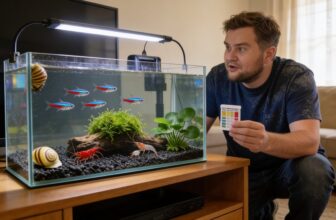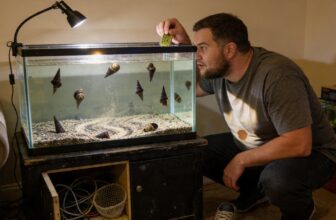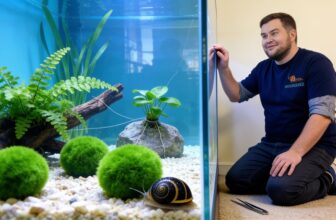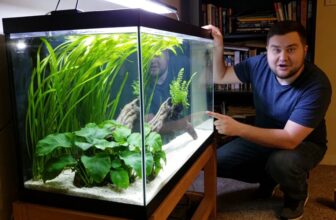
Yes, you can—with planning.
You’ll need a 15-gallon tank minimum, a gentle HOB filter under 40dB, and plenty of plants like Anubias and Hornwort for escape routes.
Keep one male betta with three or four drab female guppies; flashy males invite fights.
Maintain 78–80°F, pH 6.8–7.6, and 6–8 dGH.
Watch for clamped fins or tail nipping.
If aggression flares, rescape the tank or try a 20-minute time-out.
Stick around; we’ll walk through the setup step-by-step so you don’t end up refereeing bar brawls.
At A Glance
- Minimum 15-gallon tank with a magnetic cover prevents aggression and guppy jumps.
- Pair a male betta with three to four drab female guppies for visual compatibility.
- Floating and broad-leaf plants create escape routes and visual barriers for both species.
- Maintain 78-80°F, pH 6.8-7.6, and 6-8 dGH for shared water stability.
- Weekly 30% water changes and regular monitoring reduce stress and aggression triggers.
Can Betta and Guppies Actually Live Together?
Bottom line: it works best with a calm female betta and a trio of female guppies. Keep the tank peaceful, or you’ll be playing referee. Using a magnetic fish tank cover can prevent jump-prone guppies from escaping during stressful tank dynamics. For optimal water quality, perform weekly water change of 30% to maintain low nitrite levels and support filter bacteria activity.
Minimum Tank Size for a Betta and Guppy Community
Before you rush out to buy a tank, know this: the absolute minimum is 10 gallons for one male betta and three guppies.
The absolute minimum is a 10-gallon tank for one male betta and three guppies.
But don’t stop there. A cramped 10-gallon tank? That’s like putting two grudging roommates in a tiny studio—you’re just asking for fin-flaring drama.
Go bigger.
- Aim for a 15-gallon tank instead. It’s roomier, reduces stress, and gives you wiggle room.
- Add 5 gallons for every three extra guppies you want.
Trust me, more space equals fewer squabbles.
You’ll feel like a pro when your fish have room to breathe—and you won’t be stuck playing referee daily.
Bottom line: 15 gallons is your sweet spot for peace.
For a well-rounded setup, consider pairing the tank with a 220 lb rated stand from the HOOBRO or Snughome options to safely support the aquarium.
The Aqueon 10-gallon Complete Starter Kit includes a 50-watt preset heater that maintains a steady 78 °F for tropical fish like bettas and guppies.
Water Parameters That Work for Both Betta and Guppies
When you’ve got the space sorted, nailing the water parameters is where you either set your fish up for a chill life or turn your tank into a chemistry experiment gone wrong. You’re aiming for that sweet spot where both species feel like they belong, not just survive.
- Keep the temperature locked at 78–80°F—it’s the Goldilocks zone where your betta won’t sulk and your guppies won’t stress.
- Stabilize pH between 6.8 and 7.6; drifting outside that range makes everyone grumpy and prone to disease.
- Test your water weekly, since ammonia spikes from overfeeding are the fastest way to ruin your community vibe.
- For reliable readings, use a digital pH meter with auto-calibration to ensure accuracy around the 6.8–7.6 target.
- A 7‑in‑1 Test Kit can quickly check multiple parameters like pH, hardness, and nitrate all at once for consistent monitoring.
Get those numbers dialed in, and you’re halfway to a tank that actually works.
How to Balance Soft and Hard Water for Both Fish
You’re not trying to clone the perfect water—you’re making a compromise that works for both fish, and that starts with hardness.
Aim for 6–8 dGH, splitting the difference between Betta’s soft 3–4 and Guppy’s hard 8–12.
Mix RO or distilled water with your tap to lower it, or use crushed coral in your filter to raise it.
Test weekly, adjusting gradually.
A 10‑gallon setup costs about $30 for a basic test kit.
“Hardness isn’t hard to fix—just don’t shock your fish.”
Get it stable, and they’ll thrive.
Bottom line: hit 6–8 dGH, and you’re part of the crew.
You can use a digital hygrometer to monitor temperature stability during water adjustments.
For stable alkalinity, you can rely on general buffering principles measured in mEq/L to predict how quickly your water resists pH swings.
Best Plants and Decor to Prevent Betta Territory Wars
So, how do you stop your betta from treating the guppy colony like a personal punching bag? You outsmart his territorial brain with strategic decor. Think of it as interior design for fish diplomacy.
- Floating plants like Water Sprite or Hornwort break line-of-sight, giving guppies escape routes. They soften light, too—betta’s chill, guppies feel safe. A handful costs about $8. For added depth and contrast, a layer of CaribSea Moonlight Sand can further diffuse light and create a calming, natural base.
- Broad-leafed Anubias or Java Fern create betta-approved “throne rooms.” Place them at different heights; your betta claims one, guppies claim the rest. No overlap, no drama. A sterile tissue culture of Anubias Nana Snow White ensures a pest-free start for these low-light thrones.
- Caves and driftwood provide lower-level bolt holes for guppies. Your betta won’t chase what he can’t see. Add two caves—one per species—and you’ve got a peace treaty, not a war zone.
Why Guppies Should Enter the Tank Before the Betta
If you want peace in the tank, you need to let the guppies set up their turf first.
Adding a betta to an established guppy colony works wonders—your betta sees them as locals, not intruders. This lowers his territorial aggression dramatically.
Adding a betta to an established guppy colony works wonders—he sees them as locals, not intruders.
Here’s the trick: guppies stake out hiding spots and swimming lanes before the betta arrives. He enters a claimed space, so he’s less likely to flare up. You’re fundamentally letting the guppies be the welcoming committee, not the invaders.
Maintain stable water parameters to prevent stress that triggers aggression in both species.
Bottom line: introduce your guppy group a week early. It’s cheap insurance—costs you nothing but patience—and saves you from a fin‑nipping feud later.
This strategy works best when all fish are kept in a group of six or more to reduce aggression.
What to Feed Betta and Guppies Without Missing Protein
- Feed high-protein pellets first—drop one or two for your betta while guppies eat flakes; this targets carnivore needs without overfeeding.
- Add frozen brine shrimp—a communal treat everyone loves, just thaw a cube ($3) and sprinkle sparingly. This helps both species thrive with a natural food source, and the heater should be mounted near the filter outflow for even heat distribution.
- Offer blanched spinach—guppies nibble fiber, bettas ignore it, preventing bloating from too much protein.
Stick to this plan, and you’re part of the crew that keeps both species thriving. For optimal health, add a vitamin supplement twice weekly to support coloration and immune function.
Why Male Betta + Female Guppy Is the Safest Combo
You’ve nailed the feeding strategy, so now let’s talk about the roommate that won’t turn your tank into a soap opera.
You’ve nailed the feeding strategy, so now let’s talk about the roommate that won’t turn your tank into a soap opera.
A male betta plus female guppies is your safest bet—here’s why. Male guppies flaunt flashy fins that trigger your betta’s territorial rage. Females? They’re drab, dull, and practically invisible to him. That means less chasing, less stress, and fewer torn fins.
- No flashy competition: Female guppies don’t look like rivals.
- Lower aggression risk: Your betta stays calm, you stay sane.
Bottom line: keep it simple. Add three or four drab females, give them hiding spots, and your tank becomes a peaceful community—not a soap opera. Dim LED lighting for six hours daily helps reduce stress and algae growth in the tank. Adding multiple driftwood pieces as tunnels and hiding spots also provides essential shelter for guppies and helps your betta feel secure.
Which Betta–Guppy Pairings You Should Never Try
As a male betta with female guppies is the golden ticket, other pairings basically roll out the red carpet for disaster. You’re not just risking fins here—you’re tanking your whole setup. Avoid these three doomed combos:
- Male betta + male guppies – That’s a boxing match waiting to happen. The betta sees flashy colors and long tails as direct challenges, not buddies. Expect torn fins and constant chasing.
- Female betta + male guppies – She’ll either mate with them (stressing everyone) or treat them as intruders. Either way, you lose guppies.
- Two male bettas with any guppies – That’s a homicide party. Bettas fight each other to the death, and guppies just become collateral damage.
Stick to the safe combo, and you’ll belong to the happy-tank club. A turtle’s diet, by contrast, should rely on a 4:6 meat‑to‑vegetable ratio for red‑eared sliders to support healthy shell growth. For treating any resulting infections from torn fins, API Melafix provides a natural antibacterial option safe for freshwater tanks.
How to Spot Stress in Your Betta or Nipped Guppies
Even when you nail the perfect pairing, stress can still sneak in like a bad roommate who eats your leftovers.
Watch for clamped fins—your betta’s tail is usually a flowing flag, not a tight, droopy mess.
Watch for clamped fins—your betta’s tail is usually a flowing flag, not a tight, droopy mess.
If he’s scraping his body against gravel or plants, stop and think; it’s not a move, it’s discomfort.
For your guppies, missing tail bits or dark red streaks near their tails mean nipping.
They might additionally hover near the filter, hiding instead of schooling.
Keep an eye on pale colors or rapid gill movement.
Spot these early, and you’re still in control.
To help reduce bacterial stress in the water, consider adding ceramic rings as biological media in your filter.
Consistent feeding schedules with a programmable feeding schedule can also help maintain water quality by reducing leftover food waste.
Is the Betta or the Guppies Causing the Aggression?
So you’ve spotted clamped fins on your betta or a missing chunk on a guppy. Now you’ve gotta play detective—who’s the bully? Watch the behavior, not just the battle scars.
- Betta’s bullying: If he flares, chases, and pins guppies against the glass, it’s him—he’s defending his turf, not just being grumpy.
- Guppy gang‑ups: If your female guppies nip his fins and dart away fast, guilt lies with them; they’re testing dominance in numbers.
- Shared blame: Both show frayed fins and stress signals—your tank’s too small, or you need more plants (like Java fern) to break sightlines.
Identify the culprit, then tweak your setup—community harmony’s worth the work. Using a dedicated aquarium caddy can organize your tools and reduce stress during water changes. Adding slime‑coat support through a conditioner like API Stress Coat can help heal fin tears and reduce stress from aggression.
How to Introduce Guppies to a Betta Tank Step by Step
Introducing guppies to a betta tank is less like a blind date and more like a hostage negotiation—one wrong move, and someone loses a fin. First, quarantine your guppies for two weeks in a separate tank. Then, rearrange your betta’s tank completely; this breaks his territorial claim. Next, float the guppy bag for 15 minutes, then add a cup of tank water every 10 minutes for an hour.
| Step | Action | Key Detail |
|---|---|---|
| 1 | Quarantine guppies | 2 weeks, separate tank |
| 2 | Rearrange betta’s tank | Move plants, hide spots |
| 3 | Slow acclimation | Drip method over 1 hour |
Release guppies at night when the betta’s less active. Watch closely for 30 minutes. You’ve got this, we’re all rooting for a peaceful tank.
Backup Plan If Your Betta and Guppies Still Fight
If your betta and guppies still fight despite your careful introduction, don’t panic—you’ve got a few solid backup options before you need to surrender to a permanent tank divider.
- Temporary Time‑out: Use a clean, large plastic cup or breeder box to isolate the aggressor for 20‑30 minutes. This resets territorial disputes without moving fish out. Try it daily for three days; most Bettas calm down.
- Rescape the Tank: Rearrange all plants and decorations. This destroys established territories. Add extra hiding spots—caves, dense hornwort clumps. It’s a cheap fix ($10–$20) that often rebalances the pecking order. Adding a spray bar to the return line gently distributes return water across the sump surface like rain, preventing turbulence that can stress fish and trigger aggression. Consider adding an HOB filter with a quiet motor under 40 dB to reduce vibration and noise, which can further lower stress levels in the tank.
- Shift Lighting Schedule: Reduce light intensity or shorten the photoperiod to 6 hours. Bright lights trigger aggression; dimmer conditions promote peaceful co‑existence. A simple timer ($15) automates this.
You’ve got this—your fish family deserves a fighting chance.
Better Tank Mates Than Guppies for Your Betta Fish
Sure, let’s skip the guesswork and go straight to the best tank mates that won’t turn your betta into a grumpy roommate.
Go with peaceful bottom-dwellers like cory catfish—they’re fast, stay low, and mind their own business.
Or try snail species; nerite snails are hardy, eat algae, and cost about $3 each.
Shrimp, like cherry or amano, work too, but your betta might snack on tiny ones—start with larger adults.
Stick to these, and you’ll avoid the fin-nipping drama guppies bring.
If you need a temporary separation for a sick or aggressive betta, a hospital tank with transparent walls allows observation without disturbing the fish.
Your betta stays calm, you stay happy. That’s a win-win.
Frequently Asked Questions
How Long Should the Tank Lights Be on Daily?
You should keep your tank lights on for 8-10 hours daily. Any longer, and you’re basically running a disco for algae—they’ll throw a party you didn’t invite.
Stick to a consistent schedule; a timer (under $20) takes the guesswork out.
Too little light, and your plants sulk.
Too much, and you’re scrubbing glass every week.
Find that sweet spot, and your betta and guppies will thank you with fewer headaches.
Can Guppies and Bettas Breed Together if Kept in the Same Tank?
No, you can’t breed bettas and guppies together—they’re entirely different species, like trying to cross a cat with a dog.
Male guppies might chase female bettas, but no hybrid fry will result. Your betta will likely eat any guppy fry anyway. So, you’re safe from accidental crossbreeding.
Focus instead on preventing aggression: a 10‑gallon tank with lots of plants (think Anubias or Java fern) keeps peace.
Bottom line? For breeding, stick to same‑species tanks; for cohabitation, stick to the setup rules.
What Tank Shape Reduces Aggression Best for Bettas and Guppies?
You want a long, rectangular tank—think a 20‑gallon “long” (30 in × 12 in). Here’s why:
- Horizontal space gives both betta and guppies distinct territories, reducing face‑offs.
- Tall, narrow tanks compress territory, spiking aggression—bad news for $5 guppies.
- Add large‑leaf plants (Anubias, $8) to break sightlines; it’s like giving them privacy fences.
Bottom line: skip fancy hex tanks. A standard 20‑long keeps the peace, not your blood pressure.
Do Bettas and Guppies Need a Quarantine Period Before Introduction?
Yes, you absolutely need a quarantine period.
Skip it, and you’re rolling the dice on introducing parasites or diseases.
Keep each new fish in a separate 5‑gallon tank for 2‑4 weeks, watching for white spots or clamped fins—common stress signals.
It’s boring, indeed, like watching paint dry, but it’s your best bet for a peaceful tank.
Patience now saves you a headache later; no shortcuts here.
How Often Should I Replace Live Plants in the Tank?
You don’t need to replace live plants on a schedule—just trim dying leaves.
Anubias, Java fern, or Amazon sword? They’ll last years with good light and water.
Replace them only when they melt (rot) or algae smothers growth.
Tear out totally dead ones to prevent ammonia spikes.
Most keepers swap plants every 6–12 months for fresh look or growth.
Honestly, your betta and guppies care more about hiding spots than plant age.
Keep ’em healthy; you’re set.
Rounding Up
So, can betta and guppies live together? Yes—but it’s a gamble.
You’ll need at least a 20-gallon tank ($50–80), tons of hiding spots like java fern or driftwood, and a backup tank for the guppy you’re certain will get chased. Start with the guppies first so they own the space, then add the betta last. Watch for tail nipping or flaring within 48 hours. If you see blood, separate them—no shame in that. Honestly? A single betta with shrimp or snails is way less drama. Save yourself the headache.