You’ll want tank mates that match guppy water—72‑78°F, pH 6.8‑7.8, soft to moderate hardness—without nipping fins or eating fry.
Cardinal tetras school mid-water, cory catfish scavenge the bottom, and cherry shrimp ignore babies while cleaning algae.
Nerite snails scrub glass without breeding, Amano shrimp are peaceful cleanup crews, zebra danios add dithering motion.
Stick to a heavily planted 20‑gallon with soft sand and sponge filters for zero drama. There’s more to these 15 picks if you stick around.
At A Glance
- Peaceful mid-column schooling fish like cardinal tetras and harlequin rasboras coexist well with guppies.
- Bottom-dwelling cory catfish, otocinclus, and shrimp safely clean leftover food without aggression.
- Maintain stable water parameters: 72–78°F, pH 6.8–7.8, and dGH 8–12 for all community fish.
- Heavily planted tanks with soft sand and gentle filtration reduce stress for guppies and tank mates.
- Tight-fitting lids prevent jumping by guppies and royal grammas while supporting a secure environment.
Why These 15 Species Make Ideal Guppy Tank Mates
Since guppies are basically the labradors of the fish world—friendly, adaptable, and a little too trusting—you’ve got to pick tank mates that won’t turn your community tank into a reality show. You want a chill crew, not a soap opera.
Cardinal tetras, harlequin rasboras, and rummy nose tetras? They’re your guppy’s kindred spirits. Peaceful, schooling, and *comparably* sized, they’ll swim the middle column without drama. Cory catfish and dwarf chain loaches? They stick to the bottom, keeping the peace. Cherry shrimp? They’re the cleanup crew, no threat at all. Just avoid fin-nippers like zebra danios. Stick with these, and you’re golden. To ensure precise water parameters for your peaceful community, use a NIST‑traceable hydrometer to monitor specific gravity or proof levels with confidence.
Match Guppy Water Parameters for a Stress-Free Tank
Since guppies are the goldfish of the livebearer world—tough, adaptable, and forgiving—you don’t need a chemistry degree to build their community.
Guppies are the goldfish of the livebearer world—tough, adaptable, and forgiving.
Keep your tank at a cozy 72–78°F, pH between 6.8 and 7.8, and hardness around 8–12 dGH.
That’s it. Most peaceful species you’ll meet share this sweet spot.
Mollies like it harder, but you can adjust slowly.
White Clouds need cooler temps, so skip them here.
Match these numbers, and you’re already part of the club—the one with happy, stress-free guppies swimming alongside their new buddies.
Using a digital pH meter ensures you stay within this ideal range for your guppies.
Tank Mates That Won’t Bully Your Guppies
If you’re already wincing at the thought of a fin‑nipping bully turning your tranquil tank into an underwater Thunderdome, relax—most guppy‑compatible mates are famously peaceful. You’ll fit right in with this crew.
Consider these gentle tank mates:
- Endler’s Livebearers: Active, comparable size, just keep three females per male to avoid squabbles.
- Cory Catfish: These bottom‑dwelling janitors mind their own business in groups of four.
- Harlequin Rasboras: Schooling fish, eight to ten strong, too busy being chased to start trouble.
- Otocinclus: Tiny algae eaters that won’t bother anyone.
- Twig Catfish: Like Otocinclus, these peaceful bottom-dwellers thrive in a calm environment with soft sand substrate and plenty of driftwood to graze on.
Bottom line: Stick with peaceful, comparable sized fish, and your guppies will thrive without drama.
Cardinal Tetras: Schooling Guppy Tank Mates for Soft Water
Cardinal tetras aren’t just a pretty face—they’re the ideal soft‑water squad for your guppies.
You’ll need a 20‑gallon tank minimum for their school of six.
Their soft, acidic water (2‑6 dKH) perfectly matches softer guppy setups.
They’re peaceful, so no one’s bullying anyone.
Keep them in heavily planted tanks, and you’ll see their red‑and‑blue flash all day.
They max out at two inches, so size isn’t an issue.
Maintain a stable temperature above 75°F to keep them active and healthy.
Honestly, they’re the cool cousins your guppies wish they had.
Bottom line: grab a school, add plants, and watch your community thrive.
You won’t regret it.
Cory Catfish: Bottom Dwellers That Match Guppy Water
Need a cleanup crew that won’t zoom off and stress your guppies? Cory catfish are your bottom‑dwelling best friends. They match guppy water perfectly—same temperature, same pH—so you don’t need to tweak a thing.
Cory catfish are your bottom-dwelling best friends—no tank tweaks needed for guppy water.
- Peaceful scroungers: These slow‑pokes sift through sand all day, munching leftover food and algae. No fin‑nipping, no drama.
- Tiny tanks welcome: A 10‑gallon houses a school of 4‑6, making them ideal for compact setups.
- Armored but gentle: Their bony plates protect them from curious guppies, yet they’re calm enough for fry.
Stick with captive‑bred species, and you’ll feel like you’ve joined the “clean tank club.” A group of five is the minimum needed for them to feel confident and social, reducing stress even further.
Harlequin Rasboras: Hardy Guppy Tank Mates That Tolerate Fluctuations
So, you’ve got your cory catfish happily scouring the sand for leftovers, but you’re eyeing a fish that swims in the middle—something hardy that won’t keel over if your water parameters wobble a bit.
Enter the Harlequin Rasbora, your forgiving new friend. These little guys don’t throw a fit when pH drifts or temp drops, which is exactly what you want in a community.
They school tight in groups of 8-10, turning your tank into a calm, flowing spectacle. No nipping, no drama—just easygoing company that hangs right where guppies roam. You’ll feel like you finally nailed that perfect mix. For best health, aim for stable temperature within their preferred range.
Rummy Nose Tetras: Shoaling Fish That Prefer Warmer Water
If your water’s a touch warmer and softer than standard guppy fare, the rummy nose tetra is your guy. You’ll need a 20‑gallon tank, since these guys need room to glide. Keep at least six—they’re shoalers, not loners.
- Color: Their bright‑red heads scream “look at me,” fading if stressed.
- Schooling: Watch them move as one, like a synchronized swim team.
- Behavior: Completely peaceful, never nipping fins.
They’re not fussy, but warmer water (78‑84 °F) keeps them lively. A tight‑fitting canopy prevents escapes and protects these nervous swimmers from jumping. Bottom line? They’re the cool kids your guppies will thank you for.
Platies: Easygoing Livebearers From the Same Family as Guppies
Platies are practically the cousin who shows up to the family reunion with the same last name and the same easygoing attitude.
You’ll love how they just fit in—same livebearing family, same peaceful vibe.
They’re small, 2–3 inches, and thrive in a 10-gallon tank.
Keep 2–3 females per male to avoid squabbles.
Their water hardness lands a bit lower than guppies, but you’ve got overlap.
They won’t nip fins, won’t stress your crew, and they bring color without drama.
If you keep shrimp as tank mates, remember that stable water conditions are essential to support stress-free molting for them.
Bottom line: if you want a no-fuss friend that belongs, platies are your people.
Honey Gouramis: Shy Top-Dwellers for Planted Guppy Tanks
From platies, you step sideways into the domain of shy, gentle top-dwellers: honey gouramis. They’re your planted tank’s quiet neighbors, maxing out at just 2 inches and glowing a soft honey-yellow.
From platies, you step sideways into the domain of shy, gentle top-dwellers: honey gouramis.
- They thrive in groups of 4–6, swaying together like autumn leaves near the surface.
- Their labyrinth organ lets them breathe air, so they’ll often pause at the top, sizing you up.
- Live plants are their security blanket—they’ll probe every stem when they feel safe.
You’ll get calm convos, not chaos. Just keep a lid on; they’re famous for splashy escapes. For a peaceful, top-level presence, they’re your perfect match. A tight‑fitting lid also prevents jumping, similar to the requirements for royal grammas in a reef tank.
Kuhli Loaches: The Eel-Shaped Cleaners That Sleep by Day
While you might think an eel-shaped fish would be a high-maintenance diva, the kuhli loach (Pangio kuhlii) is actually a laid-back, nocturnal scavenger that tops out at 3-5 inches.
You’ll find them sleeping buried in your sand during the day.
Come nightfall, they’re your cleanup crew, sifting for leftover food.
Keeping three or more makes them feel secure, so you’ll actually spot them more.
Their thin scales? Yeah, they’re sensitive—pure water quality is non-negotiable here.
A soft sand substrate is essential to prevent barbel injury and belly scratches during their nightly foraging.
Bottom line: Add a small group to your planted guppy tank. They’re the shy, efficient buddies you never knew you needed.
Otocinclus Catfish: Tiny Algae Eaters That Love a Crowd
If you’ve ever wished your guppy tank could clean itself without you lifting a finger, meet the otocinclus catfish—a tiny, passive algae-eater that maxes out at just 2 inches. They’ll stick to your glass, munching green spots with tiny sucker mouths. You’ll want a group of 4–6 to make them feel brave.
- They’re bottom dwellers, armored like mini knights.
- You’ll see them grazing at all hours, not hiding.
- A 10-gallon tank is enough, planted thick.
- For precise planting and trimming, consider using a Jeimier Aquascaping Tool Kit.
They won’t bother your guppies or chase fry. Bottom line: these little guys keep your tank clean while blending right in.
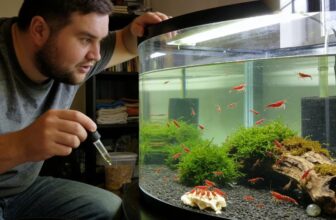
Cherry and Ghost Shrimp: Cleanup Crews That Leave Guppy Fry Alone
Cherry and ghost shrimp make the best cleanup crew for a guppy tank since they simply don’t care about guppy fry. You’ll love watching them scavenge leftover food and algae without any fry‑hunting drama. They’re bottom‑dwellers, maxing out at 1.5 inches, so your babys are totally safe.
- Hardy and low‑maintenance, they tolerate guppy water perfectly.
- Need a 5‑gallon tank minimum—super beginner‑friendly.
- Cherries cost about $4 each; ghosts, just $2.
Just don’t overfeed—they’ll stop cleaning. Bottom line: grab a small crew, and you’re part of the “clean tank, happy guppy” club.
To prevent stress in these shrimp, ensure the tank has gentle sponge filtration and a dimmable LED light with a 6‑8 hour photoperiod.
Nerite Snails: Hardy Grazers That Thrive in Guppy Water
Since Nerite snails are practically built for guppy tanks, they’re the cleanup crew that won’t stress you out. These tiny algae eaters, maxing out at 1 inch, fit right into your community. Here’s what you’re getting:
- Glass-scraping pros: They’ll polish your tank walls and decorations without bothering your guppies.
- Water-parameter chameleons: They match your guppy’s pH and hardness, so no extra balancing act.
- Zero breeding headaches: They need brackish water to reproduce, so you won’t get overrun.
Just toss them in, and they’ll handle the grunt work. You’ll feel like part of the in-crowd with these low-maintenance helpers. Their role as a low-maintenance cleanup crew can be enhanced by using an Aquaneat basket as a filter sock alternative to simplify waste collection.
Amano Shrimp: Peaceful Tank Cleaners That Ignore Guppy Fry
Why wouldn’t you want a shrimp that cleans your tank and leaves your fry alone? Amano shrimp are the gold-standard cleanup crew you’ve been searching for.
You’ll watch these tiny janitors tirelessly graze algae and leftover food, never once bothering your precious guppy fry.
Key Benefits:
- Max size: 2 inches—safe with adult guppies
- Tank minimum: 10 gallons
- Hardy, adaptable to your guppy’s water parameters
- Work harder than your last roommate
These little guys are practically bomb-proof, thriving in temps from 65-80°F.
Just give them some Java moss for molting privacy and you’re set.
You’ll feel like part of the smart tank club with these creatures.
Bottom line: get at least three—they’re worth every penny.
These shrimp work alongside high-CFU powder supplements to enhance biological filtration and reduce algae growth in your aquarium.
Zebra Danios: Active Dither Fish for Every Guppy Community
- The Street Cops: They patrol every level of your tank, calming your guppies with their confident presence.
- The Speed Racers: Watch them race, zig-zagging like tiny torpedoes—your guppies can’t help but join in.
- The Easy Breezy Bunch: They’re tough as nails, tolerating your mistakes, and a school of 5+ costs under $15.
Just keep an eye on nipping—it’s rare, but they’re quick. Bottom line? Zebra danios give your community that missing spark. Always choose captive‑bred fish to support conservation and avoid depleting wild Myanmar populations.
Frequently Asked Questions
Can Guppies and Bettas Live Together Safely?
Yes, you can keep guppies and bettas together, but it’s not a guarantee—think of it like roommates with very different vibes.
You’ll need a 20-gallon tank or bigger, heavily planted with hiding spots.
A single female betta works best; males often mistake flashy guppies for rivals.
Stick with a calm betta, monitor for fin-nipping, and have a backup tank ready.
Bottom line? Risky but doable with careful planning.
Do Male Guppies Need a Specific Female-To-Male Ratio?
Nope, male guppies don’t particularly need a set ratio—but you’ll want one for your own sanity.
Keep at least two females per male. Without that, males constantly chase, stressing females to death. It’s not romance; it’s harassment.
Go for a 3:1 ratio if possible. Your tank stays peaceful, females get breaks, and you avoid constant fry production.
Think of it as crowd control, not matchmaking.
Will Zebra Danios Nip the Fins of Slower Guppies?
Yes, they might. Zebra danios are fast, active swimmers, and slower guppies can become targets.
You’ll see nipped fins if your danios are bored or the tank’s too small.
Keep a school of 5+ danios in a 20-gallon tank with plenty of plants to break lines of sight. That spreads out their energy.
If fins get ragged, add more hiding spots or rehome the danios.
Bottom line: it’s risky, not guaranteed—you’re gambling your guppy’s fins.
Can I Keep Kuhli Loaches With Guppy Fry in the Tank?
Yes, you can, but it’s risky.
Kuhli loaches are peaceful bottom-dwellers that won’t hunt fry, but at night—when they’re most active—they might accidentally eat tiny fry that stray too low.
For safety, add dense plants or a breeding box until fry grow bigger (around 1 inch).
You’ll lose some fry, but if you want a community setup, it’s doable.
Honestly, it’s a gamble your fry mightn’t survive.
How Often Should I Feed My Cleanup Crew Shrimp and Snails?
Feed your shrimp and snails every 2-3 days—just a pinch of algae wafer or blanched veggie.
Overfeeding fouls the water, killing your cleanup crew faster than a guppy.
They’re scavengers, not pigs; they’ll munch on leftover fish food and biofilm too.
A hungry crew works harder, so skip a day weekly.
That’s it—simple, sustainable, and your tank stays balanced without you becoming a short-order cook.
Rounding Up
So, you’ve got your pick—15 solid options that won’t turn your tank into a fishy fight club. Stick with corydoras or cherry shrimp for zero drama, or grab zebra danios if you want extra activity (they’re like hyper, harmless toddlers). Avoid big, nippy fish, and you’re golden.
Bottom line: Match guppy water (74–82°F, pH 6.8–7.8), keep groups of 4+ for schoolers, and you’ll have a peaceful, low-maintenance community. Costs run $3–$8 per fish; worth every penny for a calm tank.