Freshwater angelfish size often tops out at six inches – but only if you give them the tank height and space to actually get there.
A single fish needs a 20-gallon tall tank minimum; cramped quarters crush fin development and twist the spine.

Provides vertical space for angelfish to reach full size and stretch their fins.

Ideal for larger species like Altum or Black Lace to reach 10 inches.

Clear viewing of upward growth with high light transmission.
Check discounted items inAquarium Tanks
Altum and Black Lace types can hit ten inches, requiring even larger setups.
Skip the bowl and give them vertical room to stretch upward.
Stick around for the five-step plan to raise a full-sized angelfish.
At A Glance
- Tank space determines full size; cramped quarters stunt growth permanently.
- Most common angelfish species reach about six inches in proper conditions.
- Altum and Black Lace angelfish can grow up to ten inches.
- Minimum 20-gallon tall tank needed for one fish; 40 for a pair.
- Stable 78–82°F water and vertical swimming height support maximum growth.
Why Tank Space Determines Your Angelfish’s Full Size
Since an angelfish’s growth is directly tied to its environment, tank space isn’t just a suggestion – it’s the single biggest factor in determining whether your fish reaches its full size. Cramped quarters stunt growth, plain and simple. Those majestic six-inch fins? They won’t happen in a bowl.
Tank decorations matter too, providing hiding spots that reduce stress, which helps growth. Additionally, water hardness should stay stable – soft to neutral works best. Properly rinsed natural stone gravel supports bacterial colonization and water clarity, aiding healthy development. Choosing a substrate like Aqua Natural Sugar White Sand can further enhance bacterial growth and water quality.
A happy angelfish grows. A stressed one doesn’t. Give them room to stretch those tall fins, and they’ll reward you. Belonging to the well-prepared crew means setting up success from day one.
The 20-Gallon Rule: One Angelfish Needs This Minimum
Since one angelfish needs at least 20 gallons, the “20-gallon rule” is the non‑negotiable starting point for any keeper. This isn’t a suggestion; it’s the floor. Skimping on volume stunts their stressed size, leaving them cramped and sickly.
A 20-gallon tank offers the tank depth these vertical swimmers crave – they grow up, not out. Think of it as their minimum studio apartment. No, you can’t squeeze one into a ten-gallon; that’s a closet. Even the tallest 10-gallon designs provide only 12 inches of height, which angelfish quickly outgrow.
For a single angelfish, this rule guarantees proper growth and calm behavior. Bottom line: start here, or don’t start at all. A tank with strong filtration is essential to handle the heavy bioload that angelfish produce, preventing rapid ammonia buildup.
How Tall Tanks Help Angelfish Reach Full Growth
Since angelfish grow upward rather than outward, a tall tank is necessary for them to reach their full mature size.
A cramped, short tank squishes their finspan genetics, stunting those elegant fins before they can fully develop.
You want them to show off their breeder lineage, right? Go with a 55-gallon tall or taller.
Your angelfish needs room to stretch up, like a skyscraper for fish.
Don’t let a shallow tank clip their wings – literally.
A tall tank isn’t fancy; it’s functional.
Bottom line: height equals healthy growth, so measure up before you buy.
Using 91 % light transmission glass ensures you see every inch of their upward development clearly.
Pair this with a low‑iron rimless tank for maximum vertical viewing clarity.
Angelfish Species Compared: Which Matches Your Tank Size?
As your tank height guarantees the vertical glide, the species you pick determines whether that glide is a gentle cruise or a full-on stretch. Your community needs harmony, so match size to your setup.
| Species | Mature Size |
|---|---|
| Silver Angelfish | 6 inches |
| Marble Angelfish | 6 inches |
| Koi Angelfish | 6 inches, 8 inches deep |
Silver, Marble, and Koi all top out around six inches – perfect for a standard 20-gallon tall. Their origin size is manageable, lacking the wild sensitivity that demands extra care. These are your low-fuss, tank-friendly picks. For a 40-gallon pair, they glide comfortably. Bottom line: stick with these if you want a calm, belonging vibe without the stretch. A taller 20-gallon tank suits vertical swimmers like these angelfish, providing the height they need for their natural glide.
Altum vs. Black Lace: The Two Angelfish That Can Hit 10 Inches
Why would anyone want an angelfish that pushes past the one-foot mark? You, the connoisseur, who craves a centerpiece that commands a tall tank.
The Altum, from wild habitats, demands soft, acidic water and a natural diet of live insects. It’s a living sculpture, but finicky – a project fish for the devoted.
The Black Lace, a hardy domestic, additionally reaches ten inches. It lacks the Altum’s fussiness but startles easily. A calm, planted community suits it best.
Altum: wild, challenging, majestic.
Black Lace: gentle, large, resilient.
Your verdict? Accept the wild’s challenge or the comfort of a giant gentle spirit. Choose your tribe.
Silver, Albino, Gold, or Veil: Standard 6-Inch Choices for Hobbyists
If you settle for a six-inch angelfish, you’re in good company – most hobbyists do. Silver, Albino, Gold, and Veil all top out right there, making them predictable, reliable choices.
That predictability matters when planning tank dynamics. These types rarely develop crest deformities, a common issue in larger, faster-growing strains. They likewise show less fin damage dominance, meaning less torn fins from bickering. For long-term care, regular water quality monitoring helps ensure stable conditions that prevent stress-related health issues.
Prediction reduces crest deformities and dominance-driven fin damage in these stable angelfish types.
Veil types need extra care, though; their flowing fins tempt nippy tankmates. Silver and Gold are sturdy, forgiving starters. Using a gentle bubble flow in their tank minimizes stress and protects delicate fins.
Pick one, and you’ll belong to the sensible club that skips the drama and enjoys the view.
Bottom line: they’re the trusty sedans of the angelfish world.
Koi Angelfish: 6 Inches Long but 8 Inches Deep-What That Means
This depth demands a *deep body tank*, at least 20 gallons per fish, ideally tall. A standard 55-gallon works for a small school. These fish need height, not just floor space. Without it, they cramp, stress, and lose that gorgeous pattern. A tank with a gentle flow filter prevents damage to their tall fins during swimming. A filter’s adjustable flow control helps tailor the current for delicate finned fish.
Think of them as aquatic showpieces with attitude. Bottom line: if your tank is short, skip them; if tall, they’re a stunning, interactive choice.
Marble Angelfish: The Sturdy 6-Inch Species That Rarely Gets Sick
Marble Angelfish are the dependable workhorses of the freshwater world. They top out at a solid 6 inches, no fuss, no drama.
Marble Angelfish are the dependable workhorses of the freshwater world, topping out at a solid 6 inches with no fuss, no drama.
Their hardy build means fine rot prevention is practically built‑in, saving you worry. Disease resistance traits make them a smart choice for beginners or anyone tired of sickly fish.
They rarely get sick, so you can focus on enjoying your tank, not treating it. For reliable water condition checks, using high‑volume test kits can help you monitor parameters like ammonia and pH to maintain a healthy environment.
For a sturdy, low‑maintenance angelfish that just works, the Marble delivers.
Bottom line: it’s the reliable friend your aquarium needs.
If issues do arise, using API FinBody Cure powder offers an easy antibacterial treatment for common bacterial problems like fin rot or cloudy eyes.
Zebra Angelfish: The Only Standard Type That Reaches 7½ Inches
Most angelfish stop at six inches, but the Zebra Angelfish – a standard type, not a specialty breed – keeps growing to 7½ inches long. That extra inch and a half sets it apart, making it a solid pick for hobbyists wanting a larger, classic look without fussy care demands.
Unlike Altum behavior, which requires soft, acidic water, Zebras adapt to standard community tanks. Watch for Koi stress signs – if their bold stripes fade, check water quality. For a 40‑75 gallon setup, use an Orlushy 500W submersible heater built with thick quartz glass for reliable performance.
They need a 40-gallon tall tank minimum, so skip cramped quarters.
For reliable temperature stability, choose a kit with a UL‑approved heater to maintain steady 78°F conditions.
Bottom line: Zebra Angelfish deliver impressive size and simplicity for those who belong to the “bigger is better” club.
Signs of Stunted Growth: Bent Spines and Dwarfing in Small Tanks
Ever wonder why some angelfish look like they got folded in half? That bent spine is a classic sign of stunted growth, not bad dwarfing genetics.
The real bent spine causes? Cramped tanks that crush their natural shape. When an angelfish can’t stretch its body, it literally deforms, like a plant kept in too small a pot.
Cramped tanks crush their natural shape – a stunted angelfish bent by too little space.
This isn’t about cute quirks; it’s about suffering. A fish stuck in, say, a ten-gallon never reaches its six-inch potential, instead becoming a twisted, tiny version of itself. Most nano tanks offer only a 91‑92 % light transmittance that benefits plants, but their cramped volumes prevent the open swimming space angelfish need.
Proper space isn’t optional. That bent spine is a cry for help. Give them room to grow straight. Many compact aquariums marketed for shrimp and bettas use gentle flow filtration that underscores why angelfish require larger, open tanks to avoid spinal deformation.
How to Fix Growth Issues: Upgrade Tank Space and Reduce Stress
The fix for stunted angelfish growth isn’t a magic potion – it’s a bigger tank. A single fish needs twenty gallons, but breeding pairs require at least forty. Cramped quarters stress them, halting growth. A stand rated for 660 lb load capacity ensures your 40-gallon tank remains stable and safe. Some stands in this category feature adjustable second-tier wooden shelves for filters or quarantine buckets.
Diet impact matters too; offer varied flakes and frozen foods, but space comes first. Tall tanks, not wide ones, let them stretch upward.
Reduce stress by rearranging decor and keeping water pristine. For a small school, grab a fifty‑five gallon.
Trust this: bigger tanks, calmer fish, larger angelfish. It’s that simple, and your fish will thank you – probably with a few more inches.
Do Tank Mates Steal Your Angelfish’s Growth? Overcrowding Explained
Overcrowding doesn’t just stress angelfish – it literally steals their growth. Tank mates, especially fast or aggressive ones, cause tank bullying that raises cortisol. That hormone redirects energy from growing to surviving, stunting them long before their genetic limits are reached. Even peaceful fish in tight quarters create competition for food and territory. Using a dedicated quarantine tank can prevent overcrowding from affecting your main aquarium’s population. For example, a breeding box can isolate even a single aggressive tank mate to restore peace and allow your angelfish to grow without stress.
| Tank Size | Max Angelfish | Growth Impact |
|---|---|---|
| 20 gal | 1 | Full potential |
| 40 gal | 2 | Moderate stunting |
| 55 gal | 4 | Slight delay |
| 75 gal | 6 | Minimal effect |
| 125+ gal | 8+ | Genetic limits |
For full size, give them space. A crowded tank is a small tank in disguise.
Temperature and Growth: Why 78–82°F Maximizes Size Potential
Temperature runs the show. For an angelfish, 78–82°F isn’t just comfortable; it’s the metabolic sweet spot that activates its genetic potential. Too cold? Digestion slows, growth stunts. Too hot? Stress spikes, water quality suffers. That warm, stable range lets them efficiently convert food into size. You’ll see the difference – faster, fuller growth, no wasted effort. Water quality matters here too; stable heat supports biological filters. Your angelfish wants to reach its best. Give it this range, and it will. Bottom line: keep the heater reliable, aim for 80°F, and watch them thrive. Using a controller with high/low temperature alarms ensures the tank never drifts outside this critical range. An Inkbird ITC-308 provides remote monitoring and 0.1°F resolution for precise temperature management.
The 5-Step Plan for Raising a Full-Sized Angelfish
Your angelfish’s full size isn’t a mystery – it’s a math problem with five simple steps.
Step one: respect genetic limits. Even perfect care won’t turn a Silver into an Altum.
Step two: feed high‑protein meals three times daily, not just flakes.
Step three: give a tall, 55‑gallon tank – cramped quarters stunt growth.
Step four: keep water pristine, 78–82°F, to avoid stress.
Step five: understand wild vs captive – wild Altums need extra finesse, whereas tank‑bred varieties tolerate more.
Follow these, and that 6‑inch potential becomes reality. No magic, just math. And a bigger tank. Use a fine‑mesh net to transfer your angelfish safely during tank maintenance, protecting delicate fins from snagging.
Frequently Asked Questions
Can Different Angelfish Species Breed Together?
Yes, different angelfish species can breed together, but species compatibility varies. For example, an Altum and a Silver angelfish might spawn, but hybrid viability is low – offspring often have health issues or die young.
Most common types, like Koi or Veil, are the same species (Pterophyllum scalare), so they mix freely. But crossing species, like Altums (P. altum) with Scalare, is risky. You’ll get sterile or weak fry, so stick with same-type parents for sturdy babies.
Bottom line: stay within one species for success.
How Long Does It Take an Angelfish to Reach Full Size?
An angelfish’s journey to full size is a slow waltz, not a sprint – typically taking 10 to 12 months.
Growth rate factors, like diet and genetics, decide the pace.
Aquarium size impact is huge: a cramped 20-gallon tank stunts their potential, whereas a tall 55-gallon tank lets them stretch toward that majestic 10-inch mark.
A proper home, you see, makes all the difference between a stunted dime and a stunning disc.
Do Angelfish Need a Heater in Their Tank?
Yes, angelfish absolutely need a heater. They are tropical fish, requiring stable water temperature between 76-82°F.
Without tank heating, temperatures fluctuate, stressing them and inviting disease.
Think of it this way: a heater is not optional gear, it’s indispensable survival kit. A reliable 100-watt heater costs around $20.
You wouldn’t skip winter boots for a snowstorm, right? Same logic here. Keep that water cozy, and your angelfish will thrive instead of sulk.
Can Angelfish Live With Other Fish in a 20-Gallon Tank?
Oh certainly, put a fish in a 20-gallon tank and call it a party. That’s like squeezing into a clown car. One angelfish needs 20 gallons minimum, so adding tankmates invites feeding aggression and stress. Tankmates compatibility plummets with limited space. A single angelfish, maybe some tiny snails, that’s it.
Anything else? The fish gets cramped, nippy, and sick. Bottom line: 20 gallons fits one angelfish alone, not a community. Save the social life for a bigger tank.
What Is the Lifespan of a Full-Sized Freshwater Angelfish?
A full-sized freshwater angelfish lives about 10–15 years in captivity, but less in the wild. Growth rate factors, like tank size and water quality, directly affect lifespan. Stunted growth from small tanks shortens it.
Captive vs wild angelfish differ; the wild ones face predators and stress, so they rarely hit that age.
To help yours thrive, give them room and stable conditions. Basically, a happy angelfish sticks around longer.
Rounding Up
So, your angelfish won’t stay a cute six-inch secret. Altums and Black Lace lines? They’re the closet giants, pushing ten inches of graceful, flowing fin. That’s not a guess – it’s biology. Keep one cramped in a standard twenty-gallon tall, and you’ll get a stunted shadow of its potential, a fish trapped in a too-small glass box.

Strong filtration for heavy bioload, keeps water clean for healthy growth.
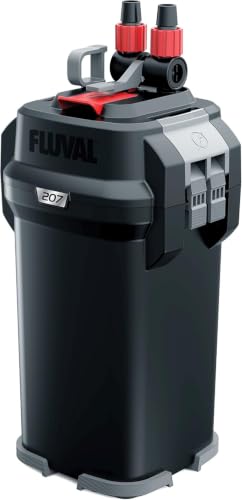
Canister filter for tall tanks, ensures stable water quality.

Adjustable flow protects delicate fins while maintaining water quality.
Browse discountedAquarium Filterson Amazon
- The fix: a tall forty-gallon breeder (36” x 18” x 16”) plus spotless water.
- The bottom line: give them vertical room to unfurl, or watch their growth hit a hard, sad ceiling.