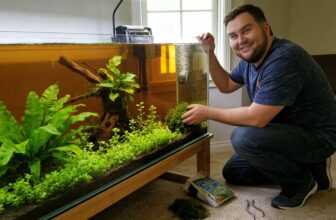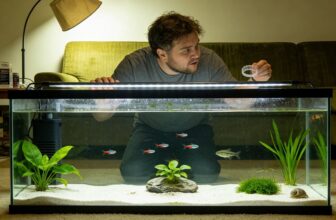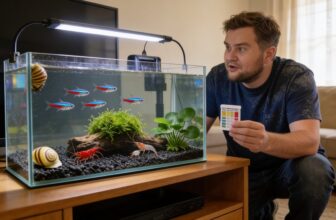
You’ll get cleaner water and fewer water changes with lucky bamboo, since it gobbles up nitrates like a teenager at a buffet.
Give it steady CO₂ (pressurized is best), low-moderate lighting for 10–12 hours, and a 5-gallon tank minimum.
Keep stalks shallow in nutrient-rich substrate, trim mushy roots, and avoid goldfish.
It’s basically a low-maintenance, decade-long plant that does your water work.
Stick around—there’s a setup trick you won’t want to miss.
At A Glance
- Lucky bamboo thrives in 59-80°F water with low-moderate lighting and steady CO₂.
- Use nutrient-rich substrate at least 3 inches deep; avoid direct sunlight.
- Submerge stalks with 1+ leaf joint; trim lower leaves and root in dechlorinated water.
- Perform weekly 25% water changes to control nitrates and prevent rot.
- Compatible with Neon Tetras, Cherry Shrimp, and Nerite Snails; avoid goldfish.
Why Lucky Bamboo Works in Aquariums (And What to Expect)
Since lucky bamboo is actually a water‑tolerant tropical understory plant rather than true bamboo, it adapts surprisingly well to aquarium life—if you play by its rules.
Since lucky bamboo is actually a water‑tolerant tropical understory plant rather than true bamboo, it adapts surprisingly well to aquarium life—if you play by its rules.
You’ll get a sturdy stalk that soaks up nitrates, helping your tank stay clean and stable.
It grows anywhere from a few inches to four feet, so you can place it up front or as a background accent.
Most people say it lives about ten years, though yours might beat that record—or not.
It’s forgiving, but don’t slack on water changes.
You belong here: just keep it trimmed, and you’re golden.
To support healthy fin recovery, maintain nitrate under 20 ppm with weekly water changes.
Using non‑phosphate formulas prevents algae blooms while the bamboo absorbs excess nutrients.
What to Know Before Adding Lucky Bamboo to Your Tank
Before you toss a lucky bamboo stalk into your tank, know that it’s not a set‑it‑and‑forget‑it plant. It’s a *Dracaena*, not true bamboo, so it craves specific water parameters—freshwater only, 59‑80°F, low‑moderate light for 10‑12 daily hours.
Skip that, or yellow leaves or stunted growth shows up fast.
You’ll need a nutrient‑rich substrate, planted 3‑4 inches deep, plus CO₂ and aeration gear.
No brackish tanks—game over.
Test ammonia, nitrite, and nitrate weekly, do 25% water changes, or you’re asking for rot.
It’s hardy but demands respect.
Bottom line: plan ahead, or it’s a pricey lesson.
A UL‑approved heater can help maintain the steady 78°F temperature tropical species require, but smaller starter kits often omit this essential gear. For secure placement inside the tank, consider using heavy ceramic plugs that provide stable anchoring and prevent drift during water changes.
Place Lucky Bamboo in Foreground, Midground, or Background
Lucky bamboo’s height—from a few inches to nearly four feet—dictates its spot in your tank.
Stalks under six inches belong in the foreground, creating a neat carpet edge.
Stalks under six inches belong in the foreground, creating a neat carpet edge.
Midgrow varieties, around one to two feet, fill the middle zone nicely without blocking views.
Taller stalks, reaching three to four feet, anchor the background, giving depth and hiding equipment.
You’re joining a community that values thoughtful placement, blending form with function.
Just measure your stalks before planting; nobody wants a bamboo surprise blocking your angelfish’s grand entrance.
Keep it simple, keep it practical, and your tank feels like home.
If you need extra height to hide equipment, consider pairing the bamboo with a cover that allows high light transmission for healthy growth.
To enhance visual appeal and fish health, pair your bamboo with a tank that offers customizable underwater ambience.
Tank Size, Substrate, and Water Conditions for Lucky Bamboo
You don’t need a massive tank, but going smaller than five gallons is asking for trouble. That’s the minimum; larger tanks keep water stable—your bamboo’s best friend. Pick a nutrient-rich plant substrate, at least three inches deep, so roots dig in without flopping. Water-wise, keep it freshwater only, 59–80°F, and change 25% weekly to dodge ammonia spikes. For consistent temperatures, choose a heater with a digital display thermostat that maintains ±1°F accuracy. Many modern heaters include a low-water detection feature to automatically shut off and prevent damage if the water level drops.
| Parameter | Ideal Range |
|---|---|
| Tank size | 5+ gallons |
| Substrate depth | 3+ inches |
| Temperature | 59–80°F |
| Water changes | 25% weekly |
Stick to these specs, and you’re in the club—no drama, just growth.
Lighting, CO₂, and Oxygen for Healthy Lucky Bamboo
Now set up the water and substrate, it’s time to talk about keeping your lucky bamboo alive through light, CO₂, and oxygen.
You’ll want low to moderate light—10‑12 hours daily, no direct sun. Too much burns leaves; too little, you get stunted growth and yellowing. Think Goldilocks, honestly.
For fully submerged stalks, CO₂ matters. A pressurized system does magic, but liquid carbon works on a budget. Bubbles from an air stone? Non‑negotiable for oxygen. Without them, roots rot fast. For reliable oxygen flow, consider using a LANDEN Aquarium Canister Filter Hose Connector for easy push‑in attachment to your filtration system. Using a feeder like the Lukovee with Wi‑Fi Connectivity allows you to maintain consistent feeding schedules while away.
- Light: Low‑moderate, 10‑12hrs, 5‑10 watts.
- CO₂: High for full sub—skip if partial.
- Oxygen: bubbler or strong filter always.
Bottom line? Don’t overthink. Match these, and your lucky bamboo won’t just survive—it’ll thrive in the crew.
Lucky Bamboo vs. True Bamboo: What’s the Real Difference?
The difference between lucky bamboo and true bamboo isn’t just botanical—it’s like comparing a housecat to a tiger. You’re getting *Dracaena sanderiana*, a tropical lily, not a grass at all.
True bamboo grows woody, invasive, and needs soil; lucky bamboo thrives in water, stays under 4 feet, and won’t take over your tank. It’s a docile, forgiving houseplant—think of it as bamboo’s laid‑back cousin.
Perfect for aquariums as it absorbs nitrates without demanding strong light or special CO₂. Just don’t plant it like real bamboo, or you’ll rot the stalk. Stick with this easygoing option. It’s your best bet for a clean, low‑stress setup. A clear polycarbonate canopy provides shatter‑resistant access and a distortion‑free view for easy maintenance of the bamboo.
For stable placement in the sump, acrylic stands offer transparent, lightweight support that dampens noise and keeps the water level consistent.
How to Plant Lucky Bamboo Correctly for Strong Roots
So, you know lucky bamboo isn’t a real bamboo at all—it’s basically a water‑loving lily in disguise.
For strong roots, plant it deep. Bury the stalk at least three to four inches into a nutrient-rich substrate; fine gravel or sand works best.
Don’t compact the soil too tightly—delicate roots need room to spread. Anchor the cutting above the substrate so you can spot new white roots within days.
Check weekly for rot; healthy roots look firm, not mushy.
Check weekly for rot; healthy roots look firm, not mushy.
Consistent water parameters—59‑80°F, low ammonia—keep your bamboo thriving, and regular water changes of 20% only help preserve beneficial bacteria. Remove any activated carbon from the filter before adding medications to prevent absorption.
You’ve got this.
Step-By-Step Guide to Propagating Lucky Bamboo From Cuttings
You’ll want to start with a healthy cutting that has at least one leaf joint—two or three is better—because those nodes are where new growth will emerge. Snip an inch below a node with sharp scissors, then trim off the lower leaves so they don’t rot underwater. Root those cuttings in a separate jar of dechlorinated water for two weeks, changing it every three days. Yes, it’s that easy—like cloning a plant, but without the mad‑scientist lab coat.
| Step | Mistake That Stings |
|---|---|
| Cutting too short | A tiny cutting struggles; you’ll both feel the pain. |
| Leaving lower leaves | They rot, stinking up your tank—nobody likes a stinky friend. |
| Skipping water changes | Algae slimes your cutting; you’ll watch it sulk. |
| Planting too deep | Roots suffocate; your cutting gasps for air. |
| Using tap water | Chlorine burns roots—ouch, that’s your fault. |
Once you see tiny white roots, you’ll feel like part of the plant‑propagation club. Welcome, friend—you belong here.
How to Fix Yellowing Leaves and Root Rot in Lucky Bamboo
Yellowing leaves and root rot in lucky bamboo are a plant parent’s version of a check‑engine light—messy, alarming, and begging for a quick fix. Don’t panic; you’re in good company.
First, snip off any mushy, brown roots with clean scissors—no mercy. Then, trim yellow leaves at their base. Rinse the stalks under lukewarm water, removing slime.
Replace your tank water and check your filter; poor circulation invites rot. Boost oxygen with a bubbler ($10–$20) and dial back lighting to 10 hours daily. Consider adding a water chiller to maintain stable temperatures and prevent bacterial growth that worsens root rot. A programmable timer with sunrise/sunset simulation can gently ease your bamboo into the light cycle, reducing stress and preventing further yellowing.
Finally, give your bamboo a pep talk—it’ll perk up. You’ve got this.
Common Health Problems: Spot Symptoms Early
You’ve already got your scissors out for yellow leaves and root rot, so let’s keep them handy—spotting health problems early saves you a bigger headache later.
Brown spots? That’s usually too much light or a phosphorus shortage.
Brown spots? Usually too much light or a phosphorus shortage—keep an eye on both.
Small leaves and leggy growth scream “feed me” or “more CO₂, please.”
Stunted stalks often mean ammonia’s creeping up—test your water, stat.
Catch these signs fast, and you’ll fix them before your lucky bamboo turns into a sad, crispy mess.
You’re in this alongside your tank, so stay sharp—your plant’s relying on you.
If murky water persists after addressing plant health, try adding a water clarifier designed for freshwater aquariums to quickly bind fine particles.
Regularly replacing worn pre‑filter sponge rolls on your pump can also prevent debris buildup that stresses aquatic plants.
Best Tank Mates: Fish, Shrimp, and Snails That Thrive
Which fish actually won’t turn your lucky bamboo into an expensive, shredded salad? You’d think goldfish would be elegant companions—nope, they’re hungry bulldozers. Instead, choose gentle swimmers that respect your stalks.
| Tank Mate | Why It Works |
|---|---|
| Neon Tetras | Small, peaceful, and ignore bamboo completely. Perfect for nano tanks. |
| Cherry Shrimp | Scavenge algae without nibbling stalks. Cost: ~$3 each. |
| Nerite Snails | Clean glass and leaves, won’t uproot plants. Hardy and reliable. |
Stick with these three. They’ll share space without drama, just like you want. Your lucky bamboo stays safe, your tank stays peaceful, and you feel like you’ve got this figured out. Compatible slow, peaceful tank mates like these avoid the swim bladder disorder caused by poor diet and water quality in more sensitive species. For a similarly calm community, Harlequin Rasboras thrive in groups of eight or more and will ignore bamboo stalks entirely.
Let Your Lucky Bamboo Clean the Water Naturally
Since your lucky bamboo already looks better than that sad pothos in the corner, let’s make it earn its keep by scrubbing your water clean.
You won’t need fancy filters—this plant absorbs nitrates, those nasty leftovers from fish waste and rotting food. It’s like having a quiet, green roommate who does dishes.
For a ten‑gallon tank, a few stalks slash your nitrate levels noticeably within weeks. That means fewer water changes, less stress for your fish, and more time enjoying your setup. This process mimics the dual‑stage regulator safety by providing a stable, gradual reduction of pollutants rather than sudden spikes.
It’s a simple win you can brag about to fellow aquarists. Pairing this with a 300‑500 µm air stone ensures stable oxygenation for both fish and plant roots.
Join the club.
Setting up a Paludarium or Vivarium With Lucky Bamboo
If you eyeing a paludarium or vivarium—a hybrid setup with both water and land areas—lucky bamboo is your MVP.
It thrives with its lower half submerged, roots anchored in substrate three inches deep, whereas its leaves reach into humid air.
Keep that water fresh, temps between 59‑80°F, and lighting low to moderate for 10-12 hours daily.
Pair it with frogs or toads, and you’re part of a smart crew pulling off that land‑water balance.
No CO₂ needed here; you’ve got this.
For isolating sensitive animals, choose a Multi‑Chamber Large Isolation Box that offers acrylic clarity and separate compartments for quarantine or breeding.
A stand with adjustable feet helps keep the water surface level and reduces stress on delicate amphibians.
Long-Term Care: Water Changes, Pruning, and Lifespan
Once you’ve got your lucky bamboo tucked into its tank, the real magic—and the occasional comedy of errors—lies in the long game.
The real magic—and the occasional comedy of errors—lies in the long game.
You’ll swap 25% of the water weekly—no skimping, or algae throws a party.
Prune yellow leaves with sharp scissors, trimming close to the stalk; that’s its golden ticket to fresh growth.
Expect a decade of life, assuming you don’t drown it in love or neglect.
Check roots monthly for mush—snip rot fast.
Keep CO₂ steady, light moderate, and your bamboo won’t bail on the crew.
You can pair it with a low‑noise operation pump like the POPOSOAP 660GPH to maintain gentle water movement without disturbing the tank.
Bottom line: consistent care, not perfection, earns you ten years of green.
Frequently Asked Questions
Can Lucky Bamboo Grow Fully Submerged Long Term?
No, you can’t keep lucky bamboo fully submerged long term without serious effort.
It’ll survive a few months, then rot.
For real success, keep its leaves above water—it’s a semi-aquatic plant, not a true aquatic.
Fully submerged needs high CO₂, strong oxygen, and perfect water: 59-80°F, low ammonia.
Even then, it’s risky.
Stick to partial submersion; your bamboo will thrive, not just survive.
Does Lucky Bamboo Need a Dormant Period Each Year?
No, your lucky bamboo doesn’t need a yearly dormant period—it’s not a typical plant that goes to sleep.
In your aquarium, it keeps growing year-round as long as water parameters stay stable, with temps between 59–80°F and weekly 25% water changes.
You’ll just keep trimming stalks that get too tall, like a haircut it can’t refuse.
This hardy plant’s a set‑and‑forget workhorse, not a diva demanding seasonal breaks.
How Do I Prevent Algae on Lucky Bamboo Stalks?
You can stop algae on lucky bamboo stalks by keeping leaves above water—submerged leaves rot and feed algae.
Scrub stalks gently weekly with a soft sponge; don’t use soap.
Limit light to 10–12 hours daily, and avoid direct sun.
Add a few shrimp or snails—they’re like tiny cleanup crews.
Test water weekly; high nitrates invite algae.
Keep it simple, you’ll win this slimy battle.
Can Lucky Bamboo Flower Underwater in an Aquarium?
No, lucky bamboo can’t flower underwater in an aquarium. It’s a tropical plant that blooms only above water, and even then, only rarely.
Underwater, your stalks focus on survival—growing roots and leaves—not reproduction. You’ll get healthier growth and maybe small, insignificant flowers if you let the tips emerge above the surface. Otherwise, don’t expect any blooms beneath the waterline.
Keep your focus on stable conditions and clean water instead.
Is Lucky Bamboo Safe for Turtles or Amphibians?
Yes, lucky bamboo is typically safe for turtles and amphibians.
You’ll want partially submerged stalks—turtles nibble leaves but won’t get poisoned.
Amphibians love perching on the stems.
Keep leaves above water to avoid rot, and watch for burrowing frogs uprooting shallow plants.
Deep planting, a few inches, solves that.
It’s a hardy, low‑light option that scrubs nitrates—just don’t expect it to flower or replace your filter.
Stick with it for a natural, tolerant setup.
Rounding Up
So, can you grow lucky bamboo fully submerged? Yes—but you’ll need decent CO₂ injection (about $20–$30 for a DIY kit) and a five-gallon tank minimum. Without it, stalks rot. With it, they scrub nitrates like tiny green Roombas.
- Needs nutrient-rich substrate, three inches deep
- Low-to-moderate light, 10–12 hours daily
- Pair with shrimp or snails, not goldfish
Sure, it’s not real bamboo—but real bamboo would’ve just died. Your fish won’t care about taxonomy. Give it proper care, or watch it sulk.