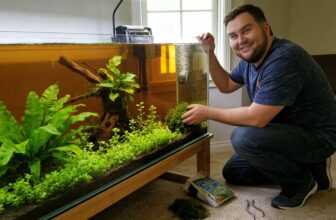
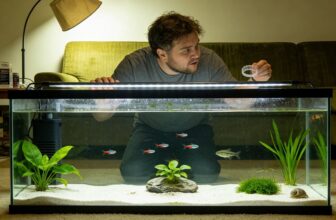
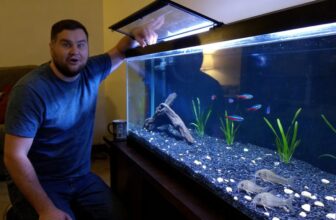
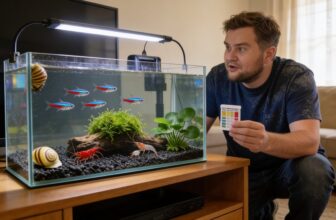
If you’re fighting algae although bright lights and fertilizers, you’re missing CO₂.
Without it, plants choke, algae thrives.
Pressurized gas injection—costing $100–$300 upfront—delivers 30–40 ppm, crushing liquid carbon’s measly 10 ppm.
Plants outgrow algae, consume nutrients first, and form a “team” that starves competition.
Start at one bubble per second, watch for pearling, and tweak slowly.
My first regulator leaked—don’t skip PTFE tape.
Stick around; the gear specifics might save your next paycheck.
At A Glance
- CO₂ injection drives rapid plant growth, outcompeting algae for nutrients.
- Proper CO₂ levels enable plants to starve algae, creating a lush tank.
- Gas injection maintains stable 30-40 ppm CO₂, unlike less effective liquid carbon.
- A regulator with bubble counter and timer prevents gas waste and fish stress.
- Watch for pearling leaves and green drop checker to confirm optimal CO₂.
Why CO₂ Is the Missing Ingredient in Your Planted Tank
So you’ve got bright lights, you’re dosing fertilizers like a chemist, and your plants still look like they’re giving up on life. Take a breather.
The missing link is CO₂. Without it, growth stalls, and algae cheerfully takes over. CO₂ keeps plants thriving, outcompeting that green fuzz.
A cheap DIY setup? Risky. You need a regulator that doesn’t dump gas like a toddler with a hose. The CO2art Pro‑SE Dual Stage gives you precision—bubble counter, solenoid, five‑year warranty. No more guessing.
Bottom line: dial in CO₂, and you’re part of the secret club with lush, algae‑free tanks. Choose a supplement with documented CFU counts at manufacture and expiration to further stabilize your tank’s biological filtration.
How CO₂ Helps Plants Beat Algae
Since bright light feeds both plants and algae, plants without enough CO₂ can’t use that light to grow—so algae wins.
Bright light feeds both plants and algae, but without CO₂, only algae wins.
But here’s the trick: when you add CO₂, your plants kick into high gear. They grow fast, thick, and greedy, snatching up nutrients before algae gets a sip.
You’re not just feeding plants—you’re building a team that starves the competition. Algae doesn’t stand a chance against lush, CO₂‑fueled growth.
It’s like giving your garden a secret weapon. Using a copper‑free gel formula ensures the added nutrients are safe for shrimp and other invertebrates in your tank. You want your tank to be part of the “plants win” club, right? CO₂ is your ticket in.
5 Telltale Signs Your Plants Are Starving for CO₂
Even without a CO₂ system, your plants might be sending you distress signals—you just have to know what to look for. Spot these five clues before algae takes over.
| Sign | What You See |
|---|---|
| Stunted growth | New leaves stay tiny, old ones yellow |
| Pinholes | Leaves look like someone poked them with a needle |
| Pale color | Green fades to translucent yellow |
| Melted stems | Lower leaves disintegrate into mush |
| Algae takeover | Stringy green goo coats everything |
Don’t ignore these. Your tank’s telling you it’s gasping. You’re part of a crew that spots trouble early—fix the CO₂, and you’ll belong to the “thriving plant” club. Using a digital pH meter can help you precisely monitor the CO₂ levels your plants need to recover.
How Photosynthesis Turns CO₂ Into Plant Growth
When your plants are starved for CO₂, they can’t run the engine that turns light and water into food—that’s photosynthesis in a nutshell.
Fundamentally, plants inhale CO₂ through their leaves, then, using light energy, they split water molecules. They stitch carbon atoms from that CO₂ into sugar chains. This, my friend, is how they build new leaves, stems, and roots.
Without enough CO₂, the assembly line stalls. Your plants simply can’t grow. They’re stuck, unable to outcompete algae. Ensuring high light transmission through your tank cover supports this photosynthesis process by allowing essential light to reach the plants.
What Happens to Algae When Plants Get Enough CO₂?
Why do algae suddenly lose their grip when plants get enough CO₂? Simple—your plants finally become the bullies in the tank, outcompeting algae for light and nutrients. That green fuzz you hated? It starves. You’ll see the shift:
- Leaves grow faster, shading algae into submission
- Roots soak up nitrates and phosphates before algae can
- Water stays clearer, less green haze on the glass
- Substrate stays clean, no slimy films forming overnight
- Fish look better, swimming through a crisp, healthy jungle
You’re not just adding gas; you’re tipping the balance. When plants thrive, algae just can’t hang. It’s that satisfying—join the crew that’s finally winning.
A Water‑change bucket with a precise pouring spout helps keep your maintenance routine efficient while your plants dominate the tank.
Gas Injection vs. Liquid Carbon: Which CO₂ Source Works?
You’ve seen what happens when plants get enough CO₂—algae gets wrecked.
Now, gas injection or liquid carbon? Gas wins. Hands down. A CO₂ tank, regulator, and diffuser deliver stable, plant‑chomping CO₂ all day long.
Now, gas injection or liquid carbon? Gas wins. Hands down.
Liquid carbon’s a weak substitute, okay for nano tanks or spot‑treating algae, but it’s like using a squirt gun on a fire.
- Gas injection gives you 30-40 ppm CO₂; liquid carbon barely hits 10.
- Liquid carbon can melt delicate plants like Vallisneria.
- Cost: Gas setup runs $100–300; liquid carbon costs $10–15 monthly.
Bottom line: join the gas club. Your plants will, and algae won’t.
For those running a gas setup, choosing a filter that maximizes oxygenation features like a waterfall return can further boost plant health and bio‑filter efficiency.
Why a CO₂ Regulator Is Absolutely Worth the Investment
One regulator can save you from a world of hurt—and about $200 in wasted CO₂.
A cheap needle valve can’t hold a consistent flow, so you’ll dump gas into the tank overnight, then wonder why your fish gasp.
Don’t be that person. A proper aquarium regulator does what cheap knockoffs can’t:
- Holds your CO₂ rate steady, so your plants feast without starving the fish.
- Kills gas at night via a solenoid, saving you refills and algae blooms.
- Works with your diffuser, turning gas into a fog instead of wasteful bursts.
- Pays for itself in four months; that’s about the cost of one ruined batch of shrimp.
- Joins the club of people who dial in growth, not guess.
Skip the pain. Buy the regulator.
A dual‑stage design provides safety comparable to a seatbelt plus an airbag by dropping cylinder pressure twice.
Must-Have Regulator Features: Needle Valve, Solenoid, Bubble Counter
A regulator without the right features is just an expensive paperweight, and your plants will be the ones paying for it. You need three things to join the CO₂ club without the headache.
The needle valve gives you that microscopic flow control, so you can dial in exactly one bubble per second, not a geyser.
A solenoid is your smart shut-off, turning gas off at night when plants don’t photosynthesize, saving CO₂ and your fish.
Finally, a bubble counter lets you see your flow, confirming everything’s working. It’s the difference between thriving and merely surviving. Get these, and you’re part of the planted-tank crew. For example, systems like the Hygger 2L kit include a 12V waterproof solenoid paired with a timer for consistent automated control.
CO₂ Regulator Showdown: Comparing 5 Best Models
Let’s get the elephant (or rather, the CO₂ tank) in the room sorted. You’ve got five top regulators, each with a job. Here’s how they stack up:
- CO2art Pro-SE Dual Stage: Twin gauges, needle valve, solenoid, bubble counter, and a 5-year warranty. Rock-solid for big tanks.
- Fzone Triple Stage: Works with paintball or standard tanks, fine needle valve, DC solenoid. Perfect for medium planted setups.
- Tunze Dual Gauge: German engineering, pressure relief valve, no solenoid. You’ll manually control it, but precision’s unmatched.
- AQUATEK Mini: Dual gauges, fine needle valve, solenoid. Designed for nano tanks—small but mighty.
- ISTA: All-metal, dual gauges, solenoid, rugged. Built for larger, demanding systems.
Your choice depends on your tank size and whether you want automation. If you need a powerful return pump to circulate CO₂-rich water, consider a model like the Jebao MDP‑3500 Smart DC Pump for precise Wi‑Fi control.
Fzone vs. Tunze CO₂ Regulator: Which One Wins?
Here’s the thing: picking between the Fzone Triple Stage and the Tunze Dual Gauge isn’t about which is “better”—it’s about what you’re actually running.
If you’ve got a paintball tank or want electronic control from a 12V solenoid, the Fzone’s your buddy—$75 gets you triple-stage stability, a bubble counter, and a check valve. That’s plug-and-play convenience.
But if you’re running a standard CGA-320 tank and crave German precision, Tunze wins. It’s $90, dual gauges, manual fine adjustment—no solenoid, so you’re twisting valves yourself. That’s lab-quality control for the tinkerer. Fzone auto top off systems also use AI evaporation analysis to reduce pump cycles by up to 60 percent.
Bottom line: Fzone for automated ease, Tunze for hands-on accuracy. Pick your tribe.
How to Connect Your CO₂ Regulator in 5 Minutes
Wrap PTFE tape around the tank threads—three layers, like a tiny mummy.
Screw the regulator onto the tank; hand‑tighten only, no Hulk moves.
Attach silicone tubing from regulator outlet to your diffuser—snug fit, no leaks.
Connect your bubble counter inline (if included) and fill it halfway with water.
Crack the tank valve slowly, then close it—listen for hissing, that’s your enemy.
You’re one of us now, no floods required. For uninterrupted dosing, consider adding power‑loss memory to your system to protect your CO₂ schedule during outages.
Fine-Tune Your CO₂ Regulator Flow for Maximum Plant Uptake
You’ve got the regulator on the tank without flooding the room—good job.
Now, let’s dial it in. Start at one bubble per second, then watch your plants.
Pearling, that’s tiny oxygen bubbles forming on leaves, means they’re feasting on CO₂.
No pearling? Crank it up carefully—half a bubble more, then wait an hour.
Too much gas turns fish into floaters, so obsessively check your drop checker.
You want lime green, not yellow panic or blue starvation.
A pressurized filter like the Anbull Bio Pressure uses a 9W UV-C lamp to eliminate microscopic algae and pathogens, supporting plant health.
Adjust morning, lock it afternoon, then leave it alone.
This rhythm makes you part of the careful crew, not a chaotic beginner.
3 CO₂ Regulator Mistakes That Kill Your Plants (and How to Fix Them)
Since your regulator is the heart of your CO₂ system, messing it up starves your plants or gasses your fish. Don’t let these three blunders ruin your tank.
- Cracking the needle valve too far, flooding bubbles until your drop checker turns yellow, stressing livestock and wasting gas.
- Leaving your solenoid unplugged overnight, letting CO₂ build up like a silent assassin while you sleep.
- Using a cheap, unregulated paintball valve that bleeds pressure, starving your plants on a Tuesday afternoon.
- Forgetting a check valve, letting tank water back‑siphon into your regulator—hello, expensive paperweight.
- Setting your bubble counter at 2 bps for a nano tank, treating it like a 75‑gallon behemoth.
Fix each with a fine‑adjustment valve, a timer, and a matching regulator to your tank size. We’re all learning this together. To ensure accurate CO₂ levels, always rely on a NIST-traceable hydrometer for precise specific gravity readings.
Match Your CO₂ Regulator to Tank Size and Plant Demands
Picking the wrong regulator for your tank is like putting a lawnmower engine on a race car—it’ll run, but not well.
Picking the wrong regulator for your tank is like putting a lawnmower engine on a race car—it’ll run, but not well.
For a 10‑gallon nano, grab the AQUATEK Mini ($70); it’s perfect for paintball bottles.
Your 75‑gallon jungle? The CO2art Pro‑SE ($200) handles heavy plant demand with its dual‑stage precision—no guesswork.
Match tank size to regulator flow.
Small setups don’t need huge canisters; big tanks won’t thrive on a cheap paintball rig.
That’s just common sense, right?
Check your plant load: high light and dense greenery demand a solenoid for night shut‑off.
Don’t overspend or undershoot—belong to the well‑balanced tank club.
For smaller tanks, avoid over‑dosing as it can clog filters and stress fish.
Frequently Asked Questions
How Often Should I Refill My Co₂ Tank?
You’ll refill your CO₂ tank every 2–6 months, depending on tank size, lighting, and plant demand.
A small paintball bottle in a nano tank might last 2 months, whereas a 5‑pound canister for a heavily planted 40‑gallon can stretch to 6 months.
Check your bubble counter daily—if bubbles slow, it’s time.
Running out mid‑week? That’s a classic rookie move.
Do yourself a favor: keep a spare tank handy for swap‑and‑go convenience.
Can I Use a Co₂ Regulator With a DIY Yeast System?
You can use a CO₂ regulator with a DIY yeast system, but honestly, it’s overkill.
Yeast systems produce low, inconsistent pressure, so a regulator’s fine‑tuning is wasted—you’ll get better results with a simple diffuser and check valve.
Save the regulator for a proper CO₂ tank, where its precision actually matters.
For yeast setups, keep it cheap and simple; don’t overcomplicate a low‑budget approach.
If you’re serious about growth, skip the yeast entirely and grab a paintball setup instead.
Will Co₂ Injection Harm My Fish or Shrimp?
No, CO₂ injection won’t hurt your fish or shrimp if you do it right.
The key is control—using a regulator with a fine‑adjustment valve, like the Fzone Triple Stage, keeps levels stable.
You’ll target 20–30 ppm; go wilder than 40 ppm, and you’re asking for gasping livestock.
Start slow, add a drop checker to monitor, and run the solenoid off at night.
Your plants will thank you, your critters won’t notice, and you’ll feel like a pro without the panic.
Bottom line: steady CO₂ is safe CO₂.
What Is the Ideal Co₂ Bubble Rate per Second?
You’re aiming for 1-2 bubbles per second in a standard planted tank—but that’s a moving target.
Your tank size, plant mass, and light intensity all shift that number.
Too few bubbles, your plants stall; too many, you gas your fish.
Start at one bubble per second, watch your drop checker (it turns green at 30 ppm CO₂), and adjust slowly.
That sweet spot? It’s where your plants pearly and algae stays shy.
You’ll nail it.
Do I Need a Co₂ Drop Checker for Safety?
No, you don’t *need* one for safety, but a drop checker—a small glass bulb that measures dissolved CO₂—saves you from gasping fish.
Without it, you’re guessing; plants stall, algae wins, and your tank becomes a science experiment gone wrong.
Cheap checkers run $10-$15; they’re a no-brainer insurance policy.
Bottom line: skip it only if you enjoy risking your fish’s gills for a few bucks.
Don’t be that aquarist.
Rounding Up
So, that’s the deal. CO₂ isn’t optional if you want a tank that grows plants, not green slime. A decent regulator runs $80–150; don’t cheap out (looking at you, $30 Amazon specials that dump gas overnight). For a 20-gallon, a paintball setup works fine. Bigger tank? Go 5-pound cylinder. It’s a one‑time setup for daily payoff. Your plants will finally use the light you’re paying for. Bottom line: inject CO₂, stop feeding algae.