I’ve run CO₂ aquarium systems on tanks from desktop nano setups to 120-gallon showpieces, and I’ve learned that bubble counters save your plants while automatic relief valves save your living room. The metal discs that vent at 70 kilograms aren’t optional—they’re peace of mind pressed into steel.
For tanks under ten gallons, I keep coming back to slim aluminum regulators paired with 45-gram disposable cartridges. They’re discreet, they mount anywhere, and they don’t dwarf a scape built around a single stone.
Once you cross forty gallons, 4-liter steel cylinders become non-negotiable. The dual-stage valves hold line pressure steady through temperature swings, so your flow rate doesn’t drift while you’re at work.
I won’t wire a system without a timed solenoid anymore. Kills the gas at lights-out, slashes refill costs, and stops the morning pH crash that wiped my neon tetras in 2022.
The glass drop checker is my daily reference. That bulb shifts from blue to green when CO₂ hits 25-30 parts per million—right where plant growth explodes but fish respiration stays easy.
Full kits from established brands run $200-$400, which stings until you price the alternatives. A DIY citric acid rig with baking soda drops running costs to roughly ten cents daily, though you trade convenience for the savings.
Bottle size matters more than most hobbyists admit. Tall cylinders suit rimless stands with vertical clearance; squat 2-liter variants slide under ADA-style cabinets where every inch counts. Match your tank depth to working pressure—deeper water columns need more PSI to drive diffusion across the full water column.
Upgraded Aquarium CO2 Generator System with Timer (5L)
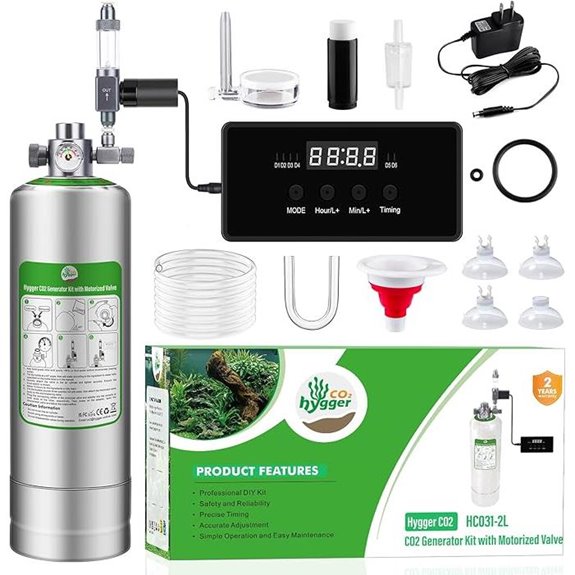
Built from 1.5 mm SUS304 stainless steel, this five-liter cylinder feels substantial in my hands since it is about twenty percent thicker than most standard bottles I’ve handled.
The automatic pressure relief valve, which is a safety feature that opens when pressure gets too high, activates at 30-40 bar.
Hygger’s motor valve, a timer-controlled opening for gas flow, replaces the usual solenoid and lets me set precise schedules.
The soft clicking sound when it operates reminds me the system is working.
I appreciate the quick-release snap-in design for the bubble counter and tubing, no more fiddling with screw-on fittings.
The timer requires patience: I must first shut it off manually, then re-enable automatic mode to start the built-in program.
Soaking the diffuser for twenty-four hours before first use prevents frustration when bubbles don’t appear immediately.
| Complete Aquarium CO2 System for Nano Tanks |  | Best for Nano Tanks | System Type: Disposable cartridge regulator | Capacity/Size: 45g cartridge | Primary Material: Aluminum | LOWEST AMAZON PRICE | Read Our Analysis |
| Aquarium CO2 Generator Kit Double Pressurization Enhanced Version G700S |  | Best Double Pressurization | System Type: DIY citric acid generator (4L) | Capacity/Size: 4L gas storage / 600ml liquid | Primary Material: 304 stainless steel | LOWEST AMAZON PRICE | Read Our Analysis |
| ZRDR 4L CO2 Generator System for Aquarium Plants |  | Best Safety Features | System Type: DIY citric acid generator (4L) | Capacity/Size: 4L | Primary Material: 304 stainless steel | LOWEST AMAZON PRICE | Read Our Analysis |
| BAOSHISHAN 2L Aquarium CO2 System with Regulator |  | Best Precision Control | System Type: DIY citric acid generator (2L) | Capacity/Size: 2L | Primary Material: 304 stainless steel | LOWEST AMAZON PRICE | Read Our Analysis |
| 2L Aquarium CO2 Generator System for Plants |  | Best Rated 2L Kit | System Type: DIY citric acid generator (2L) | Capacity/Size: 2L | Primary Material: SUS304 stainless steel | LOWEST AMAZON PRICE | Read Our Analysis |
| FZONE Aquatic CO2 Drop Checker for Aquarium Fish Tank |  | Best Drop Checker | System Type: CO2 drop checker/monitor | Capacity/Size: 15ml solution | Primary Material: Glass | LOWEST AMAZON PRICE | Read Our Analysis |
| Glass CO2 Drop Checker for Aquarium Plants |  | Best Premium Drop Checker | System Type: CO2 drop checker/monitor | Capacity/Size: 15ml solution | Primary Material: Borosilicate glass | LOWEST AMAZON PRICE | Read Our Analysis |
| Pawfly Glass CO2 Drop Checker for Aquarium |  | Best Budget Drop Checker | System Type: CO2 drop checker/monitor | Capacity/Size: 20 drops reagent | Primary Material: Glass | LOWEST AMAZON PRICE | Read Our Analysis |
| Aquarium DIY CO2 Generator System Kit G200 |  | Best DIY Starter Kit | System Type: DIY bottle kit (2L bottles) | Capacity/Size: 2L x 2 bottles | Primary Material: ABS plastic, PET bottles | LOWEST AMAZON PRICE | Read Our Analysis |
| Aquarium CO2 System 2L with Double Switch |  | Highest Rated | System Type: DIY citric acid generator (2L) | Capacity/Size: 2L | Primary Material: SUS304 stainless steel | LOWEST AMAZON PRICE | Read Our Analysis |
| Upgraded Aquarium CO2 Generator System with Timer (5L) |  | Best Timer Integration | System Type: DIY citric acid generator (5L) | Capacity/Size: 2L or 5L | Primary Material: SUS304 stainless steel | LOWEST AMAZON PRICE | Read Our Analysis |
| FZONE 2.5L Aquarium CO₂ System for Planted Tanks |  | Best 2.5L Capacity | System Type: DIY citric acid generator (2.5L) | Capacity/Size: 2.5L | Primary Material: 304 stainless steel | LOWEST AMAZON PRICE | Read Our Analysis |
| API Co2 Booster Freshwater Aquarium Plant Treatment 8 Fl oz Bottle |  | Best Liquid Alternative | System Type: Liquid CO2 booster | Capacity/Size: 8 fl oz (237ml) | Primary Material: Liquid solution (bottle) | LOWEST AMAZON PRICE | Read Our Analysis |
| FZONE Desktop Aquarium CO2 System Regulator |  | Best Disposable Cartridge | System Type: Disposable cartridge regulator | Capacity/Size: 45g cartridge | Primary Material: Aluminum | LOWEST AMAZON PRICE | Read Our Analysis |
| Aquarium CO2 Generator System Kit (G211) |  | Best 4-in-1 Diffuser | System Type: DIY bottle kit (2L bottles) | Capacity/Size: 2L bottles | Primary Material: Metal/plastic components | LOWEST AMAZON PRICE | Read Our Analysis |
| Dual Stage CO2 Regulator Aquarium with Expandable Manifold |  | Best Dual-Tank Setup | System Type: Dual-stage regulator (cylinder) | Capacity/Size: CGA320 cylinder | Primary Material: Metal (manifold aluminum/brass) | LOWEST AMAZON PRICE | Read Our Analysis |
| Upgraded Aquarium CO2 Generator System with Timer (5L) | | Best Quick-Release Design | System Type: DIY citric acid generator (2L/5L) | Capacity/Size: 2L or 5L | Primary Material: SUS304 stainless steel | LOWEST AMAZON PRICE | Read Our Analysis |
| FZONE 5.5L Aquarium CO2 Generator System Kit |  | Best Heavy-Duty Capacity | System Type: DIY citric acid generator (5.5L) | Capacity/Size: 5.5L (600-800g material) | Primary Material: SUS304 stainless steel | LOWEST AMAZON PRICE | Read Our Analysis |
More Details on Our Top Picks
Complete Aquarium CO2 System for Nano Tanks
I hold this slim aluminum regulator in my hand, and I feel a small spark of relief. This complete aquarium CO2 system—just 9.8 by 2 inches—weighs almost nothing, so I grip it easily with one hand.
It fits my nano tank perfectly, the small aquariums that need gentle care.
The aluminum body, seamless and sealed tight, connects two ways: standard 5/8″ threaded cylinders, or smaller 3/8″ ones with the adapter I’ve snapped on. No twisting tubes, just quick-connect clicks.
One 45-gram cartridge, running one bubble per second for eight hours daily, lasts me fifty days—no constant refills, no fuss.
Help stays available, always, if I need it.
- System Type:Disposable cartridge regulator
- Capacity/Size:45g cartridge
- Primary Material:Aluminum
- CO2 Source:Liquid CO2 cartridge
- Solenoid/Valve Type:Manual regulator (no solenoid)
- Safety Mechanism:Precision seals, seamless body
- Additional Feature:50-day cartridge life
- Additional Feature:One-hand operation
- Additional Feature:Quick-connect tubing
Aquarium CO2 Generator Kit Double Pressurization Enhanced Version G700S
The thick steel cylinder of the Clscea G700S, holding four liters of gas in a body you could mistake for a small fire extinguisher, offers something rare: room to breathe between refills, a luxury for aquarists tending tanks larger than forty gallons who tire of weekly maintenance routines.
I appreciate how the 304 stainless steel everywhere—bottle, regulator, even the triple filter—means fewer breakdowns.
The water injection solenoid bubble counter saves me daily fuss, and the John Guest fittings click together in one second.
At 4.1 stars from 297 reviews, it sits at #121 in air pump accessories—a solid, unspectacular choice.
- System Type:DIY citric acid generator (4L)
- Capacity/Size:4L gas storage / 600ml liquid
- Primary Material:304 stainless steel
- CO2 Source:Citric acid + baking soda
- Solenoid/Valve Type:Water injection solenoid
- Safety Mechanism:Pressure gauge, triple filter
- Additional Feature:Water injection solenoid
- Additional Feature:Triple steel filter
- Additional Feature:John Guest fitting
ZRDR 4L CO2 Generator System for Aquarium Plants
A heavy 304 stainless steel cylinder sits on your countertop, ready to feed your underwater garden. I like how the ZRDR 4L feels solid, four liters of pressure‑resistant metal that won’t flinch.
The safety measures comfort me. An automatic relief valve vents if pressure climbs past 70 kilograms, like a tea kettle whistling before trouble starts. The 12‑volt waterproof solenoid valve seals tight, stopping leaks before they reach your floor.
The bubble counter upgrades matter too. You inject with a syringe, no fussing with closures. Bubbles start large, settle within three days, and the atomizer—think of it as a tiny blender for gas—dissolves CO₂ better into water. You get two.
The kit holds everything: cylinder, regulator, filter, that solenoid with power supply, spare seals, suction cups, U‑tube, tubing, funnel, instructions. Direct manufacturer support answers questions without runaround.
It’s dependable equipment for patient growers, built to last past quick fixes.
- System Type:DIY citric acid generator (4L)
- Capacity/Size:4L
- Primary Material:304 stainless steel
- CO2 Source:Citric acid + baking soda
- Solenoid/Valve Type:12V waterproof solenoid
- Safety Mechanism:Auto pressure relief (>70kg), check valve
- Additional Feature:Parallel operation capable
- Additional Feature:Syringe injection bubble counter
- Additional Feature:Spare atomizer included
BAOSHISHAN 2L Aquarium CO2 System with Regulator
This 4.9‑pound silvery cylinder, born November 6, 2024, fits my hands like a promise I can keep to thirsty plants.
I appreciate its 304 stainless steel walls, 1.2 millimeters thick, which means twenty percent more metal than ordinary tanks, so I feel secure holding pressure that could feed my aquarium for forty-five days on one fill of citric acid, baking soda, and water—cheap groceries turned into plant food.
The needle valve regulator lets me set flow with surgical accuracy, a precision that reminds me how small adjustments, made patiently, grow into steady health.
I trust the 35-kilogram auto-relief valve and 12-volt waterproof solenoid, as safety, like honesty, works best when it protects without my constant watching.
The water-injectable bubble counter lets me fine-tune bubbles while everything runs, teaching me that good systems need not stop to improve.
At 4.0 stars from twenty reviewers, this kit carries modest confidence, neither boastful nor desperate, like a neighbor who shows up prepared and stays quiet about it.
- System Type:DIY citric acid generator (2L)
- Capacity/Size:2L
- Primary Material:304 stainless steel
- CO2 Source:Citric acid + baking soda
- Solenoid/Valve Type:12V waterproof solenoid
- Safety Mechanism:35kg auto-relief, manual shut-off
- Additional Feature:External thread design
- Additional Feature:45-day runtime per fill
- Additional Feature:Manual shut-off valve
2L Aquarium CO2 Generator System for Plants
My hands remember the first time I set up a CO₂ system, how I worried about pressure, leaks, and whether my plants would actually grow.
The Hygger 2L generator eases those fears with its 1.2mm SUS304 steel bottle, which means stainless steel that’s twenty percent thicker than ordinary tanks, so it holds strong under stress.
You’ll find a regulator, solenoid valve—that’s an electric on-off switch for gas—plus a bubble counter and check valve in the kit.
The automatic pressure-relief valve opens at 30-35 kg, like a safety valve on a pressure cooker, releasing before danger builds.
I appreciate the 12V waterproof solenoid for timer-controlled scheduling, though you’ll want to keep the motorized valve dry.
This system runs on citric acid and sodium bicarbonate powders, which you buy separately, creating CO₂ through a simple chemical reaction, like an elementary school volcano experiment controlled and contained.
Soak your diffuser twenty-four hours first, and check connections if bubbles hesitate.
It ranks #147 in aquarium air accessories with 4.2 stars from fifty-one reviewers, suggesting decent reliability for the price.
- System Type:DIY citric acid generator (2L)
- Capacity/Size:2L
- Primary Material:SUS304 stainless steel
- CO2 Source:Citric acid + sodium bicarbonate
- Solenoid/Valve Type:12V timer solenoid
- Safety Mechanism:30-35kg auto-relief, check valve
- Additional Feature:Motorized timer valve
- Additional Feature:Built-in check valve
- Additional Feature:Diffuser pre-soak required
FZONE Aquatic CO2 Drop Checker for Aquarium Fish Tank
The glass bulb sits in your hand like a tiny, clear egg, waiting to tell you something important about your fish’s home.
I fill this FZONE drop checker halfway with the 4dKH solution, fifteen milliliters in the little bottle they include.
The suction cup presses against my aquarium glass, holding steady.
I wait one hour, watching patience turn into information.
Blue means my plants hunger for more carbon dioxide, green means balance lives here, yellow means my fish might struggle to breathe.
This simple glass tool reads my water column continuously, no batteries, no noise.
Four-point-five stars from seven hundred forty-five people tell me I’m not alone in trusting this quiet monitor.
- System Type:CO2 drop checker/monitor
- Capacity/Size:15ml solution
- Primary Material:Glass
- CO2 Source:N/A (monitor only)
- Solenoid/Valve Type:N/A
- Safety Mechanism:N/A
- Additional Feature:4dKH pre-mixed solution
- Additional Feature:1-hour color readout
- Additional Feature:Continuous monitoring capable
Glass CO2 Drop Checker for Aquarium Plants
Glass tubes filled with colored liquid sit inside aquariums like tiny lighthouses, helping people like you and me see something invisible.
I want to show you the JARDLI Glass CO2 Drop Checker, a small tool that tells us when our underwater plants breathe comfortably. It comes as a kit: one sturdy glass tube made of borosilicate—that means laboratory-grade glass that resists heat and shocks—plus 15 milliliters of pre-mixed 4 dKH solution, and a little pipette for measuring. The whole thing weighs 1.58 ounces, about as much as a large grape.
You fill the bulb halfway with the blue liquid, attach it with a suction cup, and wait. The water inside exchanges gases with your tank, and the color shifts: blue means your plants need more CO2, yellow means too much, and green means just right, like porridge that’s perfect. This continuous monitoring keeps your plants from gasping or drowning in excess.
JARDLI released this in July 2023, and 477 fellow hobbyists have rated it 4.4 stars. That satisfaction tells me it works, simply and reliably.
- System Type:CO2 drop checker/monitor
- Capacity/Size:15ml solution
- Primary Material:Borosilicate glass
- CO2 Source:N/A (monitor only)
- Solenoid/Valve Type:N/A
- Safety Mechanism:N/A
- Additional Feature:Laboratory-grade borosilicate
- Additional Feature:Pre-mixed indicator solution
- Additional Feature:Pipette included
Pawfly Glass CO2 Drop Checker for Aquarium
Curved glass tubing sits in my hand like a tiny lighthouse, waiting to tell me if my fish and plants have enough invisible CO₂ gas to stay happy.
I add twenty drops of reagent solution into the curved tube, that small bottle of liquid clutched in my palm.
The suction cups press firmly against my tank wall, holding the glass vertical with its opening downward, a silent sentinel.
Two hours later, the color speaks.
Green means balance, the sweet spot where plants breathe and thrive. Yellow warns me of too much, danger for gills. Blue means hunger, leaves starving for carbon.
The thick glass feels sturdy, won’t crack or scratch curious fins.
- System Type:CO2 drop checker/monitor
- Capacity/Size:20 drops reagent
- Primary Material:Glass
- CO2 Source:N/A (monitor only)
- Solenoid/Valve Type:N/A
- Safety Mechanism:N/A
- Additional Feature:Curved glass tubing
- Additional Feature:2-hour result time
- Additional Feature:Dual suction cups
Aquarium DIY CO2 Generator System Kit G200
A plastic bottle cap clicks into place, and I watch bubbles form in my test tube. This is the G200 kit, the heart of my planted tank’s growth.
I mix citric acid and baking soda in two liter bottles, ordinary soda bottles mind you, nothing fancy. The quick reaction tube speeds everything up, so I’m not waiting all afternoon. An acid-absorbing ball watches over my mixture, keeping consumption steady and my hands free from worry.
The pressure gauge shows me exact numbers, and a relief valve stands guard like a careful parent. I adjust my needle valve once, then use the simple white on/off switch daily. No fuss, no repeated fiddling.
The tubing resists acid, pressure, even water breakdown. ABS plastic caps won’t warp or age on me. I get a complete diffuser, check valve, and every accessory needed.
You’ll supply two two-liter bottles, baking soda, and citric acid. Never use flat bottles; they won’t hold the pressure. I feel capable running this system, like I’ve built something worthwhile with my own two hands.
- System Type:DIY bottle kit (2L bottles)
- Capacity/Size:2L x 2 bottles
- Primary Material:ABS plastic, PET bottles
- CO2 Source:Citric acid + baking soda
- Solenoid/Valve Type:Needle valve + on/off valve
- Safety Mechanism:Pressure relief valve, pressure gauge
- Additional Feature:Quick reaction test tube
- Additional Feature:Acid-absorbing ball
- Additional Feature:Standard bottle compatible
Aquarium CO2 System 2L with Double Switch
The stainless steel cylinder rests in my hands like a small fire extinguisher, six pounds of silver metal built to hold pressure and purpose.
I notice the double-switch solenoid valve first, a mechanism that lets me control CO₂ flow with simple precision—on, off, timed release, like a gentle hand guiding breath itself.
The built-in bubble counter shows me exactly how much gas travels through, drop by countable drop, so plants receive steady nourishment without drowning in excess.
I appreciate the safety valve, a hidden guardian that opens automatically if pressure grows too bold, protecting both aquarium and keeper from harm.
Refilling brings quiet satisfaction: 200 grams of citric acid and baking soda, common kitchen chemistry, transformed into life-giving bubbles for green growing things.
- System Type:DIY citric acid generator (2L)
- Capacity/Size:2L
- Primary Material:SUS304 stainless steel
- CO2 Source:Citric acid + baking soda
- Solenoid/Valve Type:Double-switch solenoid
- Safety Mechanism:Auto safety valve, check valve
- Additional Feature:Double-switch solenoid
- Additional Feature:200g powder capacity
- Additional Feature:Built-in bubble counter
Upgraded Aquarium CO2 Generator System with Timer (5L)
Built from 1.5 mm SUS304 stainless steel, this five-liter cylinder feels substantial in my hands since it is about twenty percent thicker than most standard bottles I’ve handled.
The automatic pressure relief valve, which is a safety feature that opens when pressure gets too high, activates at 30-40 bar.
Hygger’s motor valve, a timer-controlled opening for gas flow, replaces the usual solenoid and lets me set precise schedules.
The soft clicking sound when it operates reminds me the system is working.
I appreciate the quick-release snap-in design for the bubble counter and tubing, no more fiddling with screw-on fittings.
The timer requires patience: I must first shut it off manually, then re-enable automatic mode to start the built-in program.
Soaking the diffuser for twenty-four hours before first use prevents frustration when bubbles don’t appear immediately.
- System Type:DIY citric acid generator (5L)
- Capacity/Size:2L or 5L
- Primary Material:SUS304 stainless steel
- CO2 Source:Citric acid + baking soda
- Solenoid/Valve Type:Timer motor valve (non-waterproof)
- Safety Mechanism:30-40bar auto-relief
- Additional Feature:Quick-release snap-in design
- Additional Feature:2-year warranty
- Additional Feature:Automatic mode programming
FZONE 2.5L Aquarium CO₂ System for Planted Tanks
This sturdy steel canister, made from food‑grade 304 stainless steel that’s fifty percent thicker than ordinary models, holds 2.5 liters and feels reassuringly solid in your hands.
I mix citric acid and sodium bicarbonate—simple kitchen chemistry—to generate pure CO₂ right at home. No driving to refill stations, no heavy cylinders to haul around. The precision needle valve lets me dial in exactly the right bubble count, and I watch the clear bubble counter like a gentle heartbeat. The pressure gauge shows me real‑time status, so I never guess.
Safety matters to me. The manual shut‑off valve gives instant control, and the automatic relief valve releases pressure if things build too high, protecting both me and my tank.
The upgraded solenoid combines functions, reducing connections where leaks might hide. External threads stay clean, and I add water through a built‑in port without unscrewing anything.
You’ll receive tubing, diffuser, check valve, syringe, and sealing rings, ready to assemble. Just bring your own citric acid and baking soda—we call it sodium bicarbonate—to begin.
- System Type:DIY citric acid generator (2.5L)
- Capacity/Size:2.5L
- Primary Material:304 stainless steel
- CO2 Source:Citric acid + sodium bicarbonate
- Solenoid/Valve Type:Upgraded all-in-one solenoid
- Safety Mechanism:Auto-relief valve, manual shut-off
- Additional Feature:External thread cleaning
- Additional Feature:Syringe water addition
- Additional Feature:All-in-one solenoid
API Co2 Booster Freshwater Aquarium Plant Treatment 8 Fl oz Bottle
A small brown bottle holding 237 milliliters of liquid carbon sits on my shelf when I’m helping friends who want greener plants without the hiss of gas canisters.
I pick it up, feeling its modest weight of 9.6 ounces, and recall that API has spent over fifty years learning what fish need.
This liquid feeds plants two ways: quick organic carbon, plus slow-release CO₂ that bubbles gently over hours. It is safe for goldfish, cichlids, and community fish, and it will not swing your pH up or down.
You dose daily, one squeeze, alongside API’s Leaf Zone or Root Tabs if you want complete nutrition.
Think of it like a vitamin that works alone or teams up with bigger systems. For individuals testing planted tanks, or renters who cannot keep compressed gas, this bottle offers steady growth without the hardware.
The apple-free formula comes from Mars Fishcare, a name I trust when someone’s java fern looks pale and patience feels thin.
- System Type:Liquid CO2 booster
- Capacity/Size:8 fl oz (237ml)
- Primary Material:Liquid solution (bottle)
- CO2 Source:Liquid organic carbon
- Solenoid/Valve Type:N/A
- Safety Mechanism:pH-safe formulation
- Additional Feature:Liquid organic carbon
- Additional Feature:pH-neutral formula
- Additional Feature:Daily dosing regimen
FZONE Desktop Aquarium CO2 System Regulator
The small silver-grey regulator in my palm weighs just over a pound, yet it carries enough compressed carbon dioxide to feed delicate plants for nearly two months.
Let me show you why this feels like a quiet friend on your desk.
The FZONE MINI02 measures just 9.84 inches tall and 1.96 inches wide, small enough to hold in one hand like a thick book. It fits standard 5/8 inch threaded cylinders, and comes with a 3/8 inch adapter if you need it. High-strength aluminum, no seams, precision sealing—this means gas stays where it belongs.
I appreciate how they thought about beginners. The disposable 45 gram cartridge snaps in without refills, which removes a worry I once had about handling compressed gas. Quick-Connect tubing means no twisting pipes until your fingers hurt. One bubble per second, running eight hours daily, stretches that small cartridge across fifty days. Each bubble uses 0.03 milliliters of liquid CO₂, dense enough to pack real growing power into tiny spaces.
Released February 22, 2025, this regulator earned 4.5 stars from 95 reviewers. People trust it for nano aquariums, those small glass worlds on office desks and bedroom dressers.
There’s something gentle here about limits adopted rather than fought. The cartridge empties, you replace it, you begin again. In that rhythm, I find a small, patient honesty.
- System Type:Disposable cartridge regulator
- Capacity/Size:45g cartridge
- Primary Material:Aluminum
- CO2 Source:Liquid CO2 cartridge
- Solenoid/Valve Type:Manual regulator (no solenoid)
- Safety Mechanism:Single-use cartridge design
- Additional Feature:0.03ml per bubble
- Additional Feature:Disposable cartridge design
- Additional Feature:Handheld compact size
Aquarium CO2 Generator System Kit (G211)
When you press the white on/off valve with your fingertip, you’re controlling a living thing’s breakfast.
The Clscea G211 hands you that quiet power through its white on/off valve, which manages daily CO2 output without disturbing your needle valve setting.
You’ll find relief in the starting tube, a shake-and-wait system that reaches green pressure without squeezing bottles repeatedly. The metal needle valve holds steady at 4-5 seconds per bubble, durable and precise. A 4-in-1 diffuser counts bubbles, prevents backflow, and saves space.
Pressure builds; the upgraded safety valve releases it exactly when needed, protecting your setup.
Use only carbonated beverage bottles, nothing else. Ranked #284 in aquarium air pump accessories with 4.0 stars from 134 reviewers, this kit invites patience, rewards care, and asks for your steady attention each morning.
- System Type:DIY bottle kit (2L bottles)
- Capacity/Size:2L bottles
- Primary Material:Metal/plastic components
- CO2 Source:Citric acid + baking soda
- Solenoid/Valve Type:Needle valve + on/off valve
- Safety Mechanism:Upgraded safety valve
- Additional Feature:4-in-1 CO2 diffuser
- Additional Feature:Starting tube pressure
- Additional Feature:Shake-to-activate starting
Dual Stage CO2 Regulator Aquarium with Expandable Manifold
If you keep more than one tank, this regulator’s expandable manifold lets you split CO₂ between two aquariums without buying a whole second kit.
I find the Dmzosmd dual-stage regulator comforting since it handles uncertainty well. The first gauge watches your cylinder pressure, like a parent checking the fuel gauge on a long trip. The second gauge, the outlet, shows exactly what your plants receive—between 0 and 65 PSI. That precision matters to me.
The needle valve, a small dial that controls gas flow, bubbles slowly, one bubble every three seconds, giving delicate plants exactly what they need without drowning them. Built-in check valves stop water from traveling backward, protecting your equipment.
You get two manifold blocks pre-installed, two bubble counters for visual flow confirmation, plus an Allen key. Everything weighs just over a pound, compact at 7.28 by 6.3 by 3.35 inches.
The 12-volt solenoid valve runs quietly, saving energy since you sleep. Two tanks, independent control, one cylinder. That feels sensible.
- System Type:Dual-stage regulator (cylinder)
- Capacity/Size:CGA320 cylinder
- Primary Material:Metal (manifold aluminum/brass)
- CO2 Source:External CO2 cylinder
- Solenoid/Valve Type:12V DC solenoid
- Safety Mechanism:Dual gauges, safety valve
- Additional Feature:Expandable dual manifold
- Additional Feature:1 bubble per 3 seconds
- Additional Feature:CGA320 cylinder compatible
Upgraded Aquarium CO2 Generator System with Timer (5L)
A 2-liter steel cylinder sits in my hands, small enough to hide behind a mid-sized tank yet substantial enough to feed a dense planted scape for weeks.
This is the Upgraded Aquarium CO2 Generator System with Timer (5L), and I appreciate its clever design. The bottle holds 1.2 millimeters of SUS304 stainless steel, which means it resists rust and pressure well. The timer-enabled motor valve lets me automate CO2 flow, so my plants get consistent food even when I forget.
Setup feels simple once you learn the rhythm: flip to automatic, then manual off, then manual on, then back to automatic. This wakes up the program. I like the quick-release snap-in pieces, no more wrestling with screw-on parts that strip.
The motor valve makes a soft click when it toggles, like a gentle reminder it’s working. I soak the diffuser for twenty-four hours first, since dry ceramic won’t make bubbles. If bubbles don’t appear, I check my tubes for leaks, just like checking a garden hose.
Safety matters here. A relief valve opens at thirty to forty bar if pressure builds too high, protecting my fish and me. I mix baking soda and citric acid with water inside, common kitchen supplies, then seal everything tight.
The valve isn’t waterproof, so I mount it high and dry. This small limit feels fair for the freedom automation brings, like setting a sprinkler timer instead of standing with a hose.
- System Type:DIY citric acid generator (2L/5L)
- Capacity/Size:2L or 5L
- Primary Material:SUS304 stainless steel
- CO2 Source:Citric acid + baking soda
- Solenoid/Valve Type:Timer motor valve (non-waterproof)
- Safety Mechanism:30-40bar auto-relief
- Additional Feature:Program activation sequence
- Additional Feature:Snap-in assembly design
- Additional Feature:30-40 bar relief
FZONE 5.5L Aquarium CO2 Generator System Kit
The FZONE 5.5L Aquarium CO2 Generator System Kit holds a 5.5-liter stainless steel bottle, which is a container about the size of a small milk jug, built from SUS304 steel that’s 1.5 millimeters thick—25 percent thicker than the usual 1.2 millimeter bottles others sell.
This extra thickness brings me quiet comfort.
The bottle withstands up to 80 kilograms per square centimeter of pressure, which equals 1,137 pounds per square inch, and an automatic safety valve opens if pressure climbs too high.
I appreciate this protection.
Inside, I mix 600 to 800 grams of citric acid and sodium bicarbonate—common kitchen powders I buy separately—to generate carbon dioxide gas.
The precision needle valve lets me adjust flow carefully, and the bubble counter shows one bubble per second when tuned right.
A check valve stops water from sneaking backward, keeping my steel dry and rust-free.
The system runs on 12 volts DC, simple battery power, no wall outlet needed.
I can add a solenoid timer later for automatic schedules, though it doesn’t come in the box.
FZONE offers help anytime I call.
With 4.3 stars from 360 reviews, I trust this kit to feed my plants steadily.
- System Type:DIY citric acid generator (5.5L)
- Capacity/Size:5.5L (600-800g material)
- Primary Material:SUS304 stainless steel
- CO2 Source:Citric acid + sodium bicarbonate
- Solenoid/Valve Type:12V DC (optional timer)
- Safety Mechanism:Auto-relief (80kg/cm² rating), check valve
- Additional Feature:1137 PSI pressure rating
- Additional Feature:25% thicker steel
- Additional Feature:Optional timer add-on
Factors to Consider When Choosing CO2 Aquarium System Kits

A CO2 system is like a gentle helper for your underwater garden, and picking the right one means looking at five things that matter.
I’ll guide you through checking your tank size first, since a 10-gallon setup needs gentler bubbles than a 100-gallon giants gets, then we’ll examine whether you’d prefer a refillable canister you take to the store each month or a DIY yeast kit you mix on your kitchen counter.
Safety valves, fine-tuned knobs for counting bubbles per second, and solid brass or aluminum parts keep both you and your fish feeling secure.
Tank Size Compatibility
When I’m picking out a CO2 system for my aquarium, I start by looking at the bottle size since it has to match how much water my tank holds.
A 2-liter generator—that’s the metal bottle holding the gas—usually covers 20 to 40 gallons, whereas a 5-liter unit manages 50 to 80 gallons. I feel relieved when these numbers line up, since running out too fast frustrates me.
Next, I check the regulator, which is the valve controlling flow. Nano tanks need about 1 bubble per second; bigger tanks want 2 to 3. I count bubbles rising through the counter, feeling focused, steady.
Tubing length matters too. Longer runs need thicker walls, or pressure drops and plants suffer.
I measure my cabinet space, confirm the footprint fits, and verify the relief valve rating matches my tank’s maximum pressure. Safety brings quiet confidence.
System Type Selection
Three main paths stretch before me when I’m choosing how my CO2 will arrive: the small throw-away cartridges, the home-made chemical jars, or the refillable metal tanks I keep for years.
I pick disposable cartridges when I want simplicity and don’t mind replacing them monthly. They’re neat, like buying milk by the quart.
For tight budgets, I mix baking soda and citric acid in a generator—messy, patient work that rewards me with months of bubbles.
Refillable tanks feel like owning a tool, not renting it. I match my regulator to my need: a basic needle valve for steady tanks, dual-stage for precision, motor-controlled for exact computer dosing.
I watch wall thickness—1.5 mm steel beats 1.2 mm for safety.
I want bubble counters I can see, diffusers that mist fine as morning fog, check valves that guard against water creeping backward.
These choices shape my aquarium’s breath.
Pressure Safety Features
Before I twist any knob, I look for the little brass button that could save my fish—that’s the pressure-relief valve, a spring-loaded guard that pops open if pressure climbs past 30 or 35 kilograms, like a safety valve on a teapot screaming before it bursts.
I check the cylinder next, feeling for sturdy 304 stainless steel with walls at least 1.2 millimeters thick, about twenty-five percent heftier than ordinary tanks, so it holds strong when pressure pushes hard.
The regulator and needle valve must handle up to 80 kg/cm², matching whatever my generator can throw at them—no mismatched parts, no brittle weak points.
I want a clear pressure gauge, too, watching numbers in real-time, catching trouble before it grows.
One silent check valve, stopping water from sneaking backward into my CO₂ source, completes my safety net.
Flow Control Precision
I watch my bubble counter like a slow heartbeat, since that’s where precision lives—each globe of gas rising through clear liquid tells me exactly how much CO₂ reaches my plants. A good needle valve lets me slow that rhythm to one bubble every three seconds, gentle enough for delicate leaves. Most quality valves span half a second to five seconds per bubble, fitting everything from tiny nano tanks up to medium setups. I check the counter often, since seeing those bubbles proves the regulator keeps its promise. Stability matters too—the best ones hold flow within five percent, even when room temperature shifts or the cylinder pressure drops. With proper adjustment, I stop fiddling daily, and my plants breathe steady, unhurried.
Construction Material Quality
Once I’m satisfied the bubbles flow steady, I turn my attention to what holds the pressure itself—the metal skin of the system.
I look for stainless steel, like 304 SUS304, since it resists the crushing force inside. These tanks run twenty to twenty-five percent thicker than plastic ones, which means they won’t bulge or crack when you need them most. The walls should measure at least 1.5 millimeters, not the flimsy 1.2 you sometimes see, especially when pressures climb to eighty kilograms per square centimeter.
For small tanks, I appreciate aluminum regulators. They’re light, compact, and seal tight so nothing leaks.
Seamless construction matters too. Without weld lines, corrosion can’t take hold in humid air.
Finally, I check for automatic pressure-relief valves. They’re like a careful friend who steps in before trouble starts, releasing excess before the cylinder becomes dangerous.
Maintenance Requirements
After the tank is set up and running quiet, I pull out a small calendar, since every good machine needs a friend to remind it when to drink.
I mark the solenoid for a **weekly freshwater flush, since sticky buildup, which is gunk that clogs pipes, slows the CO₂ flow like a straw with a kink. I watch my pressure gauge; when it droops, I swap the 45-gram cartridge, which at one bubble per second for eight hours daily lasts about fifty days. Every two to three weeks, I wipe the bubble counter and diffuser**, since crusty minerals shrink bubbles and lie about the count. I test the pressure-relief valve monthly, making certain it pops at seventy kilograms or whatever the label says—that’s the safety click. I rub soapy water on every joint, hunting for telltale fizz that screams leak. Tightening now saves tears later.
Operating Cost Efficiency
With a pocket calculator and a coffee-stained notebook, I sit down to figure what this hobby truly costs me, piece by piece.
A 45-gram disposable cartridge—about the size of your thumb—runs roughly fifty days at one bubble per second. That pencils out to maybe forty cents daily depending where you shop. DIY mixtures, using citric acid and baking soda you buy in bulk, drop that to ten or fifteen cents a day. I feel relief knowing I can refill my own bottles, though I must remember to buy powders now and then.
The solenoid valve, that little electric gate controlling gas flow, sips electricity so gently my bill barely notices.
I add up tubing, diffusers, and bubble counters too. Stainless steel parts cost more upfront but live longer, like buying sturdy boots instead of cheap sneakers.
Dividing my yearly total by running days shows my true cost—usually under a quarter daily. That small number comforts me.
Frequently Asked Questions
Can CO2 Systems Harm Fish if Overdosed?
Yes, I’ll harm my fish if I overdose CO2. I’m careful with dosing since excess CO2 causes suffocation, rapid breathing, and death. I monitor levels closely and use drop checkers to keep my aquarium safe.
How Often Should I Refill Cylinder CO2 Tanks?
I’ll refill my cylinder every 3-6 months depending on tank size, bubble count, and cylinder capacity. I monitor my pressure gauge weekly, and when it drops rapidly, I know I’m due for a refill soon.
Is DIY CO2 Reliable for High-Tech Planted Tanks?
I don’t trust DIY CO2 for high-tech setups. You’ll struggle with inconsistent pressure and can’t hit the precise levels demanding plants need. I’ve seen algae explosions when my homemade mix fluctuated daily.
Do CO2 Systems Increase Algae Growth?
I don’t think CO2 systems directly cause algae; they actually suppress it when I’m consistent with dosing and maintenance. Algae blooms hit me only when my CO2 fluctuates or my nutrients go out of balance.
Can I Use CO2 in Tanks Without Live Plants?
You can, but I wouldn’t recommend it. Without plants to absorb it, CO2 lowers your pH and creates unstable water chemistry. You’re risking fish stress or worse—it’s simply not worth adding.