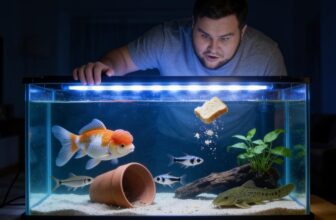
Turn your lights off at night. Period.
Fish don’t have eyelids, so total darkness is their only signal to sleep, and skipping it stresses them out, weakens immunity, and invites algae chaos.
Aim for 8–12 hours of light, then pure blackness—no excuses, no “moonlight” gimmicks unless you’re dipping in for 15 minutes of viewing.
Grab a $10 basic timer or splurge $25 on a smart plug, set it, forget it, and let your fish actually rest.
Your plants need nighttime respiration too, and your tank will thank you with brighter colors and fewer vet bills.
Keep scrolling—you’ll find the exact schedule and gear picks ahead.
At A Glance
- Aquarium fish need complete darkness at night to maintain healthy circadian rhythms and reduce stress.
- Eight to twelve hours of nightly darkness allows fish metabolism to slow and immune systems to recharge properly.
- Continuous light causes frantic swimming, weakened immunity, and increased disease susceptibility in fish.
- Plants require nighttime darkness for respiration; constant light disrupts growth and triggers algae blooms.
- Use automatic timers to ensure consistent dark periods and avoid stress from accidental overnight illumination.
Should You Turn Aquarium Lights Off at Night?
Yes, you should turn your aquarium lights off at night—and you don’t need a marine biology degree to understand why.
Your fish lack eyelids, so complete darkness signals bedtime, letting their bodies recharge properly. Leaving that LED color show running 24/7 stresses them out, regardless of fish size, causing frantic swimming. Even plants need a night-time break to respire.
Fish need darkness to sleep—no eyelids means no rest under constant light, and plants need nighttime respiration too.
The drawbacks:
- Disrupts circadian rhythms
- Weakens immune systems
- Sparks algae explosions
Use a timer, skip the midnight rave, and give everyone eight to twelve hours of solid dark. A cover net with high light transmission ensures plants still get the daylight they need while keeping fish safely contained. Your tank will thrive, and you’ll save cash on your electricity bill.
How Much Sleep Do Aquarium Fish Actually Need?
Fish need their beauty rest just like you do after binge-watching that nature documentary until 2 AM.
Your fish thrive on 8–12 hours of darkness nightly, matching their natural circadian rhythm—the internal clock telling them when to snooze and sprint. This nighttime duration lets them enter a rest state, slowing metabolism and recharging immune systems. Dim moonlights? Occasionally fine for a peek, but don’t make it a habit.
Skip the 24/7 disco. Use a $15 digital timer, set consistent on/off cycles, and watch your fish actually wake up alert instead of dragging fins. They’ll thank you with vivid colors and active days. Using a reliable test kit regularly helps confirm that stable light schedules have not thrown off your water chemistry.
Why Total Darkness Prevents Stress and Disease
Since your fish can’t pull the covers over their heads, you’re the one who needs to kill the lights. (Yeah, I know, another responsibility you didn’t ask for.) Total darkness isn’t just a nicety—it’s a physiological requirement for keeping your aquatic roommates from turning into stressed-out, disease-prone wrecks.
Your fish run on a circadian rhythm—basically an internal clock that tells ’em when to zip around and when to crash. Breaking that rhythm with midnight illumination triggers genuine algae stress, plus it keeps your fish in panic mode, weakening their immune systems. Weekly symptom checklists catch early rot, but only if total darkness allows their immune system to recover nightly.
Turn ’em off. You’re the responsible one here.
How Many Hours of Light Do Aquarium Fish Need?
8–12 hours. That’s your sweet spot, and you’ll want to stick to it.
You’re mimicking nature here, balancing your fish’s photadian rhythm—their internal clock that governs when they swim, snack, and snooze. Mess with it, and you’re basically giving them permanent jet lag. Nobody wants cranky fish.
For spectrum selection, match your lighting to your tank’s residents: 6,500K–7,500K white for planted tanks, dimmer tones for fish-only setups. Timers are your friend, except you enjoy playing sun god at 6 a.m.
Bottom line? Consistency beats intensity. Your fish will thank you by not hiding in corners, stressed and sleepless.
For small planted tanks, a light with gradual sunrise simulation can help ease fish into the day cycle naturally.
Are Moonlight LEDs Safe for Aquarium Fish?
Moonlight LEDs can be safe, but you’re walking a tightrope. Keep sessions brief—15 to 30 minutes tops—and you’ll avoid the stress that keeps fish twitching instead of resting.
Here’s what seasoned keepers swear by:
- Choose dim blue LEDs mimicking lunar glow, not spotlighting your tank like a crime scene
- Check LED spectrum stays below 470 nanometers; cooler blues won’t trigger daylight hormones
- Use timers so you’re not forgetting at 2 AM, again
- Position lights overhead, not glaring from the side like a fridge door
- Prioritize algae control by keeping intensity low; you’re not growing a reef
- Consistent calibration prevents false pH readings that mimic night-time stress and ruin algae control efforts; devices like the APERA AI209 auto-calibrate up to three points weekly.
Complete darkness remains king, but judicious moonlighting? That works.
How to Dim Your Tank for Evening Viewing
Your options break down three ways: dimmers, blue moonlight LEDs, or smart timers with sunset modes.
For evening ambiance without ruining your fish’s shut-eye, grab a $15 inline dimmer dial (works with most LED fixtures) or a dedicated moonlight strip running 0.5–1 watt, just enough glow for nighttime viewing without triggering their “stay awake” panic response.
Smart controllers like Fluval’s Plant 3.0 ($150) automate gradual darkening, mimicking nature, since yanking brightness from 100% to zero is jarring—for everyone.
Some clip-on fixtures, like the Hygger 24/7 model, include a built-in 24/7 mode that gradually transitions from sunrise to moonlight, automating this process without extra hardware.
Bottom line: keep it under 5% intensity for after-dinner tank gazing, then full darkness by bedtime.
Do Goldfish Need Total Darkness at Night?
Why do goldfish seem perfectly happy zipping around your tank at noon, yet turn into sluggish wall-huggers when the kitchen light stays on past ten? You’re witnessing goldfish vision in action—these creatures lack eyelids, so they can’t block out light, and their nocturnal metabolism demands total darkness to recharge properly.
Goldfish lack eyelids, so they can’t block out light—and their nocturnal metabolism demands total darkness to recharge properly.
Here’s what you’re dealing with:
- No eyelids means zero light control for your fish
- Darkness triggers their rest state and immune recovery
- Continuous lighting stresses their circadian rhythm
- Sluggish behavior signals sleep deprivation
- Total darkness prevents long-term health issues
Turn those lights off. Your goldfish will thank you with brighter colors and livelier mornings. This principle of rest is similar for many fish; for example, bumblebee gobies require dim LED lighting for only six hours daily to mimic their shaded habitat and prevent stress.
Do Betta Fish Sleep Better in the Dark?
If you’ve ever caught your betta staring blankly at the tank wall at 2 a.m., you might wonder if they’re plotting world domination or just desperately craving shut-eye. (Spoiler: it’s the sleep thing.) Bettas need darkness to enter their rest state, though “sleep” is a loose term since they don’t have eyelids and can’t exactly count sheep.
Your Betta circadian rhythm depends on complete darkness, not that dim blue nightlight intensity you bought for $12.99. Moonlight modes? Skip ’em. Total blackout works best.
| Light Condition | Betta Response |
|---|---|
| Total darkness | Full rest mode |
| Dim nightlight | Stressed, alert |
| Bright light | Can’t sleep, weakened |
Like many tropical fish, bettas benefit from a consistent light cycle of 8‑10 hours daily to regulate their rest periods. Bottom line: flip the switch, let them drift.
Do Mollies Need Darkness to Stay Healthy?
Do Mollies Need Darkness to Stay Healthy?
How exactly do you catch a molly at 3 a.m.?
You don’t—they’re tucked behind plants, motionless, soaking up those dark‑rest benefits like it’s a spa day.
Your mollies crave that night‑time shutdown, their Mollie circadian rhythm humming along just like yours after a double shift.
So, give them what they need:
- Unplug that tank light before Netflix starts
- Skip the “moonlight” LED gimmicks, honestly
- Block stray lamp glow with a simple tank cover
- Keep it consistently dark, like, 10-12 hours
- Accept that fish nightlife is boring—and that’s healthy
Bottom line: darkness isn’t optional, it’s medicine.
Similarly, bamboo shrimp benefit from gradual lighting adjustments to prevent stress, highlighting the importance of consistent light-dark cycles for aquarium inhabitants.
Can Natural Room Light Replace Aquarium Lights?
So you’re squinting at that sunny window, wondering if Mother Nature’s freebie beats a $40 LED rig—fair question, and honestly, sometimes she does, sometimes she leaves your tank looking like a dim cave at noon.
The verdict: Natural *room lighting room* setups work for low-tech tanks, but they’re unpredictable. A south-facing window blasts 5,000+ lux at noon, then drops to shadow by 4pm—your plants get confused, your fish get moody.
LED replacement fixes this.
- Costs $25–60 upfront, pennies monthly
- 8-hour programmable consistency
- No algae explosions from surprise sunbeams
Plants need steady photosynthesis (that’s light-to-food conversion), not solar roulette. Fish crave rhythm, not chaos. For secure filter connections, use quick-connect locking clips to prevent leaks.
Your call: free chaos, or cheap certainty?
Timers vs Smart Plugs: Automating Your Light Schedule
Consistency beats memory, and your tank doesn’t care about your weekend sleep‑ins. You need automation, plain and simple.
Your options:
- Basic timers — $10‑15, plug‑and‑play, zero Wi‑Fi headaches
- Smart plugs — $20‑35, app‑based timer integration with remote control from anywhere
- Energy‑saving benefits from precise scheduling, no accidental 14‑hour days
- Schedule flexibility for vacations, breeding phases, or that one wonky bulb
- Both beat your unreliable 11 PM “did I turn them off?” panic
Smart plugs win for adjustability. Timers win for “set it and forget it” reliability. Pick your flavor, commit, and join the ranks of tank owners who actually sleep.
Why Your Aquarium Plants Need Night Darkness Too
Plants don’t sleep like you do, but they definitely as heck need a break.
Your aquatic plants run on a 24‑hour shift, photosynthesizing all day like over‑caffeinated office workers, then switching to night respiration once the lights cut out.
Skip the darkness, and you’re inviting plant algae to crash the party—green, fuzzy freeloaders that’ll coat every leaf and rock.
Without that nightly breather, your greens can’t process nutrients properly, stalling growth and turning your carefully scaped tank into a swampy mess.
Set that timer, let your plants exhale, and watch them thrive alongside your fish.
Is Your Tank Light Causing These Stress Signs?
Your plants aren’t the only ones clocking out when lights flip off—your fish are trying to, too.
When your LED spectrum stays blazing past bedtime, you’re basically hosting a rave nobody asked for.
Watch for these red flags your lighting’s wrecking the vibe:
- Frantic, glass-surfing behavior at odd hours
- Fish hiding like they’re dodging the landlord
- Mysterious appetite crashes, since who wants breakfast at midnight?
- Algae explosions sabotaging your algae control efforts
- Listless, pale fish that look like they pulled an all-nighter
Your crew needs that 8–12 hour photoperiod. Skip the 24/7 spotlight, set a timer, and let everybody—flora and fauna—catch some actual Z’s. They’ll thank you with better color, bolder behavior, and way fewer vet bills.
How to Fix a Broken Day-Night Cycle Today
Whether you’ve been forgetting to flip the switch or your timer’s been gathering dust since 2019, breaking the all‑night light habit is easier than teaching a goldfish to play piano—and far more rewarding.
Start tonight:
- Grab a $10 mechanical timer, set it for 8 hours, boom—schedule locked.
- Ditch harsh blues; tune your LED spectrum toward warm whites, 6500K hits the sweet spot for fish color and algae control without encouraging that green carpet rebellion.
- Tonight, you go dark. Complete darkness, zero excuses—your fish, and your water clarity, will thank you.
Simple fix, big payoff.
Frequently Asked Questions
Do Nocturnal Fish Need Lights on at Night?
Nocturnal fish don’t need lights on at night.
You’ll want darkness for their natural rhythms, though a dim moonlight simulation helps you catch their nocturnal feeding without disrupting their groove.
Think of it like a nightlight for your own midnight snack runs—functional, not flashy.
Most species thrive with 8–12 hours of darkness; anything brighter stresses them out, and nobody wants grumpy fish at 3 a.m., right?
Can Fish Sleep With Red Light in Tank?
No, you shouldn’t leave red light on for sleeping fish.
- red light penetrates water deeply, still triggering melatonin suppression—your fish’s sleep hormone gets blocked, same problem as white light, just sneaky about it.
- spectral temperature matters: red sits around 2700K, which fish perceive as dim dawn, not true darkness. Your circadian rhythm needs pitch black.
- Complete darkness works best. Skip the nightlight, use a timer. Your fish—and your algae situation—will thank you.
Should I Turn off Filter When Lights Go Out?
No, don’t turn off your filter.
Your fish need that water flow running 24/7 — it’s their lifeline, literally.
Filter maintenance keeps your tank healthy as you sleep, scrubbing ammonia and debris, oxygenating water so your finned friends can breathe easy in darkness. Turning it off just to match lights? That’s like unplugging your fridge because you flipped off the kitchen switch — unnecessary, slightly tragic, definitely avoidable.
Keep it humming.
Do Baby Fish Need Different Lighting Schedules?
You don’t need a special lighting schedule for baby fish, but you’ll want to nail your cycle timing.
Fry grow fast when you sync their growth‑light to a steady 10–14 hour day, matching temperature sync to their species’ needs. Too much light stresses them; too little slows visual development, which is basically how they learn to spot food and dodge trouble.
Keep it simple: timer on, timer off, just like the grown‑ups.
Can Street Light Through Window Harm Aquarium Fish?
Street light through your window won’t usually harm your fish, but you’ve gotta watch that light intensity. A dim glow? Fine. A blazing sodium lamp blasting your tank for hours? That’s where algae growth kicks into overdrive, and your fish’s sleep schedule gets wrecked.
- Low-intensity ambient light: Typically harmless, like moonlight
- Bright, direct beams: Stresses fish, fuels algae, disrupts circadian rhythms
- Blackout curtains: $15–30 fix, total game-changer
Bottom line: If it’s brighter than a nightlight, block it. Your fish aren’t insomniacs, and neither are you—grab those curtains, save your tank, sleep easy.
Rounding Up
Flip that switch. Your fish aren’t throwing midnight raves—they need darkness like you need coffee, which is to say, desperately.
Eight to twelve hours of light, then pure blackness. Not “moonlight” gimmicks, not dim blue nonsense. Actual dark. Your $15 mechanical timer handles this better than your memory ever will.
Plants respire at night (they breathe, basically), fish rebuild their immune systems, and algae throws a tantrum. Win, win, win.
Sleep deprivation kills fish slowly. You’re not a monster, probably. Act like it.