You’ll want tank mates that are too big to swallow, too fast to catch, or armored enough to shrug off a bite.
For a single Oscar, start with a 75‑gallon tank minimum.
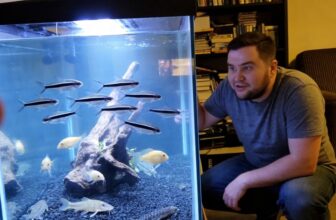
Good picks: Severums (peaceful, 12 inches), Bristlenose Plecos (armored spines), or a school of five Silver Dollars (fast top‑dwellers).
Avoid tiny fish or breeding Convicts—they’ll become snacks or bullies.
Keep filtration rated for double your tank volume and do 30% water changes weekly.
There’s more to unpack on risky picks like Jack Dempseys and feeding tricks if you stick around.
At A Glance
- Minimum 75-gallon tank for a single Oscar; 150 gallons for two.
- Pair Oscars with robust, armored bottom-dwellers like Fire Eels and Bichirs.
- Use large schools of Silver Dollars or Clown Loaches to reduce aggression.
- Avoid small or timid fish; select cichlids like Severums or Jack Dempseys.
- Add a Bristlenose Pleco for algae control and its protective armored spines.
Why Tank Size Matters for Oscar Tank Mates
Since Oscar’s aren’t exactly shrinking violets, tank size isn’t just a recommendation—it’s a survival strategy. You’re joining a club that knows this, so go big or go home.
To keep an Oscar happy, tank size isn’t a suggestion—it’s a survival necessity. Go big or go home.
A 75-gallon tank? That’s your starting line for a single fish. Anything smaller, and you’ll watch your Oscar turn into a bully, nipping at tank mates since it feels trapped.
Larger tanks—think 100 gallons or more—dilute aggression. They give everyone room to stake their claim, hide, and chill. You wouldn’t cram a Great Dane into a Mini Cooper, right? Same logic here. More water equals less drama.
Bottom line: spare no expense on that glass kingdom; your fish family deserves a peaceful neighborhood. For smaller setups, a 5‑gal Smart Mid‑Size offers a self‑cleaning system that reduces water‑change frequency, though it’s best reserved for community fish rather than large cichlids like Oscars.
Water Quality Basics for a Healthy Oscar Community
Since your Oscar’s waste output rivals a small municipal sewer system, water quality isn’t just a detail—it’s the backbone of a peaceful tank.
You’re running a full-blown bio-load, so filtration must be industrial-strength.
Grab a canister filter rated for double your tank’s volume—yes, that means 150 gph for a 75-gallon setup.
Test ammonia and nitrite weekly; any spike means war.
Shift 30% water every Monday—no excuses.
A stable pH between 6.5 and 7.5 keeps everyone breathing easy.
Bottom line: clean water equals calm fish. Keep it pristine, or you’ll be fishing out unhappy tank mates.
A U‑V Canister 400 GPH filter can help control algae from heavy bioloads with its UV sterilization feature.
Best Cichlid Tank Mates for Your Oscar
Oscars play nice with other cichlids—mostly—if you pick the right ones.
Your best bet? A Severum. It’s peaceful, hits 12 inches, and won’t start a turf war in your 75‑gallon tank.
Convict cichlids work too, but keep it single‑sex; a breeding pair turns your Oscar into a referee.
Red parrots? Certainly, but they’re messy eaters—your Oscar might bully them.
Jack Dempseys hold their ground at 8 inches, though you’ll need plenty of caves.
Green Terrors? Bold, but in a small tank, they lose.
Bottom line: match size, temperament, and tank space. You’re building a community, not a brawl.
For bottom-dwelling tank mates, ensure soft sand or smooth gravel substrate to protect their bellies while grazing.
Two Oscars Together: When It Works and When It Fails
You might be tempted to add a second Oscar to your tank after seeing how well a Severum works. But here’s the thing—it’s a gamble, not a guarantee.
- Tank size matters: You’ll need at least 150 gallons, double the minimum for one Oscar. Cramped spaces turn friends into rivals.
- Same-sized introductions matter: Adding a much smaller Oscar invites bullying. Pair them when they’re both around 4–6 inches.
- Sex and temperament matter: Two males often clash. A male-female pair works better, but you can’t always predict aggression.
- Territory setup matters: Plenty of rocks, driftwood, and caves let each claim a zone. No hiding spots means constant stress.
When it works, you’ll see synchronized swimming. When it fails, you’ll need a backup tank—ask me how I know. A powerful filter like the Penn‑Plax Cascade 300, with self‑priming after power outages, helps maintain water quality in heavily stocked Oscar tanks.
Schooling Fish That Make Your Oscar Feel Safer
If you’ve ever watched an Oscar sulk in the corner of a too-quiet tank, you know they get spooked—just like that overly dramatic roommate who jumps at every creak. Schooling fish change that. They’re your Oscar’s security team, darting around, signaling “all clear.” This cuts his stress, making him bolder and less aggressive.
Schooling fish are your Oscar’s security team, darting around and signaling “all clear.”
- Clown loaches need a big crew—at least five—and a 150‑gallon tank; they’re active, peaceful, and share your Oscar’s water column.
- Their constant movement creates a visual barrier, dispersing his territorial focus.
Bottom line: a proper school turns a nervous Oscar into a confident one. Don’t skip the math—smaller groups hide, defeating the whole point.
Maintain stable water parameters to prevent stress and swim bladder issues when pairing these fish.
Silver Dollars: The Perfect Dither Fish for Oscars
Since you’re picking tank mates for a messy, moody Oscar, silver dollars (*Metynnis argenteus*) are basically the fish equivalent of that calm friend who talks everyone down at a party. They’re fast, peaceful, and schooling—perfect dither fish that signal safety to your Oscar.
- Big school, big calm: Keep at least five; their flat, silvery bodies deter your Oscar’s curiosity.
- Top‑dwelling, low conflict: They stay in the upper water, leaving your Oscar’s throne alone.
- Plant‑eaters, not food competitors: They munch veggies, so you never fight over pellets.
- Visible stress relief: Their constant motion tells your Oscar “no predators here,” cutting territorial angst.
You want a tank that feels like a community, not a boxing ring. Silver dollars deliver. Stick with five or more, give them space, and watch your Oscar relax. If you need to separate them during illness or breeding, a Fluval Multi-Chamber Breeding Box provides three separate compartments that hang externally on the aquarium glass for easy observation.
Clown Loaches as Oscar Tank Mates
Whilst clown loaches might look like they’d be a catastrophe—all those fins and that constant buzzing activity—they actually make surprisingly solid Oscar tank mates, as long as you’ve got the space.
You’ll need at least 150 gallons for a school of five or more; that’s non-negotiable.
They’ll share the middle column without issue, and their boisterous, schooling energy actually calms your Oscar down.
Certainly, they’re pricey—expect around $15–$20 each—but you’re buying into a lifelong crew that’ll outlast most other tank mates.
Plus, who doesn’t love a fish that wiggles like it’s late for a party?
Clown loaches can live 8–10 years with stable 68–75 °F water.
Bottom Dwellers That Hold Their Own Against an Oscar
The fire eel is your best bet for a bottom dweller that won’t become an Oscar snack. It’s armored with toxic slime and spines that’d make any Oscar think twice. You’ll need an 80-gallon tank with sandy substrate—this guy loves to dig. A USB rechargeable feeder can keep your fire eel’s sinking pellets dry with its moisture-proof design.
- Protective spines – They deter bites, so your eel stays safe.
- Vertical separation – Eels stick to the bottom, Oscars own the middle, so they rarely clash.
- Dim lighting helps – Floating plants create cover, reducing stress.
- High bioload tolerance – Fire eels handle Oscar’s mess without issue.
Bottom line: a fire eel gives you a tough, peaceful tank mate that fits right in.
Bichirs and Fire Eels: Oddballs That Thrive With Oscars
When you’ve already got a fire eel burrowed in the sand, you might as well toss in a bichir—Polypterus bichir, to be exact—and watch two fossils from the Cretaceous act like roommates who never argue.
Each patrols different zones. Your eel’s toxic slime and spines discourage Oscar nips, whereas the bichir’s armored scales deflect bites. Neither competes for food.
Each patrols different zones, so neither competes for food or space.
You’ll need a 90‑gallon minimum for a bichir, plus sinking pellets at night. Fire eels demand 80 gallons with soft sand—roots, caves, the works.
Both thrive with Oscars because they’re tough, ancient, and occupy low‑stress real estate. Stick to a single bichir; multiple bichirs feud.
Bottom line: these oddballs earn their keep. However, note that both species require strong water flow to carry waste away from their resting areas.
Giant Gourami: A Peaceful Giant for Big Oscar Tanks
If a bichir is a Cretaceous fossil with legs, then a giant gourami (Osphronemus goramy) is the quiet roommate who reads in the corner—peaceful, massive, and nearly impossible to bully.
You’ll need at least a 200‑gallon tank for this 27‑inch behemoth, but here’s what you gain:
- Calm confidence – They rarely fight, letting your Oscar own the spotlight.
- Vegetable diet – They eat plants, reducing food competition.
- Surface dweller – They occupy the top, leaving bottom zones free.
- Stress shield – Their size deters aggression, making your tank a peaceful home.
You belong with the crew that chooses gentle giants, not chaos.
Breeding giant gouramis requires a stable environment and specific gravity maintained between 1.020 and 1.025.
Moderate-Risk Tank Mates: Jack Dempsey, Green Terror, Convicts
Since you’re not ready to drop $200 on a giant gourami, you’re looking at the middle-weight contenders: Jack Dempsey, Green Terror, and convict cichlids. These guys share your Oscar’s attitude but aren’t bulletproof. For a cleaner tank, consider adding a Bristlenose Pleco, which can help scrape algae from wood and glass and adapts to varied water conditions.
- Jack Dempsey: 6–8 inches, needs 55 gallons. Give them caves—they’re stubborn but manageable.
- Green Terror: 8–12 inches, bold. Tank too small? It loses.
- Convict: 4–5 inches, aggressive. Keep single-sex or risk fry wars.
You’ll need a 75+ gallon tank and plenty of hiding spots. Monitor closely; these aren’t guaranteed survivors. Bottom line: they work if you’re ready to separate losers. Belonging means accepting the brawls.
Plecos: The Cleanup Crew That Can Defend Itself
Oscars bulldoze through decorations like neurotic demolition experts, so you need a bottom-dweller that doesn’t just survive a territorial tantrum—it laughs it off.
Enter the pleco, your cleanup crew with built-in armor. Its sharp dorsal spines make Oscar think twice before biting, and its peaceful nature keeps stress low.
For you, the underdog tank boss:
- Size matters: A 100‑gallon tank suits most species, from 8‑inch commons to 2‑foot sails.
- Spines save lives: Those dorsal spikes are nature’s “back off” button.
- Algae appetite: They’ll munch leftover food and algae—Oscar’s messy eating, their feast.
- Peaceful coexistence: They stay bottom‑dwelling, avoiding Oscar’s mid‑water turf wars.
These bacteria supplements also support biological filtration to maintain stable water parameters in the tank. Grab a bristlenose or common pleco—you’ll feel like a genius when Oscar ignores it.
Arowana: A Predator for Very Large Oscar Tanks
Plecos might shrug off Oscar’s antics, but the silver arowana (Osteoglossum bicirrhosum) straight-up ignores them. This isn’t a tank mate; it’s a living torpedo that needs a 250-gallon tank—minimum 8 feet long—to thrive. You’re looking at a $50–$200 fish that hits 3 feet, so yeah, your Oscar’s not the boss here. A heavy, weighted lid is essential because arowanas can jump up to 3 meters when startled.
- Requires pristine water; arowanas hate nitrates, so you’ll need heavy filtration.
- Top-dweller; your Oscar owns the middle, so they rarely clash.
- Costly setup; expect $500+ for a proper tank and filter.
Bottom line: If you’ve got the space and budget, this predator works. Otherwise, stick to smaller fish you can actually keep.
Feeding Strategies to Reduce Aggression and Competition
Why do Oscars turn into tank tyrants at feeding time? They’re greedy, territorial beasts who’ll hog every pellet. You’ve got to outsmart them, or your tank mates starve. Here’s how you feed the crew without a brawl:
Oscars turn into greedy tank tyrants at feeding time, so outsmart them or your tank mates starve.
- Feed Oscar first, then dithers—this fills his belly and cuts his drive to chase.
- Use sinking pellets for bottom dwellers like plecos or loaches, so they eat before Oscar vacuums the top.
- Distribute food in multiple spots—drops on both ends of the tank scatter attention, reducing pile‑ups.
- Add veggie clips for silver dollars or gouramis—they munch greens while Oscar ignores them.
You’re not just feeding fish; you’re managing a dinner party. Do it right, and everyone gets fed without a fight. For planted tanks, consider using an aquarium iron supplement like Flora Multi Minerals to support fast‑growing stem plants that help absorb excess nutrients and reduce algae.
Frequently Asked Questions
Do Oscars Recognize Their Owners?
Yes, they do—though it’s not the same as a dog.
You’ll notice your Oscar swims to the front when you approach.
They associate your face with food, learning patterns over time.
I’ve had mine dart to the glass when I walk by, whereas strangers get ignored.
It’s less emotional attachment, more routine recognition.
But hey, who wouldn’t love a fish that perks up just for you?
Their memory lasts weeks, so build a daily ritual—feeding time’s your best bet for bonding.
Can Oscars Live With Frogs or Turtles?
No, you really shouldn’t. Frogs? They’re snack-sized to an Oscar, so that’s an expensive, tragic mistake.
Turtles? They seem tough, but an Oscar can nip fins and cause infections, and a turtle might return the favor.
Plus, their waste loads clash, making water maintenance a nightmare.
Stick with fish tank mates you can trust.
For your Oscar’s safety and your sanity, skip the amphibians and reptiles entirely—they don’t belong together.
Bottom line: keep it finned.
How Do I Introduce New Fish to an Oscar Tank?
You’ll want to rearrange your tank first, moving decorations and adding new hiding spots.
Then, quarantine the new fish for two weeks before introducing them at night with lights off.
Oscar’s a territorial bully, so this short-term memory wipe curbs his aggression.
Add the newcomers before him to avoid turf wars.
Monitor closely; keep a backup tank ready if things get ugly.
Bottom line? Slow, deliberate introductions lower stress for everyone.
You’ll feel like a diplomat, not a fish doctor.
What Plants Are Safe With Oscars in a Tank?
You’ve got a tough spot: Oscars treat plants like salad and a demolition project.
They’ll uproot them, nibble, and destroy.
Go with tough, fast-growing plants like Java fern or Anubias—anchor them to driftwood or rocks, not soil.
They’re cheap, around $5-$12, and can survive Oscar’s bulldozing.
Floating plants like hornwort add cover but risk becoming a snack.
Bottom line? Expect replanting, maybe monthly.
Save yourself grief: stick to hardy, tied-down species.
How Do I Treat Injuries From Oscar Aggression?
First, isolate the injured fish to prevent further attacks.
You’ll want a separate hospital tank (around 20 gallons works) with clean, warm water—add aquarium salt (1 tablespoon per 5 gallons, it’s cheap) to reduce stress and fight infection.
Monitor for torn fins or open wounds; if you see fuzzy growth, use a mild antibacterial like Melafix.
Don’t overcomplicate it: clean water and time are your best friends here.
Bottom line: quarantine, salt, patience.
Rounding Up
So, you’ve read the list. The verdict? Keep it simple, keep it big, and keep an exit plan. A 75-gallon is the bare minimum—go 120 if you can.
- Tank math is easy: one Oscar, maybe one pleco, and a small school of silver dollars.
- Skip the “maybe” fish (Jack Dempsey, Green Terror) unless you’ve got a backup tank and a thick skin.
- Bottom line? Your Oscar is a jerk with fins. Give them space, strong filtration (like a Fluval FX4, $250), and fast swimmers. Or just let them be the star. Good luck, you’ll need it—I certainly did.