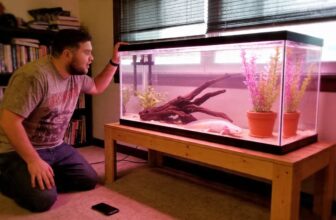
You hold a tiny scarlet badis in your mind, no bigger than your thumb, flashing ruby stripes if you treat it right. Place ten gallons of water before you—that’s a standard tank, about two shoeboxes long—filled with soft sand and thick green plants like Java moss, which is just a fuzzy underwater carpet. Keep the water slow, warm at 75 degrees, and a little sour at pH 7.0, testing every Sunday. Feed live food only, or watch them fade and hide. The real trouble starts when you wonder who else can share their home.
At A Glance
- Keep water soft to moderately hard (10–20 dGH) and slightly acidic to neutral (pH 6.5–7.5) for optimal coloration.
- Provide fine gravel or sand substrate and dense moss to protect barbels and establish territories.
- Feed live foods such as baby brine shrimp, microworms, and daphnia to trigger natural hunting instincts.
- Stock only one male per ten gallons to prevent aggression; females need plant retreats.
- Choose calm tank mates like dwarf rasboras; avoid shrimp and fast, boisterous companions.
Scarlet Badis: Nano Fish for Patient Specialists
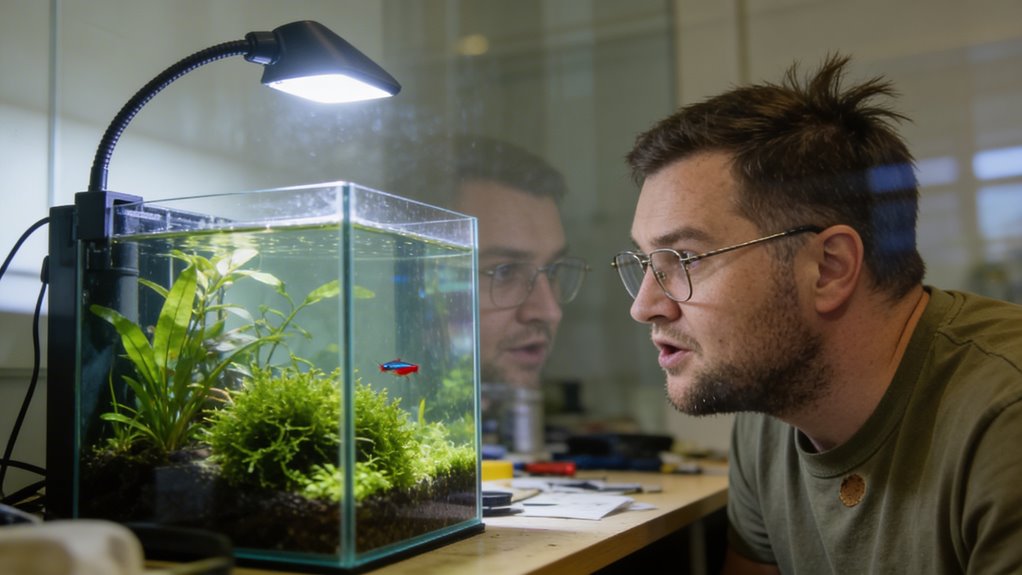
When you hold a net over your tank, you’re already practicing the first skill a scarlet badis teaches.
These fish demand quiet attention, rewarding those who wait. Native to shallow Indian streams, scarlet badis measure barely an inch, their scarlet-and-blue males glowing like embers beneath proper breite lighting.
Scarlet badis barely an inch, yet their patience teaches what rushing never could—quiet attention, ember-glow reward.
You’ll need substrate grading fine enough for whisker-like barbels to sweep, searching for microprey. Sand works best, soft between your fingers.
Your patience builds their trust.
In dense planted shadows, they reveal themselves slowly, mirroring how belonging grows when you stop rushing, start noticing, stay gentle, and give small creatures room to become brave.
Tank Size and Setup: Replicating Indian Stream Beds
A single ten-gallon glass box fits on most desks, yet it holds the width of a whole stream bed if you arrange it with care.
You spread Indian substrate two inches deep, sand or fine gravel, letting badis push through it like they do in Brahmaputra shallows.
Riparian flow matters. You aim your filter outlet along one glass wall, creating a gentle walk-current, not a rushing hose.
Plant thickly. Let Rotala, Java moss, and Limnophila grow dense. This green architecture shelters shy fish, gives them corners to claim, territories to guard.
You build belonging through careful mimicry.
Water Parameters: Soft, Acidic, and Stable
Although your badis came from clear Himalayan streams, they’ll learn to trust your tap if you teach it slowly.
You keep pH between 6.5 and 7.5, soft water hardness at 10-20 dGH, and temperature stability locked at 72-79°F.
| Parameter | Your Target |
|---|---|
| pH | 6.5–7.5 |
| Water Hardness | 10–20 dGH |
| Temperature | 72–79°F (22–26°C) |
| Stability | Zero swings |
Test weekly. Change half the water each Sunday. When your numbers hold steady, your badis feel safe enough to show you their brightest colors.
Live Foods: What Dario Dario Actually Eats
The frozen bloodworms in your hand look nothing like what scarlet badis encounter in wild Indian streams.
Frozen bloodworms bear no resemblance to what scarlet badis hunt in India’s wild streams.
You’ve got to match their nutritional preferences, or they’ll waste away, ignoring flakes that rot on the bottom.
Live foods wake something ancient in them.
- Baby brine shrimp, swimming briefly, trigger pursuit.
- Microworms wriggle, and your male’s stripes blaze brighter.
- Daphnia pulse through the water column, building hunting patience.
- Blackworms, buried shallow, reward bottom-probing persistence.
Watch your badis inspect, pause, strike—you’ll feel the click of belonging, caretaker to hunter, connected across glass.
Tank Mates: What Works (and Shrimps That Won’t)
Look down at your tank’s glass bottom, and picture a scarlet badis, no bigger than your thumb, darting into a clump of Java moss. You’re building a community where this tiny hunter feels safe.
Choose other calm, small fish who respect its space. A compatible spawner, like a gentle dwarf rasbora, shares your badis’s quiet rhythm without competing for territory. Avoid shrimps completely; those tempting cherry or amano varieties become expensive snacks, algae control or not.
Your badis doesn’t want to fight. It wants neighbors who drift past like leaves, not intruders who crowd its mossy home.
Territorial Behavior: Managing Male Aggression
Why does your brightest male suddenly charge his own reflection? You watch him flare his ventral fins, the blue edges glinting like tiny swords, and you feel a small worry in your chest.
Male territory matters deeply to scarlet badis, even in a ten‑gallon tank. Your male sees himself as a rival, you see, since he cannot tell glass from water. This is normal, but exhausting for him.
Try these gentle steps:
- Cover three sides of his tank with paper, so reflections fade.
- Add dense plants, like Rotala rotundifolia, breaking sightlines.
- Guarantee Female retreat spaces exist behind thick moss.
- Keep only one male per ten gallons, or six in twenty.
You help him feel safe.
Trigger Breeding: Courtship to Free-Swimming Fry
A small clump of Java moss, no bigger than your fist, holds the whole future.
You dim the aquarium lighting to mimic dawn, that soft half-light that tricks scarlet badis bodies into readiness.
Watch your male. He flares his fins, stripes pulsing like tiny heartbeats, vibrating fast enough to blur. This movement invites her near.
His fins flare, stripes pulse like heartbeats, blurring with invitation.
She inspects the moss, a leafy cave he claimed. If she approves, she lays 70 to 90 eggs, sticky pearls you might miss. He fertilizes, then chases her away.
Water filtration must stay gentle now. Strong currents scatter eggs.
He guards one week.
They hatch.
Tiny, transparent, and finally free.
Raising Fry: First Foods and Survival Strategies
The yolk sac fades like a small, shrinking sun, and hunger arrives in its place.
You watch the tiny fry drift, helpless as dust, and know survival hinges on what you add next.
Egg density matters here—too many eggs in one spot mean competition too fierce for these delicate mouths. Spread the risk, and they stand a chance.
Water filtration must stay gentle, sponge filters only, or you’ll suck them away like leaves in a storm.
Now, you feed:
- Infusoria for the first three days, invisible food for invisible fish.
- Vinegar eels wriggling longer, easier to spot.
- Baby brine shrimp at day five, their first real bite.
- Micro worms ground fine, building strength.
You feel the quiet hope of a gardener planting seeds you cannot yet see.
Frequently Asked Questions
Do Scarlet Badis Need a Filter or Air Stone?
You don’t need an air stone, but you’ll want a gentle filter. Place it in a corner where water flow stays soft, like a slow stream, not a rushing river. These tiny fish come from still, plant-filled waters, and strong currents exhaust them. Aim your filter output toward the glass to break the push, or use a sponge filter. Clean water matters, but calm water keeps them happy.
Can Scarlet Badis Change Color Based on Mood?
Yes, scarlet badis display mood‑linked pigmentation, meaning their colors shift with feelings.
When calm, males glow bright orange‑red with bold stripes. When stressed or frightened, they pale to a washed‑out grey. This emotional color shift works like a mood ring on your finger, revealing inner states through outward change.
You’ll notice these changes during courtship too, when males deepen their reds to impress a female, then guard eggs with steady, reassuring color.
How Can You Tell Scarlet Badis Age?
You can’t tell a scarlet badis’s exact age just by looking, but you’ll notice clues. Young fish show faint, developing color patterns, whereas adults display bold orange, red, and blue stripes. Their age growth affects size too—mature males reach about two centimeters, roughly the width of a nickel. You’ll feel curious comparing your fish, wondering about its journey, and that’s part of sharing life with another living thing.
Are Scarlet Badis Sensitive to Medications?
You must watch your scarlet badis closely, as they carry high medication sensitivity in their small bodies. When illness strikes, you’ll need strict dosage guidelines—use half-strength treatments meant for scaleless fish, since their delicate skin absorbs chemicals fast. Always remove carbon filters first, and you’ve got to test water daily. Your patience protects them. Remember: gentle healing beats harsh curing, every single time.
Do Scarlet Badis Jump Out of Open Tanks?
Yes, scarlet badis jump from open tanks, so you’ll need a secure lid.
Your tank design prevents this—tight-fitting glass covers with small gaps stop escapes. Their tank behavior includes sudden upward bursts when startled, especially during breeding cues when males chase rivals. Dim lighting preferences keep them calm and less jumpy. Fine gravel substrate choice helps them feel grounded. You’ll feel safer knowing they’re contained, and they’ll feel safer too.
Rounding Up
A ten-gallon tank with soft, brown leaves and gentle bubbles becomes your Scarlet Badis‘ whole world. You will feel quiet pride watching males flare crimson at dawn, knowing patience built this peace. Keep water steady, feed live foods, choose calm friends, and accept that some fry vanish—that is nature’s bargain. You are not just keeping fish; you are tending a slow, living conversation between yourself and something wild.