Look at a peacock cichlid, and you’ll see colors that don’t fade—blues like deep water, reds like sunset—if you give them what they need. You’ll use a 55-gallon tank, minimum, with sand soft enough to sift and rocks smooth enough to hide behind. You’ll keep the water warm, 74 to 82 degrees, and a little hard, the way their lake runs in Africa. You’ll choose tank mates carefully, since these fish feel safe in groups, stressed when crowded or chased. You’ll notice their colors dull when they’re frightened, brighten when they’re home. That’s the quiet reward of patience: a fish that shows you, without words, when you’ve gotten it right. There’s one thing almost everyone misses, though, and it costs them the brightest fish in the tank.
At A Glance
- House peacock cichlids in 55–100 gallon tanks with fine sand, smooth rock caves, and dim lighting to protect gills and enhance coloration.
- Maintain water at 74–82 °F, pH 7.5–8.5, and 4–6 dKH with strong filtration for optimal health and pigment retention.
- Feed sinking pellets twice daily, frozen mysis or brine shrimp thrice weekly, and spirulina for balanced nutrition and carotenoid color boost.
- Stock one male with three to four females to reduce aggression and respect natural hierarchy in social groups.
- Choose compatible tank mates such as other Malawi cichlids, small tetras, rasboras, or Botia loaches while avoiding aggressive or fin-nipping species.
Why Peacock Cichlids Work in Home Aquariums
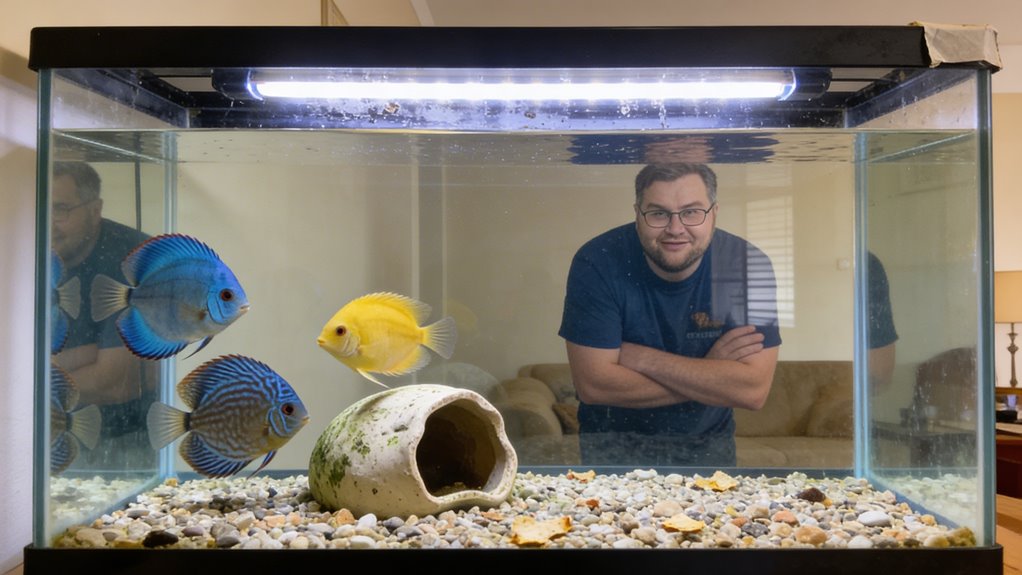
A smooth, flat rock sits at the bottom of your aquarium, and when light hits it just right, you’ll catch a flash of electric blue or sunset orange sweeping past.
That’s your peacock cichlid, a fish bred through coloration genetics to carry living rainbows in its scales.
Their aquarium behavior fits your living room perfectly.
You’ll watch males patrol territories about twelve inches wide, flaring fins at rivals, then retreat to caves you’ve built from stacked slate.
They recognize you, gathering at the glass when you approach with food.
It’s a quiet companionship, steady and bright.
You’re not alone in that glow.
Tank Size and Water Parameters for Peacock Cichlids
Before you set up your tank, you’ll need to understand exactly how much space these fish require and what kind of water keeps them healthy, measurements that prevent problems before they start.
You’ll want at least 55 gallons for a small group, though 100 gallons lets them swim freely together.
| Parameter | Ideal Range |
|---|---|
| Temperature | 74-82°F |
| pH | 7.5-8.5 |
| Hardness | 4-6 dKH |
Your aquarium filtration must run strong and steady, cleaning waste from these active fish. You’ll feel calmer knowing your lighting cycles mimic sunrise and sunset, about 10-12 hours daily. This rhythm soothes them, and you too.
Peacock Cichlid Substrate and Hardscape: Sand, Rocks, and Caves
Why does the bottom of your tank matter so much to a fish that spends its days sifting through sand? You’ll want soft substrate, not sharp gravel, to keep their gills safe as they hunt. Choose fine substrate grain size, about 1-2 millimeters, so they can filter and feel secure. Stack smooth rocks into caves, spacing them so each male claims his own territory. Aim for moderate cave placement density, roughly one cave per fish, leaving open swimming paths. You’re building a home where they belong, where digging and hiding feel natural.
What to Feed Peacock Cichlids for Their Best Colors
If you want those scarlet and sapphire patches to glow like stained glass under water, you’ll need to think about what goes into your fish’s mouth, not just what lights up the tank.
Colorhabitat enrichment starts with your choices at feeding time, and you’re part of a community that wants these fish to flourish.
Here’s how you nourish that brilliance:
- Begin with sinking cichlid pellets, measured to what your fish finish in two minutes, twice daily.
- Add frozen mysis shrimp or brine shrimp, rich in carotenoids, three times weekly.
- Use pigment boosting supplements containing astaxanthin, following label directions precisely.
- Include vegetable matter, like spirulina flakes, for balance you’re proud to provide.
Malawi Bloat and Other Peacock Cichlid Health Problems
The pellets and shrimp you measured so carefully can turn against your fish if you’re too generous.
Malawi bloat comes when protein overwhelms your peacock’s digestive system. You’ll notice dloat symptoms: swollen belly, clamped fins, hiding instead of greeting you.
Act fast with early disease detection. Isolate fish using quarantine protocols, then consult treatment options like Metronidazole at proper medication dosage guidelines.
Your preventive feeding strategies matter deeply. Feed small amounts twice daily, never more than they finish in two minutes.
Keep water quality monitoring consistent. Test weekly, maintain aquarium cleaning schedules, and practice stress reduction techniques through stable temperatures.
Document everything in health record keeping. You’re building trust, one careful observation at a time.
Male or Female? Sexing Peacock Cichlids and Group Ratios
Look at your peacock cichlid’s tail fin, and you’ll spot the first clue.
Tail fins whisper their secrets—watch closely and gender reveals itself.
Males display longer, more pointed anal and dorsal fins, whereas females keep theirs shorter, rounder, softer. You’re witnessing color dimorphism—nature’s way of signaling who’s who. Males blaze with electric blues, fiery reds, and gold patterns; females wear modest tans and silvers, like sensible shoes at a party.
Follow these steps to build harmony:
- Count your males first, then add females.
- Aim for one male per three to four females.
- Watch fins for gender clues before buying.
- Adjust your sex ratio if chasing begins.
You’re creating a peaceful community, not a boxing ring.
Best Tank Mates for Peacock Cichlids (and Who to Avoid)
Picture a busy playground where every kid needs enough space on the swings, and you’ve got the right idea for stocking your peacock cichlid tank. You want companions who respect boundaries, not bullies who hog the rock caves.
Good tank mates share your peacocks’ calm curiosity. Consider other Malawi cichlids, like the gentle Haplochromis redfin haps, or small schooling fish such as tetras and rasboras who glide through properly tuned aquarium lighting without stirring trouble. Even Botia loaches make pleasant neighbors, sifting sand together in companionable silence.
Proper water filtration keeps conditions stable for this diverse community. You’ll feel proud watching them thrive together.
Avoid large aggressive cichlids and fin‑nippers, who bring only stress.
Top 5 Peacock Cichlid Varieties: From Dragon Blood to Strawberry
Colors flicker like living jewels beneath your aquarium lights, and few fish shine brighter than peacock cichlids in their many painted forms. You’ll find your heart drawn to these five beloved varieties that make any tank feel like home.
- Dragon Blood Peacock – coral-pink with tiny dots, named for its fiery hue, needs strong aquarium lighting to glow.
- Strawberry Peacock – soft rose with spotted fins, gentle and welcoming.
- Blue Peacock – sapphire stripes calm busy minds.
- OB Peacock – bold patches of orange and blue, striking and unique.
Clean water filtration keeps their colors true, so you and your fish belong together in beauty.
How to Breed Peacock Cichlids Successfully at Home?
Since these fish carry their eggs in their mouths, you’ll watch something tender unfold right in your tank. Start with one male and three or four females, each about four inches long, so everyone feels safe. Pick your breeding timing carefully: raise the water temperature to 80-82 degrees Fahrenheit over two weeks, and your male will dig a shallow pit in the sand, maybe two inches deep. Pay close attention to fry survival. After roughly thirty days, the mother releases twelve to forty-eight tiny swimmers, each barely half an inch. You’ll feed them crushed flakes four times daily, and feel proud watching your careful work become new life.
Peacock Cichlid Stress Signals and Quick Recovery Steps
When you peer into your aquarium, you’ll notice your peacock cichlid’s colors—those bright reds, blues, or pinks you love—start to fade, like a shirt left too long in the sun. That pale, washed-out look is called stress coloration, and it means your fish feels unsafe or uncomfortable. You’ll additionally see them hiding more, breathing faster, or refusing food—these are their quiet ways of asking for help.
To bring them back to calm, bright health, follow these steps:
To bring them back to calm, bright health, follow these steps: check water temperature, test pH weekly, acclimate new fish properly, and provide dim lighting with plenty of caves.
- Check your water temperature stays steady between 74–82°F, using a reliable thermometer.
- Test pH weekly, keeping it at 7.5–8.5, since sudden shifts shock their bodies.
- Perform rapid acclimation—float the bag for 15 minutes, then add small amounts of tank water every 5 minutes—when introducing new fish.
- Dim your lights and add more caves, so everyone has a private corner to rest.
You’re building a home where they feel truly seen.
Peacock Cichlid Lifespan: Reaching 10–15 Years
The plastic bucket in your hands holds a tiny swimmer you hope will stay with you for a long, long time.
Peacock cichlids can reach ten to fifteen years, but you must earn this genation through steady care.
Genetics set the foundation, like seeds in good soil, yet your choices shape what grows.
Proper water conditions, measured at 74–82 degrees Fahrenheit, protect their Coloration from fading to gray.
Their Behavior stays calm when you respect their social needs, keeping more females than males.
You belong to something lasting when you commit to these rhythms, watching your fish thrive year after steady year.
Frequently Asked Questions
Can Peacock Cichlids Live With African Dwarf Frogs?
You can keep peacock cichlids with African dwarf frogs, but compatibility requires careful attention. Your tank size matters greatly—you’ll need at least 55 gallons, though 75+ gallons works better, giving everyone room to claim small territories.
Peacock cichlids are less aggressive than many cousins, yet they’re still bigger, faster fish. Dwarf frogs stay small, about 2.5 inches, and hunt slowly along the bottom.
You must watch feeding time closely. Cichlids race to eat; frogs often starve if food disappears first. You’ll need target-feeding, perhaps using tongs or sinking pellets in separate spots.
Water parameters match well—both want 74-82°F, pH 7.5-8.5. Still, you should provide frog-safe caves, smooth-edged without sharp rocks, since their delicate skin tears easily.
A higher female-to-male cichlid ratio, say three or four females per male, keeps peace spread thinner. Then frogs feel safer exploring open sand.
Malawi cichlids sometimes mouth-browse substrate; frogs might seem like moving snacks to confused males. You won’t see outright hunting, but stress harms both species.
Your success depends on space, feeding patience, and watching behaviors daily. Neither creature asks for drama; they simply need their own corners in your shared water world.
Do Peacock Cichlids Need Air Stones or Extra Oxygen?
Your peacock cichlids don’t strictly need air stones, but you’ll want reliable oxygenation methods. Strong tank filtration—think power filters or canisters—creates surface movement that mixes air into the water. You can add an airstone if your tank runs warm or crowded, above 78 degrees. Watch your fish: if they gulp at the surface, they’re telling you oxygen feels scarce, and you’ll need to help them breathe easier.
How Often Should I Change Peacock Cichlid Water?
You should change about 20-30% of your peacock cichlid water weekly, or 10-15% twice weekly if your tank is crowded. Test your water with a kit—if ammonia or nitrites climb, you’re waiting too long.
Your filter needs monthly attention. Rinse the sponges in old tank water, not tap water, so you don’t kill the helpful bacteria living there. Replace carbon cartridges every 3-4 weeks.
Can I Keep a Single Male Peacock Cichlid Alone?
A single male peacock cichlid can live alone, but you’ll miss the natural behaviors that make these fish captivating. Without females, he won’t display vivid colors or engage in courtship rituals. Tank dynamics suffer from this isolation, leaving you with a dull, stressed fish. You need a 55-gallon minimum, and you’d truly benefit from adding three to five females. Your aquarium becomes a living community, not just a container.
Do Peacock Cichlids Recognize Their Owners?
Peacock cichlids learn your owner behavior through daily patterns, recognizing you as the source of food and safety. With proper habitat enrichment—caves, rocks, plants—they feel secure enough to show curiosity, swimming toward the glass when you approach. You’ll notice them watching, sometimes following your movements across the room. Their recognition feels quiet, like a familiar neighbor nodding hello, building gentle trust through repeated, calm interactions over weeks and months.
Rounding Up
A 100‑gallon tank, steady 78°F water, and smooth river rocks give your peacocks room to flourish. You will feed sinking pellets, watch for Malawi bloat—swelling means trouble—and keep one male with three or four females. Their blues and reds reward your patience with 10 to 15 years of quiet wonder. Stay consistent, like tending a garden, and your fish will thrive.