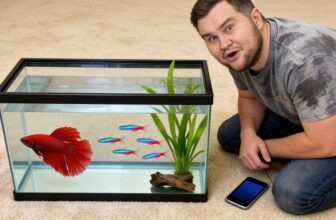
You’ll want a pleco that fits your tank’s real water volume, not just the sticker on the glass.
Small stars like the 3‑inch Bristlenose clean algae gently in 25 gallons, whereas the 4‑inch Rubber Lip needs smooth rocks and a single cave to feel safe.
Mid‑sized Clown Plecos live past ten years but must chew driftwood for fiber.
If you crave stripes, the Zebra Pleco costs $40‑60 since breeders work hard to raise them.
Bigger tanks open doors to giants like the 19‑inch Sailfin, which needs 100 gallons and powerful filters.
Each fish carries quiet needs beneath its pretty shell, and noticing them brings calm satisfaction.
There’s a whole map of personalities waiting if you stay curious.
At A Glance
- Small plecos like Bristlenose and Rubber Lip suit 20–25 gallon tanks with minimal care requirements.
- Mid-size species such as Clown and Peppermint need driftwood, specific flows, or smooth substrates to thrive.
- Sailfin Plecos demand 100+ gallon tanks and powerful filtration due to massive size and bioload.
- Collector favorites like Zebra and Gold Nugget Plecos carry premium prices and need specialized tank setups.
- All plecos require stable temperatures, quality water testing, and adequate territory to minimize stress and aggression.
Bristlenose Pleco: The Best Starter Pleco for Beginners
When you first peer into a crowded aquarium store, the pleco tank can feel overwhelming, like staring at a wall of brown rocks that all look the same.
You’ll spot the Bristlenose by its whisker-like bristles, especially frilly on males, and its wide, dotted head.
This fish fits your beginner’s tank perfectly. It stays small, three to five inches, and thrives in twenty-five gallons with steady temperatures between sixty and eighty degrees.
Bristlenose care is straightforward. Feed algae wafers daily, add sinking pellets, and watch it graze peacefully along the bottom. It’s forgiving, gentle, and works hard keeping glass clean. For maintaining that steady temperature range, consider using a digital temperature controller to prevent harmful fluctuations that could stress your pleco.
Zebra Pleco: What Makes This Striped Beauty Worth the Premium Price?
Since you’ve already met the humble Bristlenose, you’re ready to understand why some aquarists pay fifty, even a hundred dollars for a single Zebra Pleco. This striped beauty commands attention with bold black and white bands covering its three-and-a-half inch body. You’re witnessing supply scarcity meet collector appeal in real time. The rarity factor intensifies since breeding difficulty keeps numbers low, and market demand never wavers. Your cost analysis reveals that zebra pleco value proposition extends beyond appearance—ownership brings quiet pride. Consider this zebra pleco price justification table:
| Factor | Impact on Price | Your Experience |
|---|---|---|
| Wild harvest restrictions | $40-60 increase | You feel ethical satisfaction |
| Captive breeding challenges | $30-40 increase | You celebrate rare success |
| Limited availability | $20-30 increase | You join exclusive company |
You hold living art, and that matters. For advanced recirculating systems, aquarists often employ acrylic disk technology to maintain the pristine water conditions these sensitive plecos demand.
Clown Pleco: A Low-Maintenance Algae Eater That Lives Over 10 Years
Take a small, striped fish with a big appetite for algae, add a driftwood log for hiding, and you’ve got a pet that’ll stick around longer than some friendships.
A small striped fish, a driftwood log, and a decade of quiet companionship—easier than keeping some friendships alive.
You’ll enjoy algae longevity with this striped helper. The Clown Pleco, marked in black with thin yellow-orange stripes, grows to just 3.5 inches.
Lifespan maintenance proves simple. Keep water between 73-82°F, pH near 6.8-7.6—nothing fancy.
You’ll watch it rasp algae from glass, then retreat to its driftwood cave. That wood matters; they munch it for fiber.
Give a 20-gallon tank, stable conditions, and patience. In return, you receive ten-plus years of quiet, purposeful companionship.
Since these long-lived fish require stable water quality, plan to test ammonia levels at least twice weekly using a reliable kit to prevent stress from elevated nitrogen compounds.
Gold Nugget Pleco: How to Handle Their Surprising Territorial Side
Why does a fish named after treasure sometimes act like it’s guarding a vault? Your Gold Nugget Pleco brings those bright yellow spots into your tank, and you expect peace.
Then you notice the chasing, the fin-flaring near that one driftwood cave. That’s territorial behavior, plain and simple. This fish claims spaces, especially dark corners, and doesn’t like sharing them.
You’ll want to watch the feeding hierarchy too. Put food in multiple spots so your pleco doesn’t hog one area and block tank-mates.
Give each fish at least six inches of territory. Stress melts when everyone’s got room to eat.
Consider installing a whisper‑quiet filter to maintain peaceful water conditions and minimize additional stress on your territorial pleco.
Sailfin Pleco: Is Your Tank Big Enough for This 19-Inch Giant?
That tall sailfin rising from your pleco’s back isn’t just for show, even though it looks like a flag snapping in the wind.
It spreads nearly to his tail when folded, and that body stretches to 19 inches. You might feel surprised, then worried, since your 30-gallon tank suddenly seems very small. He needs 100 gallons minimum, room to turn without scraping his fins.
Tank filtration matters enormously here. He eats twice daily, plants and wafers and live food, and produces waste like a much larger fish. Your filter must work hard, or ammonia builds quietly. A 400 GPH canister filter provides the turnover rate needed to handle his heavy bioload without creating excessive surface agitation.
Sailfin cohabitation requires planning too. He hides by day, emerges hungry at dusk, and may bump tankmates who crowd his driftwood cave. Choose peaceful fish who swim higher, leaving him the bottom.
You might feel proud watching that sail rise, knowing you gave him space enough to stretch.
Royal Pleco: What Those Bulbous Red Eyes Tell You About Their Care
Those bulbous red eyes catch your light like twin warning signals, and they’re asking you to look closer. Royal Plecos possess oversized eyes adapted to low light, meaning you’ll want dim corners and hiding spots to protect their eye health. They’re shy, preferring driftwood caves to open swimming.
Watch for territorial behavior, especially in cramped quarters. At 17 inches long, they demand 125 gallons minimum to stake personal boundaries without conflict. Their slightly bulky body limits quick movement, so they rely on claiming space early and defending it steadily.
Feed them wood-based diets, vegetables, and occasional protein. When setting up their filtration, consider using check valves to prevent back-siphoning during power outages, protecting your shy giants from sudden water disturbances. You’ll find peace in giving them room to be alone together.
Snowball Pleco: Recreating Blackwater Conditions for This Rio Negro Native
A driftwood cave holds the Royal Pleco safe, but the Snowball Pleco asks for something stranger and darker.
Your Snowball Pleco needs blackwater filtration to feel at home, like the tea-colored Rio Negro where sunlight barely reaches.
You’ll want soft, acidic water with a pH between 5.8 and 7.6.
Tannin dosing helps you build this shadowy world, releasing compounds from driftwood or almond leaves that turn the water amber-brown.
This dimness soothes your fish, letting those white-spotted fins glow like scattered snow against dark stone.
Give them caves, gentle current, and patience. They’ll emerge when ready, bottom-dwelling secrets finally shared. If you need to isolate a sick Snowball Pleco for treatment, consider using an acrylic quarantine box with suction-cup mounting that maintains water flow while keeping the fish safely contained.
Rubber Lip Pleco: The Undemanding Option for Busy Aquarists
When life’s rushing past like water through a filter, you’ll find comfort in a fish that asks so little.
The Rubber Lip Pleco grows only four inches, fitting snugly in a twenty-gallon tank where it quietly eats algae from glass, rocks, and driftwood.
Keep one per tank, as two males bicker over territory like brothers sharing a bedroom.
Two males bicker over territory like brothers sharing a bedroom—keep one per tank, and keep the peace.
Follow these simple setup tips: anchor driftwood for grazing, add smooth river rocks, and maintain gentle water flow mimicking mountain streams.
Your maintenance stays light—weekly water changes of twenty-five percent, monthly filter rinsing, and daily sinking algae wafers at dusk.
This pleco forgives missed feedings and cloudy days, forgiving the way good friends do.
For aquarists who want to enhance their tank’s backdrop without adding maintenance, consider a static‑cling background that applies without adhesive and can be repositioned as needed.
Leopard Frog Pleco: Managing Male Aggression in This Striped Species
Managing Male Aggression in Leopard Frog Plecos
You’ll notice the stripes first, bold black and yellow bands wrapping around a fish no bigger than your palm—four inches from nose to tail. The Leopard Frog Pleco looks gentle, but males fight hard.
You’ll want caves for territory marking, one per male, spaced apart like separate rooms in a house. This gives each fish a door to guard, reducing clashes.
Establish a clear feeding hierarchy by dropping food on opposite ends of your 30-gallon tank. Dominant males claim one spot, letting others eat in peace. You’ll feel relief watching conflict drop once rules exist.
Peppermint Pleco: Why Fast-Moving Water Isn’t Optional
The Peppermint Pleco comes from Brazil’s Rio Xingu, a river that rushes fast over smooth rocks, and this fish is built for that life.
Built for rushing currents, the Peppermint Pleco thrives where water surges over smooth stone.
You’ll need to replicate that current flow at home, or this fish won’t thrive. They attach themselves to rocks with their sucker mouths, grazing algae while fighting the stream.
- You’ll need smooth, rounded stones for grazing, since rough surfaces damage their bellies.
- Your substrate composition should include sand and flat slate, mimicking those riverbeds where they rest between meals.
- You must provide powerheads or canister outflows creating genuine turbulence, not gentle bubbles.
Without this movement, they grow sluggish, vulnerable, and sad.
Just as proper pump sizing ensures optimal water flow in aquarium filtration systems, matching your powerhead output to your tank’s dimensions keeps these plecos healthy and active.
Candy Striped Pleco: Can This Territorial Fish Work in Community Tanks?
A striped pattern of amber and midnight wraps around this small fish’s body, catching your eye like a warning sign on a country road.
You’ll find this four-inch fish guards its patch of gravel like a dog watches a porch. Candy pleco compatibility demands careful thought. They’re friendly when fish swim above, but challenge any creature that creeps below.
Territorial behavior management means you stack rocks and driftwood thick, creating separate apartments so neighbors don’t bump fins. Think of it like drawing lines on a playground—everyone needs their own space to feel safe.
Mid-water swimmers, small tetras perhaps, make the calmest roommates. Give fifteen gallons minimum, feed algae and occasional treats, and watch peace settle like dust on a still afternoon. Rooted plants benefit from substrate fertilizers like root tabs placed beneath the gravel, delivering slow-release nutrients without disturbing your carefully stacked territories.
Vampire Pleco: Protecting Their Delicate Fins From Damage
Protecting Delicate Fin Rays
Nine inches of shadow drift through your tank after sunset, their fins spread like tissue paper in a slow breeze.
The Vampire Pleco’s dorsal, pectoral, and anal fins contain delicate, thread-like rays that catch on rough edges.
Fin protection means choosing smooth driftwood, rounded rocks, and inspecting decorations for burrs.
During net handling, you’re moving slowly, supporting the full body, never squeezing the fin membranes.
Their eyes dilate wide in darkness, so sudden light startles them into thrashing.
Damage causes stress that fades their spotted pattern.
- Choose fine-mesh nets with soft, knotless weave to prevent ray snags
- Position filter intakes behind sponge baffles that block strong currents from battering trailing fins
- Maintain stable groups of three or more to reduce chasing that causes fin wear
Sunshine Pleco: Will They Eat Your Shrimp and Snails?
Shrimp Predation and Tank Mate Compatibility
Why do your ghost shrimp keep vanishing from the bottom corner where the rocks pile up?
Ghost shrimp vanishing from the rocky bottom corner? Check your tank after dark.
You’ve spotted the Sunshine Pleco, a foot-long fish with orange-tipped fins, cruising there at dusk.
This pleco eats algae, yes, but shrimp predation happens too. Those twelve inches of shy fish hunt small invertebrates when hungry.
Snail compatibility fares better. Adult snails with hard shells usually survive. Baby snails vanish like your shrimp.
You must choose: keep this beautiful algae-eater, or protect your tiny tank-mates. The Sunshine Pleco demands 125 gallons, driftwood, and hiding spots.
It won’t uproot plants, but it might damage leaves.
Blue-Eyed Pleco: Are You Ready for a 2-Foot Fish With Extreme Demands?
Armor, Eyes, and Extreme Demands
The two things you’ll notice first are the armor and the eyes: thick gray plates covering this fish like a knight’s suit, and bright blue circles that seem to glow from within.
Blue-eye genetics make this rare Colombian native unmistakable, but beauty demands sacrifice. You’ll need a fast flow setup, strong currents mimicking mountain rivers, or this fish grows stressed, then sick.
They reach two feet, needing 180 gallons minimum, piles of driftwood for grazing, hiding, resting.
Consider these needs carefully:
- Space for a fish longer than your forearm
- Water rushing like a stream, never still
- Years of commitment, fifteen or more
Are you truly ready?
Butterfly Pleco: Handling Their High Waste Output in Smaller Tanks
Managing High Waste in Small Tanks
High-waste fish in compact tanks demand relentless maintenance: robust filtration, weekly water changes, and the labor of accepting what beauty requires.
A sponge filter, crammed into the corner of your twenty-gallon tank, will clog within three days when a Butterfly Pleco moves in.
This fish, six inches of constant grazing, produces waste that overwhelms compact ecosystem setups. You’ll need robust filtration, meaning multiple systems working together to scrub ammonia from the water. Weekly water changes become non-negotiable, 25 percent every seven days minimum.
The frustration feels familiar, like tending a garden that grows faster than you can weed. Accept this labor, or choose a smaller pleco. The Butterfly’s beauty demands respect through maintenance, not wishes.
Frequently Asked Questions
Do Plecos Need Air Stones or Additional Oxygenation?
You don’t strictly need air stones, but you’ll want oxygen filtration methods if your tank’s understocked with plants or overstocked with fish. An oxygen pump helps, especially for larger species like Sailfin or Royal Plecos in warm water.
Can Different Pleco Species Be Kept Together Safely?
You can’t safely mix most pleco species because of poor species compatibility and habitat overlap—territorial Royal Plecos, Sunshine Plecos, and aggressive Vampire Plecos will fight over cave space and driftwood territories, causing stress or injury.
How Often Should Pleco Caves Be Cleaned or Replaced?
You’ll find your cave cleaning schedule depends on waste buildup; check caves weekly and rinse them in tank water during water changes. Your substrate turnover frequency should match, ensuring you’re not disturbing plecos’ established territories unnecessarily.
What Signs Indicate a Pleco Is Starving or Malnourished?
You’ll notice starvation signs when your pleco’s belly appears sunken and its activity drops sharply. Watch for nutritional deficiencies like fading colors, weight loss, and lethargy—clear signals you’re not feeding enough varied foods.
Do Plecos Require Specialized Lighting for Their Nocturnal Habits?
You don’t need specialized nocturnal lighting for plecos, though dim or blue LED setups help you observe their nighttime activity. Standard aquarium lighting suffices for algae control, just make certain tank decorations provide plenty of dark hiding spots.
Rounding Up
You have looked at fifteen plecos, each with its own needs and surprises. Some stay small, like the bristlenose at four inches. Others grow huge, like the blue-eyed at two feet. You now know which ones fit your tank, your time, and your budget. Trust what you have learned, measure your aquarium twice, and choose the fish that matches your life. You are ready to bring home your perfect nighttime cleaner.