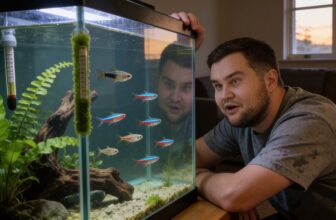
You’ll want a 10-gallon for a small group (one male, two females), since 5-gallons works only for a solo puffer.
Keep water at 74–82°F, pH 7.2–7.5, and hardness 4–10 dH.
Use sponge filters (gentle flow, $5–$15) — power filters create currents that stress them.
Add live plants like stargrass, Java moss, and Anubias to break sightlines and reduce aggression.
Feed live bloodworms, brine shrimp, and blackworms; flakes are useless.
Their skin lacks scales, so pristine water is non-negotiable.
Stick around — the breeding setup is surprisingly simple once you nail the basics.
At A Glance
- Tank size: 5‑gallon for one, 10‑gallon for a group of one male and two females.
- Sponge filters are essential for gentle flow and zero suction risk.
- Live plants like Java moss and Anubias create hiding spots and reduce aggression.
- Diet strictly live foods: bloodworms, brine shrimp, and blackworms.
- Breeding requires a 5‑gallon tank with stable 79°F and Java moss as spawning mop.
What’s the Minimum Tank Size for a Single Pea Puffer?
You’ll additionally need:
- A sponge filter with adjustable flow; they’re weak swimmers.
- A reliable heater to lock in 74‑82°F.
- A 3‑stage filtration system helps maintain water clarity and healthy bacterial colonies for the tank.
Skip the nanotanks. They’re death traps, not homes.
For a happy, healthy puffer, stick with this setup—you’re giving it a real chance, not just a container. For optimal health, pair this with a quiet canister filter that uses a copper brushless motor for vibration damping and low electricity use.
Why a 10-Gallon Tank Works Best for a Small Group
If you’ve settled on a single pea puffer in a 5-gallon, you’ve got a solid start.
But for a small group—say, one male with two females—you’ll want a 10-gallon.
That extra space isn’t just luxury; it’s survival.
That extra space isn’t just luxury; it’s survival.
In a 10-gallon, you can break up sightlines with plants, giving each puffer its own territory. For example, a kit like the Aqueon 10‑gallon Complete Starter Kit includes a low-noise filter and a preset heater to maintain steady 78 °F.
Less squabbling, more personality.
You’re part of a club that gets it: your puffers will display natural behaviors, not constant stress.
It’s the sweet spot—big enough for harmony, small enough to manage.
Bottom line: go 10-gallon for a thriving trio.
Choosing a fine grain dark substrate like Aqua Natural Diamond Black Gravel enhances plant root visibility and provides contrast for colorful fish.
Pea Puffer Water Parameters: PH, Hardness, and Temperature
Stability is the name of the game for pea puffers. You’re aiming for a steady environment—these little guys hate surprises. Here’s what you need:
- Temperature: Keep it constant between 74‑82°F (23‑28°C). A heater’s your best friend; room swings stress them out.
- pH: Range of 6.5‑8.4, but shoot for 7.2‑7.5. Stay consistent, or they’ll sulk. Use a species-appropriate non‑phosphate buffer to maintain this target without causing algae blooms.
- Hardness: 4‑10 dH is the sweet spot. Too soft or hard? You’ll see it in their mood.
- Zero ammonia, nitrite, nitrate: Pristine water is non‑negotiable. Your puffers belong in clean water, just like you belong in this club.
Aquarium lighting with gradual sunrise simulation helps maintain a stable day-night cycle, reducing stress on your pea puffers.
Sponge Filters vs. Power Filters: Which Won’t Stress Your Pea Puffer?
Why complicate things when the answer is sitting right there, bubbling away on the floor of a planted tank? Sponge filters win, hands down.
Power filters create currents that exhaust your weak-swimming puffer, stressing it into hiding or illness. You want belonging in the puffer-keeping club? Go sponge.
Sponge filters—gentle flow, zero suction risk, cheap at $5–15, and perfect for a planted 10‑gallon. Your puffer glides, not fights. Even the quietest HOB models, like those with motors ≤ 40 dB, still produce a current that stresses pea puffers.
Power filters—strong currents, possible fin damage, and noisy. Not worth the hassle.
Bottom line: spend ten bucks, get a simple sponge filter. Your puffer relaxes, thrives, and you join the ranks of smart keepers.
For optimal fine debris capture, choose a 40 PPI sponge to protect delicate species.
Best Live Plants and Decor to Reduce Aggression
So you’ve got the sponge filter humming in your 10‑gallon, water conditions dialed in, and your pea puffer’s waiting for its next bloodworm. Let’s break those sightlines, since a puffer with nowhere to hide is a territorial menace.
- Stargrass – grows fast, $5 a bunch, creates a dense forest that splits the tank into living rooms, not one open arena.
- Java moss – clump it on driftwood, $8, gives them cave-like nooks to claim as their private bachelor pad.
- Anubias – glue it to a rock, $6, broad leaves block a puffer’s direct eye line, calming their inner grump.
- Cholla wood – $4 for a few logs, provides tunnel escapes when a housemate gets pushy.
Bottom line: pack it thick, and you’ll see less fin nipping.
This thick planting also mimics the alkaline mineral drops approach used in other systems to maintain stable pH, though here the stability comes from dense biological filtration rather than chemical buffers.
For additional cover, Jungle Vallisneria can be added to the background to create vertical sightline breaks and towering hiding spots.
Can Pea Puffers Live With Other Fish? The Best Tank Mates
Good picks:
- Small tetras (ember, green neon)
- Fast danios or rasboras
- Otocinclus catfish
- Cherry shrimp (they’ll breed fast enough)
Avoid:
- Bettas, gouramis, fin‑nippers
- Snails or shrimp you like (they’re food, not friends)
- Slow, long‑finned fish
Bottom line: load up on plants, break sightlines, and watch closely. A well‑planted 10‑gallon community works—just don’t expect everyone to get along perfectly. Like the royal gramma, pea puffers benefit from ample caves and reduced current to alleviate stress and prevent aggressive disputes. Use a digital hygrometer to monitor the fermentation chamber environment if you are culturing live foods for your puffers.
How to Tell Male vs. Female Pea Puffers Apart
Telling male and female pea puffers apart isn’t easy until they’re fully grown, but once you know what to look for, it’s like spotting the difference between a sporty hatchback and a sensible sedan.
- Belly color – Males sport a greenish‑gold belly, whereas females show off a yellow or white one with a throat patch.
- Lateral line – That dark line running along the side? Thicker and more continuous on males, thinner and broken on females.
- Body shape – Males stay slender and streamlined; females grow plumper, especially when gravid (carrying eggs).
- Eye wrinkles – Males often have distinct wrinkles behind their eyes; females lack this feature entirely.
Like any club, knowing these signs helps you fit right in. A high light transmission mesh cover can be added to the tank to prevent jumpers while keeping these visual cues clear. For best results, maintain stable water parameters to reduce stress and support healthy coloration in both sexes.
Setting Up a Breeding Tank for Pea Puffers
Once you’ve got the hang of telling males from females, it’s time to give a lucky pair their own private suite.
Grab a five‑gallon tank—anything bigger works, but smaller’s easier to manage for just two fish.
Keep the temp steady at 79°F with a reliable heater; these guys hate fluctuations.
Pack it with Java moss clumps—that’s their preferred spawning mop.
Add a gentle sponge filter; strong currents stress them out.
No gravel needed, just soft sand or bare bottom for easy cleanup.
Water changes every other day keep conditions pristine.
You’re aiming for that sweet spot where they feel safe enough to breed.
Maintaining stable water parameters helps prevent stress and supports successful spawning.
A low power draw design like the Delta Mini surface skimmer can help keep the water surface clean without disturbing the pair.
The Complete Diet Guide: Live, Frozen, and Freeze-Dried Foods
Since we’ve tackled breeding, let’s turn to what keeps pea puffers happy and healthy: food. You’re feeding strict carnivores, so skip flakes and pellets entirely. They need protein-packed live or frozen options to thrive.
- Watch them hunt bloodworms – those squirming red larvae trigger their natural stalking instincts perfectly.
- Offer brine shrimp – tiny, wriggling crustaceans they’ll chase with excited, puffing bursts.
- Drop in blackworms – thin, dark worms they’ll slurp up like spaghetti, tails wiggling.
- Use rehydrated freeze-dried daphnia (soak 20+ minutes) – those little water fleas crunch satisfyingly.
For a sustainable protein option, consider Fluval Bug Bites, which rely on black soldier fly larvae to provide a natural insect-based diet. Feed small portions multiple times daily. No teeth-grinding needed here – you’re in the clear. A high-precision digital thermometer with ±0.1 °C accuracy can help you maintain the stable, warm water temperatures these sensitive carnivores need while hunting their food.
What to Feed Pea Puffer Fry After They Hatch
You’ve got the adults chowing down on bloodworms and brine shrimp, but when baby puffers—fry—hatch, they need a whole different menu. Those tiny mouths can’t manage adult prey at first.
Start with infusoria, a microscopic soup of microorganisms. You can culture it yourself by steeping lettuce in tank water for a week. After three days, switch to baby brine shrimp—hatch those daily using a simple cone kit. Microworms work well too; they’re easy to raise on oatmeal.
Feed small amounts four times daily. Keep water pristine—fry are fragile. Stick to live foods; they won’t touch flakes. Get it right, and you’ll have a thriving school. Welcome to the fry-feeding club. You can also boost fry growth by adding a crushed red algae mineral supplement to the water for trace elements. For optimal water quality, an adjustable acrylic stand can help keep filtration equipment stable in the sump.
What Health Problems Do Pea Puffers Get: and How Do You Stop Them?
Pea puffers lack scales, which makes them prone to skin infections, so poor water quality hits them hard.
Pea puffers lack scales, so poor water quality makes skin infections inevitable.
You’re fundamentally inviting trouble if your tank’s not pristine.
Common issues include:
- Ich — white salt-grain spots on fins; treat with heat (86°F) and aquarium salt.
- Fish lice — tiny green disks stuck to skin; remove manually with tweezers.
- Fungal infections — fluffy white patches; quarantine and use antifungal meds.
- Internal parasites — sunken belly, stringy poop; treat with praziquantel-based dewormers.
You’re part of a careful crew, right?
Check your parameters daily, keep ammonia at zero, and you’ll dodge most problems. Using a conditioner like Seachem Prime helps detoxify ammonia if levels ever spike.
Clean water’s your cheapest cure—seriously.
How to Move Your Pea Puffer Without Hurting It
Since those nets with big mesh holes can damage a pea puffer’s delicate skin, you’ll want a soft, stress-free method every time you move them.
Grab a clean plastic cup, scoop them gently, and keep them underwater—no scooping air, puffer bro.
If you’re tank‑to‑tank, use a small container, same water, quick transfer.
For bagging at the store, ask for a plastic cup or smooth‑sided vessel.
Never grab them dry; that’s a one‑way ticket to stressville.
Keep movements slow, calm, and quiet—we’re all in this together.
Simple gear, soft hands, and you’re their safe ride home.
To ensure the stand can handle the tank’s weight, check the load capacity ratings against the puffer’s full setup weight.
Using a heavy‑wall PVC bulkhead fitting for any plumbing can prevent leaks and ensure a reliable seal in the tank system.
Why Stable Temperature Matters More for Pea Puffers
Why does temperature stability hit pea puffers harder than most fish? Since they’re scaleless—no armor against stress from swings. Think of it like this:
- That 78°F heater clicks off at night, dropping five degrees—your puffer’s immune system tanks, inviting fungal infections.
- A sudden spike to 85°F from a faulty heater stresses them into hiding, refusing food for days.
- Room temperature dips during a cold snap? Their metabolism scrambles, digestion halts, and they bloat dangerously.
- Daily instability triggers erratic flashing—rubbing against decor—damaging sensitive skin.
Your nano-tank needs a reliable heater; cheap ones fail. Spend $25 on a 50-watt adjustable unit. Keep it locked at 78°F. Your puffer’s four-year lifespan depends on it—so does your peace of mind. For small tanks, the HiTauing 25W heater offers precise control between 65-89°F with a thickened glass tube for added durability.
Where to Buy Healthy Pea Puffers and What to Look For
No, you can’t just grab the first puffball you see at PetSmart and call it a day. You’ve got to hunt for healthy stock—specialty fish stores or reputable breeders are your best bet. Here’s what to spot:
| What to Look For | Why It Matters |
|---|---|
| Round, plump belly | Indicates good nutrition and energy |
| Clear eyes, no spots | Signals no infections or ich |
| Active, curious swimming | Shows low stress and strong health |
| Ask what they eat | Smooths diet change avoid picky eaters |
Prices run $3–$15; captive-bred cost more but live longer. Skip sunken-bellied fish—they’re usually sick. You want a puffer that’s ready to join your crew, not a project.
Frequently Asked Questions
Can Pea Puffers Live With Other Pea Puffers Peacefully?
Yes, they can, but it’s a delicate waltz.
Keeping a single male with two or more females works best—males are territorial brutes.
A 10-gallon tank with heavy planting breaks sightlines, giving everyone their own spot.
You’ll see some chasing, which is normal, but watch for real fights.
If you spot injuries, quarantine immediately.
So, peaceful? More like a cold war with plants as peace treaties.
Bottom line: doable, but you’re the referee.
How Often Should I Clean a Pea Puffer Tank?
You’ll want to clean that pea puffer tank weekly, no shortcuts.
A 10‑gallon setup needs a 20‑30% water change every seven days, plus a quick gravel vacuum fussy with leftover bloodworms.
Skip that, and ammonia spikes—bad news for scaleless skin.
Use a sponge filter (gentle flow, remember?), rinse it monthly in tank water, not tap.
Bottom line: stay on top of it, or you’re asking for stress and a four‑year lifespan cut short.
Do Pea Puffers Need a Lid on Their Tank?
Yes, you absolutely need a lid.
Pea puffers are notorious jumpers, especially when startled or during water changes.
A simple glass or mesh lid prevents a sudden, dramatic exit from your tank—which is definitely not the adventure you want.
They’re tiny venturers, not escape artists by choice.
For a 5‑gallon tank, a custom glass lid costs around $15‑$20.
Skip the lid, and you’ll likely find a dried‑out puffer on your floor.
Save yourself the heartache; cover it.
What Plants Are Safe for Soft-Bodied Pea Puffers?
You’re safe with live plants like Anubias, Java moss, Cabomba, or Stargrass—they won’t harm your pea puffer’s soft body.
These species provide cover and break sightlines, reducing aggression.
Stick to broad-leafed or fine textures; avoid sharp or plastic plants that could scratch.
Puffers appreciate hiding spots, and you’ll enjoy watching them investigate.
Bottom line: load up on these non-toxic greens, give your little guy a calm home, and you’ll both feel like part of the club.
Can I Keep Pea Puffers in a Heavily Planted Tank Only?
Yes, you can keep pea puffers in a heavily planted tank only—it’s their ideal home.
Those dense plants break sightlines, reducing territorial squabbles you’d otherwise see between these feisty fish.
Think of plants as natural room dividers; they’re cheap therapy for aggressive puffers.
Stick to soft species like Java moss or Anubias—no sharp edges to harm their delicate skin.
Bottom line: skip the bare tank, go full jungle, and watch them thrive with less drama.
Rounding Up
So, you’ve got your pea puffer setup dialed. That’s the hard part; now comes the fun, watching that tiny tyrant rule its planted kingdom. Don’t expect a social fish—this is a one‑man (or carefully balanced harem) show. Stick with stable 79°F water and live snails on the menu. Honestly, if you follow the basics, you’ll keep your puffer sassy, not sick. Bottom line: get the tank right, feed the beast, and you’re golden.