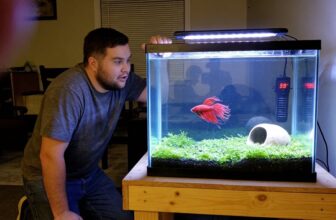
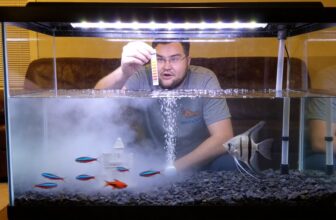
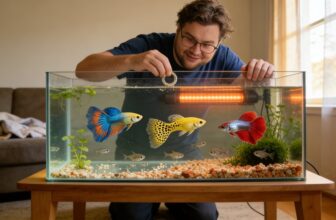
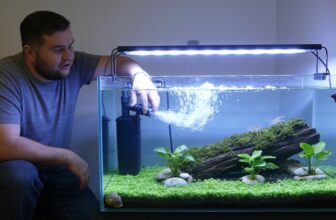
Start with a 20-gallon tank, which holds steady heat and dilutes waste so you test less and change water every 2-3 weeks.
Choose fine sand or smooth gravel, a single driftwood piece, and two flat rocks spaced six inches apart for simple cleaning.
Add one betta or six small tetras, plus a few Nerite snails or Amano shrimp to eat algae.
Set a timer for lights and a small autofeeder for meals, check food levels weekly, and rinse your sponge filter monthly in old tank water.
A 25% water change takes under twenty minutes, leaving you calm and your fish content without daily fuss.
There’s more waiting if you want the full picture, starting with why tiny tanks steal your weekends.
At A Glance
- Choose a 20‑40 gallon tank for stable water chemistry and fewer emergency water changes.
- Use fine sand or smooth gravel with slow‑release root tabs for minimal vacuuming and fertilizing.
- Stock a solo betta or small tetra school with Nerite snails and Amano shrimp to limit waste.
- Run sponge or HOB filters with a programmable timer and autofeeder for hands‑off daily care.
- Schedule 25 % water changes every 2‑3 weeks and trim plants twice yearly, not weekly.
Start With 20-40 Gallons: The Low-Maintenance Sweet Spot
When you walk into the pet store, you’ll see rows of tiny tanks no bigger than a shoebox, and they look so easy. You’ll feel tempted—you’ll imagine pretty fish gliding through a tiny world that fits on your desk. But here’s what you won’t see: those little tanks turn into trouble fast. One missed feeding, one warm afternoon, and the water goes bad like milk left out.
That’s why you’re choosing twenty gallons, maybe thirty or forty. More water means steadier home—temperature stays put, chemicals don’t spike. You’ll relax knowing your fish aren’t living on the edge.
Aqu filtration works harder when it has room to breathe, same as you do. You’ll pick a filter sized for your tank, not the minimum, and the water stays clean longer. You won’t need fancy gadgets, won’t fuss with DIY CO₂ systems that demand daily mixing and measuring. You’ll skip the chemistry set.
You’ll spend less time fixing crises, more time watching fish. That’s the lazy aquarist’s secret: start bigger, work less.
A 20‑gallon complete kit with integrated filter, heater, and LED lighting eliminates the guesswork of matching separate components.
Skip the 5-Gallon: Why Small Tanks Demand More Work
A five-gallon tank sits on your desk like a coffee mug with fish inside, and you think you’ve found the easy path.
You’ve made a common mistake.
Tiny water volumes crash fast. One missed feeding, one extra flake, and ammonia spikes poison your fish within hours. The swim volume—meaning the space water has to dilute waste—simply isn’t there. You test water every few days, panic at readings, change water constantly. That “budget friendly” purchase costs you time, stress, and replacement fish. Stability lives in larger spaces. You wanted lazy; you built yourself a second job.
Even a 3‑gallon weekly water change of just 30 percent demands constant vigilance to maintain safe nitrite levels and prevent ammonia buildup.
Choose Fine Sand or Gravel for Less Vacuuming
Your gravel vacuum sits in the closet since you hate dragging it out, and that feeling tells you something important about how tanks actually work.
Substrate texture determines how much gunk gets trapped. Chunky gravel hides debris in pockets, forcing weekly cleaning. Fine sand or smooth gravel pack tighter, letting waste rest on top where filters grab it. Your cleaning frequency drops.
| Substrate Type | Debris Behavior | Your Effort |
|---|---|---|
| Chunky gravel | Hides in gaps | Weekly vacuuming |
| Fine sand | Sits on surface | Monthly stir |
| Smooth gravel | Rolls off easily | Biweekly light pass |
| Bare bottom | Visible immediately | Constant wiping |
Choose fine sand, and you’ll touch that vacuum twice monthly, not twice weekly.
An Aquaneat Bio Sponge Filter Media Pad can further reduce maintenance by blocking fish waste before it reaches your substrate, working alongside your chosen surface to minimize cleaning demands.
Simplify Your Hardscape: Driftwood, Rocks, and Caves
Now that you’ve got sand keeping debris where you can see it, you’re ready to choose what sits on top.
Pick one bold driftwood piece with rough driftwood texture. Algae grows slower on smooth surfaces, so rough spots hide what little fuzz appears. Anchor it off-center, not dead middle. You’ll feel calmer looking at something slightly uneven.
Add two flat river rocks, maybe six inches apart. Stack them, or don’t. Small fish squeeze underneath, and that choice matters.
Cave placement decides comfort. Tuck caves where light reaches dimly, about two-thirds back. Fish want shadows they can find, not hunt.
Resin driftwood offers zero maintenance and no tannin release, making it perfect for aquarists who want natural aesthetics without the boiling prep time.
- One driftwood centerpiece beats three scattered sticks
- Rocks create natural sight lines, breaking open space
- Caves near plants let shrimp dart quickly to cover
- Empty patches of sand mean less scrubbing later
Let Your Filter Do the Dirty Work: Sponge or Hang-On-Back
Why let your own hands do what a sponge or plastic box can manage as you sleep?
A sponge filter sits quiet, bubbling gently, catching waste in its porous body while bacteria turn poison into plant food. You rinse it monthly in old tank water, that’s all.
A hang-on-back clips to your rim, pulling water through floss and cartridges, dumping debris before it rots. Both styles cost little, break rarely, and forgive forgetfulness.
Better filtration means fewer water changes, less testing, more peace. You choose simplicity, and the tank breathes easier. Your future self feels grateful, watching clear water swirl while you rest.
Many self-priming HOB filters resume operation automatically after power outages, eliminating the need for manual intervention.
Pick a Stable Heater With a Visible Indicator Light
Once the filter hums with steady work, the water still needs one more guard against trouble, and that guard is heat.
Pick a heater with a thermostat, not a fixed-watt stick. Thermal stability keeps your fish from shiver-stress or cooking.
A thermostat gives your fish steady warmth; fixed-watt sticks gamble with their lives.
Look for a visible indicator light, one that glows when heating happens. This tiny signal tells you, at a glance, if warmth flows or if the tool has failed.
Check this light each morning. It takes three seconds, like glancing at a stove burner.
Models with 2 mm thick quartz glass offer better protection against thermal shock and last longer in busy tanks.
- Choose adjustable thermostats, fixed temperatures invite disaster
- Demand a bright indicator, dim lights hide problems
- Verify thermal stability through steady temperature readings
- Replace heaters every three years, parts wear quietly
Stock Light: Solo Bettas, Tetras, and Rasboras Only
When you’re choosing who lives in your water, think of your tank like a small bedroom, not a crowded party bus.
You pick one betta, or a small group of tetras, or rasboras. That’s it.
Betta aggression means you keep him solo. He patrols his space, flares at his reflection, rests on a leaf. One fish, simple needs.
Tetra schooling gives you six to eight small swimmers moving together, like birds in formation. They feel safe in numbers, you enjoy watching their synchronized movement.
Fewer fish make less waste. Your filter works lighter, your water stays cleaner longer.
You relax more, worry less.
For a true low-maintenance setup, consider adding a few slow-release root tabs beneath your substrate to feed any hardy plants without demanding weekly fertilizing schedules.
Add Java Fern and Anubias: Plants That Thrive on Neglect
Although most plants demand your daily attention like a thirsty pet, Java fern and Anubias ask almost nothing of you. You simply tie them to driftwood or rock with cotton thread. They absorb nutrients straight from the water, no fancy soil required.
- Java fern grows slowly, forgiving your missed doses completely
- Anubias tolerates minimal light, thriving in corners other plants reject
- You trim them twice yearly, not weekly, saving precious hours
- Their broad leaves shelter shy fish, creating calm, safe spaces
You’ll feel quietly proud watching these survivors flourish despite your forgetfulness, proof nature rewards gentle hands.
Java fern is especially well-suited for beginners because its soft, delicate fronds won’t snag fish fins, and it thrives under 20-40 lux light—meaning a cloudy windowsill is all you need.
Recruit Snails and Shrimp: Your Natural Cleanup Crew
Fish food drifts to the bottom, uneaten and forgotten, but snails and shrimp roll up their sleeves and get to work.
Leftover fish food doesn’t stand a chance when snails and shrimp clock in for their shift.
You want helpers who never call in sick. Nerite snails, a snail species with zebra-striped shells, scrape algae from glass like tiny window washers. They won’t overrun your tank, and they leave your plants alone.
Amano shrimp, one of the hardiest shrimp varieties, pick through gravel like curious detectives, finding crumbs you can’t see. Ghost shrimp work too, though they’re shyer.
You watch them patrol at dusk, peaceful and busy. Their work means you scrub less, stress less, and simply enjoy.
For shrimp breeding or isolation, consider a dual-layer breeding box with transparent walls to monitor your colony’s growth while maintaining proper water flow.
Set-and-Forget Lighting: 6-8 Hours on Timer
A small black box plugs into your wall and tells your aquarium light when to wake up and when to sleep.
You set your LED timer for six to eight hours daily, no more, no less. This steady rhythm feels safe, like locking your door each night. Algae control becomes simple since you stop feeding the green fuzz with endless light.
- Choose a digital LED timer; it remembers, even when you forget
- Set lights before breakfast, off after dinner
- Watch your plants grow steady, not frantic
- Feel calm seeing that same glow each evening
For truly hands-off operation, look for lights with built-in programmable timers that eliminate the need for separate hardware entirely.
Automate Feeding: Timer-Based Portion Control
Timer-Based Portion Control
Your autofeeder sits like a small mailbox on the tank lid, and it keeps your secret promise to the fish.
You set the Feeder calibration once, measuring pellets to the gram, and the machine remembers. Portion scheduling means breakfast happens at 8 a.m. whether you’re home or not.
| Task | Frequency |
|---|---|
| Check food level | Weekly |
| Clean dispenser | Monthly |
| Recalibrate portions | Quarterly |
| Test battery backup | Every 6 months |
| Replace desiccant | As needed |
You avoid the guilt of forgotten meals, and your fish stay healthy without daily effort from you.
Water Changes Every 2-3 Weeks: The 25% Routine
25% Water Change Routine
Once the autofeeder handles breakfast, you’ve still got one chore that water can’t do for itself: a partial refresh every few weeks.
You swap twenty-five percent of the water, which means one gallon in a four-gallon bucket, every fourteen to twenty-one days. This keeps your water chemistry steady, like changing the air in a stuffy room. Plants and good filtration stretch your schedule, but you can’t skip indefinitely.
Skipping invites trouble. Algae control weakens when old water lingers too long, letting green fuzz claim your glass.
- Use a siphon gravel vacuum to lift debris while draining
- Match new water temperature to the tank, test with your wrist
- Add dechlorinator before pouring, one drop per gallon
- Wipe glass first, so algae floats free for removal
Build a 3-Item Emergency Kit for Power Failures
Three Lifesavers for Blackouts
Even when the lights go out, your tank keeps breathing, and that’s why you need a small kit ready before trouble strikes.
The lights may die, but your tank doesn’t hold its breath—and neither should you.
You gather three things: a Battery backup, a jar of Emergency filter media, and a battery-powered air pump.
The Battery backup, a small black box, plugs between your wall and your filter. It holds one hour of power, long enough for a short outage. Think of it as a spare flashlight for your fish’s lungs.
Emergency filter media sits wet in your fridge, seeded with good bacteria. If your filter breaks, you swap this in within minutes.
You feel calmer, prepared, like keeping a Band-Aid in your pocket.
Your First 14 Days: From Empty Tank to Self-Sustaining System
From Emergency Kit to Cycling Tank
That emergency kit now sits ready on your shelf, and you can turn toward the tank itself.
You begin with substrate cycling, spreading two inches of fine gravel across the bottom. This layer houses tiny helpers you can’t see.
Next comes cycling, the two-week wait as invisible bacteria colonize your biofilter. You add ammonia drops, testing water chemistry every three days, watching numbers shift like a slow tide.
Your patience builds the biofilter’s living colony, turning poison into plant food.
By day fourteen, you feel quiet pride seeing stable readings.
- Drop ammonia to 2 ppm on day one, then wait.
- Test nitrites daily; they spike, then fade to zero.
- Watch nitrates appear, signaling your biofilter’s alive.
- Add fish only when ammonia and nitrite read zero.
Frequently Asked Questions
Can I Use Fake Plants Instead?
Yes, you can use fake plants, but you’ll increase your plant care duties and maintenance cost. Real plants absorb nutrients and stabilize your tank, whereas fake ones trap debris and demand more frequent cleaning without offering any biological benefits.
Do I Need CO2 Injection for This?
You don’t need CO2 injection for this low‑maintenance setup. You’ll rely on CO2 alternatives like java fern and anubias, and you can skip nutrient dosing entirely—those hardy plants thrive on fish waste alone.
How Many Fish Fit in 20 Gallons?
You’ll want a stock density of one inch of fish per gallon, so roughly 20 small fish fit in 20 gallons. Assess tank suitability by avoiding messy eaters; small tetras or a single betta work best for low-maintenance setups.
What if My Heater Breaks Overnight?
Your tank faces rapid temperature drops during heater failure or power outage, so you’ll insulate it with blankets and monitor closely. You’ve prepared an emergency kit and battery backup to keep filters running whereas you replace broken equipment.
Can I Keep a Pleco for Algae Control?
You can’t rely on a pleco for low‑maintenance algae grazing; most species grow too large and produce heavy waste, ruining tank compatibility. Stick with nerite snails and Amano shrimp instead—they’re smaller, cleaner, and far more manageable for your setup.
Rounding Up
A twenty-gallon tank sits on your desk, its water clear and steady. You’ve built something that breathes without you, eats on schedule, asks little but gives plenty.
This is care made sustainable, attention converted to patience. The fish don’t need perfection, just consistency. Neither do you.
Let the filter hum, watch the plants grow, check parameters monthly. Your time remains yours.
Responsible keeping looks like this: presence without pressure, beauty without burnout.