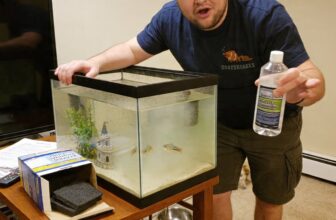
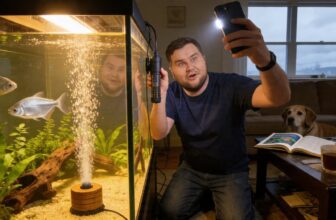
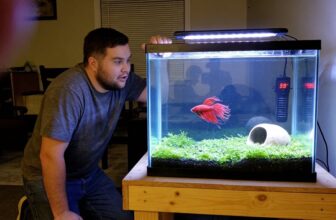
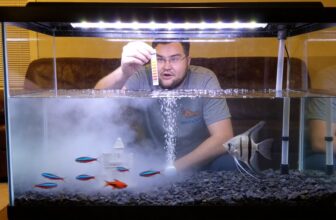
Your tank’s cloudy since something’s overdriven—bacterial bloom from new gravel or waste overload turns water milky grey, as pea-soup green means algae’s feasting on light and phosphates you’re ignoring.
You’ll fix grey water by cutting feeding, adding water conditioner, and gently vacuuming substrate as rinsing clogged filter media, or grab a $15 phosphate pad and a $60 UV sterilizer for stubborn green blooms.
Prevention means 30 gallons minimum per fancy goldfish, weekly 20% water changes, and running lights just four hours daily.
It’s mostly elbow grease and patience, not magic in a bottle.
The details below walk you through exactly which moves fix which mess.
At A Glance
- Causes: New substrate, bacterial blooms, algae, overfeeding, or disturbed sediment cloud goldfish tanks.
- Identification: Grey‑white water signals bacteria or debris; pea‑soup green indicates algal bloom.
- Quick fixes: Vacuum gently, change 15% water, dose conditioner, and rinse mechanical filter media.
- Green water treatments: Reduce light to 4 hours, blackout 48 hours, or install UV sterilizer ($40–80).
- Prevention: Feed sparingly twice daily, test weekly, stock 30+ gallons per fancy goldfish, and use phosphate‑removing pads.
Why Is My Goldfish Tank Cloudy? (Causes Explained)
You look at your tank, squint, and wonder if your goldfish suddenly developed a fog machine habit—no, that’s just cloudy water, and it happens to the best of us.
You’re dealing with two main troublemakers. First, a substrate bloom—that’s fancy talk for good bacteria exploding after you set up new gravel, or sometimes bad bacteria partying because your filter’s overwhelmed. It looks grey-white, like someone’s dropped milk in there.
Second, green water—algae having a field day, usually ** your tank’s basically a sunbathing salon.
Unconditioned tap water, with its weird water hardness and chlorine, doesn’t help either. Goldfish poop like tiny factory farms, and without solid filtration, you’re swimming in suspended particles. A mesh cover with high light transmission can help reduce the algae bloom that contributes to green water.
Grey or Green? How to Tell What You’re Seeing
If your tank looks like someone poured milk in it, that’s grey‑white cloudiness—usually a bacterial bloom doing its thing, or gravel debris floating around.
You’re witnessing nutrient cycling in action—bacteria multiplying to process waste, basically your tank’s awkward teenage phase.
Your tank’s going through puberty—awkward, cloudy, and full of bacteria trying to figure life out.
Green water? That’s algae throwing a party. Excess light, phosphates from tap water, or overfeeding fuel it. Think pea soup, not milk.
Here’s your cheat sheet:
- Grey‑white = bacterial bloom, disturbed substrate, or debris
- Green = algal bloom from light/nutrient overload
Substrate testing reveals hidden phosphate traps. Know your color, know your fix.
Products like Fritz Aquatics FritzZyme 7 can accelerate the biological cycling process from six weeks to just ten days.
How to Clear Grey/White Water: Step-by-Step Fix
Why does your tank look like a snow globe someone shook too hard? You’ve got grey/white cloudiness, friend, and it’s fixable.
| Problem | Quick Fix | Timeline |
|---|---|---|
| Bacterial bloom | Wait it out, test pH filtration | 2-7 days |
| Disturbed gravel | Vacuum gently, 15% water change | Hours |
| Unconditioned tap water | Add water conditioning now | Immediate |
| Clogged filter | Rinse mechanical media | Same day |
Don’t panic. Bacterial blooms happen to everyone, especially new tanks. Your beneficial bacteria are just throwing a house party. Skip unnecessary water changes—you’ll reset the cycle. Instead, grab a water clarifier or fine-mesh polisher to trap suspended junk. Check your filter; if it’s struggling, upgrade that pH filtration or add seed media. Always use water conditioning when topping off—tap chemicals murder clarity fast. Vacuum lightly, feed less, and let nature do its thing. You’ve got this. Crystal water belongs to patient keepers. For stable temperature maintenance during cold snaps, an aquarium heater can prevent bacterial bloom setbacks.
How to Get Rid of Green Water for Good
First, slash that photoperiod hard—drop to four hours daily, black out windows, maybe even toss a blanket over the thing for 48 hours (your fish won’t care, they’ve got no weekend plans).
Green algae thrives on light and phosphates, so you’re cutting both.
Next, grab phosphate control media—those little resin bags that suck fertilizer straight from your water, about $8-12, swap monthly.
Add fast-growing plants like hornwort; they’ll outcompete algae for nutrients.
Finally, consider a UV sterilizer, $30-60, which zaps floating algae cells dead. Ensure the unit uses 254 nm UV-C for effective germicidal action against algae.
Stay consistent, and you’ll join the clear-water club—no more pea-soup tank.
Should You Do a Water Change When Water’s Cloudy?
Whether you’re staring down a murky tank wondering if you should grab that siphon, the short answer is yes—but with a few caveats that’ll save you from turning cloudy into catastrophe.
You’ll want a light dosage approach: swap 15-30% weekly, not half the tank in one panicked go. Test your water hardness first—soft water clears differently than hard stuff. Slash your lighting intensity too, since that combo of fresh water plus dimmed bulbs keeps algae from thanking you for the buffet.
Don’t overdo it. You’ll stress your fish, wreck your cycle, and join the “why is it worse now?” club nobody wants admission to.
For safe water removal, a Laifoo Siphon Vacuum offers instant flow control without requiring electricity.
Is Cloudy Water Harmful to Your Goldfish?
How worried should you actually be when you can’t see your goldfish through the haze? Honestly? You’re not panicking yet, but you shouldn’t shrug it off either. Cloudy water signals trouble brewing beneath that murky surface.
Here’s the deal:
- Goldfish stress spikes when water chemistry goes sideways. Fish can’t see, breathe easy, or chill when particles clog their gills.
- Ammonia and nitrite swings — common in bacterial blooms — literally poison your fish while you squint at the tank, wondering if it’s “just algae” (spoiler: it’s rarely *just* anything).
Your fish feel it first. They’ll clamp fins, gasp at the surface, or hide like you avoiding that one relative at holidays. Not fun for anyone involved.
Bottom line: Temporary cloudiness? Annoying. Persistent haze? You’re stressing your fish and gambling with water chemistry. Adding pond salt can improve gill oxygen uptake and reduce stress during recovery. Test your parameters, fix the root cause, and stop hoping it’ll “clear up on its own.” It won’t, and your goldfish know it.
Stop Cloudy Water From Coming Back: Daily Habits
Since you’ve already fought the cloudiness battle once, you’re not exactly eager to rerun that particular aquatic horror show—and honestly, who could blame you? Here’s your damage-control plan.
Habit hygiene keeps you sane. Skipping even two days invites chaos. Check your tank daily—peek at water clarity, sniff for funk (yes, really), and note anything off. You’re building a routine that sticks. Use a high test volume kit to monitor copper and iron levels, which are often overlooked but can trigger bacterial blooms.
Master nitrate cycling. Test weekly; nitrates should stay below 20 ppm. Partial water changes—think 20%—dilute buildup before algae throws a party.
Bottom line: five minutes daily beats five hours of crisis mode. Your future self, the one who actually enjoys watching fish, will thank you.
Feed Less, Feed Smarter: Fix Your Routine
Why does your tank look like someone poured milk in it every time you pinch those flakes? You’re overfeeding, friend, and your fish aren’t grateful—they’re stressed.
Feed timing matters more than you’d think. Give them two tiny meals, morning and evening, nothing more. They’ll beg. Ignore them. It’s a goldfish drama routine.
Nutrient cycling—your tank’s invisible cleanup crew—can’t keep up when you dump excess food. Uneaten flakes rot, ammonia spikes, bacteria explode, and suddenly you’re staring at cloudy soup.
Scoop out leftovers after two minutes. Your filter will thank you. So will your water bill. Use a low-waste floating pellet instead of flakes to reduce clouding and overfeeding waste.
Control Light to Stop Algae Blooms
Where’s that eerie green glow coming from—your aquarium or a nuclear test site? Algae thrives on light intensity you’ve probably been too generous with, my friend.
Here’s your fix: photoperiod control means capping daily light to four hours (yes, really). Light intensity reduction? Move the tank from that sunny window or dim your fixture. LED spectrum adjustment—switching to warmer, lower-Kelvin bulbs—shifts energy away from algae-friendly wavelengths. For even greater control, use lights with full‑day cycles to reduce fish stress and improve schooling behavior of neon tetras.
For stubborn green soup, UV sterilization zaps floating algae cells without chemicals, running you about $40-80 for a decent unit.
Bottom line: you’re the sun god now, use that power wisely, and your goldfish will thank you.
Filter Upgrades That Actually Work for Goldfish
If you’ve ever peered into your tank and wondered whether your filter is working or just politely pretending, you’re probably onto something.
Goldfish swim in a category called “messy,” and that sponge crammed in your hang-on-back isn’t cutting it. You need upgrades with teeth.
- Magnetic media: tiny iron-coated beads that grab fine particles like a lint roller for water, about $15-20 online. Replace monthly.
- Carbon block: solid, not granules, traps chemicals and polishes water for weeks. Skip the cheap stuff; buy rated-for-5-micron blocks.
Drop both into a canister filter. Your water clears, your fish thank you, and you’ll finally stop squinting. Models with self‑priming motors automatically maintain flow after power outages, preventing filter failure during cleaning.
Stock Fewer Fish: The Right Goldfish-to-Water Ratio
How many goldfish can you squeeze into a tank before the water turns into soup? You’ve seen it, that murky fog where your fish ghost through clouds of their own making, and frankly, you know you’ve pushed it too far.
Your tank’s water capacity isn’t a suggestion, it’s physics. Here’s your sanity check:
Your tank’s water capacity isn’t a suggestion, it’s physics. Here’s your sanity check:
- One fancy goldfish needs 30 gallons minimum, that’s your baseline water density ratio.
- Each additional fish demands 10 more gallons, no shortcuts.
- Comet goldfish? Double those numbers, they’re swimmers with appetites.
- When in doubt, subtract one fish from your plan, you’ll thank yourself later.
Stock smart. Your filter, and your fish, will breathe easier.
When to Call an Aquarium Expert About Cloudy Water
Three days of pea-soup water is about all the suffering most people can stand—you’ve done the water changes, dimmed the lights like a romantic dinner nobody wanted, and still your goldfish look like they’re swimming through a fog bank in London.
When DIY fixes flop, it’s time for expert diagnosis. You’ve earned your spot in the hobbyist club, but pros have microscopes and test kits you won’t buy for $15.
Call for professional consultation if cloudiness persists past 72 hours, fish gasp at the surface, or you’ve got mysterious deaths. Spending $50-100 beats losing your whole tank.
Bottom line: knowing when to fold ’em makes you smarter, not weaker.
Why Did My Tank Cloud Up After a Water Change?
Here’s what actually happened, and it’s usually one of three culprits.
Your water change disrupted something—either gravel, bacteria, or chemistry—and now you’re squinting at murky water like you forgot your glasses.
1) You stirred up silt from the bottom layer during substrate cycling, releasing trapped debris.
2) That fresh tap water contained chlorine or heavy metals, shocking your bacterial colony into a temporary free‑for‑all.
3) You accidentally triggered nitrate spikes by removing too much water too fast, or by adding unconditioned water that killed beneficial bacteria.
Give it 24–48 hours. Most post‑change cloudiness clears on its own—patience beats panic, every time.
Can You Use Chemicals to Clear Cloudy Water?
Yes, you can, but don’t expect a magic eraser.
Chemical condition will bind particles. Just follow dosage exactly. Don’t wing it.
Bind the particles, but measure twice—precision beats guesswork every time.
Phosphate removal targets algae fuel. Add this media to your filter, around $8‑15 monthly. Cheap insurance.
UV sterilizers ($40‑80) nuke green water, but they won’t fix your overfeeding.
Here’s the deal:
- Water clarifiers: fast, temporary, use sparingly
- Phosphate‑removing pads: prevent blooms at the source
- Algaecides: last resort, stress fish if you overdose (ask me how I know)
Bottom line: chemicals buy time, they don’t replace elbow grease. Fix the cause, or you’re just pouring money into cloudy water.
Frequently Asked Questions
How Long Does Bacterial Bloom Typically Last?
A bacterial bloom typically clears in 2–7 days, sometimes two weeks if you’re unlucky.
Your tank’s bacterial cycle is just finding its footing—new tanks hit this hardest. You’re watching microscopic bacteria explode, then settle.
Water clarity returns once populations stabilize and your filter catches up. Don’t panic-change water; you’ll reset the whole circus. Trust the process, test weekly, and keep lights dimmed. Your patience pays off clearer than any quick-fix bottle.
Can Cloudy Water Affect Goldfish Appetite?
Yes, you’ll notice your goldfish turning up their noses at dinner when murky water sets in—like trying to enjoy a meal in a smoke-filled room, it’s just not appetizing.
- Stress loss appetite kicks in fast; cloudy conditions signal danger to their tiny fish brains
- Stress indicators include hiding, clamped fins, lethargy, and that telltale food boycott
Poor water quality spikes ammonia and nitrites, which burns their gills and wrecks their immune system. You’re basically asking them to chow down while standing in their own toilet—no thanks, they’ll pass.
The fix? Test your water (API Freshwater Master Test Kit, ~$25, lasts forever), fix the root cause, and appetite returns within 24–48 hours once they feel safe again. Don’t just feed more—that’s like yelling “cheer up” at someone with a migraine.
Bottom line: cloudy water equals stressed, hungry fish. Clear the tank, restore their comfort, and watch them wolf down flakes like it’s Thanksgiving.
Should I Turn off Lights During Green Water Treatment?
Yes, you’ll want to dial back that light schedule—think 4 hours max, maybe less as you’re fighting the green menace.
Green water’s just algae throwing a party since your water chemistry’s got too many nutrients floating around, and light’s the DJ keeping it going. Cut the lights, you’re basically taking away the snacks.
- Less light = slower algae growth
- Test phosphates, nitrates as you’re at it
Bottom line: dark tank for a week, you’ll see clearing.
Will Adding More Fish Help Clear Cloudy Water?
Adding more fish won’t help. You’re already struggling with cloudiness—extra fish means extra waste, and your fish filtration isn’t ready for that load.
Think of it like inviting friends to a messy apartment: chaos multiplies. Without stable nutrient cycling (how bacteria break down fish waste into safer compounds), you’re just adding fuel to the fire.
- More fish = more ammonia, more cloudiness
- Your filter needs time, not pressure
Skip the extra goldfish. Fix your cycle first.
Does Cloudy Water Mean My Filter Is Broken?
No, cloudy water doesn’t mean your filter’s broken.
You’re likely dealing with good old bacterial bloom or mucky water chemistry, not mechanical failure.
Check your filter maintenance—clogged pads or old carbon can’t trap squat.
Test ammonia and nitrites; a spike screams “biology, not busted motor.”
Clean media monthly, replace chemical filters bi‑weekly, and don’t panic‑buy a new unit.
Your filter’s probably fine, just neglected.
Rounding Up
You started with murky water and murkier confusion, but now you’ve got clarity—both kinds. Your tank can be a foggy regret or a glass showcase; the difference is you. Test weekly, feed less, clean smarter. Your goldfish won’t thank you—they’re fish—but you’ll sleep better. Now go stare at something pretty.