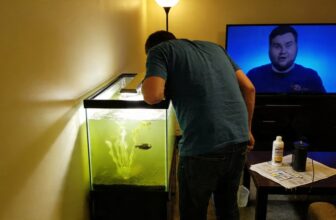
You’ll want a 30‑gallon tank and a school of eight or more tiger barbs to spread out their nippy energy.
Cherry barbs, Odessa barbs, and black ruby barbs all share that warm, slightly acidic water (pH ~6.5, 75°F) and fast swimming style.
Platies and short‑finned mollies add color without tempting fin‑nips.
Add tiger barbs last so other fish claim territory first.
When you match water parameters and plant heavily, stress drops fast.
Stick around for the full list.
At A Glance
- Tiger barbs thrive with at least six tank mates to curb fin-nipping aggression.
- Cherry barbs share ideal water parameters, reaching two inches with vivid red coloration.
- Odessa barbs need dappled lighting and heavily planted tanks with open swimming lanes.
- Cory catfish scavenge scraps on sand substrate in groups of four to six.
- Diamond tetras’ shimmering scales contrast tiger barbs while remaining peaceful and active.
Why a 30-Gallon Tank and School of 8+ Matter First
Before you even think about picking tank mates, you’ve got to nail two non-negotiable basics: a 30-gallon minimum tank and a school of at least eight tiger barbs.
Skip these, and you’re basically inviting a fin‑nipping free‑for‑all.
A cramped tank breeds stress, stress breeds aggression. Same goes for a too‑small school—you want a gang, not a lone wolf.
Eight or more barbs spread out the chaos, keeping everyone calmer.
Eight or more barbs spread out the chaos, keeping everyone calmer.
That thirty gallons gives them room to zoom and you room to add friends without overcrowding.
A stable, spacious setup isn’t optional; it’s your ticket to a peaceful community. For example, even smaller self‑cleaning options like the SYSENCIAGA 1.2 gal systems require careful consideration of space for any fish. Get this right first.
Cherry Barbs: Bright Red Tiger Barb Tank Mates
One of the best-looking, most sensible tank mates for your tiger barbs is the cherry barb (Puntius titteya). You’ll love their vivid red color—it pops against green plants.
They’re active schoolers, just like your barbs, and need groups of six or more. A 25-gallon tank works, but 30 is safer.
- Same water needs: pH 6.5, temps around 75°F.
- Similar size (2 inches) means less bullying.
Bottom line? Cherry barbs bring color without chaos. They’re tough, peaceful, and fit right in. A brine shrimp diet supports their health and vibrancy. Add them to your tank, and you’ve got a match made in fishkeeping heaven.
Odessa Barbs: Speedy Companions for Active Tanks
If your tiger barbs treat the tank like their personal racetrack, the Odessa barb (*Pethia padamya*) is the perfect co-driver.
You’ll need at least five for confidence—they’re speedy, striking, and hit the same 2.5‑inch size as your barbs.
These guys thrive in heavily planted setups with open swimming lanes, so you’re not sacrificing decor for motion.
The upside?
- Same water parameters (pH 6.0–8.0) simplify feeding.
- Minimal aggression when schooled properly.
Just remember: Keep that 30‑gallon minimum, and you’ve got a crew that matches your barbs’ pace without the drama. They’ll slot right into your active community.
Providing dim, dappled lighting through plants will help reduce stress and enhance their coloration.
Black Ruby Barbs: Slightly Smaller but Surprisingly Bold
Black Ruby Barbs (*Pethia nigrofasciata*) are your proof that good things come in slightly smaller packages—they top out around 2 inches, about half an inch shorter than tiger barbs, but they’ve got just as much attitude.
You’ll need a minimum 30‑gallon tank and a group of at least eight to keep them peaceful.
They thrive in slightly acidic, densely planted setups, matching your tiger barbs’ pH range.
Their bold, ruby‑red males will dash through the middle zone without backing down.
It’s a perfect match: same spunk, less size, zero regret.
This setup also accommodates a peaceful bottom dweller like the Rubbernose Pleco, which requires a similar minimum tank size and compatible water parameters.
Platies: Hardy, Colorful, and Happy in the Same Water
Platies are the aquarium equivalent of that friend who shows up to every party, gets along with everyone, and never causes drama—but still manages to look great doing it. They’re hardy, colorful, and thrive in the same 68‑82°F water you’re already keeping for your tiger barbs. You’ll feel like part of the club when your tank runs smoothly. Platies also benefit from dim lighting to reduce stress and encourage natural behavior.
- Peaceful coexistence: They ignore barbs’ antics, so no nipped fins or stress.
- Breeding bonus: Females drop live fry monthly—free fish for the community.
- Easy care: Accept flake food and handle beginner mistakes like a champ.
Stick with 2‑3 females per male for harmony. You belong in this tank crew.
Mollies: Stick to Short-Finned Varieties for Safety
Mollies sound like a solid choice—until their long, flowing tails turn into temptation for your tiger barbs. You’ll watch those beautiful fins get shredded in days. Stick with short-finned varieties only.
- Short-finned mollies move faster, matching your barbs’ speed.
- Sailfins or lyretails? Nope—they’re nipping magnets.
- Keep a group of four or more, with more females than males.
A stable, 30-gallon tank works great, with temps around 75°F. They’ll handle the same pH range, 6.5 to 8.0. Don’t risk the fancy ones. Pick practical, durable mollies, and your barbs won’t turn them into targets. That’s the safe bet. The high light transmission of a clear mesh cover can support healthy plant growth alongside these active fish.
Siamese Algae Eaters: Bottom Dwellers That Pull Their Weight
If you want a cleanup crew that actually works instead of just looking pretty, the Siamese algae eater is your fish. They’ll munch that green fuzz off your plants without bullying your barbs.
If you want a cleanup crew that actually works, the Siamese algae eater is your fish.
- Eats everything: Black beard algae? Covered. Leftover flakes? Gone. They’re like a tiny, finned vacuum.
- Peaceful zone: Stays at the bottom, minding its own business. Barbs swim above—perfect harmony.
- Room to grow: Needs a 20‑gallon minimum since it hits six inches. Skip it if your tank’s cramped.
- Like the fine nylon mesh in a quality aquarium net, their gentle nature protects delicate tankmates from harm.
Bottom line? These guys earn their keep. You’ll feel like a pro when your glass stays spotless.
Cory Catfish: Peaceful Scavengers With a Strong Will
Not a bad run with the Siamese algae eater, but let’s talk about a bottom-dweller that’s way more fun to watch—and just as useful. Cory catfish bring personality to your tank, scavenging scraps with a quiet determination that’ll surprise you. They’re peaceful, certainly, but don’t mistake that for weakness; these little armored fish hold their own against tiger barbs’ antics. However, their lateral line sensors help them synchronize schooling movements to avoid barbs’ fin-nipping. – Need a soft sand substrate—their barbels are sensitive. – Keep groups of 4-6; they’re social and braver together. – Thrive in your barb’s water temps, 72-78°F.
Bottom line: You get a cleanup crew with character. They’ll earn their keep, and you’ll feel like part of the club.
Otocinclus: Armored Cleaners Tiger Barbs Ignore
Since tiger barbs have the attention span of a caffeinated squirrel, you’ll want tank mates that don’t rely on charm to survive—enter the otocinclus. These tiny armored cleaners just don’t register as targets. They’re basically living algae magnets that your barbs ignore completely.
- Built-in armor: Their bony plates make them unpalatable; tiger barbs take one nibble, then learn it’s like chewing gravel.
- Group of 4–6 minimum: Alone, they hide; together, they graze confidently on glass and plants.
- Same water, same zone: They thrive in your 68–82°F, slightly acidic tank—no extra fuss.
Keep your barbs busy chasing each other. Your otos? They’ll just clean, ignored, and your tank stays spotless. That’s the easy win. For best results, ensure a moderate current of about 2 inches per second to support their feeding and activity.
Apistogramma Dwarf Cichlids: Pick the Bigger Species
Whilst dwarf cichlids sound delicate, Apistogramma species that reach the upper end of their size range—around 3 inches—can actually hold their own with tiger barbs.
You’ll want a bonded pair or one male with multiple females, avoiding multiple males to prevent turf wars.
These bottom‑dwellers rarely clash with mid‑water barbs, so you’re reducing daily drama.
Pick a bigger Apistogramma, like A. cacatuoides, because smaller species (under 2 inches) just get bullied.
It’s a solid, peaceful match for your community.
Bottom line: size matters here, so don’t skimp—your barbs and cichlids thank you.
To maintain high water quality for these cichlids, a filter with a quiet motor below 40 dB helps keep stress low.
Red Spotted Severums: Advanced Option for 100-Gallon Tanks
If you’ve got a 100-gallon tank lying around—or you’re ready to buy one—Red Spotted Severums are a bold, advanced choice for tiger barbs. They’re big, calm, and won’t nip your barbs’ fins. Just don’t expect them to be pushovers.
If you’ve got a 100-gallon tank, Red Spotted Severums are a bold, calm choice for tiger barbs.
- They hit 10 inches, so that 100-gallon helps everyone breathe—literally.
- They’re peaceful unless breeding, then they guard their cave like a grumpy landlord.
- They prefer soft, acidic water, matching tiger barb comfort zones perfectly.
For a large, stable community that looks like a pro built it, severums deliver. They thrive in low‑flow conditions that prevent stagnant pockets without stressing fish.
Plant, Harden, and Arrange Your Tank for Peace
Even big, chill severums don’t fix a tank that’s set up wrong.
You’ve gotta build peace from the ground up.
Plant Java fern or Anubias mid-tank—that’s your barbs’ play zone.
Driftwood and smooth rocks? Shove ’em on the bottom for hiding spots.
Leave a clear swimming lane open; these guys need to zoom.
Harden your water to 6.5 pH, mid-70s Fahrenheit—stable temps keep nipping down.
Skip the tight decor; overcrowding cranks up stress.
Get it right, and you’ll belong with a calm gang, not a fin-nipping riot.
Provide at least one cave per fish to establish secure territories and reduce conflict.
Add Tiger Barbs Last: The Right Order Matters
Since you’re likely stoked to dump those tiger barbs in, you’ve gotta pump the brakes — introducing them last is the secret to keeping fins intact. This order gives your other fish time to claim territories and settle in.
- Bully‑proof the pecking order: Tiger barbs are fin‑nipping jerks. Add them last, and they’re the new kids, not the bullies. Established tank mates won’t back down.
- Reduce stress spikes: New arrivals always cause chaos. Let your calm species adjust first, then unleash the barbs. Calm waters mean fewer shredded tails.
- Let plants root fully: Plants dug up by frantic new fish? Not on your watch. Give them two weeks to anchor before the barb tornado hits. You’ll thank yourself.
Bottom line: patience pays in unnipped fins. To reduce aggression, maintain an ideal tank ratio of more females than males, such as one male to three females, for peaceful coexistence.
Match Water Parameters to Keep Everyone Stable
Since your tiger barbs are already swimming in your head, let’s talk numbers—specifically, the water conditions that keep everyone from freaking out. Get these dialed, and your whole crew feels like it belongs.
| Parameter | Tiger Barb Zone | Community Safe Zone |
|---|---|---|
| Temperature | 68–82°F | Mid‑70s°F—stable |
| pH | 6.0–8.0 | ~6.5—slightly acidic |
| Hardness | 4–10 dKH | 4–6 dKH—softish |
Keep temps rock‑steady with a reliable heater—drastic swings spark aggression. Test pH weekly; buffers smooth things out. Don’t overthink it—hit these targets, and your tank becomes a cozy neighborhood, not a turf war. Use lab‑accurate test strips to confirm your carbonate hardness and pH stay consistent after every water change.
5 Stress Signs: And Exactly How to Respond
Wondering if your tiger barbs are trying to tell you something? Spot these five stress signals fast. They’ll fade, hide, or dash frantically—you’ll feel like a fish therapist. Don’t panic, just respond.
Wondering if your tiger barbs are trying to tell you something? Spot these five stress signals fast.
- Faded colors: Your barb’s losing its stripe? Check water temperature (68‑82°F) and pH (6.0‑8.0). Stable parameters fix this.
- Fin nipping or clamped fins: They’re fighting boredom. Add more tiger barbs (≥8) or break line‑of‑sight with driftwood.
- Hiding all day: Tank’s too bright or crowded. Provide caves and dense plants, then dim the lights.
You’re part of their squad now—tune in, adjust, and watch them thrive. Ensure a school of 6 + helps reduce stress and prevent nipping through synchronized swimming.
Frequently Asked Questions
Can Tiger Barbs Live With Angelfish?
No. You really can’t keep tiger barbs with angelfish. Tiger barbs are notorious fin-nippers, and angelfish have long, flowing fins that are just too tempting. It’s a recipe for stress—your angelfish will get harassed, maybe injured.
Save yourself the headache. Stick with fast-swimming, short-finned tank mates. Cherry barbs or odessa barbs will give you that active energy without the constant bullying. Your community tank will thank you.
What Happens if I Keep Only Four Tiger Barbs?
Keeping just four tiger barbs? You’re asking for trouble.
They’ll turn into fin-nipping bullies without a proper school of eight or more.
In small groups, aggression spikes—they chase each other and any tank mate relentlessly.
A 30‑gallon tank with at least eight barbs calms them down.
You need numbers to spread out that feistiness.
Bottom line: four barbs equals chaos.
Save yourself the headache and either add more or pick a different fish.
Will Tiger Barbs Eat My Shrimp?
Yes, they probably will. Tiger barbs see shrimp as moving snacks, not tank mates.
You’re essentially serving a pricey appetizer. Even larger shrimp risk getting nipped to death during feeding frenzies.
If you must try, choose fast, mature ghost shrimp or amano shrimp—they’re cheaper losses.
But honestly, skip shrimp. Your barbs’ aggression spikes with any tiny, slow critter.
Save your money for a dedicated shrimp tank instead.
Do Tiger Barbs Need a Lid on the Tank?
Yes, you absolutely need a lid for your tank. Tiger barbs are notorious jumpers—they’ll launch themselves out of a gap smaller than a credit card.
Without a cover, you’re asking for a dried-up fish on your floor.
A glass canopy costs about $20-40; a mesh lid runs cheaper. Both work.
You’ll also lose less water to evaporation, meaning less topping off. Bottom line: spend the few bucks on a lid. It’s not optional here, it’s survival gear.
Can I Keep Tiger Barbs With Goldfish?
You can keep tiger barbs with goldfish, but it’s a gamble—they’re not ideal tank mates.
Goldfish prefer cooler water (65-72°F) than tiger barbs’ 68-82°F range, so you’ll stress one species.
Plus, tiger barbs are nippy, and goldfish have long fins, making them easy targets.
If you try, use a 30+ gallon tank with lots of plants and hiding spots, like driftwood or caves.
Nonetheless, you’re better off choosing community fish that match tiger barbs’ water needs—avoid the headache.
Rounding Up
So, you’ve got your tiger barbs a school of eight, a 30-gallon tank, and some fast, tough roommates. Skip the slow, fancy fish except when you enjoy watching a $10 fin get shredded in an afternoon. Stick with cherry barbs, platies, or speedy bottom-dwellers like loaches. Dense planting? Non-negotiable. Add them last, keep parameters steady, and watch for stress signs. Bottom line? Respect their chaos, and you’ll dodge the mayhem. Your call.