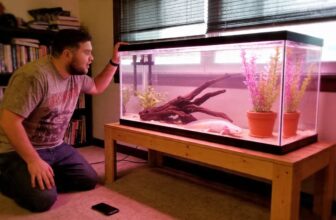
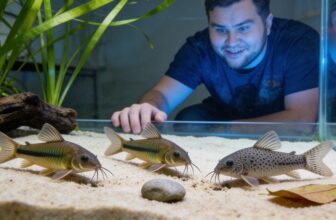
The White Cloud Mountain Minnow handles 57–72°F without a heater, thrives in 10 gallons with dark substrate and 70% plant cover, and schools best at 5–6 individuals—fewer fish fade, hide, clamp fins.
pH 6.0–8.5 works, hardness 10–15 dKH, dim lighting at 10–20 PAR keeps those iridescent stripes popping.
Feed small, frequent meals: flakes, frozen shrimp, micro worms, remove the extras.
Breeding demands Java moss or yarn mops, fry hatch in two days, Infusoria first, then brine shrimp.
Weekly 20–25% water changes, gentle circulation, test your parameters—ammonia spikes show before fish do.
Now, the details below get into tankmates that won’t snack your shrimp, why warm water ages them fast, and the mop-and-bottle method for raising fifty fingerlings in a spare bedroom.
At A Glance
- Keep 10‑gallon tanks with dark substrate and 70% plant cover at 57–72 °F without heaters.
- Maintain schools of 5–6+ fish to ensure tight schooling behavior and vivid red coloration.
- Feed quality flakes plus frozen brine shrimp or micro worms 2–3 times daily, removing uneaten food.
- Change 20–25% water weekly and test for ammonia, nitrites, and nitrates to prevent disease.
- Breed in 10–15 gallon tanks with Java moss, feeding fry infusoria first, then microworms and baby brine shrimp.
White Cloud Mountain Minnow Beginner Basics: 5 Traits That Make Them Ideal
Picture a fish that forgives, that shrugs off your rookie mistakes with cool-water indifference and keeps swimming anyway. The White Cloud Mountain Minnow offers exactly this grace to newcomers.
Five traits earn their reputation as beginner darlings:
- Forgiving temperatures — 57–72°F, no heater drama
- Peaceful nature — community tank compatibility without the bloodshed
- Modest space needs — though they’ll use every inch you give
- Breeding tricks — scatter eggs freely, ignore them completely, still get fry
- Hardy constitution — survive parameters that murder fussier species
Their bre compatibility extends to fellow cool-water dwellers: danios, small tetras, shrimp. No special pleading required.
Beginners belong here. These fish practically welcome you in. For those starting with nano tanks, a compact black housing skimmer like the Sicce Shark Nano suits their small footprint needs.
White Cloud Tank Size: Why 10 Gallons Is the Minimum
Three inches of fish doesn’t sound like much, I mean, until you try stuffing six of them into a jam jar and watch the chaos unfold.
Ten gallons. That’s the floor, not the ceiling. White Clouds need swimming room, and cramped quarters turn their schooling behavior into stressed, washed-out hiding.
Ten gallons is your floor, not your ceiling—cramped quarters turn their schooling into stressed, washed-out hiding.
Tank aesthetics matter here—dark substrates, open centers, planted edges. The tank layout should let them dart, pause, regroup. Crowd them and they fade, literally. Color, confidence, community: all three need space to breathe.
While betta tanks often start at 1.2 gallons in starter kits, White Clouds demand significantly more volume to sustain their active schooling nature.
White Cloud Water Parameters: 57–72°F, pH, and Hardness Explained
How cold is too cold, and where does “room temperature” become a death sentence? The White Cloud Mountain Minnow thrives between 57–72°F, though pushing past 72°F isn’t immediately lethal—it’s just, well, a slow goodbye to those five-to-seven years you were promised. Now, here’s the thing about pH: anywhere from 6.0–8.5 works, with 6.8–7.5 being that sweet spot where everyone gets along. Hard water cycling matters more than you’d think, and seasonal temperature swings actually help—these fish evolved in mountain streams that shift with the months. A reliable 7-in-1 test kit covers all the essential parameters—pH, carbonate, hardness, chlorine, nitrate, and nitrite—in about 30 seconds, giving you lab-accurate results without the guesswork.
| Parameter | Ideal Range |
|---|---|
| Temperature | 57–72°F (optimal ~64°F) |
| pH | 6.0–8.5 (target 6.8–7.5) |
| Hardness | 10–15 dKH, low |
| Cycling | High-quality test kit crucial |
I mean, get the hardness wrong and you’re just guessing, right?
Temperature Errors That Kill White Clouds: Why Warm Water Shortens Lifespan
Keeping White Clouds in warm water is, bluntly, the most common way hobbyists rob themselves of years—not days, years—of a fish’s life.
Now, here’s the thing: these fish evolved in mountain streams, that crisp, oxygen-rich water running somewhere around 64°F. Push them past 72°F and you’ve bought trouble. Heat stress kicks their metabolism into overdrive, burning through their finite cellular resources like a teenager with a gas card. Organs work harder, immune systems falter, and fish that should cruise past age six wither by three.
Metabolic slowdown isn’t the enemy here—acceleration is. Warm water speeds aging, period. Some keepers report White Clouds lingering at 75°F, certainly, but “surviving” and “thriving” split wide open. I mean, you’re aiming for the full five-to-seven-year run, right?
Belonging to this hobby means knowing better. Check that heater—sometimes “off” is the correct setting. Unlike reef systems where LED thermal management demands active cooling to prevent spectrum drift and coral stress, White Clouds simply need the absence of heat—no fans, no heatsinks, just cool water done right.
Building a Mountain Stream Habitat: Substrate, Plants, and Hiding Spots
A few inches of dark sand or fine gravel will get you most of the way there, though “authentic” is a sliding scale when you’re recreating a Chinese mountain stream in a living room in Ohio.
Now, rock stream flow matters. Stack smooth stones, maybe two or three, to break sightlines and create eddies where fish feel safe.
For plant selection, keep it simple: Hornwort, Water Sprite, maybe some Dwarf Rotalia. Aim for 70% coverage, tops. Low‑light tolerant Hornwort excels in mountain stream setups where dense shading from overhanging vegetation keeps the bottom dim.
Hiding spots? Driftwood caves work. Just leave the middle open. White Clouds school there, flash their colors, pretend they’re back in Guangzhou.
Lighting That Enhances White Cloud Colors: Dim vs. Bright Aquarium Lights
Every single lighting decision you make for White Cloud Mountain Minnows amounts to a tradeoff between showing off their iridescent lateral stripes and reminding them, perhaps too insistently, that they still live in glass boxes.
Dim lighting—think forest-floor dappled, maybe 10–20 PAR—makes those stripes absolutely glow. The LED spectrum matters here: warm whites around 2700K–4000K bring out golds and reds without washing them to ghosts.
Bright lights? Cold, hospital-bright setups flatten everything. No color contrast, just stressed fish.
For nano setups under 5 gallons, a clip-on gooseneck design like the Hygger 24/7 or Pawfly 6W delivers precise control over that low PAR sweet spot without overwhelming small tanks.
White Cloud Feeding Guide: Diet, Schedule, and Foods to Avoid
Once the lights are sorted—dim enough to flatter those stripes, not so dim the fish start bumping into décor—attention shifts to what actually fuels them.
White Clouds are opportunistic omnivores, not picky, but they thrive on variety. Seasonal feeding—heartier in warmer months when metabolism quickens, lighter when temperatures drop—keeps digestion on track. Nutrient balance matters: quality flakes or micro-pellets form the base, supplemented with frozen brine shrimp, micro worms, mosquito larvae. Small amounts, two or three times daily. Remove uneaten food immediately; these fish are enthusiastic but messy.
Avoid overfeeding—constipation kills—and skip large pellets they cannot swallow. Live foods carry parasite risks if not home-cultured.
Given White Clouds’ preference for stable water conditions, routine water quality checks including trace iron detection help prevent stress from fluctuating minerals that can accompany seasonal dietary changes.
Now, their social needs.
White Cloud School Size: Why 5–6 Fish Minimum for Color and Activity
Three is a crowd in the wrong direction—too few White Clouds, and the tank goes dull, the fish go pale, and the whole point of keeping them, those flickering lateral stripes like tiny racing stripes, starts to feel like a transaction you lost. Now, five or six? That is where the magic happens. I mean, they start schooling properly, the males flare, and you get that colorary breeding behavior where they chase and flash. A tank of varieties—maybe some golds mixed with standards—really pops when they move as one. If your schedule keeps you away, a well-programmed automatic fish feeder with portion control ensures your school never misses a meal while you’re gone. Below, the breakdown:
| School Size | Behavior You See | Color Result |
|---|---|---|
| 1–2 fish | Hiding, stress, surface-gulping | Faded, grayish tones |
| 3–4 fish | Loose grouping, some skittishness | Patchy, inconsistent |
| 5–6+ fish | Tight schooling, active mid-water movement | Full stripe display, vivid reds |
White Cloud Tank Mates: Cold-Water Species for Peaceful Communities
Seven compatible species, maybe eight if you’re pushing it, will turn a White Cloud tank from a glass box into something worth staring at during commercials.
Now, cold water compatibility isn’t a suggestion—it’s the whole game. These fish hail from mountain streams, so tank mates need to share that preference for 57–72°F without complaining.
Peaceful options include:
- Celestial Pearl Danios, small and understated
- Zebra Danios, active without being jerks
- Corydoras catfish, bottom-dwelling cleanup crew
- Neocaridina shrimp, though babies become snacks
Seasonal temperament shifts matter, too. Spring can spark brief squabbles, even among White Clouds themselves. Nothing brutal, just fish being fish.
Maintaining pristine water quality becomes easier with a magnetic algae cleaner, which keeps viewing panels clear without disturbing the peaceful community during routine maintenance.
White Cloud Diseases: Ich, Dropsy, and Stress Prevention
Catch a White Cloud Mountain Minnow looking peaked, and you’ve got a puzzle with moving parts—ich, dropsy, fin rot, the whole unhappy catalogue. These fish, hardy though they are, still demand your vigilance. Disease monitoring starts with watching them dart, or not dart; stress management means keeping that water cool and stable, since warmth? That’s their kryptonite.
| Symptom | Likely Culprit |
|---|---|
| White spots, flashing | Ich—parasite, treat with heat or meds |
| Bloated scales, lethargy | Dropsy—bacterial, often fatal |
| Frayed fins, hiding | Stress or bacterial fin rot |
Now, prevention beats cure. Test water weekly, feed quality food, and resist impulse buys from questionable tanks. Your school depends on it.
Maintaining gentle water circulation with a low-flow pump around 158–265 GPH prevents stagnant pockets where parasites thrive without overwhelming these hillstream fish with torrential current.
Weekly White Cloud Maintenance: Water Changes and Health Checks
Water Changes and Health Checks
Roll up your sleeves—weekly maintenance isn’t glamorous, but it’s what separates thriving schools from sad, grayish fish hiding behind the filter.
Dirty work keeps colorful schools alive—neglect breeds gray ghosts haunting the filter.
Now, the water test: drop that liquid kit in, check ammonia, nitrites, nitrates—cool-water fish hate spikes, and they’ll tell you with clamped fins before they tell you anything else.
Change twenty, maybe twenty-five percent. Siphon slowly, don’t terrorize the school.
Keep a symptom log, I mean actually write it down—”Tuesday, one fish hiding, mild fin fray.” Patterns emerge, and you’re the detective now. Spot trouble early, fix it cheap. Or don’t, and watch your tank become a ghost story.
Breeding White Clouds: Tank Setup Through Spawning
Tank Setup Through Spawning
Why do so many aquarists panic at the word “breeding,” as if fish reproduction requires wizardry instead of water, patience, and a decent spawning mop?
Set up a dedicated tank—ten gallons, maybe fifteen if you’re feeling generous—at roughly 72°F, slightly warmer than usual. Dark gravel helps, indeed, but the real star is spawning substrate: Java moss, fine-leaved plants, or that aforementioned mop, which is literally just yarn tied to a cork.
Females scatter eggs everywhere, adults mostly ignore them, and fry nutrition becomes the next puzzle. But that’s another section.
Raising White Cloud Fry: Infusoria to Baby Brine Shrimp Timeline
Raising White Cloud Fry from Infusoria to Baby Brine Shrimp
Once the eggs hatch—roughly two days, give or take six hours depending on your water chemistry and how much you obsessively checked them—you’re stuck with fry that are, let’s be honest, barely there.
Two days, give or take, and you’ve got fry barely worth the name.
Hatch timing matters less than what comes next. Fry nutrition starts microscopic, since mouths that small can’t handle much. Now, the progression moves fast, so pay attention:
- Days 1–3: Infusoria, that cloudy soup of single-celled goodness you cultured in a jar on your windowsill like a weird science experiment.
- Days 4–7: Microworms, slightly bigger, slightly easier.
- Week 2 onward: Baby brine shrimp, the golden standard everyone graduates to eventually.
I mean, they grow or they don’t.
From Fry to Adult: White Cloud Maturity at 6 Months
How quickly six months passes when you’re measuring it in fish years—admittedly not a standard unit anyone uses. Fry emerge from eggs at forty-eight hours, barely visible specks requiring infusoria, then graduating to baby brine shrimp as their gaping mouths grow.
Growth rate varies; some hit maturity milestones earlier, some dawdle. By month six, they’ve transformed: one-point-five inches, sexual dimorphism visible, males slender and brighter, ready for their own spawning mops.
Now you’ve joined the club. Breeders nod knowingly; six months means your tank’s first generation is complete, cycling onward, self-sustaining.
Frequently Asked Questions
Do White Cloud Minnows Jump Out of Open Tanks?
White Cloud minnows do jump, especially when startled. Their tank behavior involves darting upward toward surface insects, and without a lid, they’ll find the floor instead.
Tank design must account for this: keep water levels an inch below the rim, add a tight-fitting cover, and avoid sudden movements near the glass.
They’re not escape artists by nature, but panic happens, and these fish don’t understand ceilings exist.
Can White Cloud Minnows Survive Outdoor Pond Life?
White Cloud minnows absolutely survive outdoor ponds, provided the temperature stays within their 57–72°F range, which honestly suits most temperate climates just fine.
Now, breeding behavior actually improves outdoors—natural light cues trigger spawning, and they’ll scatter eggs among plants just like they do indoors, only with more enthusiasm.
The catch? Predators, temperature swings, and the fact that these little guys school beautifully but offer easy snacks to hungry birds.
How Do I Transport White Cloud Minnows Safely?
Transport White Cloud minnows in insulated bags, partial water, breathable surface, stable temperature—aim for 64°F, their comfort zone.
Control stress: dark bags, limited handling, no sudden jolts.
Breeding methods aside, transport mimics spawning conditions—calm, shallow, plant-dense.
Acclimate slowly; float bags, match parameters.
Twenty minutes, maybe thirty.
And always, always check for leaks.
Nobody wants a floor fish.
Do White Cloud Minnows Need an Air Pump?
No, White Cloud minnows don’t strictly need an air pump—these surface-dwelling fish can survive on gas exchange at the water’s surface, provided the tank isn’t overcrowded and water chemistry stays stable.
Still, gentle aeration helps, especially in warmer setups where oxygen dissolves poorly.
Temperature control matters more: keep things cool, around 64°F, and they’ll thrive without fancy gadgets.
Simple setups work.
Should I Quarantine New White Cloud Minnows?
Yes. Quarantine protocols protect existing fish, and disease prevention starts before newcomers hit the main tank.
Quarantine basics:
- 2–4 weeks in a separate tank, roughly 65–70 °F
- Observe for ich, fin rot, erratic swimming—basically anything weird
Why it matters: White Clouds are hardy but not invincible, and one sick fish can crash a whole school.
Skip it if you’re feeling lucky, I guess, but don’t say you weren’t warned.