You can absolutely keep colorful freshwater fish, but you’ll need to match your ambition to your tank size and patience level.
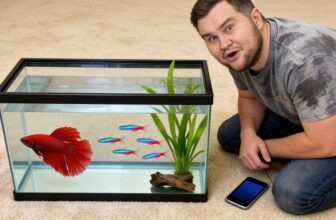
Small tanks (5 gallons) suit a lone betta ($15-40) or chili rasboras ($3-5) under warm LEDs, whereas 10 gallons lets you school celestial pearl danios or neon tetras—minimum six, or they’ll gray out from stress.
Twenty gallons opens the door to discus and rainbowfish, though you’ll pay more and babysit water parameters like a helicopter parent.
Genetics set the palette, but carotenoid-rich foods (think astaxanthin, not bargain flakes) and stable chemistry keep those chromatophores firing.
Skip the wishful thinking, grab a $49 Apera pH meter, and test weekly—your fish will thank you with color that doesn’t quit.
The real magic happens when you stop guessing and start planning.
At A Glance
- Colorful fish need carotenoid-rich diets and stable water chemistry to maintain vibrant hues.
- Tank size determines suitable species: 5-gallon for bettas, 10-gallon for schools, 20-gallon for showpieces.
- Match fish temperaments and water parameters to prevent stress-induced color fading.
- Minimum group sizes of 6-8 prevent stress and display full natural coloration.
- Inspect fish health before purchase: bright even tones indicate good care and genetic quality.
What Makes Freshwater Fish Display Vivid Colors
Here’s what actually matters for your tank:
- Pig pigment genetics: You’re literally buying DNA, not paint. Some fish hatch boring and bloom later—others stay dull, like that cheap T-shirt that fades after one wash.
- Diet-driven coloration: Feed them garbage, watch them gray out. Carotenoids in quality food? That’s their glow-up fuel, not magic.
You’re part of a club now, one that notices when a tetra’s stripe pops or a gourami shimmers. It’s science, indeed, but also bragging rights. Get the genetics right, feed like you care, and your tank becomes the living room’s main character—no reef required. Maintaining stable alkalinity in your water chemistry prevents stress that dulls colors.
Bottom line: Color’s earned, not bought on clearance.
5-Gallon Freshwater Wonders: Maximum Color, Minimum Space
Your fish doesn’t need a mansion to turn heads—just five gallons of water and some smart choices.
Five gallons. Smart choices. Maximum impact.
You belong here, even in tight spaces. A Betta’s flowing fins pop under proper tank lighting, turning your desk into a gallery. Chili Rasboras fire up crimson when you apply basic color theory—warm LEDs against dark substrate, simple stuff. Clown Killifish? They’re basically aquatic confetti.
- Betta: $15-40, 3 inches, 3-5 years
- Chili Rasbora: $3-5 each, schooling in tiny packs
- Clown Killifish: $4-8, top-dwelling acrobats
Skip the guppies here—they’ll overpopulate faster than your uncle’s “quick” stories. Also, choose a tank with low-flow filtration to protect delicate fins.
Bottom line: One showstopper, or six micro-fish. Pick your vibe, light it right, you’re golden.
10-Gallon Freshwater Standouts: Schooling Fish That Dazzle
Celestial Pearl Danios? They’re your gateway drug to nano schooling, and yes, you’ll want six minimum—anything less and they sulk like teenagers at a family reunion.
Your 10-gallon becomes a living kaleidoscope with these guys. Schooling palettes shift from deep sapphire to copper-spotted cream as they dart through midwater, as Neon Tetras bring pure neon dynamics with that electric lateral stripe—nature’s LED strip, basically.
- Harlequin Rasboras: copper wedges, bulletproof, $4 each
- Zebra Danios: hyperactive, nearly indestructible, $2-3
Skip the Dwarf Gourami here; they hog space like that one friend who needs the whole couch.
Bottom line: six Celestial Pearls, soft filtration, planted corners. You’ve got a shimmer tank, not a fishbowl.
A 10-gallon tank is too small for a proper school of Harlequin Rasboras, which need a minimum 20‑gal for 8‑12 fish.
20-Gallon Freshwater Showpieces: Discus, Angels, and Rainbowfish
Once you cross into 20-gallon territory, you’re officially done with “cute” and into “commitment” territory—these fish demand respect, stable water, and yeah, a little extra cash.
Discus are the crown jewels here—vivid color genetics (that’s breeder-speak for “they look like living art”) produce turquoise, pigeon blood, and checkerboard patterns. But they’re divas: 82-86°F, soft water, and daily attention. Tank lighting trends favor full-spectrum LEDs that make these guys absolutely glow.
Discus demand diva-grade care—hot water, soft conditions, daily attention—but reward you with living art that glows under the right LEDs.
Angels bring that iconic triangular silhouette, hitting 6-8 inches tall with stripes or marble patterns. Rainbowfish add that iridescent, ever-shifting shimmer—Bosemani and Neon Dwarfs school beautifully. Guppies offer similar vibrant coloration with a key distinction being that males display long flowing fins and brighter patterns than the larger, more subdued females.
Bottom line: pick one species, commit to the care, and you’ll join the serious hobbyist club. Worth it? Absolutely.
30-Gallon and Beyond: Large Freshwater Fish Worth the Space
When you’re staring at that empty 30-gallon tank, you’re basically holding a backstage pass to the big leagues—no more tetra crowds, this is where fish with actual shoulders show up.
You’ve committed, now own it.
- Oscar – These large fish demand respect, hitting 12-plus inches with personality for days. Match their habitat region (South America) to keep them chill.
- Firemouth Cichlid – Smaller but fierce, 5-6 inches of attitude. Adjust water chemistry (pH 6.5-7.5) or they’ll let you know.
- Blue Acara – Moderate care, 8-10 year commitment. Upgrade that filtration system, seriously, they’re messy roommates.
Size isn’t optional here—skip the shelf, build the system. Even in larger tanks, consider adding driftwood hiding spots to reduce stress for bottom-dwelling species.
Peaceful or Aggressive: Which Colorful Fish Mix Best?
You’ve spent weeks picking the perfect substrate and now you’re about to blow it by tossing a Betta in with a bunch of Tetras like it’s a peace summit. Stop. Let’s talk compatibility before your tank becomes a crime scene.
Peaceful palettes belong together—Neon Tetras, Harlequin Rasboras, and Dwarf Gouramis school happily, spreading color without bloodshed. Aggressive palettes demand respect—Bettas, Angelfish, and Firemouth Cichlids need their territory, or they’ll turn your aquascape into a boxing ring.
Mixing these? That’s asking for trouble.
Maintain a minimum group size of 6-8 for Neon Tetras to prevent stress-induced color loss.
Bottom line: Match temperaments, not just hues. Your fish—and your sanity—will thank you.
Beginner-Friendly Color: Fish That Forgive Mistakes
Why are some of the prettiest fish likewise the most demanding? You don’t need that stress when you’re starting out. Some colorful freshwater fish offer mistake forgiveness without sacrificing vibrant looks. You want colorful coloration that survives your learning curve.
These three species welcome you into the hobby:
- Betta — Stunners in tiny 5‑gallon tanks, they’ll tolerate missed water changes better than most, living 3‑5 years with minimal fuss
- Guppy — Prolific, cheap, and forgiving; their endless patterns make losing a few sting less
- Harlequin Rasbora — Schooling copper wedges that bounce back from beginner missteps, thriving in basic 10‑gallon setups
You belong here. Pick forgiving fish, learn the ropes, then branch out.
To keep these jump‑prone beginners safe, consider adding a magnetic anti‑jump net cover to your tank.
Moderate Care, Major Reward: When to Level Up
Once you’ve mastered the forgiving stuff, it’s time to stop playing it safe.
Welcome to the middle ground, where budget care meets serious color payoff.
You’re graduating from “oops, forgot a water change” to “stable parameters matter,” and the fish notice.
Moderate-care species—think Discus, Angelfish, Blue Acara, Redtail Shark—demand attention, not obsession.
You’ll test water weekly, not daily.
You’ll learn that heat matters, that these fish sulk when cold, that their colors pop when you get it right.
It’s a sweet spot, really.
Not beginner luck, not expert burnout.
Just you, leveling up, belonging to the club that knows the difference.
This includes maintaining specific gravity 1.020-1.025 to replicate stable marine conditions, though your freshwater setup will focus on similar pH and temperature vigilance.
Matching Water Parameters to Colorful Freshwater Fish
Since every colorful fish is basically a tiny, swimming chemistry experiment, you’ll need to match their water needs before you match their colors to your living room vibe—otherwise, you’re just renting disappointment.
pH, temperature, hardness: these aren’t aquarium buzzwords, they’re the difference between a fish that glows and one that, well, doesn’t.
Your tank décor actually shifts those color parameters—dark substrates make neons pop, while driftwood softens water for rams.
- Test your tap water first; no point fighting chemistry you’ll lose.
- Match species to your baseline, not fantasies.
- Adjust gradually—shock kills faster than wrong numbers.
Belonging starts with compatibility, not compromise.
Devices like the APERA AI209 Waterproof Kit offer auto‑calibration up to three points for precise pH readings, helping you maintain stable water conditions.
Why Tank Size Changes What You See
Whether you’re cramming a betta into a coffee-can aquascape or turning your living room into a discus palace, the tank size you pick doesn’t just change where your fish live—it completely rewires what colors you actually get to see.
Tank size doesn’t just change where your fish live—it completely rewires what colors you actually get to see.
Small tanks? Your lighting spectrum options shrink faster than your patience during a water change. Limited space means weaker LED spreads, and your fish’s color intensity dims like a dying flashlight.
- 5-10 gallons: Cheap clip-on lights dominate; reds fade, blues muddle
- 20+ gallons: You release full RGB controls, proper water chemistry stability
Bigger tanks buffer pH swings, letting chromatophores—that’s fancy fish skin—fire at full saturation. Your wallet hurts, but your discus glow like neon signs. A larger tank also accommodates more powerful fixtures like a VIPARSPECTRA 165 W with even light spread and natural dawn-to-dusk dimming, which further enhances fish coloration.
Community Tanks: Mixing Colorful Fish Without Conflict
Colorful community tanks live or die by three things: temperament matching, water-parameter overlap, and whether your fish see each other as roommates or snack plates.
You want compatible harmony, not a soap opera with fins. Start here:
- Match temperaments — keep neon tetras with harlequin rasboras, not Oscars with guppies, unless you’re running a tiny gladiator school.
- Align water needs — your discus need 82-86°F, so don’t park them with zebra danios who prefer 64-75°F. Someone’s going to have a bad day.
- Plan for color contrast — emerald corydoras against chili rasboras pop visually, creating depth you can’t fake with plastic plants.
Bottom line: research before you buy, or you’ll learn the hard way.
Spotting Healthy Fish: Signs of Quality Before You Buy
If you can’t spot a dud from a gem at the fish store, you’re basically throwing money into a tiny, finned toilet. But you’re smarter than that, right? You want fish that’ll thrive, not just survive.
Here’s your game plan:
- Color chart check — bright, even tones mean good care; patchy or washed-out hues signal stress or disease
- Health checklist — clear eyes, intact fins, steady swimming; avoid fish clamping their fins or hiding in corners
- Tank inspection — cloudy water or dead tankmates? Red flag bigger than a fire engine
You belong in the club of aquarists who get it right the first time.
Why Freshwater Fish Fade (And How to Fix It)
Your fish didn’t sign up for a life of beige, but here you are, staring at a tank full of drab, listless swimmers that look like they’ve given up on everything. Fading colors signal something’s off, and you’re probably the culprit—sorry, not sorry.
Here’s what to fix:
- Diet stress – You’re feeding flake food from 2003. Toss it. Upgrade to quality pellets, frozen brine shrimp, or spirulina-enriched foods. Your fish aren’t vegan, but they need variety.
- Diet deficiencies – Missing carotenoids? That’s like you skipping vitamin C. Add color-enhancing foods with astaxanthin.
- Water parameters – Test your tank. Ammonia spikes stress fish, bleach their hues.
Bottom line: Feed better, test weekly, stop being lazy.
Three Complete Colorful Tank Plans From 5 to 30 Gallons
So you’ve got a tank sitting empty, or maybe one that’s been boring you to tears, and you’re wondering where to even start with stocking it? Here’s your roadmap to finally belonging in the hobby.
5 gallons: One male Betta, dark substrate choice (brings out his blues), and gentle tank lighting. Add a silk plant, done. Cost: about $45 total.
10 gallons: Six Neon Tetras, reddish-brown substrate choice, and dim tank lighting (they glow better). Throw in driftwood, pretend you’re a pro. Cost: roughly $85.
30 gallons: Four Pearl Gouramis, sand substrate choice, bright tank lighting for that shimmer. Fake plants welcome—no shame. Cost: around $200.
Pick a plan, fill it up, join the club.
Frequently Asked Questions
Do Colorful Freshwater Fish Recognize Their Owners?
Yes, they do—sort of.
Your Betta or Oscar won’t write you birthday cards, but their visual cognition lets them spot you across the room.
That owner perception you notice? It’s real recognition behavior, not just hunger.
Fish form owner attachment through routine, associating your giant face with food and safety.
You’re basically a vending machine they tolerate, maybe even like.
Lower your expectations, raise your tank lid slowly.
Can Fluorescent Lighting Enhance Fish Colors Artificially?
Think of a neon sign buzzing to life—that’s your tank under fluorescent lighting, and yes, it’ll improve your fish’s colors, but here’s the catch: you’re mostly seeing fluorescence, not true improvement.
The fluorescent spectrum (the range of light wavelengths emitted) hits certain pigments and makes them pop artificially, like a cheap Instagram filter. Light intensity (brightness level, measured in lumens) matters too—too weak and colors go flat, too strong and you’ll stress your fish or spark an algae party you’ll regret.
- Pros: Cheap fixtures ($15-40), energy-efficient, decent for beginner setups
- Cons: Won’t bring out natural iridescence like full-spectrum LEDs, can wash out reds and blues
Stick to 6500K daylight fluorescents for a balanced look, or upgrade to LEDs when you’re ready—your fish deserve better than a gas station glow.
Are Dyed Fish Ethical to Keep in Home Aquariums?
Dyed fish aren’t ethical—you’re supporting a painful, stressful process where fish get dunked in acid baths or injected with dye.
- ethical dyeing: doesn’t exist; it’s all harmful, no matter what sellers claim
- market demand: drives this ugly trade, so your wallet’s your vote
Skip the neon tetras that glow wrong, grab naturally vivid fish—chili rasboras, wild-type guppies—and sleep better. You’ll still get color, minus the guilt trip.
Do Fish Colors Change During Breeding Seasons?
Have you noticed your aquarium’s palette shifting with the calendar?
You’re watching *hormonal coloration* in action—fish literally broadcast their breeding status through *breal pigment* changes.
That *seasonal shift* isn’t vanity; it’s survival.
Males intensify hues for *mating displays*, females flash submission signals.
Temperature and photoperiod trigger these transformations.
You’ll spot it in guppies, bettas, cichlids especially.
No, you can’t stop it—nor should you want to.
Which Colorful Fish Are Legal in All U.S. States?
No colorful freshwater fish are legal in all 50 U.S. states—state regulations vary too wildly for that.
You’ve got to check state distribution maps before you buy, since legal compliance isn’t optional, it’s the law.
Bettas, guppies, and neon tetras face uniform restrictions in places like Florida and California, where invasive species rules bite hardest.
Always verify local laws; your wallet—and conscience—will thank you.
Rounding Up
You don’t need a mansion to keep dazzling fish—just 5 gallons and decent water changes. Studies show bettas recognize their owners (yes, really), which beats most apartment roommates. Pick species that match your space and schedule, not your ego, or you’ll join the 80% of beginners who quit year one. Start small, upgrade smart, and let that fish actually see you coming.