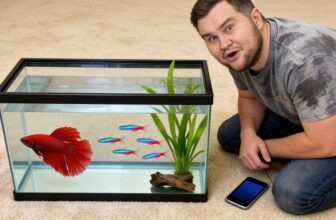
Start with fancy guppies, their fan-shaped tails flash like tiny flags in a 5-gallon tank.
You’ll watch real-time genetics as fry inherit blended colors from both parents.
Endler’s livebearers sparkle orange-blue-green in schools of six, whereas betta fish glow in reds, blues, and dragon-scales under adjustable light.
Cherry barbs ripple red waves through planted tanks, and zebra danios streak silver-blue in tight schools.
Electric blue acaras shimmer like sky underwater, needing soft LED to show their candle-yellow fins.
Oscar fish spread orange-black across 55 gallons, moving gravel with deliberate confidence.
Each species matches skill level, tank size, and patience—you’ll find your perfect match waiting just ahead.
At A Glance
- Fancy Guppies flash rainbow tails from genetic blends in compact 5–10 gal tanks.
- German Blue Rams glow electric blue when kept in bonded pairs with stable, soft water.
- Betta fish display layered pigment morphs best under dim, warm 78–80 °F conditions.
- Cherry Barb schools of 12+ generate flowing red waves that animate planted aquascapes.
- Electric Blue Acaras need subdued LED lighting to preserve their six-inch metallic shimmer.
Beginner-Friendly Color: Fancy Guppies for First-Time Aquarists
What draws your eye first when you walk into a room full of fish tanks? You’ll spot Fancy Guppies immediately, their fan-shaped tails waving like tiny flags.
These fish carry their color in their genes, and you’ll learn this fast when you try Guppy breeding. Each fry inherits paint from both parents, so you’ll watch color genetics unfold in real time. A red-tailed male plus a spotted female creates surprises.
Every fry inherits paint from both parents—watch color genetics unfold in real time.
You’ll need just five to ten gallons, and the water stays room temperature. They eat flakes, they’re peaceful, and they multiply without fuss.
A full‑spectrum LED brings out their iridescent scales and makes tail patterns pop under proper lighting.
For your first aquarium, they’re forgiving teachers.
Tiny Tank Options: Endler’s Livebearer vs. German Blue Ram
Your first tank sits empty, or maybe it holds just five gallons of water, and you want something bright that won’t outgrow the glass.
Consider two small fish that bring serious color to tiny spaces. You’ll find Endler’s Livebearer, a speckled swimmer in orange, blue, and green, needs just ten gallons. Endler’s water maintenance stays simple—you’re changing water weekly, testing monthly, watching these busy dots dart like living confetti.
Or choose German Blue Ram, a two-and-a-half-inch cichlid wearing electric blue spots and yellow streaks like tiny armor. They’re peaceful, curious, and fit twenty gallons comfortably.
Installing a proper sump with adjustable acrylic baffles helps maintain the stable water conditions these vibrant fish require, especially in smaller tanks where parameters fluctuate quickly.
| Feature | Endler’s Livebearer | German Blue Ram |
|---|---|---|
| Minimum tank | 10 gallons | 20 gallons |
| Adult size | 1.5 inches | 2.5 inches |
| Best group size | 6+ (schooling feels safe) | Pair (they form bonds) |
| Your weekly task | Water change, basic test | Stable temperature, soft water check |
Pick Endler’s when you crave movement and ease. Choose German Blue Ram when you want one fish to watch closely, to notice how it tilts its head, recognizing you back.
Nano Centerpiece: Betta Fish Color Morphs and Care
One small cup on the shelf holds a fish that carries more color than seems possible for its size.
You watch a male Betta flare his fins, and you understand why people fall in love. Betta genetics work like paint mixing—layers of pigment cells create reds, blues, metallics, even patterns like marble or dragon scale. You don’t need to be a scientist, but you do need to know the basics.
Color morph care means matching your fish to his needs. Darker morphs often need dimmer light, which feels safer, so consider using a modular height adjustment riser to fine-tune your lighting intensity. All Bettas need warm water, 78-80 degrees, and clean space to swim. You give him five gallons minimum, and he’ll show you his best colors.
Peaceful Community Stars: Cherry Barb Schools for Planted Tanks
Three dozen small fish can turn a patch of green water into a living jewel box.
You watch your Cherry Barbs weave through stems and leaves, their bodies catching light like drops of ripe fruit. They’re peaceful neighbors, never nipping fins or claiming corners.
A well-maintained aquarium benefits from mechanical coarse filtration to remove debris before it clouds the water, just as pond keepers use cut-to-fit pads for crystal clarity.
| Feature | Benefit | How You’ll See It |
|---|---|---|
| Planted filtration | Roots clean the water naturally | Clearer tank, fewer water changes |
| Algae control | They graze gently on surfaces | Less green fuzz on glass and leaves |
| Schooling behavior | Safety in numbers, beauty in motion | Rippling red waves at dawn |
| Plant-safe | No digging, no uprooting | Carpet plants stay rooted |
| Beginner-friendly | Forgiving of small mistakes | Healthy fish even when you’re learning |
You’ll feel calm watching them. Their needs teach patience, rewards coming steady, like friendship built over time.
Active Midwater Movement: Zebra Danio Stripes and Schooling
Since they stay busy in the water column, you notice Zebra Danios more than bottom-hiders. You watch them zip back and forth, their dark stripes catching the light like tiny racing flags.
Zebra Danios stay busy in the water column, zipping back and forth, their stripes catching the light like tiny racing flags.
You’ll appreciate Zebra Danio schooling since eight or more fish move as one shimmering unit, like a flock of birds turning together. This behavior keeps each fish safe and makes you feel calm when you observe it.
Their dynamic stripe patterns—deep blue-black lines over silver—create visual energy no single fish could match. You see how simple marks, repeated, build something lively and bright.
You keep water between 64–75°F, and they thank you with constant motion.
When moving these active fish between tanks, a fine-mesh protection net prevents damage to their swift-moving fins and keeps the school intact during transfer.
Gourami Varieties: Surface-Dwelling Color for 10-20 Gallons
When Zebra Danios race through the middle of your tank, you might notice the top surface sitting empty and still.
You can fill that space with Gourami varieties, fish that prefer breathing at the water’s top, just like you might float at a pool’s surface.
Their Gourami palettes include golden Honey Gouramis, blue Dwarfs with red edges, and Pearl Gouramis with soft silver spots.
These Surface hues shimmer when light hits from above, creating a lid of color above your Danios’ busy stripes.
Consider adding porous resin ornaments beneath the surface to create visual depth that complements your Gouramis’ shimmering colors.
| Species | Size | Best Feature | Your Feeling |
|---|---|---|---|
| Dwarf Gourami | 2 in | Neon blue-slash-red body | Calm wonder |
| Honey Gourami | 1.5 in | Sunset orange glow | Quiet warmth |
| Sparkling Gourami | 1 in | Green iridescent dots | Gentle curiosity |
| Pearl Gourami | 4 in | Lacy fins with pearl spots | Peaceful pride |
They need 10-20 gallons, plants to hide beneath, and no pushy tank mates nipping their waving feelers.
Paradise Fish: Vertical Stripes With Caution Required
The Paradise Fish swims like a living ribbon, its body striped in strong reds, oranges, and blues that run straight up and down, vertical bands that catch light like stained glass.
You’ll keep this fish in twenty gallons of water, watching those bright stripes glow against dark plants.
But stripe stripe care means watching closely. This fish carries temper, old fire from rice paddies where it fought for space. Temperament monitoring becomes your quiet duty, checking fins nipped, checking hiding spots used. You’ll house it with quick swimmers, not slow dreamers. Peace comes through careful planning, through knowing beauty often has an edge.
When introducing new Paradise Fish to your aquarium, a temporary quarantine period allows you to observe for aggression or disease before placing them with established tank mates.
Intermediate Showpieces: Electric Blue Acara Metallic Shine
What does a living mirror look like when it swims?
You’ll find your answer in the Electric Blue Acara, a six-inch beginner-intermediate fish that carries metallic shimmer across every scale.
Adjust your habitat lighting carefully—too bright washes out their glow, too dim hides their magic. You want a soft LED, mimicking dawn through South American waters where they roam sandy riverbeds.
You’ll notice calm confidence in their swimming, peaceful enough for community tanks unlike pushier cichlids. Their yellow dorsal ridge catches light like a candle flame.
You’re tending a mood, really. When they glide past, you feel quiet wonder, six-tenths full, like holding a piece of sky underwater.
A 20‑gallon curved glass setup with three LED modes provides ample swimming space and customizable lighting to showcase their shifting metallic blues without overwhelming their subtle glow.
Peacock Cichlid: Lake Malawi Blues for 55-Gallon Tanks
You set down the soft blue shimmer of the Acara and pick up something sharper, something carrying its own weather.
Lake Malawi genetics gift these fish their saturated blues, each strain a map of underwater geography.
| Trait | Measurement | What It Means |
|---|---|---|
| Adult size | 4–6 inches | Fits your 55-gallon with swimming room |
| Temperament | Semi-aggressive | Needs space, not war |
| Color source | Regional bloodlines | Select for the blue you want |
| Cichlid breeding | Mouthbrooding females | Watch mother hold eggs safe |
You’ll study lineages like a farmer reads seed packets, choosing depth over flash. The aragonite and calcium carbonate composition of your substrate will buffer water chemistry to support stable pH for these demanding cichlids.
Electric Yellow Lab: Sunshine Cichlids With Black Fin Accents
When you’re ready to move past the blue shimmer of the Acara, reach for something that carries its own light.
You’ll find three inches of pure sunshine swimming through the middle of your tank.
The Electric Yellow Lab glows like a lemon drop, with black racing stripes painted across its dorsal and ventral fins, edges sharp as a felt-tip marker.
You’ll need fifty gallons and hard, alkaline water, matching the rocky shores of Lake Malawi where these fish evolved.
Yellow Lab breeding rewards your patience with fry that shimmer like their parents.
Color genetics determines whether those black accents stay crisp or soften, and you’ll watch generations reveal hidden patterns.
For stable water conditions in your Malawi setup, a dual-outlet controller lets you run both a primary heater and backup simultaneously, protecting your investment in these vibrant fish.
Semi-Aggressive Statement Fish: Jack Dempsey Color Forms
Jack Dempsey Color Forms
If you’re drawn to fish that announce themselves with muscle and shimmer, the Jack Dempsey steps forward like a boxer under a spotlight.
You’ll find this semi-aggressive cichlid in several striking color forms. The classic Jack Dempsey shows deep blue-green scales with iridescent spots, like tiny coins catching light. Electric blue variants glow with solid sapphire bodies, no speckles, just pure underwater neon.
This hue variety means you can pick a mood: mysterious dark tones, or brilliant electric flashes.
Large Tank Demands: Oscar Fish Orange-Black Dominance
Tank Size and Powerful Presence
Even smaller tanks tempt many beginners, Oscar fish rewrite the rules with bodies built for dominance and color that fills a room.
Oscar fish don’t adapt to your tank. They demand space worthy of their presence.
You’ll need 55 gallons minimum, more if you want two. That orange black palette spreads across thick, muscular flanks like spilled paint on velvet—burnt orange dots floating in deep black fields, catching light like wet stones in a stream.
Oscar color dominance demands your attention. These fish grow rapidly, reaching twelve inches within months, and they know their size. They rearrange gravel, shift driftwood, claim territory with slow, deliberate confidence. You’re not decorating their tank. You’re leasing space.
Flowerhorn Cichlid: Humped Giants for Dedicated Owners
Flowerhorn Traits and Care
A bulbous head rises from the water like a smooth stone worn by centuries of current, and you realize this fish has been waiting for someone exactly like you.
You’re looking at a Flowerhorn Cichlid, a 12-inch giant with pink-red scales and white spots.
Strong owner interaction separates thriving Flowerhorns from lonely ones. They’ll follow your finger, beg for food, even seem to recognize your face.
Hump care matters since that fleshy crown shrinks when they’re stressed or underfed. You keep it full with quality protein, clean water, and attention.
They demand seventy gallons minimum. They bite tankmates. They need you daily.
But you get a fish who meets your gaze like a friend across the room.
Advanced Challenge: Discus Fish Colors and Parameter Precision
Discus Fish Colors and Parameter Precision
The glass thermometer reads exactly 84 degrees, and you’re watching your Discus fish flare their fins like slow-moving sails.
You want the intense reds and electric blues?
Discus hue genetics determine what shades you’ll see, from turquoise leopards to pigeon blood maroons.
But you can’t rush this beauty.
Parameter sensitive water chemistry means your nitrate stays under 10 ppm, your pH hovers at 6.5, soft as rainwater. You test twice weekly, feeling patient, steady, like tending a garden in fog.
| Color Variety | Water Temperature | Hardness Level |
|---|---|---|
| Red Turquoise | 82-86°F | 1-4 dGH |
| Blue Diamond | 85-87°F | 1-3 dGH |
| Pigeon Blood | 84-86°F | 2-4 dGH |
| Checkerboard | 82-85°F | 1-3 dGH |
| Leopard Snake | 83-86°F | 2-5 dGH |
You change thirty percent weekly, you watch them bloom.
Matching Fish to Tank Size and Experience Level
Where do you start when the aisle of aquariums stretches before you, row on row of glass boxes humming with filters? You start with what you can actually manage, friend.
Measure your space. Check your patience. Then look at the fish.
- Beginners pick Germans or Endlers in 10‑20 gallons. You’re learning temperature tolerance here, keeping things steady.
- Intermediate keepers handle Peacocks or Jack Dempseys at 55 gallons. You navigate bi compatibility, mixing fish without bloodshed.
- Advanced aquarists tackle Discus in 50+ gallons. You balance exacting chemistry daily.
Choose fish that fit your hands, your hours, your heart.
Frequently Asked Questions
Which Colorful Fish Eat Algae and Clean Tanks?
You’ll want otocinclus catfish, Siamese algae eaters, or colorful bristlenose plecos for algae scrap and tank cleaning—they actively graze green surfaces as adding visual interest, and you won’t find better hardworking helpers among vivid freshwater species.
Can Colorful Freshwater Fish Live in Outdoor Ponds?
You can keep colorful freshwater fish in outdoor ponds if you match their temperature tolerance to your pond pond climate. Research each species’ needs, as tropical varieties won’t survive cold winters without heating.
Do Vibrant Fish Colors Fade With Age or Stress?
Yes, you’ll notice color stress dulls your fish’s vivid hues, as age‑related fading naturally occurs over time. You’ll see brighter colors return when you reduce stressors like poor water quality or aggressive tank mates.
What Lighting Best Enhances Fish Coloration?
You’ll boost your fish’s hues by selecting a full LED spectrum with red and blue wavelengths, and you’ll adjust light intensity to highlight iridescent scales without washing out deeper colors—moderate brightness prevents stress-induced fading.
Are Dyed or Genetically Modified Colorful Fish Ethical?
Your color fascination shouldn’t support dyed fish, as they’re cruelly injected with chemicals. You’ll find ethical breeding far preferable, producing vivid, healthy specimens through selective genetics rather than harmful artificial alteration that shortens their lives.
Rounding Up
Your aquarium glass holds living paint that swims and breathes. You’ve met fifteen fish that turn water into wonder, from a guppy’s rainbow tail to a discus’s round, bright body. Some need small tanks, ten gallons, whereas others need fifty or more. Some ask for easy care, others need your daily attention. Pick the fish that matches your hands, your time, your space. Then watch colors move where emptiness lived before.