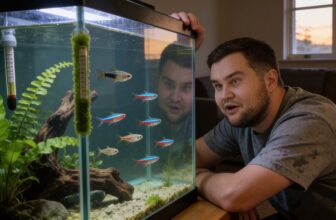
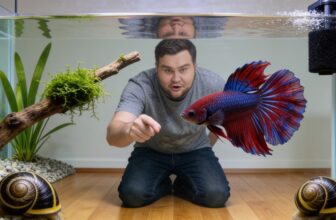
Your betta can absolutely get depressed, and you’ll know when those electric blues fade to dishwater gray and your swimmer parks behind the filter like it’s avoiding rent.
Small tanks crush their spirit—five gallons minimum, people—while stagnant water, zero enrichment, and mirror‑less boredom turn them into listless couch potatoes.
Fix it with silk plants ($5‑10), a ping‑pong ball for hunting practice, weekly food rotation, and that mirror trick twice weekly to spark their fighting spirit.
Healthy bettas build bubble nests, clamped fins and rotting uneaten food scream “help.”
Test your water, give them caves, and yes, you can hover your finger daily like a weirdo—they’ll follow you.
Skip the plastic plants, they’re basically fish‑fin shredders.
Still sulking? There’s more to uncover below.
At A Glance
- Betta fish display depression through faded colors, clamped fins, hiding, and refusal to eat.
- Minimum five-gallon tanks with stable water parameters prevent stress-induced depression.
- Enrichment items like silk plants, caves, and floating toys stimulate natural hunting behaviors.
- Varied protein-rich diets including live daphnia and frozen bloodworms boost mood and health.
- Daily finger training and brief mirror play build trust and provide mental stimulation.
Do Betta Fish Actually Get Depressed?
Yes, betta fish can get depressed, and if you’ve ever stared at your own reflection at ****2 a.m. wondering about the meaning of existence, you’ve got more in common with your finned roommate than you might think.
Betta depression is real, people. These fish aren’t just decorative—they feel. When their world shrinks to a tiny cup, they spiral. You’ll spot general stress signs like faded colors, clamped fins, hiding, or tail-nipping. They’re basically screaming, “I’m bored, lonely, and this water’s garbage.”
Unchecked, their immune systems tank. They get sick, they suffer, they check out early. You’re the landlord of their entire universe. Make it count. Adding an anti-jump mesh cover prevents escape and injury, giving your betta a secure environment to explore.
7 Signs Your Betta Is Depressed (Not Just Lazy)
Alright, so your betta’s acting off—before you write it off as your fish just being a couch potato, let’s sort lazy from legitimately bummed out. Real depression shows behavior depth that goes way beyond your average lazy Sunday afternoon.
- He stops eating, leaving expensive flakes to rot
- Colors fade to dull grays, like old sun-bleached jeans
- Hiding nonstop behind plastic castle, ignoring your taps
- Fins clamp tight against body, zero flowing flair
- Erratic darting turns to freeze-frame stillness at bottom depths
- Remember that color fading with age or stress can also indicate poor water quality, so check your parameters regularly.
You’re looking for behavior depth that screams depression, not just a slow day, so check him daily, okay?
Why Bubble Nests Mean Your Betta Is Happy
Why do betta owners get weirdly proud of floating spit? Since bubble nest signaling means you’ve cracked the code.
That foamy cluster on the surface? It’s a mood indicator, pure and simple. When your betta blows bubbles, he’s saying, “I’ve got enough energy, I’m not stressed, and I feel like showing off.” In betta slang, that’s happiness.
A foamy cluster on the surface means your betta’s got energy, zero stress, and something to prove. In short: happiness.
You’ll spot it more often in warm, clean, stable water—basically when you’re doing your job right. No nest doesn’t mean he’s depressed (some bettas are just lazy architects), but when you see one, you’ve earned your stripes.
Keep conditions consistent, and you’ll keep seeing those proud little rafts. To maintain this environment, provide gentle flow filtration that won’t stress his delicate fins.
How Tiny Tanks Trigger Betta Depression
Since you’ve probably walked past that sad, palm-sized cup at the pet store and thought, “How bad could it be?”—let’s talk about why your betta’s cramped studio apartment is basically a prescription for fish therapy.
You’re condemning a three-inch athlete to a puddle. Tiny tank size means:
- Zero swimming room (they need exercise, too)
- Toxic ammonia buildup that burns their gills
- No enrichment to spark curiosity
- Constant stress that fades their colors
- Lethargy that masquerades as “lazy fish personality”
You’re not getting a low-maintenance pet; you’re slowly breaking a living creature. Get five gallons, minimum—before you become the villain in someone else’s fish memoir. Even a 3-gallon plastic bowl provides significantly more living space than those tiny death traps.
The 5-Gallon Fix: Minimum Space for Mental Health
How much water does a fighting fish actually need to stop sulking? Five gallons, minimum—anything less, and you’re basically asking a marathon runner to live in a closet.
A fighting fish needs five gallons minimum—anything less is asking a marathon runner to live in a closet.
Tank cycling matters here, obviously. That nitrogen cycle‘s your invisible foundation, turning toxic ammonia into something survivable. Skip it, and you’ve built a swimming pool over a sinkhole.
Mental enrichment starts with space itself. Your betta needs room to patrol, to claim territory, to actually swim somewhere. Tiny bowls create listless fish. You want personality? Give him real estate.
Small tank syndrome isn’t pretty—stunted fins, stress stripes, the whole sad package.
Five gallons fixes that. For even better visual clarity and color, consider upgrading to a tank with low‑iron glass, which provides high transparency and reduced color distortion.
Silk Plants, Caves, and Toys That Prevent Boredom
Stocking a five‑gallon slice of water isn’t where the job ends, it’s where the real work kicks in. Your betta needs stuff to do, or he’ll stare at the glass like you check your fridge at midnight—hopeful, then disappointed.
- Silk décor protects those flowing fins (plastic tears them, nobody wants a tattered fish)
- Caves cost $4‑12, give him a panic room for overstimulated days
- Interactive toys like floating ping‑pong balls trigger hunting instincts
- Leaf hammocks near the surface let him breathe easy, literally
- Laser pointers work underwater; yes, you become that person
Boredom kills. Enrichment costs pocket change. Choose silk over plastic, rotate toys weekly, and watch him perk up—color brightening, fins flaring, actually moving. Happy betta, Happy betta, validated you.
Rinsing any new gravel at least twice prevents cloudy tank syndrome and keeps the water clear for your betta’s toys and plants.
Rearrange Your Tank Monthly: Novelty Fights Depression
Even if your betta’s tank looks like a five-star resort, he’ll still get bored staring at the same rock every single day—imagine eating breakfast at the same table for a year, you’d start talking to your toast.
You need to shake things up. Monthly rearrangements of your tank décor give betta fish a fresh territory to investigate, triggering natural curiosity and reducing depressive lethargy. Pair this with seasonal lighting—warmer whites in winter, cooler blues in summer—to mimic natural cycles, and you’ve got environmental enrichment that actually works. Using a long curved scissors during redecorating helps trim plants without bruising stems, preserving water quality.
| Quick Wins | Why It Matters |
|---|---|
| Move that castle left, driftwood right | Prevents territory stagnation, sparks investigation |
| Swap silk plants monthly | New hiding spots reduce stress stripes |
| Adjust seasonal lighting quarterly | Mimics natural day-length changes |
| Add one new ornament biweekly | Gradual novelty avoids overwhelming |
| Rotate external décor weekly | Visual stimulation beyond glass walls |
You’re not just keeping a fish alive, you’re building a world. Change keeps him engaged, and an engaged betta is a happy betta. Start this weekend—you’ve probably been ignoring that algae magnet behind the filter anyway.
Best Foods to Lift a Depressed Betta’s Mood
Your betta might’ve a new cave layout, but if he’s still sulking on the substrate, the problem’s probably on his plate—not in his palace.
- Live daphnia and brine shrimp deliver colorological enrichment, firing up those reds and blues
- Frozen bloodworms provide scent stimuli that trigger hunting instincts, basically betta catnip
- Mosquito larvae offer protein-packed variety, since nobody wants the same flakes forever
- High-quality pellets (New Life Spectrum, $8-12) balance nutrition when live food runs out—admit it, it happens
- Weekly rotation prevents menu fatigue; you’re not eating pizza seven days straight, right?
Feed diverse, watch him perk. A slow-release gel block provides steady nutrition during owner absence without electronic programming. Simple as that.
Finger Training and Mirror Play for Lonely Bettas
Isolation breeds eccentricity, even in fish with fins fancier than your grandmother’s curtains. Your betta needs you, not just flakes.
Finger training builds trust—hover your finger near the glass, let him follow. Five minutes daily, that’s it. He’ll greet you like a dog who forgot he’s fish-shaped.
Hover, follow, repeat. Five minutes turns glass-watcher into loyal companion.
Mirror play sparks his fighting spirit safely. Hold a small mirror for three minutes; he’ll flare, display, feel alive. You can keep his aquarium setup on a heavy-duty stand that supports up to 1,100 pounds to ensure safety while you interact. Mirror training twice weekly prevents boredom, not belligerence—think coffee shot, not espresso IV.
You’re his pod, his school, his entertainment committee. Lonely tanks need busy hands, and honestly, you’ve got nothing better to do.
Safe Tank Mates That Ease Betta Isolation
Mirror play keeps your betta stimulated, surely, but you’re still his only roommate, and let’s be honest—you’re lousy company sometimes, especially before coffee. Real companionship changes everything. You need compatible algae eaters and peaceful bottom dwellers—creatures your betta notices without fighting. That bubble support matters too, since active tank mates encourage natural behaviors you’d never see alone.
Consider these gentle additions:
- Otocinclus, tiny sucker-mouth catfish that graze algae peacefully
- Corydoras catfish, bottom-scavenging goofballs in small schools
- Mystery snails, slow algae-cleaners your betta largely ignores
- Amano shrimp, industrious plant-keepers with zero attitude
- African dwarf frogs, comedic swimmers that stay below your betta’s radar
Start with snails first—they’re forgiving, cheap (~$3), and test your betta’s tolerance without risk. Bigger tank, happier family. Twig catfish also thrive with driftwood for grazing, which promotes natural scraping behavior and dental health.
Daily 5-Minute Routines of Thriving Betta Owners
Five minutes. That’s all it takes, and it changes everything.
Five minutes is all it takes to change everything about how he lives.
You check water parameters first, since ammonia spikes ruin everyone’s day, then you rearrange one plant or swap in a new cave.
Mind enrichment happens fast when you switch things up.
You drop in a floating ping-pong ball (mood-boosting toys, two bucks, endless entertainment), hover your finger, and watch him flare.
You speak, briefly, since yes, he notices.
You note: active, colorful, eating.
Done.
This is the routine that thriving owners share, quietly, like a club you just joined.
Start tomorrow. Five minutes.
Is Your Betta Still Depressed? 6 Quick Fixes to Try
You’ve done the five‑minute routine, switched the plants, talked to your fish like a sane person, and still he’s sulking at the bottom like a teenager whose Wi‑Fi just died. Don’t panic. Your betta needs mind enrichment, stat.
- Float a ping‑pong ball for mental stimulation—he’ll push it like a soccer star
- Add a leaf hammock near the surface for lounging privileges
- Flash a mirror for 30 seconds daily to spark his fighting spirit
- Drop in a new silk plant, rearrange weekly for novelty
- Try live daphnia instead of flakes—hunting beats buffet boredom
Six fixes, one happier fish. You’re not failing; you’re fine‑tuning.
Water Parameters That Secretly Stress Your Betta
You checked the thermometer, dumped in the water conditioner, and called it a day—yet your betta’s still acting like he’s paying rent for a place he hates.
You missed the invisible culprits. pH stress wrecks his slime coat faster than a bad landlord ignores leaks. Ammonia spikes? That’s toxic waste building up while you’re none the wiser. Your fish feels it, trust me.
| Parameter | What’s Safe | What Happens When It’s Wrong |
|---|---|---|
| pH level | 6.5 – 7.5 | pH stress damages gills, fades color |
| Ammonia | 0 ppm | Ammonia spikes burn tissue, kill appetite |
| Nitrite | 0 ppm | Suffocation, listlessness |
| Nitrate | < 20 ppm | Lethargy in high doses |
Test weekly, adjust gradually. Your betta deserves water he can actually brag about.
When to Call a Vet: Depression vs. Disease
How do you tell if your betta’s just having a rough week or if something’s actually wrong? You’re scanning your fish like a worried parent, and honestly, we’ve all been there.
- Lethargy lasting more than a week signals vet time, not just blues
- Odd lumps, fuzzy patches, or fins rotting mean disease, not depression
- Gasping at the surface suggests water issues or infection
- Refusing a varied vet diet after enrichment changes warrants professional eyes
- Erratic swimming paired with color loss needs ruling out parasites
You’ve tweaked the enrichment, rotated the vet diet, and still see clamped fins? Call the vet. Trust your gut—you know your betta better than anyone.
Frequently Asked Questions
Can Betta Fish Die From Depression?
Yes, your betta can die from depression.
When you ignore stress, poor water quality, and zero diet variety, your fish shuts down—immune system tanks, infections creep in, and lethargy turns fatal.
A depressed betta stops eating, hides, and wastes away.
You’re basically watching a slow-motion disaster in a glass box.
Fix your setup, or you’re planning a toilet funeral.
Do Male or Female Bettas Get More Depressed?
Neither gender “wins” at depression, but you’ll spot different triggers.
Males flare with gender aggression—territorial meltdowns in tiny tanks.
Females cycle through hormonal cycles (think betta puberty, monthly), causing mood swings and fin‑nipping spirals.
Both crash hard in bad water, cramped spaces, zero enrichment.
Size matters: 5‑plus gallons, silk plants, weekly rearranging.
Tankmates? Careful—males fight, females form drama‑heavy sororities.
You’re the therapist here.
How Long Does Betta Depression Last?
You’re staring at a motionless betta, wondering if it’s just a phase. Betta depression lasts days to weeks, stretching into months if you ignore it. Fix it fast.
- Environment habitat enrichment works: give him 5+ gallons, silk plants, caves—about $30‑$50 setup
- Watch stress indicators: clamped fins, faded colors, bottom‑sitting—these are your red flags
Tank upgrades beat waiting. Start there, check progress weekly. Simple, really—you’ve got this, probably.
Does Tank Lighting Affect Betta Mood?
Yes, tank lighting absolutely affects your betta’s mood. Think of it like your own sleep schedule—mess it up, and you’re cranky.
What you need to know:
- Light spectrum (the colors of light, like warm white vs. blue): stick to soft, warm tones around 5500-6500K; harsh blues stress them out, it’s basically fish disco torture
- Photoperiod timing (how long the light stays on): aim for 8-10 hours daily, mimicking natural day cycles; too much light causes lethargy, too little triggers listlessness
You’ll want a cheap timer—$10 on Amazon—because you’re definitely forgetting to flip that switch, we both know it.
Bottom line: consistent, gentle lighting keeps your betta active and colorful. Skip the rave lights.
Can Betta Fish Recognize Their Owners?
Yes, your betta recognizes you.
They’ll follow your movements, greet you during feeding, and respond to your presence specifically—not just any human.
This social bonding develops through consistent owner behavior: regular feeding, gentle interaction, and simply showing up.
They associate you with food and safety, building trust over weeks.
It’s not love exactly, but it’s recognition, and that’s something.
Keep showing up, they’ll keep watching.
Rounding Up
Your betta needs more than Instagram-perfect décor—it needs space, stimulation, and water that won’t slowly pickle it alive. Think of depression as your fish’s check engine light, not a life sentence. You’ve got the tools now. Use them, or don’t—just don’t blame the fish when it sulks at the bottom like a teenager denied Wi-Fi. Five gallons minimum, varied diet, places to hide. That’s the prescription. Your move.