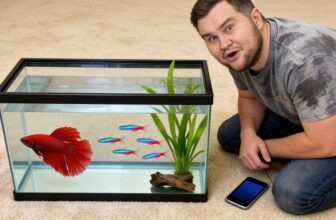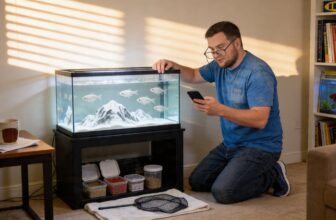
Your betta’s probably not dead—just dramatic.
Check for subtle gill movement, tap the glass, and flash a light; sleepers twitch, goners don’t.
Test ammonia immediately (zero is mandatory), grab a $12 liquid kit, and verify temperature stays 76‑80°F with a $10 adjustable heater—below 74°F and they’ll play possum from cold shock.
Look for clamped fins, faded colors, or hiding behind décor (stress, not laziness), and watch for upside‑down floating that screams swim bladder trouble from overfeeding.
Small tanks spike ammonia fast, so upgrade to 5+ gallons, add gentle aeration with an $8 bubbler, and rule out a gravid female carrying eggs before you panic.
Most “dead” bettas just need warmer, cleaner water and a break from that jerk neon tetra—keep going and you’ll nail the exact fix.
At A Glance
- Check for subtle gill movement and response to light or tapping to distinguish sleep from death.
- Test ammonia, nitrite, and nitrate levels immediately; zero ammonia and nitrite are essential for survival.
- Verify water temperature stays within 76–80°F; cold below 74°F causes lethargy and clamped fins.
- Inspect for swim bladder symptoms like floating upside-down or sinking nose-down after overfeeding.
- Assess tank size, filter current, hiding spots, and aggressive tank mates that induce stress freezing.
Is Your Betta Actually Dead? How to Check Now
First things first: your betta isn’t moving, and you’re panicking a little. You’ll check for signs of life before planning a fish funeral, trust me.
Look for subtle gill movement—that’s your blood tank equivalent, the essential flow keeping them alive. Gently tap the glass, or use a flashlight. Dead fish don’t respond, period.
Poor water filtration, lack of vitamin supplementation, or wrong substrate choice won’t kill instantly, but they’ll weaken your betta over time. Check your ammonia levels; zero’s the goal, not a suggestion. Odds are? They’re napping. Bettas are dramatic that way, you know. If your betta is prone to jumping out of the tank, consider adding a magnetic fish tank cover to prevent escape and injury.
Betta Not Moving: Sleeping or Emergency?
You’ve confirmed your betta’s alive—nice work, detective—so now you’re staring at a motionless fish wondering if you’re overreacting or missing a real problem. Most bettas, like your grumpy uncle after Thanksgiving, need their downtime. Your fish’s sleep cycle kicks in when lights dim, leaving them hovering like tiny, grumpy balloons.
But stress episodes can mimic naps, and that’s where you need sharp eyes. Check if your betta perks up when you approach, or just floats there looking offended by existence.
- Normal sleep: responds to taps, light changes, or your face pressed weirdly against glass
- Stress freeze: clamped fins, faded colors, hiding behind décor like it’s taxes week
- Test with gentle water movement—lazy wake-up means rest, zero reaction means worry
- Track timing: consistent stillness at night is healthy, random daytime crashes need detective work
Bottom line: know your betta’s normal, trust your gut, and when in doubt, test before you panic.
Small kits often omit a heater, so check if your tank temperature stays steady to rule out cold stress that mimics sleep.
Cold Water Shock: Why Temperature Stops Your Betta
Since your betta’s basically a tiny, tropical diva in a fishtank, cold water hits them like you stepping into a January pool—shock, misery, and immediate shutdown.
Your betta needs 76-80°F. Below 74°F, their metabolism crawls, and they stop moving. A sudden temperature dip triggers cold shock, leaving them lethargic, clamped, and gasping at the bottom like a drama queen who forgot her lines.
Grab a $15 adjustable heater—50 watts for a 5-gallon tank works fine. Check temperature daily with a thermometer. Cold shock kills slowly, quietly, and completely avoidably.
Warm water isn’t luxury—it’s survival. Models like the NICREW Slim include quiet motors ≤40 dB to avoid additional stress during recovery.
Is Swim Bladder Disease Making Your Betta Float Strange?
Cold shock isn’t the only thing that’ll park your betta like a broken pool toy—sometimes their own body turns traitor. Swim bladder disease hits when your fish can’t balance anymore, leaving them floating sideways, sinking like a stone, or doing backstroke at the surface. The swim bladder’s basically their built-in floatie, and when it malfunctions, you’re looking at a motionless, tilted betta. Similar to the royal gramma, providing ample caves and reduced water current can help alleviate stress and support recovery.
- Look for upside-down floating or nose-down sinking
- Check for bloated belly after heavy feeding
- Poor gen bladder genetics can doom some bettas from birth
- Diet impact matters—overfeeding triggers this fast
Skip the peas (myth), grab daphnia, fast them a day. Bottom line: smaller meals, better genes next time.
Test Ammonia, Nitrite, and Nitrate: Poison Causes Stillness
If your betta’s parked at the bottom like it’s waiting for a bus that’ll never come, your water might be toxic soup. You’re not a bad fish parent—probably—but invisible killers like ammonia, nitrite, and nitrate build up fast, and your buddy pays the price.
Grab a liquid test kit (API Freshwater Master, about $25). You need numbers, not guesses.
| Toxin | Safe Level | Danger Sign | Your Move |
|---|---|---|---|
| Ammonia | 0 ppm | Gasping, red gills | 50% water change, now |
| Nitrite | 0 ppm | Brown gills, lethargy | Add Prime, check filter |
| Nitrate | <20 ppm | Listless, dull color | Water change, live plants |
| Hardness | 3-12 dGH | Stress, clamped fins | Test GH/KH, adjust slowly |
Nitrite toxicity hits fast—it’s basically fish carbon monoxide. Water hardness issues? They creep up, stressing organs you can’t see. Test weekly. Your betta’s counting on you, and honestly, you’ve got this. For quick checks, lab-accurate test strips can provide a reliable snapshot of key parameters in about 30 seconds.
Are You Feeding Food That Makes Your Betta Lethargic?
Your water’s clean, your betta’s still a couch potato—time to eye the menu. Bettas need meaty meals, not filler flakes that’d bore a goldfish.
Check your proteinutrient balance—carnivores crave 30-40% protein, not wheat middlings masquerading as food. Cheap pellets? That’s like feeding your buddy gas station sushi.
Your feeding schedule matters too. Twice daily, 2-3 pellets each time—skip the “he looks hungry” guilt trips. Overfeeding bloats bellies and crashes energy.
- Ditch plant-based flakes—bettas need animal protein, not salad
- Set phone reminders—consistency beats your memory
- Look for whole fish or insect ingredients, not mystery meal
- Fast one day weekly—rest those guts, buddy
For an energy boost, consider a high-protein option like Fluval Bug Bites which features black soldier fly larvae to match a betta’s carnivorous needs.
Is Your pH Wrong? Chemistry Stress Freezes Bettas
While your betta’s doing its best statue impression, the pH might be staging a silent coup against its sanity.
Betta fish crave pH chemistry hovering near 7.0, that neutral sweet spot. Stray too acidic or alkaline, and you’ve triggered a stress response—skin irritation, clamped fins, and that frozen, “I’m not here” posture.
Betta fish crave pH chemistry hovering near 7.0, that neutral sweet spot. Stray too acidic or alkaline, and you’ve triggered a stress response—skin irritation, clamped fins, and that frozen, “I’m not here” posture.
Check your water with a liquid test kit, not those strip things. $8-12, lasts ages.
- Rapid swings hurt worse than steady wrong numbers
- pH Up/Down products exist, but go slow—sudden fixes shock fish
- Driftwood and leaves gently lower pH naturally
- For even more precise monitoring, consider a digital pH meter that can alert you to changes remotely.
Your betta’s not lazy. It’s chemically uncomfortable.
Fix the chemistry, restore the swim.
Fix Lighting to Restore Your Betta’s Sleep Cycle
Since your betta’s circadian rhythm runs on light cues, a tank that’s too dim or too chaotic can turn your fish into a perpetual napper. You’re basically running a 24-hour diner with flickering fluorescent tubes—nobody sleeps, nobody thrives.
Here’s your fix-it list:
- Aim for 8–12 hours of consistent light daily; think of it as setting a fish alarm clock
- Use a simple outlet timer ($10) so you don’t forget—your memory isn’t that good
- Keep light intensity moderate; too bright stresses them, too dark confuses them
- Position the tank away from windows to avoid random sun beams
- Consider a light with gradual sunrise simulation to ease your betta into the day naturally.
Master photoperiod adjustment and light intensity control, and your betta’s energy returns. Simple biology, friend.
Calm a Stressed Betta Hiding After Tank Moves
Moving a betta is basically kidnapping them from their entire universe, so don’t be shocked when they sulk behind the filter like a teenager sent to their room.
Kidnapping a betta from their entire universe comes with teenage sulking privileges.
You’ve ripped up their mental map. Everything smells wrong, the corners are different, even the water feels alien. Stress reduction starts with patience—weeks of it, sometimes.
Give them secure hiding immediately. Caves, dense plants, anything that blocks the open water. They need to feel invisible while they recalibrate. Dim the lights, skip the tapping on glass (seriously, don’t), and let them ghost around until curiosity wins. Provide driftwood and dim lighting to further reduce stress during recovery.
Bottom line: shut up, back off, they’ll come out when ready.
Remove Aggressive Tank Mates Now: Stop the Fear
Why’s your betta hugging the corner like it’s hiding from the landlord? You’ve got a roommate problem, friend.
Aggressive tank mates—fin-nipping tetras, bossy gouramis, pushy barbs—turn your betta’s home into a war zone, and freezing still is survival mode.
Remove aggressive fish immediately, or your betta will stay petrified, too scared to even flare those gorgeous fins.
- Watch for ripped fins, constant hiding, or chasing—classic bullying signs
- Quarantine bullies in a $10 plastic tub, or rehome them via social media groups
- Test solo living; bettas often thrive alone, no shame in that
- Stop fear by rebuilding trust through calm, predictable tank mates only
Bottom line: peace comes first.
A quiet, submersible filter can further reduce stress by maintaining stable water conditions and minimizing noise in the tank.
Is Your Filter Current Too Strong? Slow It Down
Your betta’s still parked like a grumpy gargoyle, even after evicting the tank bullies? Your filter flow might be the hidden villain.
Bettas hail from calm rice paddies, not churning rapids. Excessive turbulence exhausts them; they’ll hug the bottom, dodging that relentless current.
Check your filtration—many pumps blast water like mini-jets. Fix it fast: position a filter sponge (roughly $4-8) over the outflow, or DIY a baffle from a plastic bottle.
Your aeration stays adequate—you’re reducing velocity, not oxygen. Aim for gentle surface ripple, not whitewater rafting.
Watch within 24 hours; bettas usually perk up when swimmable space returns.
Low Oxygen: Why Your Betta Gapes at the Surface
If your betta’s spending more time at the surface than a snorkeler with a cramp, you’ve got an oxygen problem—plain and simple. Your fish isn’t lazy—it’s gasping. Dissolved oxygen gets depleted fast in stagnant water, especially when temps climb. You need oxygen enrichment, stat.
- Add an air stone or small bubbler ($8–$15) for gentle surface agitation
- Lower the water level slightly to increase splash from your filter
- Drop in a few fast-growing plants—they photosynthesize oxygen during daylight
- Perform a partial water change; fresh water holds more dissolved gas
Don’t let your betta become a mouth-breather. Fix this, and you’ll both breathe easier.
Tank Too Small? How Cramped Space Kills Movement
Since a betta crammed into a shoebox-sized tank isn’t living—it’s just surviving, and barely. You deserve better, and so does your fish.
| Problem | Your Betta’s Response |
|---|---|
| No room to swim | Sluggish circling, listless hovering |
| Poor tank décor options | Stress from exposed, empty space |
| Water clarity crashes fast | Ammonia spikes, toxic lethargy |
| No territory to claim | Depression, faded colors, hiding |
Bettas need 5+ gallons to thrive, not just exist. In tiny tanks, you’re fighting constant water quality battles, and your betta’s basically given up. Trust me, I’ve learned this the hard way—upgrading felt like buying my fish actual happiness, and water clarity finally stayed stable. Bigger space, livelier fish.
Is Your Female Betta Pregnant? Egg-Bearing and Resting
When a female betta starts looking like she swallowed a marble, she’s probably not lazy—she’s gravid, which is just a fancy word for “carrying eggs.” You’ll notice her belly swelling up like a tiny water balloon, and suddenly that energetic swimmer turns into a couch potato who’d rather hover near the bottom than zip around like usual.
This isn’t illness—it’s gravid breeding behavior. During egg development, her body redirects energy to producing dozens, sometimes hundreds, of tiny pearls. She needs rest, not panic.
- Look for vertical stripes (breeding bars), not horizontal stress lines
- Offer gentle filter flow so she doesn’t fight the current
- Feed protein-rich foods—think bloodworms, not flakes
- Watch for bubble nest interest, though females often skip that part
Support her through this natural phase, and she’ll bounce back. Promise.
Betta Not Moving: Or Just Naturally Low-Energy?
Some bettas are just born loafers, and that’s okay—you didn’t get a dud, you got a couch potato with fins.
Genetics play a huge role here. Some bloodlines, especially heavy-finned show types, simply burn less energy. You’ll spot the difference: healthy lazy bettas eat eagerly, flare at their reflection, and perk up for food. Sick fish don’t.
Try gen tank enrichment to coax movement. Add a $8 betta leaf hammock, live plants, or a mirror for 5-minute workouts. Puzzle feeders run $5-12 and turn mealtime into mental gymnastics.
Bottom line: if he’s eating, breathing steady, and responding to you, you’ve got a lazy boy, not a sick one. Accept the chill.
Frequently Asked Questions
Why Is My Betta Hiding Behind the Filter?
Your betta’s tucked behind that filter since you’re dealing with filter stress, plain and simple. That current’s probably too strong, or the lighting’s too harsh, so they’ve found a dark, calmer hidey-hole. Bettas aren’t exactly Olympic swimmers; they’re more like grumpy old men who want still water and a nap.
- Check your filter flow—baffle it with a sponge if it’s blasting like a fire hose
- Dim that lighting—10-12 hours max, they’re not sunbathers
Bottom line: soften the current, tweak the lights, and you’ll have a braver fish. Mine sulked for a week until I got him a gentler setup, now he’s practically showing off.
Can Medications Stop My Betta From Moving?
Yes, medications can stop your betta from moving.
- Medication side effects often include lethargy, that’s your fish basically saying, “I’m not feeling this, man.”
- Dosing errors—too much medicine—can paralyze or worse, like giving a toddler espresso and then Nyquil.
- Watch for pale color, gill fluttering, or bottom-sitting. Test water, reduce dose, add activated carbon.
Bottom line: you’ve gotta read labels like they’re treasure maps, friend.
Does Water Hardness Affect Betta Activity?
Yes, water hardness affects your betta’s activity levels, though it’s rarely the star villain.
Water hardness measures dissolved minerals—think calcium and magnesium—that water holds. Your betta tolerates soft to moderately hard water (2-15 dGH), but extremes drain its energy.
- Soft water below 2 dGH: lacks minerals for osmotic balance, your fish works harder, slows down
- Hard water above 20 dGH: stresses organs, triggers lethargy, clamped fins
You wouldn’t thrive drinking battery acid or distilled water either, right?
Test your tap water—kits run $10-15. Most bettas do fine at 5-12 dGH.
Bottom line: stabilize what’s inside your specific range, don’t chase perfection.
Why Does My Betta Stop Moving After Water Changes?
Your betta’s frozen since water changes hit them with temperature swings and chemistry shifts, pure stress stress.
Even a 2‑degree drop knocks them flat, and if you’re cramming them into a undersized tank—anything under 5 gallons—they’ve got nowhere to hide from the chaos.
Test your new water, match temps exactly, and upgrade that tank size. Your fish will thank you by actually swimming again.
Can a New Plant Cause My Betta to Freeze?
Yes, a new plant can trigger plant stress responses in your betta, causing freezing behavior.
- Lighting levels: New plants often shift your tank’s brightness, which can confuse your betta’s circadian rhythm, think of it like someone’s flipped a switch in your bedroom at 3 AM, you’re gonna pause too.
- Plant stress isn’t just for greenery: Your betta picks up on environmental instability, hiding until things settle.
Bottom line: give it 24–48 hours, dim lights temporarily if needed, and watch for normalizing activity before you panic-buy a psychiatrist for fish.
Rounding Up
Your betta’s stillness isn’t a death sentence, just a conversation starter.
- Check temperature first—78°F keeps them frisky ($15 heater, skip the cheap ones)
- Test water weekly; ammonia’s a silent assassin at 0.25 ppm
- Watch for surface-gasping—that’s your fish waving a tiny white flag
Most “lazy” bettas? Just cold, bored, or quietly judging your décor choices.
Fix the basics. They’ll forgive you. Probably.