A glass aquarium holds more than water. It holds a creature that borrows its name from a bird yet hides in sand like a secret. The peacock eel needs room to stretch, about forty gallons of horizontal space, and soft sand four inches deep for burrowing. Many keepers learn too late that cramped tanks stress these fish, causing them to stop eating or lash out. Proper care rewards patience with a companion that may live nearly two decades, but first one must understand what lies beneath that spotted, serpentine body.
At A Glance
- House peacock eels in a 40+ gallon tank with length over height for horizontal swimming.
- Provide sand substrate at least four inches deep for safe natural burrowing behavior.
- Maintain water temperature between 73–82°F with neutral pH and moderate hardness levels.
- Feed 2–3 times weekly at night using live or frozen foods delivered via pipette.
- Keep with peaceful, larger-mouthed fish such as rainbowfish and avoid small, fast tankmates.
What Is a Peacock Eel (and Why It’s Not Actually an Eel)?
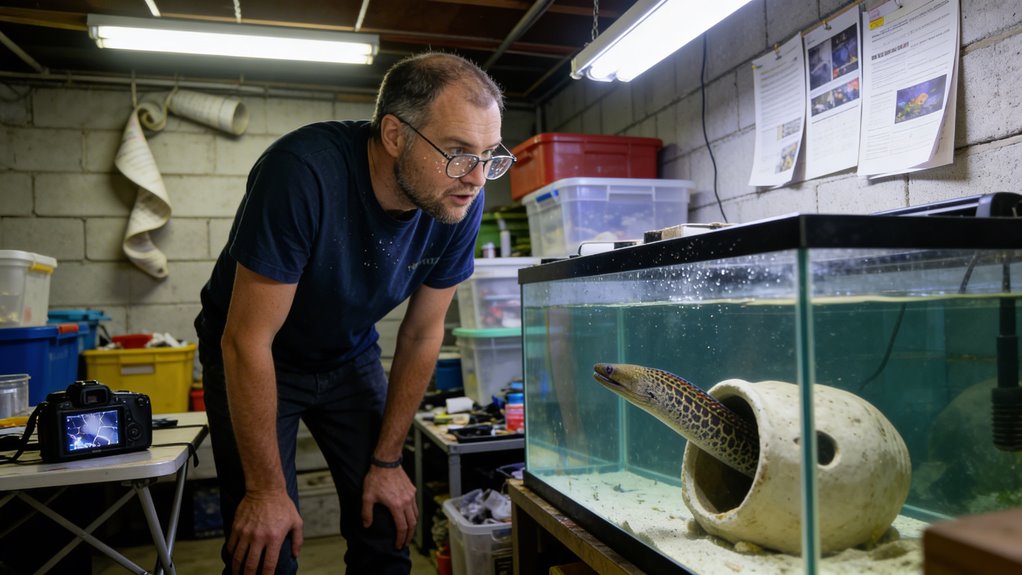
Although it glides through the water like a serpent, the peacock eel is not an eel at all, but something else entirely, a fish that borrowed a shape more than a family.
Peacock eel taxonomy places it among the spiny eels, family Mastacembelidae, not the true eels of Anguilliformes. Its evolutionary lineage split from those snake-like relatives long ago, choosing instead a path of armored independence. The sharp spines on its dorsal fin stand as proof of this separate heritage, a defensive gift true eels lack. It hails from Southeast Asia‘s slow waters, carrying three to six eyespots like borrowed confidence, a trick of light telling predators to look elsewhere. The shape deceives, but the family tree never lies.
How Long Do Peacock Eels Live?
A small, patient creature can outlast the batteries in a child’s favorite toy, if the water stays clean and the food arrives on time.
The peacock eel lives eight to eighteen years, though most keepers see five to eight. Water quality, diet, and genetics decide the difference.
| Factor | Good Care Result | Poor Care Result |
|---|---|---|
| Water changes weekly | 12+ years possible | Disease takes hold early |
| Varied protein diet | Strong immune system | Stunted growth, early death |
| Dim lighting, hiding spots | Lower stress, longer life | Constant fear, shortened span |
Ancient peacock eel folklore spoke of river spirits guarding fishermen’s dreams. Modern aquarium lighting trends favor subdued LEDs, replicating dawn and dusk. This honors old wisdom, calm and steady, letting patience become belonging.
Peacock Eel Tank Size: 40 Gallons or Bigger?
Years matter, but space matters too. A peacock eel needs room to stretch, burrow, and belong. Forty gallons marks the minimum threshold, though bigger invites fuller growth and richer behavior.
Consider four essentials when choosing your tank:
- Length over height — these bottom-dwellers cruise horizontally, not vertically
- Sand depth — four inches minimum lets them tunnel safely without scraped skin
- Tank flower options — anchored plants create soft boundaries, silk varieties prevent fin tears
- Nocturnal lighting — dim fixtures match their nighttime rhythm, reducing stress whilst you observe
Space becomes security. Security becomes trust.
How to Set Up a Peacock Eel Tank
Creation begins with sand, the soft floor where a peacock eel will spend most of its hidden hours. Aquarium lighting must stay dim, mimicking the murky rivers these fish call home; too much brightness causes stress and hiding. Filtration types should prioritize gentle flow, sponge filters or adjustable canisters set low, since strong currents exhaust a creature built for still waters. Driftwood caves and anchored plants complete the sanctuary, offering refuge from view. A secure lid prevents midnight escapes. In building this space, one learns that safety often means shadows, quiet, and room to disappear completely.
Sand Depth and Burrowing: What Peacock Eels Need Underground
Three inches of smooth, pale sand marks the difference between a frightened eel and one that rests, truly rests, against the cool darkness below.
For keepers who wish to belong among those who understand these creatures, attention to the substr substrate matters deeply.
- Sand grading must be fine enough to pack without cutting delicate skin.
- Depth allows complete burrowing behavior, not just shallow hiding.
- Proper sand prevents injury that coarse gravel causes.
- Secure edges, paired with this bedding, serve escape prevention.
The eel pushes downward, finds safety, and stays. This is care.
Water Conditions Peacock Eels Thrive In
Water slips through the filter, carrying away what the eel leaves behind, and this quiet work matters as much as food or shadow.
The water temperature must rest between 73 and 82 degrees Fahrenheit, warm like a towel from the dryer.
Water hardness, which measures minerals dissolved in the water, should stay between 6 and 25 DH—neither too soft nor too stiff for this creature’s comfort.
The pH settles best between 6.5 and 7.5, nearly neutral.
Lighting intensity belongs low, mimicking the murky rivers of home where sunlight filters weakly through muddy water. Dim bulbs prevent stress.
What to Feed Your Peacock Eel at Night
Darkness settles over the tank, and the peacock eel wakes.
Twilight stirs the water, and the hidden hunter stirs with it.
Nocturnal feeding matches its wild rhythm, when the fish hunts along murky riverbeds. The aquarist who follows this schedule joins a quiet fellowship of careful keepers.
Choose foods rich in burwater nutrient density:
- Live blackworms, wiggling, irresistible
- Frozen bloodworms, thawed, bright red
- Nightcrawler pieces, earthy, substantial
- Brine shrimp, small, protein-packed
Feed after lights dim, target with a pipette, two or three times weekly. The eel emerges, snout quivering, finding its meal where it expects.
This patience builds trust, slowly, like friendship does.
Peacock Eel Tank Mates That Won’t Disappear
Selecting companions for a peacock eel demands careful thought, like choosing playmates for a quiet child who needs gentle friends.
Peaceful fish of adequate size—rainbowfish, rasboras, swordtails—share space without fear of becoming snacks, provided their mouths exceed the eel’s girth. Small, quick fish like neon tetras vanish, mistaken for food.
Brightstone behavior matters: these eels prefer dim corners, so companions should tolerate subdued spaces rather than demanding brilliance. A consistent lighting schedule—eight to ten hours daily—soothes anxious tankmates and signals safe feeding times. Together, they belong.
Sick Peacock Eel? Common Diseases and Fixes
A sick peacock eel moves like a broken kite string, drifting rather than darting, and this quiet wrongness catches the careful keeper’s eye.
Stressalth coloration—when the bright yellow stripe fades to muddy brown—signals distress from poor Habitat adaptation, often caused by gravel that scrapes their bellies or water too warm for their river origins.
Watch for these troubles:
- Ich appears as tiny white salt grains on fins, treatable with gradual temperature rises to 86°F for 14 days
- Fungus looks like cotton wool, needing clean water and antifungal baths
- Bacterial fin rot frays edges, requiring antibiotics and daily 25% water changes
- Skin flukes cause scratching against sand, cured with diluted praziquantel
Early recognition binds keeper to creature in quiet understanding.
Don’t Get Spined: Safe Handling Tips
How does one lift something that carries knives along its spine?
The dorsal fin of the peacock eel holds sharp spines, stiff rods that can slice careless fingers.
Spine safety begins with patience, not force.
Handling gloves, the thick rubber kind used for gardening, protect palms from those sudden thrashes while netting. Wet the gloves first, so the eel’s slime coat stays intact, preventing infection.
Slide one hand beneath the belly, supporting the full length, never gripping.
The eel feels fear too, muscles tensing, seeking sand.
Gentleness builds trust between species.
This small courtesy keeps both creatures whole.
Can You Breed Peacock Eels in Captivity?
Most aquarists who ask this question already suspect the answer will disappoint them.
Breeding peacock eels in captivity presents profound challenges, and success remains virtually undocumented among home aquarists. The captivity challenges stem from the species’ reliance on specific environmental triggers.
Four hurdles explain why:
- Seasonal flooding, which signals spawning in nature, proves difficult to replicate artificially.
- Courtship behaviors, involving prolonged chasing rituals, require ample space rarely available indoors.
- Floating vegetation, where females deposit sticky eggs during wild spawning, must be positioned precisely.
- Water chemistry shifts, mimicking monsoon conditions, demand sophisticated equipment most keepers lack.
Hope persists, yet patience matters more than optimism here
Frequently Asked Questions
Can Peacock Eels Live in a Planted Aquarium?
Peacock eels thrive in a planted aquarium when anchors secure the vegetation, preventing uprooting during burrowing.
Soft substrates, four inches deep, protect their elongated bodies while roots create natural hiding spaces that reduce shyness.
Tank compatibility requires peaceful neighbors with mouths too large to be eaten, such as rainbowfish or rasboras, avoiding tiny species like tetras.
These conditions nurture security, much like a child finding comfort in a familiar, well-organized bedroom after a long day.
Do Peacock Eels Recognize Their Owners?
Peacock eels do form a gentle owner bond, though not as strongly as dogs.
Their recognition shows through learned habits, not affection. When food appears, they emerge from sand beds, following movement patterns they have memorized. This habit reflects their habitat preference for hiding, then responding to reliable signals.
The bond is quiet trust, earned slowly through daily routine, like friendship built across a fence over many mornings.
How Much Do Peacock Eels Cost to Buy?
Small pet stores charge fifteen to twenty dollars for young peacock eels, whereas specialty shops online ask thirty to fifty dollars for healthy adults. Price variation depends on size, color quality, and shipping distance. Habitat suitability matters more than cost, since cramped tanks stunt growth and shorten life. Saving for proper equipment brings longer companionship, and patience here rewards the keeper with eight years of quiet, burrowing friendship.
Are Peacock Eels Jumpers or Escape Artists?
Peacock eels are truly escape artists, known for their jumping abilities. Behavioral testing reveals they will investigate any gap in tank lids, squeezing through surprisingly small openings during habitat exploration. A secure, weighted lid with no gaps larger than half an inch prevents escape. Their patient, searching nature leads them to test boundaries repeatedly. One keeper reported losing an eel through a feeding hole, finding it dried on the floor two days later.
Can Peacock Eels Regenerate Lost Body Parts?
Peacock eels hold limited regeneration potential for lost body parts.
Unlike starfish, which rebuild whole arms, these fish manage modest tissue repair—skin wounds may close, small fin nicks sometimes regrow.
Damaged spines rarely restore fully.
The body heals through cell division, a slow patch rather than true renewal.
Owners should prevent injuries, since deep wounds often scar permanently.
Their biology simply lacks the blueprint for wholesale replacement.
Rounding Up
A forty-gallon tank, four inches of sand, and a handful of patience. That is the foundation. The Peacock Eel rewards careful keepers with quiet companionship and the small miracle of a creature burrowing safely below glass. Water, warmth, and gentle handling bridge the years between curious beginner and seasoned aquarist. The fish does not ask for much, only consistency. Meet that need, and the eel—or rather, the spiny loach—will remain.