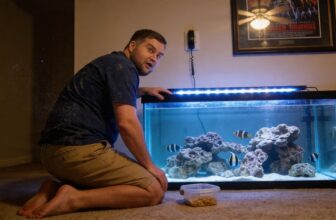
The dog-faced puffer, *Arothron nigropunctatus*, hits a foot long and demands 90 gallons minimum — really, 100 is safer, since waste builds fast and these fish swim hard.
Water stays tropical, 72–78°F, salt at 1.020–1.025, pH locked near 8.3 with buffers.

Holds 72–78°F reliably, so your puffer stays comfortable and stress-free.

Measures salinity instantly and accurately to protect against dangerous water swings.

Raises and locks pH near 8.3, keeping alkalinity stable for marine health.
See today's best deals onMarine Aquarium Supplies
They crush clams, mussels, shrimp daily — teeth never stop growing, so hard shells wear the beak down naturally.
Skip the dental work, watch drooling and hunger strikes.
Tank mates? Tangs, dwarf lions, tough triggers work; crabs, shrimp, snails become expensive snacks.
Quarantine six weeks, watch for salt-grain ich or gold-dust velvet, and maybe don’t trust “captive-bred” claims just yet.
There’s more to this fish than the basics suggest.
At A Glance
- House a single adult in a minimum 90-gallon tank with stable 72–78 °F water and robust filtration.
- Feed hard-shelled seafood daily to prevent dangerous beak overgrowth requiring veterinary trimming.
- Choose swift, assertive tank mates like tangs and dwarf lionfish; never add crustaceans or invertebrates.
- Quarantine new specimens 4–6 weeks with proactive ich and velvet treatment to ensure long-term survival.
- Maintain pH 8.1–8.4, moderate flow, and secure limestone caves to reduce stress and aggression.
Dog-Faced Puffer Overview: Species Profile and Aquarium Suitability
Picture a fish with the permanently concerned expression of a basset hound who’s just uncovered existentialism—that’s *Arothron nigropunctatus*, the Dog-Faced Puffer, turning aquarium glass into a window of low-energy comedy.
Now, the puffer anatomy matters here: this species reaches roughly 12 inches, no skinny minnow, with a stocky frame and that signature parrot-like fused beak. I mean, they’re built different.
As for habitat range, these fish cruise warm Indo-Pacific waters, coral reefs and lagoons mostly, so replicating that environment isn’t optional if you want them thriving, not just surviving.
Belonging starts with understanding what they actually need.
Given their marine origins and substantial size, these puffers require a low-iron glass aquarium of at least 75-100 gallons to accommodate their active swimming and waste production while preserving the true colors of their vibrant markings.
Lifespan Potential: From Acquisition to 10+ Years
Now, those spiritful eyes might charm you at the shop, but a Dog-Faced Puffer isn’t a short-term commitment—more like adopting a slightly damp, finicky roommate who’ll judge your life choices for a solid decade.
- Genetic lineage matters: wild-caught specimens from robust Indo-Pacific stock often outlive tank-raised casualties of rushed breeding
- Market demand fuels a trade in juveniles barely weaned, destined for early graves in unprepared hands
- Water quality, not luck, stretches that decade-plus promise; neglect halves it easily
- Diet discipline—those teeth need grinding—separates survivors from statistics
- Quarantine protocols: skip them, and you’re buying a hospice case, not a companion
Choose wisely.
A well-designed sump filtration system with baffles and silencers helps maintain the pristine water conditions these sensitive fish demand for reaching their full lifespan potential.
Minimum Tank Size and Why 90 Gallons Is Non-Negotiable
A 90-gallon minimum isn’t generous advice from hobbyists with too much tank space and too little sense—it’s bare survival arithmetic for a fish that grows to a foot long, turns on a dime, and poops like a small dog.
Space matters, water volume matters more. These fish turn waste into toxic soup fast. Without robust tank filtration—think protein skimmer, heavy biological load capacity—you’re gambling with ammonia burns and early death. A Wi‑Fi smart monitor like those used in reef tanks can provide overnight alerts if pH crashes from accumulating waste.
Water volume is your lifeline—these fish convert waste to poison faster than undersized tanks can handle.
Habitat compatibility likewise suffers in cramped quarters. Crowding triggers stress, stress triggers disease. A 90-gallon footprint lets them establish territory, exhibit natural behaviors, and coexist without constant aggression. Go smaller, and you’re just waiting for problems.
Exact Temperature, pH, and Salinity Levels?
Tank size bought breathing room—now the water itself has to cooperate.
- 72–78°F, since tropical means tropical, not “close enough”
- pH 8.1–8.4, the alkali sweet spot where chemistry stops being personal
- Specific gravity 1.020–1.025, though refractometers lie sometimes, so test twice
- Aquarium lighting matters less than you’d think—dim corners suit their mood
- Water flow: moderate, not blast-furnace, they aren’t training for anything
Carbonate hardness at 8–12 dKH buffers the swings. Skimmers pull nitrogen before it becomes problems. And yeah, stability beats perfection, I mean, who’s perfect?
For maintaining that 8.1–8.4 pH range, a liquid reef buffer with carbonate alkalinity support helps prevent dangerous spikes while boosting KH alongside your pH targets.
Rockwork Setup and Hideaway Placement
Since a dog-faced puffer without somewhere to vanish is basically a stressed potato with teeth, rockwork becomes less décor and more infrastructure. Much like how magnetic algae cleaners keep glass surfaces spotless through clever engineering of unseen forces, your rockwork should operate invisibly to support the fish’s wellbeing.
| Position | Rock Texture Aesthetics | Hiding Spot Strategy |
|---|---|---|
| Back corners | Rough, porous limestone | Full enclosure, single entrance |
| Mid-tank | Smooth base, textured top | Partial cover, sight lines out |
| Front viewing area | Decorative showpiece | No hiding—observation zone |
| Sand bed perimeter | Flat slate plates | Burrow-adjacent retreat |
| Upper water column | Stacked rubble caves | Emergency bolt-hole |
Your hiding spot strategy must layer caves, crevices, and overhangs—maybe three per puffer, though who’s counting. Rock texture aesthetics matter; rough surfaces invite grazing, smooth interiors signal safety. Now, arrange so no dead-end traps exist, or you’ll witness thirty centimeters of panic wedged behind a pump. And yes, check sight lines: these fish monitor their domain, wanting escape routes visible from every angle. I mean, think like a paranious balloon with fins. Stability counts—topple risks crush, so mortar or epoxy-stack. Belonging means security, security means architecture, architecture means your fish finally relaxes.
Diet: Hard-Shelled Foods and Feeding Schedule
The hard-shelled foundation breaks down like this:
- Shell texture matters, rough beats smooth for natural wear
- Prey variety keeps them engaged, clams, mussels, shrimp rotating weekly
- Bite size approximates their eye, too large risks refusal
- Feeding frequency, twice daily for juveniles, once suffices for adults
- Hard shell availability daily, skipping isn’t really optional
A consistent feeding schedule anchors their wellbeing, irregular meals stress the system, and these fish remember. Miss a window and you’ll know, the sulking is theatrical. Variety prevents nutritional gaps, though they’ll fixate on favorites, stubbornly. Plan for persistence, not perfection.
Just as coral dips use iodine-free botanical formulas to protect delicate tissue without harsh chemicals, balance in their diet protects their long-term health.
Dental Maintenance: Preventing Beak Overgrowth
Why do pufferfish need dental care? Their teeth fuse into a beak, forever growing, relentless. Without grinding, disaster looms.
Pufferfish teeth fuse into an ever-growing beak—without grinding, disaster looms.
- Hard-shelled foods—clams, mussels—wear them down naturally
- Smooth rocks help, sandpaper for fish mouths
- Watch for overgrowth: drooling, difficulty eating, that pathetic look
Now, beak trimming. Veterinary only, please. DIY dental work ends poorly, always. Sedation, specialized tools, someone who knows puffer jaws. Expensive? Certainly. Necessary? Absolutely.
Dental health separates thriving pets from tragedies. Skip soft foods, adopt the crunch. Ten-plus years demands this discipline. Your fish deserves functional teeth. So do you, honestly.
Supplementing their diet with bioavailable vitamins—such as those found in marine fish-specific multivitamin formulas—can support overall jaw strength and tissue health alongside proper mechanical wear.
Compatible Species: Tank Mates That Work
Navigating community tanks with a dog-faced puffer means balancing curiosity with caution, since these fish are peaceful enough—mostly—but they bite what they mistake for food, and they sulk when crowded.
A 90-gallon minimum, really, for one fish alone, though bigger feels better when you’re building something that lasts. Color morphs—those subtle grays, yellows, occasional surprises—don’t change temperament, just the wallpaper.
Suitable companions include:
- Tangs: swift, assertive, too big to swallow
- Dwarf Lionfish: dramatic flair, matching energy
- Fairy Wrasse: busy, bottom-minded, generally ignored
- Emperor Angelfish: imposing, established, respected
- Clown Triggerfish: tough, confident, holds ground
Mating rituals? Forget it. Tank harmony, though—that’s the win.
For those keeping smaller species like bettas alongside puffer research, a 2-gallon self-cleaning tank offers automated maintenance with curved glass edges and an 8,000-hour warranty for beginner peace of mind.
Incompatible Livestock: Fish and Inverts to Avoid
I mean, it’s not malice, usually. The Dog-Faced Puffer simply confuses small, skittering movement with snacks, and who hasn’t made that mistake?
Pred predators must stay separated. Aggressive triggers, large groupers, and fast-striking hunters stress this placid fish, sometimes fatally.
Avoid crustaceans entirely. Cleaner shrimp, hermit crabs, snails—these become crunchy appetizers. Even supposedly safe invertebrates vanish overnight.
Watch for toxic algae hitchhiking on live rock intended for invert-heavy setups; what’s food for snails poisons puffers. Another reason those pairings fail.
Choose tank mates wisely, fellow travelers. Peace, not casualties.
Consider investing in a quality protein skimmer setup to maintain pristine water quality, as leftover food from messy puffer feeding can quickly degrade conditions in a crowded or incompatible community tank.
Reef-Safe Status: Corals and Invertebrates at Risk?
- Coral predation ranges from mild nibbling to full demolition of soft, fleshy polyps
- Hard stony corals typically survive, though persistence varies by individual fish
- Invertebrate risk is real: snails, crabs, and ornamental shrimp become expensive snacks
- Anemones and clams face moderate danger from curious, beak-driven investigation
- Successful reef-puffer pairings demand robust coral selection and acceptable losses
- Maintaining stable water parameters requires precise temperature control, which automated aquarium controllers can provide to reduce stress-induced aggression.
Peace of mind, or peaceful tank—pick one.
Spotting Ich and Velvet Early
Early Signs of Ich and Velvet
How quickly can a single speck become a full-blown catastrophe? For dog-faced puffers, faster than you’d think, and slower than you’d hope—classic fish timing, really. Early detection separates the hobbyist who sleeps soundly from the one who panics at 2 a.m. with a flashlight. Watch for:
- Ich: salt-grain spots, scratching against rocks, rapid breathing
- Velvet: fine gold dust, clamped fins, that “something’s off” vibe
Now, early treatment matters since these fish scale poorly—medication sensitivity plus that famous puffer attitude. So peer closely, document obsessively, and act before the specks become a sentence.
Quarantine Protocol Before Introduction
But spotting the specks is only half the battle—now, the fish sits in a bag, already stressed, probably plotting revenge. Quarantine duration matters more than hope; four to six weeks minimum, since parasites laugh at shortcuts.
Now, disease screening isn’t optional paranoia—it’s the handshake that gets you into the club. I mean, nobody wants to be that person who nuked their display tank with velvet, right?
- Set up a bare-bottom hospital tank, 20-30 gallons, nothing fancy
- Run a sponge filter, cycled and waiting
- Observe appetite, breathing, that weird puffer attitude
- Treat proactively for ich and velvet, just in case
- Test, wait, retest—patience earns your membership
Why Captive Breeding Remains Unreliable
The Elusive Captive Breeding of Dog-Faced Puffers
Three decades of aquarium keeping hasn’t cracked the code on dog-faced puffer romance, and there’s a certain grim comfort in that.
Three decades of aquarium keeping hasn’t cracked the code on dog-faced puffer romance, and there’s a certain grim comfort in that.
Home aquarists seeking that badge of honor—a captive-bred specimen—face an uncooperative reality. The fish spawn, sometimes, in massive systems with oceanic water volumes most hobbyists cannot replicate. Success hinges on unknowns: specific lunar phases, temperature drops of indeterminate degrees, and hormonal cues we can neither measure nor mimic.
Genetics, too, remain poorly mapped; pairing compatible individuals becomes educated guesswork. Until institutions decode these triggers, the wild-caught supply persists. And dedicated keepers? They stock their 90-gallon minimums, accepting limits without surrendering wonder.
Common Care Mistakes That Shorten Lifespan
Common Mistakes That Shorten Lifespan
Wild-caught origins accepted, keeper attention must now turn to the mundane failures that quietly kill.
- Over diet—too much, too often, too soft—bloats bellies and rots the fish from within
- Wrong tanklighting, that harsh white glare or dim neglect, stresses the puffer into hiding, kills their curious spark
- Skipping water changes since “they look fine,” until they don’t
- Tankmates crammed in tight quarters, turning peace into war
- Ignoring tooth care, letting those beaks grow wild until starvation wins
Small choices, stacked daily, steal those ten-plus years. Now, who wants that on their conscience?
Frequently Asked Questions
Can They Recognize Their Owners?
They can, actually, though it’s complicated.
Owner recognition in *Arothron nigropunctatus* relies on visual bonding—those giant eyes aren’t just for show.
They learn faces, feeding routines, even body posture.
Not love exactly, more pattern.
Still, there’s something there.
That puffer watches. Remembers. Comes. Cold water, warm feeling—you know?
Ten years is long enough to notice who brings the clams.
Do They Puff up When Stressed?
Yes, stress triggers the puffing mechanism. Water intake expands their elastic stomach, inflating the body as a defensive response—though this exhausts them, so it shouldn’t be provoked.
Now, the stress response itself varies by individual. Some puff at tank knocks, others at aggressive tankmates, and some barely react. I mean, they’re unpredictable creatures.
- Puffing purpose: intimidation, not camouflage
- Frequency matters: repeated inflation causes harm
Handle gently, observe calmly, and let them decompress in peace.
How Intelligent Are These Pufferfish?
Dog-faced puffers demonstrate notable intelligence among aquarium fish. They recognize individual humans, anticipate feeding routines, and navigate their environment with apparent intent.
Cognitive enrichment matters—they thrive when presented novel challenges, manipulating objects and exploring new spaces.
Problem solving emerges during feeding; they learn to crack shells strategically, adapt techniques, and remember successful approaches.
Their curiosity persists years into captivity, suggesting memory retention exceeding many reef species.
Can They Escape From Open Tanks?
Escape? Definitely possible.
*Open tank designs* are basically invitations—these fish investigate gaps, overflow boxes, even small apertures in lids. They don’t jump like wrasse, but they’ll push, squeeze, find *escape routes* you’d never anticipate.
Now, a tight-fitting canopy isn’t paranoia, it’s planning. Since nobody wants to explain a dried puffer on the floor.
- Cover every opening
- Secure overflow plumbing
- Check daily for new “project sites”
Keep them in, keep them curious, keep them alive.
How Do They Sleep at Night?
Sleep patterns: reduced activity, lower metabolism, hiding in familiar spots.
Night habits: dimmer lights mean retreat to safe zones, often the same rock each evening.
And yes, they might look dead. They’re not. Just recharging.

Removes dissolved waste before it spikes ammonia, keeping water safe.

Traps debris and polishes water, reducing load on biological filtration.

Houses beneficial bacteria to handle heavy waste from a large puffer.
Check discounted items inAquarium Filtration