Your snail’s probably just napping—assassins snooze for days after big meals, and stress from aggressive tank mates makes them seal up tight.
Lift it gently: if it clings, it’s alive; if it slips off and smells like ammonia (that’s the dead giveaway), it’s gone.
Check water parameters first—ammonia spikes over 0.25 ppm kill motivation.
A hospital tank with stable 75°F water and a cuttlebone works wonders.
Curious what happens next? Keep going.
At A Glance
- Lift the snail; clinging indicates life, slipping off suggests death.
- Sniff the snail; a foul, ammonia-heavy odor means decomposition.
- Inspect the body; mushiness or an empty shell signals death.
- Observe foot position; a retracted foot with air bubble may mean stress.
- Check water quality; ammonia spikes can cause temporary inactivity, not death.
5 Reasons Your Snail Stopped Moving (Sleep, Stress, or Sickness?)
Since your snail isn’t moving, you’re probably worried—but don’t panic just yet.
Your buddy might just be catching Zs after a big meal; assassin snails can snooze for days.
Stress from aggressive tank mates? That can trigger sealing up tight.
Hibernation kicks in when temps drop or food’s scarce—think weeks, not hours.
Poor water quality, like ammonia spikes, kills motivation fast. Testing your tank with API TAP WATER CONDITIONER or a similar ammonia kit can reveal hidden toxins.
Calcium deficiency? That weakens shells and slows movement.
Each cause needs a different fix, so don’t assume the worst.
You’re not alone in this—many of us have freaked over a still snail.
Using a magnetic anti‑jump net can prevent accidental escape if your snail climbs near the waterline.
The First Check: Can Your Snail Still Cling to Surfaces?
Let’s start with the easiest test: pick up your snail. Gently lift it, foot‑up, and place it on your palm.
If it clings, even weakly, you’ve got life. A dead snail can’t hold on—it’ll fall off like a wet rock.
You’re part of the tank‑keeping crew now; you deserve this simple win.
Don’t panic if it doesn’t move right away—sometimes they’re just stubborn.
But if it slides off, no grip at all, you’ve got a problem.
A clinging snail means hope, and that’s your first solid verdict. Gentle bubble flow from a dense foam filter can help keep your snail active without causing stress. Adding an Ultum 4‑inch silencer to your overflow can reduce noise while you observe your tank.
The One Smell That Means Death (Trust It)
Why does a snail that smells like a dead fish always turn out to be a dead snail? Since rotting tissue releases that unmistakable, ammonia‑heavy funk. Your nose knows. Trust it.
If you lift your snail, give it a careful sniff—but please, wear gloves first. That stench means decomposition is underway. Don’t second‑guess.
A sleeping snail smells like nothing at all. The foul odor tells you it’s game over. A sudden ammonia spike from decay can trigger stress in fish, weakening their immunity. Remove that snail immediately. You’re protecting your whole tank.
A single dead snail can crash water quality fast. You can use a liquid conditioner like Seachem Prime to temporarily detoxify the resulting ammonia spike. You belong to a smart community that checks for this.
Bottom line: if it stinks, it’s gone.
A 3-Step Check: Cling, Smell, Body Inspection
First, gently lift your snail. Dead snails can’t cling; a sleeping one will hold tight like it’s got velcro feet.
Gently lift your snail. Dead snails can’t cling; sleeping ones hold tight like velcro feet.
Second, give it a sniff. That rancid, ammonia-like stink? That’s death. Trust it. Just as a gill‑ty pleasure in fish puns relies on instant recognition of a foul smell, that odor signals a clear verdict. For optimal clarity, rinsing all substrates before first use prevents similar foul surprises from water contamination.
Third, inspect the body. A dead snail’s body shrinks, falls out, or goes mushy. Resting snails stay sealed or retract slowly.
Skip the floating anxiety; this check gives you facts, not frustration. You’ve got this. Belong to the crew that knows when to act.
What to Do When You Find Your Snail Floating
If your snail is floating, don’t panic—it’s not always a death sentence.
First, move it to a hospital tank with stable parameters: 75–80°F and neutral pH.
Floaters often starve, so drop an algae wafer or blanched zucchini.
Leave it overnight; a gentle tap on its shell should trigger a retreat.
No response? Check water with an API Master Kit, fixing ammonia or calcium deficits fast.
Belong to the calm crew here—you’re diagnosing, not mourning.
Dead snails smell foul and shrink; live ones just need a nudge.
Consider that a simple 3‑in‑1 pump can maintain ideal water circulation for recovery.
You’ve got this.
A steady moderate current of about 2 inches per second can also help prevent starvation by delivering food particles to the snail.
Air Bubbles or Stress? How to Tell the Difference
So you’ve moved your **snail to a hospital tank**, dropped in some zucchini, and watched it float like a tiny, shell‑encased astronaut.
But is it playing with air bubbles or panicking? Easy: check the trapdoor.
If it’s clamped shut tight, that’s stress—your snail’s battening down the hatches.
Air-bubble floaters usually have their foot out, maybe nibbling surface biofilm.
Air-bubble floaters usually have their foot out, maybe nibbling surface biofilm.
Likewise, bubbly snails sink after a few hours; stressed ones stay afloat for days.
Observe for 24 hours.
Provide a cuttlebone (about $3) and stable 78°F water.
If it’s just gas, it’ll drift down.
If not, intervene.
You may also consider adding oxygenation features like a waterfall return to improve gas exchange in the tank.
A sturdy stand with a weight capacity of 1,100 lb can support both a 75-gallon tank and a separate hospital setup.
Is Hibernation (or Estivation) Causing the Inactivity?
Before you assume your snail’s gone full drama queen, check the tank thermostat. Hibernation kicks in when temps drop below 72°F, whereas estivation—a summer dormancy—happens above 82°F. Both can last weeks. Feel the glass; if it’s cold or warm, your snail’s not dead, just conserving energy. If the water is cloudy from suspended particles, a rapid-action clarifier can help you see your snail more clearly. Let the tank sit at 75–78°F for a few days. Offer a blanched zucchini slice. If it doesn’t move toward food within 48 hours, you’ve got a health issue, not a seasonal snooze. Snails also benefit from dim lighting to reduce stress during recovery. Bottom line: stable temps, wait, and watch. You’ve got this.
When Aggressive Tank Mates Trigger Shell Sealing
After a snail slams its shell shut like a tiny, sullen submarine, aggression is usually the culprit. You’ve probably got a bully—a crayfish, cichlid, or even a nippy tetras—stressing your snail into lockdown. It’s not sleeping; it’s hiding. A hang‑on‑back protein skimmer can also create strong water flow that may stress a snail into sealing its shell. Maintaining stable water parameters like temperature and pH helps prevent added stress that could keep the shell sealed.
| Aggressive Tank Mate | Snail’s Reaction |
|---|---|
| Crayfish or crab | Immediate shell seal; stays closed for days |
| Cichlid or puffer | Partial seal; pecked shell may crack |
| Nipper tetras or barbs | Occasional seal; stays near plants |
Don’t blame your snail—it’s just scared. Move the aggressor or add more hiding spots. That little guy wants to belong, too.
Why Calcium Deficiency and Shell Rot Cause Lethargy
Calcium deficiency doesn’t just make a snail sluggish—it literally eats away at its shell.
Calcium deficiency doesn’t just make a snail sluggish—it literally eats away at its shell.
Without enough calcium, your snail’s shell weakens, flakes, or develops pits. That’s shell rot, and it’s painful.
A snail with a deteriorating shell conserves energy by barely moving. You’ll see it resting, not reacting.
Check for thin, pitted, or peeling shell edges.
Boost calcium with cuttlebone ($3 at pet stores) or liquid supplements.
Feed blanched kale or zucchini weekly.
A strong shell means an active, happy snail—and you’re part of its recovery crew.
Just as aquascaping tools with titanium coating resist rust in humid tanks, ensuring your snail’s calcium intake prevents shell degradation in the aquarium environment.
PHA biopellets provide a solid carbon source that supports beneficial bacterial growth, indirectly improving water quality for snails.
How to Test Water Quality When Your Snail Stops Moving
You fixed the calcium, you patched the shell rot, and your snail still acts like a miniature rock.
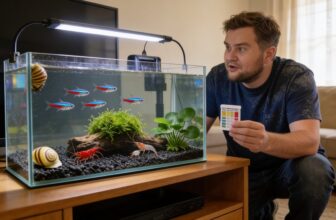
Now, you’re testing water quality—it’s your new job. Grab an API Master Kit ($35, covers ammonia, nitrite, nitrate, pH). Test for ammonia spikes first; anything above 0.25 ppm stresses snails.
Check pH too—most snails prefer 7.0–8.0.
Hardness matters: use a GH/KH kit ($15) to confirm calcium’s available.
Don’t guess; numbers don’t lie. If parameters look good, your snail’s likely sleeping. If not, correct slowly—sudden changes shock them. For more comprehensive monitoring, use JNW Direct 9-in-1 strips that measure pH, ammonia, nitrite, nitrate, hardness, alkalinity, carbonate, and chlorine. For even higher precision, consider a digital pH meter with 0.01 accuracy for consistent readings.
You’ve got this, tank buddy.
How to Set Up a Hospital Tank for a Still Snail
A spare hospital tank is your snail’s ICU—no drama, just a clean 2‑gallon setup from Petco ($15) with a sponge filter ($10) and a heater ($20) set to 75°F.
Fill it with dechlorinated water from your main tank, matching pH and hardness.
Use water from your main tank—dechlorinated, same pH and hardness—for a smooth, stress‑free recovery.
Add a smooth rock or plastic plant for grip—no sharp edges.
Don’t overthink it: this isn’t luxury. Your snail just needs stable, stress‑free conditions to recover.
Test water daily, keep it simple, and you’re part of the club that knows how to give a quiet little friend a second chance.
When transporting a still snail to its hospital tank, use a collapsible bucket with a watertight seal to avoid spills and maintain stable water parameters.
Using six anti-slip feet on the hospital stand prevents wobbling on uneven floors, keeping the snail’s environment steady.
The Right Light and Food Schedule to Wake a Sleeping Snail
Once the hospital tank is running, the next step is sorting out light and food to coax your snail out of its stupor.
You don’t need a fancy setup—just a timer. Most snails are nocturnal, so run lights for 8–10 hours daily; a $10 outlet timer from Amazon works fine. Using a digital temperature controller can also help you monitor any sudden heating changes that might further stress a sleeping snail.
Offer calcium-rich foods like blanched kale or zucchini—snails love it. Drop a cuttlebone in too; it’s cheap and prevents shell rot. Using an automatic feeder with precision portion control ensures you don’t accidentally overload the tank with uneaten food.
Don’t overfeed—you’re waking it up, not stuffing it. Two small pieces every 48 hours is plenty.
Watch for movement within three days. That’s your cue you’re winning.
How to Correct Poor Water Parameters Without Shock
Subordinating conjunctions exist for a reason, so here’s one: after you’ve identified out‑of‑range water parameters with a reliable test kit (like API’s Freshwater Master, about $25), the trick is fixing them slowly. You’re part of this tank’s team, so don’t shock your snail with sudden changes.
- Do a 10% water change daily, not a massive 50% swap—slow dilution prevents pH or ammonia swings.
- Use a drip acclimator to add new water drop by drop over an hour, mimicking nature’s pace.
- Add buffer products (like Seachem Neutral Regulator, $10) half the recommended dose, then retest.
For planted tanks with fast‑growing stem plants, you might also supplement ~0.5 mg Fe/L for new leaf production, but avoid sudden chemical swings.
Patience isn’t just a virtue; it’s your snail’s lifeline. Go slow, test again, and you’ll both win.
Prevent Future Scares With Stable Tank Parameters
Prevent those heart‑in‑throat moments by locking in stable tank parameters before your snail decides to play dead. You’re part of the calm-keepers club now.
Test weekly—ammonia zero, pH 7.0–8.0, hardness 5–15 dGH. A $20 API Master Kit catches spikes early.
Add live plants; they’re free nitrate buffers. Automate lighting with a $10 timer—snails hide from chaos.
Dose calcium with a $5 cuttlebone, and feed kale every three days.
Stable water shrinks scares. Bottom line: a routine that tests, adjusts, and nurtures keeps snails safe and you sane. No more “is it dead?” panic.
Frequently Asked Questions
Can My Snail Be Dead Even if It Still Smells Normal?
Yes, your snail can be dead and still smell normal—but it’s rare.
A dead snail usually rots fast, releasing a foul stench within 24 hours.
If it’s sealed in its trapdoor, decomp might be slower, tricking your nose.
Check if it clings to surfaces; dead ones can’t.
Sniff close to the shell opening.
If you’re still unsure, wait a day, then recheck.
Trust your senses, but don’t let hope delay removal—a decaying snail nukes your water.
Bottom line: if it’s not moving and smells fine, isolate it for 24 hours.
How Long Should I Wait Before Assuming a Hibernating Snail Is Dead?
Wait at least two weeks before assuming a hibernating snail is dead. I know, it feels like forever, but a full winter sleep can stretch that long, especially if temps dropped below 68°F or food ran low.
Give ’em a gentle sniff test after day seven—no stink means no decay.
Place the snail on a flat surface; if it doesn’t grip within five minutes, don’t panic. Patience beats panic here.
Bottom line: fourteen days of stillness with no odor usually means death, not just a long nap.
Can a Snail Survive Being Dried Out if Found Outside the Tank?
No—a snail found dried out outside the tank is almost definitely dead.
Aquatic snails rely on constant dampness; their gills collapse within minutes of exposure.
You can try a quick dip in dechlorinated water, but don’t get your hopes up.
If it doesn’t clamp down on a surface within an hour, it’s gone.
Remove it fast to avoid a stinky spike in ammonia.
Bottom line: rehydrate ASAP, but plan for a funeral. Sorry.
Should I Move a Snail That Hasn’t Moved for Days but Still Clings?
No, don’t move it yet.
If it’s still clinging, it’s likely just resting—snails can nap for days, especially after a big meal.
Moving it will only stress it out more.
Check water parameters first; ammonia spikes or wrong pH often cause this.
Give it a few more days with a light/dark cycle and calcium-rich food.
Only move it if you smell something foul—that’s when it’s not sleeping, it’s just a bad surprise.
Do All Snail Species Sleep for the Same Amount of Time?
No, they don’t—sleep duration varies wildly by species.
Your assassin snail might nap for days after a big meal, while a nerite snoozes in shorter bursts.
Temperature, food, and water quality also shake things up.
For example, a stressed mystery snail could seal itself for a week, not because it’s dead, but because it’s grumpy.
Check your tank’s pH and calcium levels; they’re usually the real culprits.
Just don’t panic—watch, test, and wait.
Rounding Up
So, you’ve done your detective work—no stink, a tight shell, and water parameters that don’t look like a chemical spill. Chances are your snail’s just being dramatic, not dead. That’s the thing with snails: they nap hard, move slow, and keep you guessing. But now you’ve got a system. Trust the smell test, keep calcium handy, and don’t flush a perfectly good sleeper. Bottom line: if it clings and doesn’t reek, it’s probably just lazy.