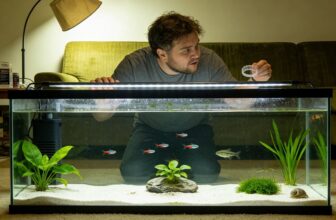
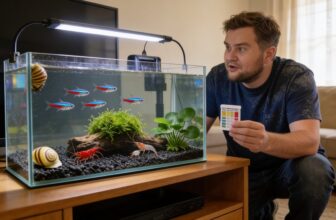
Yes, betta fish can live with snails—nerites are practically attack-proof thanks to their dull color and hard operculum (a lid they seal shut).
Stick with slower-breeding species: nerites (best bet, $4–6 each), mystery snails ($5–8, but they poop a lot), Japanese trapdoors, or Malaysian trumpets.
Avoid tiny pond snails; your betta might nip their antennae.
Quarantine every snail for two weeks first.
Give them cuttlebone for shell health.
If you want specifics on which snail fits your exact tank, keep going.
At A Glance
- Nerite snails are ideal betta tank mates due to their hard shell and inability to overbreed.
- Mystery snails’ operculum protects them from betta nipping and aggression.
- Avoid soft-bodied pond snails lacking an operculum, as bettas often attack them.
- Use a minimum 5-10 gallon tank with hiding spots and gentle filtration for both species.
- Quarantine new snails for two weeks and maintain pH 6.5-7.5, temperature 76-80°F.
Why Adding a Snail to Your Betta Tank Is a Smart Move
Why wouldn’t you want a tiny, armored cleanup crew for your betta’s tank? Snails are the ultimate low‑maintenance sidekick, munching algae and leftover food before they foul your water.
That means fewer water changes and a happier betta—plus, you get to watch that graceful glide across the glass.
I’ve seen my own betta ignore his snail pal completely, swimming past like it’s invisible furniture.
You’re not just adding a pet; you’re joining a savvy crew that knows snails keep tanks stable.
Bottom line: a nerite or mystery snail? That’s a smart, easy win.
For best results, choose a substrate that enhances fish coloration and supports stable water conditions for both species.
A magnetic aquarium lid can also prevent your betta from jumping out while keeping the snail safely enclosed.
The 3 Biggest Risks When Keeping Bettas With Snails
So maybe your betta will turn out to be a total jerk. We’ve all been there, and it’s not pretty.
Here are the three biggest risks you’ll face:
- Aggressive Nipping – Your betta might mistake a snail’s antennae for a tasty worm, especially with smaller or soft-bodied snails.
- Overpopulation Chaos – Fast breeders like pond snails can explode to 50+ in weeks if you’re not vigilant.
- Shell Damage – Hungry bettas can crack thin shells, leaving your snail defenseless.
You’ll want a backup tank ready, just in case. Nobody wants to be the one who ignored the warning signs. Early signs most owners miss include fins held clamped against the body, which can indicate stress from aggression or poor water quality.
5 Snail Species That Thrive With Bettas
Mystery snail—size matters. At two inches, its operculum (a hard trapdoor) blocks betta nips. Needs calcium supplements (try cuttlebone, $5) and harder water. Clean, slow, and peaceful. For goldfish or similar freshwater setups, similar stability can be achieved with Seachem Gold Buffer to maintain proper pH. For durable underwater repairs in their habitat, consider using J‑B Weld WaterWeld for a safe bond.
Assassin snail—the tank’s hitman. Eats pest snails, minding its own business. Three inches max; just feed it bloodworms if no prey exists. Low bioload, high cool factor.
Malaysian trumpet snail—burrows in sand, aerating substrate. Breed like rabbits, but nocturnally hide. Useful janitors, not dinner.
Pond snail—risky without operculum, but hardy; betta may nibble. Best for expert multitankers only.
Japanese trapdoor snail—five‑year lifespan, plant‑safe, slow breeder. Import rules vary; check legality. Bottom line: mystery or assassin for worry‑free vibes.
Nerite Snails: The Safest Betta Tank Mate
Nerite snails might just be the only snail that won’t test your betta’s patience—or your own. You get algae cleanup, no overpopulation drama, and a shell your betta can’t easily nibble. Here’s why they’re your best bet:
- Impossible to overbreed – They need brackish water to hatch eggs, so you’ll never wake up to a snail invasion.
- Tiny bioload – A single nerite produces minimal waste, keeping your water pristine.
- Tough operculum – That door-like shield means your betta’s curious nips won’t reach soft flesh.
- Hardy adapters – They thrive in 76-80°F and pH 6.5-7.5, exactly your betta’s sweet spot. They also benefit from stable water chemistry to support stress-free molting and shell health.
You belong with this snail. Their low-maintenance care is further supported by USB rechargeable feeders that eliminate disposable battery waste. Pick one up for $3-5 and relax.
Mystery Snails: Colorful but Heavy on Bioload
Why would you trade bulletproof simplicity for a bigger, hungrier snail that might actually stress your filter? Mystery snails look gorgeous—gold, blue, magenta—but they’re messy eaters. Their heavy bioload (waste production) demands a stable, mature tank, ideally 10+ gallons. You’ll need stronger filtration and weekly water changes to keep ammonia at 0 ppm. They’re social, though, and fun to watch munch algae off your driftwood. For a 10-gallon setup, you should choose a filter with a flow rate of 125 GPH or more to handle their waste efficiently. To help manage their waste, consider adding a chip-resistant resin decoration that provides hiding spots and sinks steadily without affecting water chemistry.
| Trait | Mystery Snail |
|---|---|
| Size | 2‑2.5 inches (bulky) |
| Bioload | High (double a nerite) |
| Water hardness | Needs 5‑8 dGH (add calcium) |
| Cleanliness | Moderate algae eater, heavy waste |
Bottom line: they’re rewarding if you’re up for extra maintenance, but not for lazy keepers.
Assassin Snails: Natural Pest Control for Your Tank
If you’ve got a snail explosion on your hands—pond snails multiplying like gremlins after midnight—an assassin snail might be your savior. It won’t pester your betta or chow on plants; it hunts other snails exclusively.
- Carnivorous hunters – They stalk prey, not your betta’s fins, so tank drama stays low.
- Solitary operators – One’s plenty for a 10-gallon; they’re nocturnal and slow, like a ninja in slow motion.
- Diet needs – Once snail buffet’s gone, feed sinking shrimp pellets every other day.
- Hardy, not invincible – They survive 65–82°F but need stable water; skip them in soft sand (they burrow).
Assassin snails benefit from sine‑wave pump technology to ensure smooth water flow and reduced noise in the tank. They’re low-maintenance peacekeepers—just don’t expect a cuddle buddy. For added safety during illness, a temporary quarantine setup using a clear plastic box can isolate a sick betta for short-term treatment and observation.
Japanese Trapdoor Snails: Long-Lived and Plant-Safe
Since assassin snails are all about hunting, Japanese trapdoor snails are the exact opposite—they’re the gentle, plant‑safe janitors you didn’t know you needed.
You can finally stop worrying about your prized Anubias getting munched.
These snails live 5–10 years—that’s a decade of low‑maintenance algae patrol. They are hardy enough to tolerate a temperature range of 75–86 °F, matching your betta’s needs perfectly.
They’re hardy, tolerating temps from 40–85 °F, so they won’t bail on your betta’s setup.
Their slow breeding keeps you from drowning in babies.
You’ll feel like a pro keeping these long‑lived guys.
Bottom line: they’re your betta’s quiet, reliable roommate.
For example, the Anubias Nana Snow White tissue culture cup is a sterile, 100% snail‑free option that grows safely in betta tanks.
Grab ‘em—you’re part of the peaceful‑tank club now.
Snail Species to Avoid (Pond Snails and Why They’re Risky)
Pond snails are the uninvited guests of the aquarium world—they show up unannounced and refuse to leave.
You’ll find them hitchhiking on plants, and once they’re in, they’re impossible to fully evict.
Here’s why they’re risky for your betta tank:
- Rapid breeding – A single pond snail can produce hundreds of eggs, turning your tank into a snail soup before you blink.
- Plant damage – They aren’t just algae eaters; they’ll shred your soft, living plants like a hungry toddler.
- No operculum – Without that trapdoor shell, your betta can easily nip their exposed bodies, stressing both.
- Hard to spot – Their small, brown shells blend into gravel and decor, making manual removal a guessing game.
Unlike higher-quality reef lights that prioritize uniform PAR distribution, pond snails create uneven stress in a betta tank.
To make matters worse, pond snails lack the specialized papillae that beneficial algae-eaters like the Chinese High Fin Banded Shark use to safely scrape surfaces without harming plants.
Bottom line: skip pond snails—they’re not worth the headache.
How to Prevent Snail Overpopulation Before It Starts
Before you even introduce a snail to your betta tank, you can already take steps to avoid a population explosion—think of it as family planning for invertebrates.
First, quarantine new plants for two weeks in a separate container; pond snails often hitchhike in on leaves.
Second, feed sparingly—leftover food is an open invitation for snail orgies. Stick to a consistent schedule, removing uneaten pellets after five minutes.
Finally, choose a slower breeder like a nerite or Japanese trapdoor snail; they won’t turn your tank into a shell-packed subdivision. For all snails, stable water conditions and gentle HOB filtration help avoid sudden environmental shifts that can stress inhabitants. Using 8‑parameter test strips can help you monitor water quality to prevent ammonia spikes that could stress snails and trigger breeding. Do this, and you’ll stay ahead of the curve.
Water Parameters That Bettas and Snails Both Love
Even though you can’t exactly ask them to split a pH test kit, bettas and most snails do agree on water—they’re surprisingly compatible roommates. You’ll keep everyone happy by nailing these four shared preferences:
- Temperature sweet spot: 76-80°F (24-26°C). Your betta’s lazy swim, your snail’s healthy shell—both thrive here.
- pH between 6.5-7.5: Neutral enough for betta slime coats, hard enough for snail shell growth.
- Zero ammonia, zero nitrite: Toxic for both; a cycled tank isn’t optional.
- GH at 3-5 dGH: Soft enough for betta fins, just mineral-rich enough for snails. For precise monitoring, consider a device with automatic temperature compensation like the APERA AI209. Use high-volume test kits to quickly monitor multiple parameters including copper and iron, which are rarely covered in lower-tier options.
Bottom line? Keep these numbers stable, and you’ve got a peaceful shared home.
How Do You Choose a Snail That Bettas Won’t Attack?
Size matters here—literally. You gotta pick a snail big enough your betta can’t mistake it for a snack.
Mystery snails, at 2-2.5 inches, work great; their hard operculum (that trapdoor shell) makes them tough to nip.
Nerites, at just an inch, often get left alone owing to their boring color.
Avoid tiny pond snails—no operculum means your betta’s curiosity turns aggressive.
Specialty bullets: get a snail with a thick shell, keep it well-fed, and pick a calm betta.
It’s not rocket science, just match sizes and avoid dinner-plate temptations.
To prevent stress from aggressive tank mates, choose calm, peaceful species like Cory catfish or Green neon tetras as alternative companions.
Adding Ultum 4‑inch Silencer disks to your sump can reduce overflow turbulence and micro-bubbles, further calming the tank environment for sensitive fish like bettas.
Set Up the Tank for Peaceful Betta-Snail Cohabitation
Alright, you’ve picked a snail with thick enough armor that your betta won’t mistake it for a floating snack. Now, set the stage for peace:
- Go 10 gallons minimum—tight spaces (like a 5‑gal) force conflict; more room means they can avoid each other when needed.
- Add soft sand or rounded gravel—snails need gentle substrate to burrow without injury; sharp edges are a no‑go.
- Overstock with hiding spots—driftwood, caves, live plants like Anubias give both territorial zones so nobody feels cornered.
- Keep water warm and clean—76‑80°F, 0 ammonia/nitrite, stable pH 6.5‑7.5; stressed snails or fish act out. A quiet HOB filter with ≤ 40 dB motors will help maintain stable water quality without adding stress.
Set this up, and you’re part of a crew that knows harmony isn’t luck—it’s design.
Feed Your Betta So It Leaves the Snail Alone
A well-fed betta is a lazy betta, so if you keep its belly full, it probably won’t treat your snail like a chew toy.
Stick to two high-quality pellets—maybe Fluval Bug Bites, $8—twice daily.
You’re part of the club that gets this: a hungry betta is a jerky betta.
Mix in frozen bloodworms or brine shrimp once a week for variety.
Overfeed, and you’ll foul the water, so watch portions.
You want it satisfied, not stuffed.
A content fish ignores your snail’s antennae.
Bottom line: consistent feeding builds tank harmony.
You’ve got this—keep the belly full.
These bug bites contain 40% black soldier fly larvae protein, a sustainable source that supports color and immune health.
If your betta does get sick from stress, you can safely mix Garlic Guard into its food to encourage feeding without harming water parameters.
Quarantine Every Snail Before Adding It to the Tank
Since you’ve got the feeding down, the next big step is quarantining every snail before it meets your betta. You don’t want unwanted hitchhikers—like pond snails—or disease crashing your party. Keep new snails separate for at least two weeks.
- Set up a small quarantine tank – A simple 2‑gallon plastic tub works, with a sponge filter ($15) and heater ($20).
- Watch for common issues – Look for lethargy, shell damage, or white spots. Healthy snails are active with intact shells.
- Treat with aquarium salt – Use 1 tablespoon per 5 gallons for parasites; your betta’s tank stays safe.
- Double‑check species – Make sure it’s not an invasive type, like apple snails, which are illegal in some states. You’re part of a careful crew now—no shortcuts.
For an effective quarantine, consider using a manual siphon power source like the Laifoo Siphon Vacuum to easily manage water changes without electricity.
Frequently Asked Questions
Can Betta Fish Eat Snails?
Yes, bettas can eat snails, but not the whole shelled adult.
They’ll nip at tiny snails like pond snails, which have no operculum (a trapdoor shell-cover), or go for snail eggs.
It’s riskier with bigger species—mystery snails wear a tough operculum, so a betta’s bite just bounces off, making them safer pals.
For population control, try crushed snail meat as a treat, but don’t rely on it.
Bottom line: your betta’s a picky eater, not a snail-cracker.
How Do I Treat a Sick Snail in a Betta Tank?
First, move that snail to a separate quarantine tank—a simple plastic container works.
You don’t want meds harming your betta.
For soft-shell issues, add a cuttlebone (about $3) for calcium.
If you spot lethargy or shell pitting, bump up water temps slowly to 78°F.
A salt bath (1 tablespoon aquarium salt per gallon for 15 minutes) fights mild infections.
Do Snails Need a Lid on the Betta Tank?
Yes, you absolutely need a lid.
Bettas are notorious jumpers—they’ll launch themselves out of a gap you didn’t even notice.
Snails, especially mystery or apple snails, can further climb right out and become crispy explorers on your floor.
A tight-fitting glass lid or mesh cover (about $15–$30) solves both problems.
No lid means dead betta and desiccated snail, guaranteed.
Don’t risk it.
Can Snails Carry Diseases to Bettas?
Yes, snails can carry diseases to bettas, but it’s rare if you’re smart.
Most issues come from parasites or bacteria hitchhiking on new snails, not from the snails themselves.
Quarantine every snail for two weeks in a separate tank—it’s a cheap 5‑gallon setup ($15).
Watch for lethargy or shell rot (pitted, softening shell).
A clean quarantine tank avoids fungal spores or flukes that could infect your betta.
Bottom line: you’re safe if you isolate new arrivals.
Will a Betta Sleep on a Snail?
Will a betta sleep on a snail? Probably not, but it’s not impossible.
Your betta might accidentally rest against a large, stationary mystery snail—think of it as a weird, living cushion.
You’ll see your betta dozing on leaves or the substrate, not actively piggybacking snails.
That’d be a hilarious image, though. Just make sure your snail’s shell is smooth and your betta isn’t stressed; they’re both fine ignoring each other.
Bottom line: don’t expect it, but don’t panic if it happens.
Rounding Up
So, can a betta live with a snail? Yeah, but you can’t just toss in any $3 pet‑store snail and hope for the best. Nerites are your safest bet—they clean algae and don’t add much bioload (waste). Pick a 10‑gallon tank, keep pH between 6.5 and 7.5, and quarantine every new snail for two weeks. That’s it. If you match the snail to your setup, you’ll get a calm tank, not a war zone. Just don’t grab a pond snail—your betta will turn it into an expensive snack.