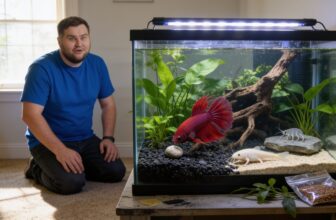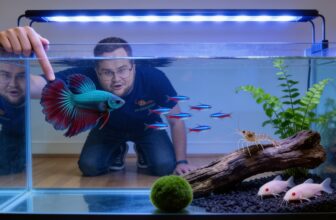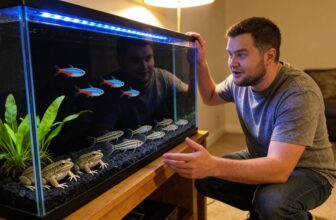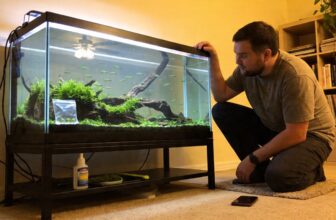
Run gentle filtration (AquaClear 20 with the flow dial cranked down), keep six-plus pygmies for proper schooling, and feed your betta floating pellets first, then sink micro-pellets five minutes later so nobody goes hungry or gets nippy.
Plant heavily—think Java Fern thickets, driftwood caves, maybe some Frogbit up top—and watch like a hawk for fin-nipping or sulking in corners.
Water sits at 75–79°F, pH 6.0–7.5, soft sand substrate, weekly 25% changes with that gravel vacuum earning its keep.
The bottom line?
This pairing absolutely works, spectacularly even, when you’ve done your assignment and accept that some bettas simply hate roommates—no matter how perfect your setup looks.
Success lives in the details you’ll find just ahead.
At A Glance
- Female bettas usually tolerate pygmy corydoras better than males do.
- A 20-gallon tank lets corydoras school and gives the betta separate territory.
- Keep six or more pygmy corydoras to maintain their group security.
- Use smooth sand substrate to protect corydoras’ barbels from damage.
- Feed betta floating food first, then sinking pellets for corydoras afterward.
Do Betta Fish and Pygmy Corydoras Get Along?
So, do betta fish and pygmy corydoras actually get along? Typically, yes—you’ve picked a solid pairing. These little corys stay bottom-dwelling, clear of your betta’s turf up top, which helps keep the peace.
Betta temperament varies wildly, though. Some flare at their own reflection; others couldn’t care less if a shrimp throws a party on their hammock. You’ll need to watch yours closely, especially at first.
Betta personalities range from mirror-aggressive to shrimp-party tolerant—observe yours closely at first.
Corydora breeding happens naturally in stable tanks, so don’t panic if you spot tiny eggs on glass. More corys isn’t a crisis—it’s free fish, basically.
Bottom line: provide plants, caves, and a backup plan. Most setups work fine. Unlike hillstream loaches, which require continuous moderate current and a 50-gallon tank, this pairing suits smaller, calmer aquariums.
Male or Female Betta: Which Works Better With Corydoras?
Female Bettas – The Safer Bet****
- Typically calmer, less territorial screaming
- Shorter fins = less target practice for stressed tankmates
- Still moody, but think “grumpy roommate,” not “battle tank”
Male Bettas – High Stakes****
- Long, flowing fins trigger their inner gladiator
- Some tolerate Corydora socialization beautifully, others wage tiny wars
Watch your individual fish. Docile male or sassy female, both work if you’re ready to separate if things go sideways.
Bottom line: Start with a female. Less drama, better odds, same gorgeous fish.
When bonding rocks and wood for aquascaping, try a fish‑safe cyanoacrylate gel that works underwater and holds fast in both setups.
Minimum Tank Size for This Specific Pairing
Here’s the math that matters—pygmy corydoras need six bodies minimum to feel safe, they’re bottom-hugging mini-schoolers who ping-pong around like caffeinated commas, and your betta patrols the upper half like a moody landlord.
You’re squeezing two lifestyles into one glass box, so betta corydoras compatibility demands respect for personal bubbles.
Shoot for 10 gallons minimum, though 20 lets you sleep easier. Here’s why elbow room matters:
- School cohesion – six corydoras need horizontal runways, not cramped corners where stress spikes
- Lighting requirements – dim zones via floating plants let your betta retreat from harsh glare, since nobody likes a spotlight when they’re grumpy
- Territorial buffering – extra gallons dilute aggression, giving you wiggle room when personalities clash
Skip the 5-gallon “starter” trap. It’ll end in tears, yours probably, and a lonely betta glaring at you from above six stressed-out pygmies huddled in a corner.
For a 10-gallon setup, a rimless low-profile hood with dual LED lighting helps create those dim zones for your betta while keeping the tank secure.
Water Conditions Both Species Need to Thrive
Since both species evolved in slow-moving, plant-choked waters, you’re not juggling wildly different chemistries here—just fine-tuning a sweet spot where neither feels like they’re swimming in someone else’s leftovers. Aim for 75-79°F—think lukewarm bath, not hot tub—and keep that water hardness soft to moderate, around 2-12 dGH (that’s “degrees of general hardness,” fancy speak for dissolved minerals). To meet your pH target, consider a pH meter for precise weekly testing.
| Parameter | Your Target Zone |
|---|---|
| Temperature | 75-79°F (24-26°C) |
| Temperature hardness tolerance | Both flexible, but stable is key |
| pH | 6.0-7.5 |
| Water hardness | Soft-moderate (2-12 dGH) |
Test weekly, adjust slowly, and you’ll have happy tankmates.
How Many Pygmy Corydoras to Keep With One Betta?
If you’re staring at your tank wondering how many tiny catfish will keep your Betta company without turning your living room into an aquatic soap opera, the magic number starts at six—though you’ll hear hobbyists whisper that eight or ten feels even better, and they’re not wrong.
- Shy fish gain confidence in bigger posses, reducing stress that tanks your water quality.
- Diet variations get easier—six Corydoras will actually *find* those sinking pellets before they rot, unlike two lonely scavengers.
- Breeding behaviors emerge, letting you witness tiny whiskered dramas instead of just, well, algae.
Six minimum, eight ideal, ten if you’ve got the square footage.
When anchoring plants for the Corydoras to explore, consider using chemically inert ceramic rings that won’t alter water parameters.
Warning Signs Your Betta Is Turning Aggressive
You’ve got your squad of six (or ten, you overachiever) tiny corydoras settled on the bottom, whiskers twitching, and for a few days everything’s Disney-level harmony—but bettas are moody Roombas with fins, and that peace can curdle fast.
Spot aggression triggers early. Behavior monitoring keeps everyone safe. Installing a magnetic cover net helps prevent jumpers if your betta startles the corydoras during a chase.
| Sign | What You’re Seeing | Your Move |
|---|---|---|
| Flaring gills, spread fins | Classic threat display | Watch closely, don’t panic yet |
| Chasing corydoras repeatedly | Territory enforcement | Add more plants, check tank size |
| Nipping barbels or fins | Physical aggression | Separate immediately, rehome if needed |
Your betta’s no villain, just stressed. Read the room, act fast, and your crew stays intact.
Create Separate Zones for Peaceful Coexistence
Your betta thinks the whole tank is his, since of course he does—he’s basically a tiny aquatic landlord with a Napoleon complex. You need territory mapping. Plant dense Java Fern in back—that’s Cory country—while you let betta claim the surface with floating Frogbit. Light zoning works wonders; dim the bottom with driftwood so pygmies scurry below, but keep the top bright for your diva’s color pop. Placing a non‑adhesive neoprene mat under the tank also absorbs vibrations from filters, reducing stress for both species.
Your betta thinks the whole tank is his—he’s basically a tiny aquatic landlord with a Napoleon complex.
- Secure bottom territory for six or more Corydoras
- Establish mid-to-top zones for betta patrolling
- Use floating plants to diffuse light and mark boundaries
See? Everyone gets their own zip code. That keeps peace.
Substrate That Protects Corydoras Barbel and Betta Fins
Since your corydoras spend their entire lives face‑down in the substrate like tiny aquatic vacuum cleaners, you can’t just dump any old gravel in there and call it a day.
Sharp gravel tears barbels—those whisker‑like sensory organs corydoras use to root for food—leaving them prone to infection Betta fins snag on rough surfaces too, shredding those flowing tails you’ve probably paid extra for.
Your move: sand substrate, **smooth sand, 0.5–1 mm** grain size, about $8–15 for a 10‑gallon layer. It’s fin friendly, lets corydoras sift naturally, and doesn’t trap debris like a gravel trap.
Quick checklist:
- Smooth sand: yes
- Sharp pebbles: hard pass
- Depth: 2 inches minimum for rooting
Bottom line—you’re building a home, not a cheese grater. Pick smooth sand, protect those barbels, and everyone’s happier.
Note that while sand or crushed coral works for some species, corydoras and bettas require exclusively smooth sand.
Feed Both Species Without Competition or Waste
Feeding two species with opposite dining habits is like running a restaurant where one guest eats on the roof and the other won’t leave the basement.
You solve this with smart feeding timing: float Betta flakes first, wait five minutes, then sink Corydoras pellets below. Your betta’s too busy surface-snacking to steal from the bottom-dwellers.
Waste reduction matters—uneaten food rots fast. Target each species with precision, skip the scatter-and-pray method. Using a suction grip ring like the Pawfly set helps contain floating food at the surface for bettas.
- Feed bettas first at the surface
- Drop sinking foods near Corydoras clusters
- Remove leftovers within 30 minutes
You’ll keep water cleaner, bellies happier, and both species feeling like they belong.
Plants and Decor That Reduce Territorial Stress
Territorial stress kills more community tanks than bad water chemistry ever will, and you’re the one holding the spray bottle—er, the planting tongs.
Dense planting = diffused aggression. Position floating Frogbit or Water Lettuce for Light diffusion across the water’s surface, calming surface-dwelling Bettas. Below, arrange driftwood caves and Cryptocoryne clusters as Hidden refuges for shy Corydoras breaking line of sight. Adding a tall backdrop of plastic plants like the JIHAQUA 21-inch stems can further partition the vertical space in larger tanks.
| Zone | Plant/Decor | Stress-Busting Job |
|---|---|---|
| Surface | Frogbit, Water Lettuce | Light diffusion, Betta security |
| Midwater | Anubias, Java Fern | Visual barrier, territory marker |
| Substrate | Cryptocoryne, caves | Hidden refuges for resting Corydoras |
| Hardscape | Driftwood, smooth rocks | Corner definition, safe exploration |
You’re building neighborhoods, not a cage match.
Filtration Gentle Enough for Long-Finned Bettas
Once you’ve got your plants locked in, the next thing that’ll make or break this pairing is your filter choice—because nothing ruins a Betta’s day like getting blown around like a plastic bag in a hurricane.
Betta flow matters. Too strong, and your fish exhaust themselves fighting the current, fins clamped and miserable. Pygmy corydoras want some movement, certainly, but your Betta needs calm waters up top.
Here’s how you nail it:
- Pick an adjustable hang‑on‑back with a flow dial—AquaClear 20s run about $25 and let you throttle that current way down, or baffle the outflow with a cut water bottle (classy, I know).
- Add a sponge filter as backup—gentle bubbling, no intake gaps where corydoras snack on their own whiskers, and it’s cheap insurance running maybe $12.
- Position that outflow—aim it at the glass, break the surface ripples, keep the bottom peaceful for your scavenging crew.
Moderate detail: sponge filters handle biological filtration fine in 10‑20 gallons, but pair one with your main filter for clarity. Flow current isn’t negotiable—you’re building a home, not a washing machine.
Bottom line? You control the Betta flow, or you’re just stressing fish and wasting money.
When to Add More Fish to This Pairing
Before you even think about expanding this little aquatic soap opera, you’ll want to make sure your current cast isn’t already plotting mutiny.
– Wait 4–6 weeks. Let your betta settle, your corydoras school, and your water chemistry run rock-steady.
Watch for these green lights:
- Zero aggression for two straight weeks
- Ammonia and nitrite holding at zero, nitrates below 20 ppm
- Everyone’s eating like it’s Thanksgiving
Time it right with seasonal breeding patterns—many fish spawn during longer daylight hours, so sync your lighting cycles to mimic spring’s stretch. Ten hours of gentle LED works, ramping up slowly, since nobody likes a jarring alarm clock, fish included.
Bottom line: patience now saves drama later.
Weekly Water Maintenance for a Healthy Community
Since your fish can’t exactly grab a mop and bucket, you’re the one stuck with weekly water duty—but it’s less of a chore than it sounds, and your tankmates will thank you for it.
You’ll swap out 25% of the water, gravel-vac the gunk nobody wants to talk about, and feel oddly proud.
- Water testing keeps ammonia, nitrite, and nitrate in check—zero, zero, under 20 ppm, or you’re inviting trouble.
- Filter cleaning means rinsing media in old tank water, never tap, or you’ll nuke your beneficial bacteria.
- Consistency builds trust; your fish recognize routine, and honestly, so do you.
It’s not glamorous. But neither’s flossing, and you do that. Probably.
When Separation Becomes Your Only Option
Sometimes your best efforts aren’t enough, and you’ve got to face the music: your betta and pygmy corydoras simply aren’t vibing.
Don’t beat yourself up—tankmate chemistry’s weird, like dating in high school, sometimes the pieces don’t fit.
Spot the signs: relentless fin-nipping, cornered corydoras refusing to surface, your bettaCamping the bottom like a grumpy landlord.
Breeding stress? That’s your red flag, since harassed corydoras won’t breed, and injured bettas risk infection—neither’s thriving, both are suffering.
Separate them. Set up a dedicated corydoras tank, minimum ten gallons, soft sand, gentle filtration, proper habitat acclimation over a few hours.
Your fish deserve peace, and honestly, so do you.
Frequently Asked Questions
What Other Fish Can Join This Community?
You’re looking at twarf shrimp and neon tetras, mostly.
These little guys fit the vibe—peaceful, small, and they won’t stress your Corydoras or agitate that moody Betta you’ve got.
- Dwarf shrimp clean house, basically free labor at $2-4 each
- Neon tetras add flash, $3-5 per fish, keep them in schools of six minimum
Skip anything colorful or nippy—no guppies, no barbs. Your Betta’s a drama queen, don’t feed the beast.
Stick to 20 gallons, though. Room helps everyone’s sanity, including yours.
Do Pygmy Corydoras Eat Betta Food?
Yes, they’ll steal it if you let ’em.
Pygmy Corydoras aren’t picky—they’ll Hoover up whatever hits the bottom, including stray Betta pellets.
That’s why your *Corydoras diet* needs sinking foods (think $4 algae wafers, $6 frozen bloodworms) dropped right on the substrate.
For *Betta feeding*, serve their high-protein flakes at the surface first, like a VIP dinner before the bottom-feeders crash the party.
– Pro move: target-feed with a turkey baster, $2 at any kitchen store.
Bottom line: feed Betta first, Corydoras second, or you’re basically buying gourmet meals for scavengers.
How Long Does Betta-Corydoras Compatibility Take?
You’ll see compatibility emerge within 2–7 days, though full tank acclimation—from hiding to confident schooling—takes 2–4 weeks for your Corydoras. That’s longer than most Netflix series you’ll binge, honestly.
- Corydora temperament helps: they’re peaceful bottom-dwellers, rarely provoking Bettas
- Watch for persistent chasing; separate if needed
- Female Bettas usually adjust faster
- Their cleaning behavior focuses on leftover food and debris, not algae control
- You’ll still need to scrub that glass yourself, sorry
- For actual algae control, grab a snail or some Amano shrimp
- Size: 10+ gallons, absolute minimum
- Betta temperament: Individual personality trumps all rules
- Cory group: 8+ Pygmies, cramped groups stress easy
- Plants: Dense cover, line-of-sight breaks vital
Bottom line: patience pays. Most successful pairings stabilize by week three, but you’ll know within a week if it’s trouble.
Can Corydoras Clean Betta Algae?
No, Corydoras won’t clean your Betta’s algae. They’re not algae-eaters.
Bottom line: Corydoras are cute little vacuum cleaners for crumbs, not window washers.
Will Betta Flare at Bottom-Dwelling Corydoras?
Your betta might flare at corydoras, but it’s usually brief curiosity, not war.
Flaring triggers include sudden movement or bright colors—corydoras have neither.
Territorial aggression? That’s top‑tank real estate, not the bottom floor.
You’ll see posturing, maybe a chase, then boredom sets in.
Keep six‑plus corydoras so they feel bold, plant heavily, and watch.
Most bettas learn to ignore them.
If it’s relentless, separate—no shame in admitting defeat.
Rounding Up
Yes, they can work. You’re threading a needle here, balancing a Betta’s ego against timid catfish—that’s the trade-off.
Water-wise, you’re in luck—both want soft, acidic, 76-78°F conditions. Feed sinking pellets for Corys, flakes or floaters for your Betta, watch closely at meals.
Aggression happens. Have a backup tank ready—seriously, that $15 quarantine bin saves lives.
Bottom line: Try it if you’ve got patience, plants, and an escape plan. Skip it if your Betta already flares at his own reflection like that one uncle at reunions.