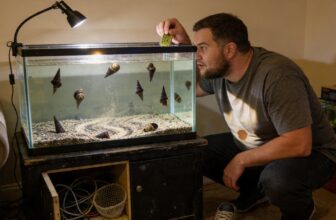
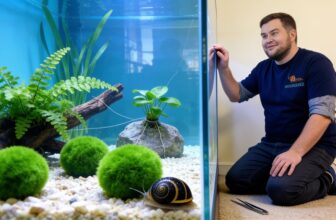
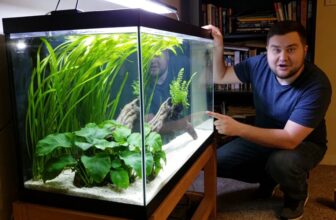
Mopani wins for instant gratification—dense, honey-to-ebony grain, sinks immediately, moderate tannins, $15-$40. Manzanita follows close: pale, intricate branches, zero wait time, barely stains your water.
Spider wood demands patience (1-2 weeks to sink) but builds airy canopies that diffuse light and curb algae. Cholla‘s porous tubes become shrimp apartments, whereas Bonsai pieces ($25-$60) anchor with pre-attached rocks for instant centerpiece status.
Skip beach driftwood—it’s a fish funeral waiting to happen. Boil anything you buy 30 minutes minimum, or soak stubborn floaters up to a month.
Match size to tank: under 8 inches for 20 gallons, 12-18 for 55. Your aquascape’s foundation starts here, and the specifics of pairing each wood to your stocking list come next.
At A Glance
- Choose certified aquarium-safe driftwood that is odor-free, dye-free, and explicitly labeled for tank use.
- Mopani and Manzanita sink immediately, while Spider and Redmoor Root require soaking before submersion.
- Boil driftwood 30–120 minutes and soak 1–4 weeks to release tannins and eliminate pests.
- Match wood size to tank capacity: under 8 inches for 20-gallon tanks, 12–18 inches for 55-gallon setups.
- Spider wood creates airy canopies, Cholla shelters shrimp, and Bonsai driftwood serves as artistic centerpieces.
What Driftwood Actually Does for Your Aquarium (Beyond Looking Good)
While driftwood might look like fancy fish furniture, you’re actually buying a multipurpose tool that reshapes your water chemistry and gives your tank inhabitants a better life.
Here’s the real kicker: driftwood releases tannin buffering, which buffers pH, lowers hardness, and adds natural acidity to the water. Think of it as nature’s gentle filter—no chemicals needed.
Your fish crave habitat enrichment, and driftwood delivers. Shrimp hide in crevices, plecos rasp off biofilm, and territorial species stake claims on prime real estate.
Driftwood turns empty tanks into thriving neighborhoods where every fish finds their niche.
For anchoring moss or plants to the wood, using a fish-safe cyanoacrylate gel provides a secure, non-toxic bond that sets underwater in seconds.
It anchors moss, roots plants, and completes your aquascape‘s visual story. You’ve joined a club that swaps plastic castles for living art.
Worth every penny.
How to Identify Aquarium-Safe Driftwood (and Red Flags to Avoid)
What exactly separates the wood that’ll kill your tank from the stuff your fish will thank you for?
You’ll want to spot aquarium‑safe driftwood fast—it’s certified, clean, and labeled explicitly for tanks.
Look for wood certification from sellers who know their business, not mystery beach grabs. That’s your first green light.
Skip anything dyed, perfumed, or suspiciously glossy. If it smells like your grandma’s furniture, hard pass.
Tannin testing matters too—safe wood releases tannins gradually without wild pH swings that crash your cycle. Brown water’s fine, sudden chemistry chaos isn’t.
You’re building a community here, not gambling with guppies. Buy smart, belong confidently.
Bottom line: Certified, odor‑free, and tannin‑tested—driftwood that respects your tank respects you.
For stable water chemistry, consider combining driftwood with a low phosphate aragonitic base rock to buffer pH without additional chemicals.
How to Prepare and Sink Driftwood Before Adding It
Before you shove that gorgeous chunk of wood into your tank and watch it float like a grumpy cork, let’s talk preparation—because nothing kills your aquascape vibe faster than driftwood that refuses to stay down.
Start with wood sterilization: give your piece a good scrub, or boil it for 30–60 minutes—kills hitchhikers, speeds up sinking, and jumpstarts tannin absorption so your water doesn’t look like weak tea. Can’t boil? Soak for 1–3 weeks, changing water until it sinks. Patience, friend—we’ve all been there, staring at floating wood like it’s personally mocking us. For denser varieties like Mopani wood, a longer boil of 50–60 minutes is recommended to prevent tannin clouding.
| Prep Method | Time Required | Best For |
|---|---|---|
| Boiling | 30–120 minutes | Killing pests, fast tannin release |
| Extended soaking | 1–4 weeks | Large pieces, thorough tannin absorption |
| Scrub + rinse | 15 minutes | Store-bought, pre-sterilized driftwood |
| Boil + soak combo | 2 hours + 1 week | Stubborn floaters, thorough wood sterilization |
| Weighted submersion | Ongoing | Immediate aquascape needs |
Bottom line: sterilize first, sink second. Your future self—and your fish—will thank you.
What Size and Shape Driftwood Fits Your Tank Dimensions
When you’re staring at a driftwood piece that looks like it was ripped from a redwood forest, you’ll need to check your tank’s ego at the door.
Your budget selection matters here, people—a 20-gallon tank craves pieces under 8 inches, as 55-gallon setups can handle 12-18 inch showstoppers. Measure twice, buy once, as Dad would say.
Shape drives your scape’s essence. Spider wood creates airy canopies for planted tanks. Root systems build cozy hideouts for shy fish. Simple branches? They let your plants do the talking.
Color coordination seals the deal. Warm reddish woods pop against dark gravel, as pale driftwood brightens blackwater setups. Contrast, don’t clash—your fish will thank you.
Bottom line: match proportion to tank, shape to style, and you’ll belong in the aquascaping club.
If you plan to add a cover to your tank, ensure the driftwood proportions leave room for high light transmission from mesh lids.
Mopani Driftwood: Dense, Dual-Tone Wood That Sinks Fast
If you’re tired of waiting weeks for your driftwood to stop bobbing like a cork, Mopani driftwood is your new best friend—dense enough to sink straight to the bottom without the usual soaking marathon, though you’ll still want to give it a rinse unless you enjoy tea-colored water.
That speed earns praise in planted tank circles.
- Sink speed: Immediate. No weights, no waiting.
- Tannin benefits: Moderate—softens water, lowers pH, mimics blackwater habitats your tetras crave.
- Look: Striking honey-to-ebony grain, each piece unique.
Budget $15–$40 for fist-sized chunks.
Drawback? Heavier than it looks—your back notices.
For planted tanks, pairing Mopani with an adjustable light riser like the Hygger bracket can help eliminate dim corners and ensure even light distribution across the wood.
Verdict: Grab Mopani when you want instant gratification with genuine character.
Spider Driftwood: Branching Canopies for Planted Tanks
– Sink speed: glacial. You’ll need patience, at least a week of soaking, maybe two, before Spider driftwood stops bobbing like a confused cork.
The payoff? Canopy aesthetics that transform your tank into an underwater forest. Those spindly branches, all reaching and twisting, create stunning light diffusion and endless fish shelter. Nestle the base into your substrate integration zone, let plants colonize the upper reaches, and you’ve got habitat complexity that dwarfs simpler scapes. For added versatility, these driftwood pieces pair well with silk leaf compact plants that gently sway with the current.
| Feature | Benefit | Best For |
|---|---|---|
| Canopy aesthetics | Dramatic overhead structure | Planted tanks |
| Light diffusion | Dappled, natural lighting | Crypts and mosses |
| Fish shelter | Multiple hideouts | Shy species |
| Water flow | Improved circulation | CO₂ distribution |
| Algae prevention | Shaded zones reduce growth | Light-sensitive areas |
Yes, it’s fussy. Yes, you’ll curse the float. But that aesthetic contrast against green foliage? Worth every gallon of water changed during soaking. Growth patterns on Spider driftwood follow those branches naturally, giving design inspiration you simply can’t fake.
Bottom line: If you want instant gratification, skip it. If you want conversation-worthy aquascaping, welcome home.
Cholla Driftwood: Lightweight Hideouts for Shrimp and Fry
Spider driftwood demands patience, but maybe you’re after something simpler—something that works right out of the bag without a two-week soakathon.
Enter Cholla driftwood, dried cactus skeleton that’s an Airbnb for shrimp babies and nano fish.
- Immediate sinker: It’s porous, lightweight, and won’t float like a cork.
- Micro-habitat magic: Those hollow tubes shrink habitats into cozy apartments for shy fry.
- Color shifts: Expect tans shifting to deep browns as biofilm colonizes the wood’s surface.
At $8-$15 per piece, it’s insurance against stressed livestock. Grab one, toss it in, and watch your invertebrates throw a housewarming party.
For lighter setups, this wood’s weight pairs well with small acrylic stands that reduce resonance noise in the sump.
Manzanita Driftwood: Intricate Branches That Resist Decay
What stops driftwood from becoming a soggy, rotting mess in your tank? Manzanita driftwood, that’s what.
You get intricate, spindly branches that look like abstract sculpture, but unlike that decorative twig you found on vacation, this stuff actually lasts.
The wood packs natural decay resistance built right in, so during others soften and turn to mush after six months, manzanita holds its shape for years, keeping your scape crisp.
You’ll love the manzanita texture—smooth, pale, almost bone-like—which contrasts beautifully against dark substrates.
It sinks fast, needs minimal prep, won’t stain your water brown. Grab this for drama without rot.
Its durable structure benefits from spill-proof mechanisms that keep floating pellets secure during automatic feeding.
Bonsai Driftwood: Handcrafted Centerpieces for Artistic Tanks
Manzanita gives you raw, wild-branch elegance, but maybe your tank needs something more deliberate—like a sculptor actually planned it.
Enter bonsai driftwood: handcrafted miniature trees, usually 6–12 inches tall, built from treated wood and rock bases. You’re not just decorating; you’re curating.
- Artistic centerpiece status—guests will ask where you bought it
- Thematic focal point for nature-style aquascapes
- Pre-attached rock means instant sinking, no week-long soaking
- Moss-ready branches, perfect for java or christmas moss carpets
Drawback? You’re paying $25–$60 for craftsmanship, not nature’s randomness.
Bottom line: If you want your tank to feel intentional, not accidental, bonsai driftwood delivers that curated, gallery-worthy vibe you’re after.
Sumatran Driftwood: Minimal Tannins, Maximum Visual Impact
If you’ve ever battled murky brownwater after adding driftwood, Sumatran driftwood feels like a cheat code. You get all the drama, none of the tea-stained cleanup.
This stuff delivers aff tannin release—you’ll barely notice water changes. Yet the payoff? Serious visual contrast against green plants and dark substrate.
Stack it: radial root systems spread like frozen fireworks, making any tank look intentional, not accidental.
- Price? Typically $15–30 for centerpiece pieces. Solid affordability for the impact.
- Sinks fast, no week-long soaking saga.
- Becomes a decorative focal point without trying too hard.
Bottom line: You want the aesthetic, not the amber aquarium. This delivers. Pair it with Java Fern for a natural low-light foreground that won’t snag fish fins.
Redmoor Root: Miniature Webs That Trigger Natural Fish Behavior
You’ll pay roughly $20–40 for a decent-sized piece, which isn’t cheap, but it’s cheaper than therapy for stressed-out tetras.
Redmoor root delivers what messy, wild aquascapers crave. Its miniature stump explodes into dense, root-woven chaos—authentic web habitats that spark genuine fish behavior. Your tetras dart through the tangles, claiming territory like they own the place. They will, eventually.
| Visual Texture | Fish Response | Best For |
|---|---|---|
| Dense root webbing | Darting, weaving, schooling | Small characins, rasboras |
| Shadowy crevices | Territory claiming, breeding | Gouramis, dwarf cichlids |
| Surface complexity | Grazing, exploring | Shrimp, loaches |
| Dark coloration | Security instincts | Timid species, new arrivals |
You’re building a refuge here, not Instagram bait. Prep demands patience—slow sinking, thorough curing—but members of your community reward the effort with visible comfort.
Which Moss Species Attach Best to Each Driftwood Type
Since driftwood and moss are basically an arranged marriage that actually works, you need to know which pairs get along before you commit.
Understanding moss‑driftwood synergy means matching texture to surface. Species‑specific attachment varies wildly, so choose wisely or watch your green carpet slide into the filter intake like a sad nacho.
- Java moss clings to anything porous, including bonsai driftwood’s handcrafted nooks
- Flame moss twists dramatically around spider driftwood’s spindly legs
- Christmas moss mats beautifully across manzanita’s intricate branches
- Phoenix moss fountains from redmoor root’s miniature webbed stumps
- Mini Taiwan moss fills cholla’s hollow cactus chambers perfectly
You are building something alive, so pair deliberately.
Where to Buy Aquarium-Safe Driftwood Online and Locally
Now that you’ve got your moss-driftwood power couples sorted, it’s time to actually buy the wood—and this is where things get dicey, since not everything labeled “driftwood” belongs anywhere near living creatures.
You want aquarium-safe pieces, not craft-store rejections. Online specialty retailers dominate for selection and transparency—check supplier reviews obsessively, as one star means dead shrimp. Driftwood pricing swings wildly: $8 for basic spider wood, $60+ for sculptural bonsai pieces. Local fish stores let you hand-pick, but stock varies wildly.
| What You Feel | What Actually Happens |
|---|---|
| Excitement spotting “free driftwood” on Facebook Marketplace | You bring home pesticides and heartbreak |
| Relief at cheap big-box prices | Your tank crashes, your fish ghost you |
| Belonging in elite aquascaping circles | You overpay for boutique “rare” scraps |
| Pride scoring会员 deals | You hoard wood you’ll never use |
Prioritize pre-treated, aquarium-specific inventory. Your tank’s inhabitants depend on it.
Driftwood Maintenance: Cleaning, Monitoring, and Replacement
Once driftwood’s in your tank, your job’s just starting—think of it as adopting a very slow-moving, very low-maintenance pet that can’t beg for food but can definitely wreck your water chemistry if ignored.
- Check water chemistry weekly; tannins drop pH, so test kits are your friend
- Scrub algae gently during water changes—no power washing, please
- Monitor light cycles; excess light fuels algae growth on your wood
- Inspect for soft spots or black mold monthly; swap it out before rot spreads
- Soak replacements before introducing them—nobody wants floaters
Replace degrading driftwood promptly. Healthy wood means healthy fish, and that makes you part of the club.
Frequently Asked Questions
How Long Does Driftwood Last in an Aquarium?
Driftwood longevity varies by type and care. You’ll get 2–5 years from softer woods like cholla, 5–10+ from dense mopani or manzanita, and potentially decades if you’re diligent.
Tank aesthetics stay sharp when you: monitor for rot, don’t let it float (unless that’s your “artistic statement”), and replace crumbling pieces before they mess with your parameters. It’s basically furniture—treat it well, it sticks around; neglect it, you’ll be rescaping sooner than planned.
Your move: buy quality, prep properly, quit fussing once it’s stable.
Can Driftwood Change Water Color Permanently?
No driftwood changes water color permanently.
You’ll see tint leaching fade significantly after 2-8 weeks of soaking, though some Mopani types keep a faint tea hue longer.
That brown water isn’t harmful—it’s tannin release working toward pH stabilization, which your soft-water fish actually prefer.
Boiling accelerates the process.
Once saturated, driftwood behaves, leaving only the occasional hint of amber after major water shifts.
Patience wins.
Why Is My Driftwood Growing White Fuzz?
You’re seeing harmless biofilm, not fungus—though it looks like white fuzz on your driftwood.
This happens since nutrient leaching from the wood feeds bacteria, creating that slimy coating. It’s ugly, certainly, but fish and shrimp actually snack on it.
- Wipe it off if it bothers you
- It clears in 2–8 weeks
- Boiling beforehand reduces, doesn’t eliminate it
Bottom line: wait it out. Your tank’s just settling in.
Do I Need to Fertilize Driftwood Moss Separately?
Your call: surviving, or thriving like an overachiever?
Can Snails or Plecos Eat Aquarium Driftwood?
Snail grazing won’t destroy your driftwood— they’ll graze on algae and biofilm coating the surface, which actually keeps it clean.
Pleco nibbling is a different story, since they’ll rasp directly into softer woods like cholla or sponge-like textures, slowly wearing them down.
Harder varieties like manzanita resist their sandpapery mouths.
You’ll want durable, dense driftwood if you keep hungry plecos, otherwise accept gentle re-sculpting as free aquascaping.
Rounding Up
You’ve got your map now, sailor. Mopani’s your anchor—heavy, dark, stubborn as a mule at $15–30 a piece—and Redmoor’s your lace, tangled pretty at $8–20 for nano castles.
Here’s your crew:
- Mopani: sinks like a stone, tannins for days, watch that pH dip
- Redmoor: zero buoyancy battles, shrimp love the tunnels, rots faster than your gym resolutions
A 10-gallon tank? Skip the branching behemoths. Go 6–8 inches max, or you’re swimming in wood soup. Prep means boiling until the tea runs weak, or you’ll grow biofilm that looks like aquarium snot—harmless, but nobody’s proud.
Your wallet wins at local fish shops over boutique shops hawking “premium curated” stump tax. Online’s fine if you’ll soak first, always.
Bottom line: Buy for the tank you’ve got, not the aquascape Pinterest convinced you need. One solid piece beats three floaters every time.