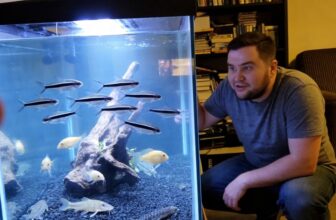
Your pictus catfish needs a 55-gallon tank minimum, with dark sand to protect those sensitive whiskers they use like fingers in murky water. You’ll want three to six fish so they feel brave enough to swim mid-tank instead of hiding.
Feed them sinking pellets each morning, bloodworms twice weekly, and they’ll live about ten years. Keep the water at 75–80 degrees, pH 7.0–7.5, and change 25–30 percent weekly.
Good tank mates include giant danios and rainbow sharks, but skip the aggressive cichlids. Watch for faded barbels or gasping at the surface, which mean trouble.
There’s more to know about keeping these spotted swimmers happy.
At A Glance
- Pictus catfish reach 5 inches in 1–2 years and need 55+ gallons per fish with open swimming space.
- Groups of 3–6 fish exhibit full shoaling behavior, while solitary individuals hide more and show muted colors.
- Ideal tank mates include giant danios, larger platies, and non-aggressive rainbow sharks; avoid African cichlids.
- Feed sinking pellets daily, bloodworms twice weekly, and brine shrimp alternately, with weekly 25–30% water changes.
- With proper care, pictus catfish live up to 10 years; watch for faded barbels, clamped fins, or gasping as health warnings.
What Is a Pictus Catfish and Why Are They Popular?
A long, whiskered fish swims through Amazon waters, and you might wonder what draws so many people to keep it home.
You meet the pictus catfish, *Pimelodus pictus*, a silver-spotted swimmer from the Orinoco and Amazon basins. Its whiskers, called barbels, help it feel its way through murky water, like fingers reaching in the dark.
You notice how aquascape trends have shifted toward recreating these wild riverbeds. Driftwood, smooth stones, and open swimming lanes match what this fish knows.
You see breeding evolution too, as breeders refine healthier stock. You feel curiosity stirring, perhaps peace, watching something so ancient thrive in glass walls you’ve prepared.
Many aquarists find inspiration in low-flow filtration designs when setting up tanks for active swimmers like the pictus catfish, ensuring gentle water movement that won’t stress their energetic nature.
How Big Do Pictus Catfish Get in Home Aquariums?
When you’re picking out a fish at the store, you might hold the bag up to the light and wonder how much growing this little silver flicker has left to do.
Your Pictus catfish, *Pimelodus pictus*, will reach about five inches long when it’s fully grown, which takes roughly one to two years in a healthy home. That’s roughly the length of your middle finger, spread flat.
A fully grown Pictus catfish reaches five inches in one to two years—about the length of your spread middle finger.
The right tank size matters more than you’d think.
- A cramped space stunts growth, like roots hitting glass.
- Long fins need room to unfurl during sharp turns.
- Open swimming corridors prevent nipped barbels.
- Proper aquarium dynamics let this active fish thrive, not merely survive.
A well-designed sump with adjustable baffle chambers helps maintain stable water parameters essential for preventing growth-stunting stress in active swimmers like Pictus catfish.
Spotting Healthy Pictus Catfish at the Pet Store
Walk up to the tank and let your eyes settle on the glass for a full minute before you pick out a fish.
You’re looking for silver bodies with bold black spots, clean edges where one color meets another.
Sick fish show faded coloration patterns, like a washed-out photograph.
Watch how they move.
Healthy pictus catfish dart with purpose, their whiskers twitching.
They shouldn’t hang at the surface gasping, or hide in corners trembling.
Check the tank for dead fish floating, or fluffy white patches on anyone.
Ask when the shipment arrived.
New arrivals carry stress you can’t see yet.
Wait three days, let them settle, then return.
Before bringing your new catfish home, consider testing iron levels weekly in your established tank, as fluctuations above 0.5 ppm can stress sensitive bottom-dwellers.
Pictus Catfish Lifespan: Can Yours Live 10 Years?
Pick up a calendar and flip through ten whole years, that’s how long a pictus catfish can live if you treat it right. Breeding variability affects how long yours might stay with you, since fish from different sources carry different strengths. Aquaculture potential keeps improving, meaning healthier stock reaches your tank. These years together teach patience, like watching a stone smooth in slow water. Maintaining stable water temperature with a reliable controller helps reduce stress that shortens lifespan.
Ten years of patience measured in slow fins and steady water, if you choose each day to care.
- A clean filter humming steady, like a heart that never skips.
- Water tests showing numbers in safe ranges, week after week.
- Food sinking slow, eaten clean, no waste clouding the blue.
- Quiet hiding spots where fins rest without fear.
You choose each day.
Why Your Pictus Catfish Needs at Least 55 Gallons
A ruler held against your aquarium glass shows twelve inches, maybe twenty-four, and that seems plenty until you watch a pictus catfish wake up.
Your water tank must hold fifty-five gallons since this fish darts like a river current made flesh, covering ten tank lengths before breakfast.
Water quality crashes fast in small spaces—these fish excrete ammonia that poisons their home when density gets too high.
Filtration handles the waste, but volume dilutes it first.
Think of your own room: you breathe easier with space to stretch. Your catfish feels that same relief, swimming free.
For a tank of this size, aim for 4‑6 turnovers per hour to maintain pristine water quality as your pictus produces continuous waste.
Build a River-Style Tank: Hiding Spots Plus Open Swimming Space
How does a fish feel safe when it can’t see the far wall? You create river aesthetics that break sightlines while leaving room to bolt.
River aesthetics break sightlines—fish feel secure yet free to bolt when danger looms unseen.
Start with substrate layering: pour dark gravel two inches deep, then stack smooth river stones against one end. Your Pictus lurks beneath, barbels twitching, ready to streak across open water.
- Add driftwood tunnels three inches wide for tight squeezes
- Plant hornwort in back corners, leaving six feet of swimming lane
- Position flat rocks two inches apart for territorial perches
- Keep the center five gallons empty for their sudden darts
You balance hiding and running, so they feel brave enough to pause. Since these active fish need consistent water movement, adding fine bubble aeration through a cylinder or disc air stone helps replicate the oxygen-rich currents of their native streams.
Pictus Catfish Water Parameters: The Exact Conditions They Thrive In
Water holds memory, you know, and your pictus catfish remembers every shift in its tiny world. You’ll want stable conditions—75–80°F, pH 7.0–7.5, hardness 5–15 dH—and frequent testing keeps things honest. Maintaining proper alkaline balance supports their physiological stability, much like how systemic buffering benefits overall pH regulation in other biological systems.
| Parameter | Your Target |
|---|---|
| Temperature | 75–80°F (23–27°C) |
| pH & Hardness | 7.0–7.5, 5–15 dH |
| Water change | Weekly 25–30% |
Your water filtration must be robust, handling their bioload and swift swimming without fatigue. Substrate choice matters too—soft, smooth sand protects their barbels from damage as they root along the bottom. Silent stability, that’s your gift to them.
Are Pictus Catfish Peaceful or Aggressive?
The barbels you protected with soft sand now guide a fish through another question you’ll face when choosing neighbors for your tank. You’ll find your pictus catfish, *Pimelodus pictus*, carries a peaceful temperament beneath that active surface. They’re shy bottom-dwellers who’d rather hide than fight, spending quiet hours in driftwood caves before their quick silver dashes across open water. Their breeding behavior remains mysterious in home aquariums, and stress from poor acclament can turn gentle fish into fin-nipping shadows of themselves. For extended travel, an automatic fish feeder with precise portion control ensures these twilight feeders receive consistent meals without overfeeding risks common to community tanks.
Watch for these compatibility clues:
- Accept similarly-sized tank mates like giant danios or larger platies without chasing
- Ignore fish too small to trigger predatory instincts during twilight feeding
- Flash pectoral spines only when cornered, not as daily aggression
- Form peaceful shoals with conspecifics when given forty extra gallons per friend
Solo vs. Group: How Many Pictus Catfish Should You Keep?
Your second pictus catfish needs room to breathe, and you’re wondering whether one suffices. A single pictus survives, but You’ll notice It hides more, darts less, and carries quiet stress you cannot always see—bre‑solo dynamics at work. Two fish establish simple group hierarchy, yet three to six create fuller shoaling behavior, each fish mirrors others’ movements, confidence grows. Your 55-gallon minimum becomes 95 gallons for a trio, 135 for five. Space costs money, but loneliness costs health.
When temporarily isolating a sick pictus for treatment, consider an acrylic isolation box with suction-cup mounting that provides clear observation without disturbing the main shoal’s dynamics.
| Setup | Behavior You’ll See |
|---|---|
| One pictus | Hiding, sporadic bursts, muted colors |
| Two pictus | Paired shadowing, mild competition |
| Three–four pictus | Clear group hierarchy, active mid-swimming |
| Five–six pictus | Full shoaling, boldest exploration |
What to Feed Your Pictus Catfish (And How Often)
Three rapid blinks below a sunken leaf, that’s how you’ll spot him scouting for dinner.
Your feeding schedule must match his quiet hunger, not your convenience.
He’ll eat whatever sinks, but that doesn’t mean he should.
- Sinking pellets every morning, about what he finishes in two minutes, no more
- Bloodworms twice weekly, frozen-thawed, like finding a beetle under bark
- Brine shrimp on alternating days, small amounts, for color and energy
- One fasting day weekly, his stomach needs rest too
This nutrition frequency keeps him active, not desperate. Watch him hunt. You’ll know when it’s right.
If appetite drops during stress or minor illness, consider Garlic Guard as a smell and taste enhancer to encourage reluctant feeders back to their routine.
Which Fish Actually Get Along With Your Pictus Catfish?
Tank Mates That Get Along With Pictus Catfish
Where do you begin when the wrong neighbor turns your quiet tank into a chase?
You start with size, friend. Your Pictus catfish grows to five inches, fast and gentle, but it’ll snag anything tiny that flutters.
Skip the aggressive crowd—African cichlids, Jack Dempseys, they’ll bully your soft-hearted catfish into hiding. Instead, you pick roommates who match its pace: giant danios zipping mid-tank, rainbow sharks claiming corners, larger platies drifting through hornwort you planted for cover.
Your substrate choice matters too—soft sand protects barbels while breant algae establishes naturally on driftwood, giving shy fish familiar landmarks.
Peace isn’t luck. You build it deliberately, one compatible fin at a time.
Is Your Pictus Catfish Sick? Watch For These Symptoms
Sick Pictus Catfish Symptoms
Since a healthy Pictus catfish moves like a dart through dusk, you’ll notice quickly when something changes.
Watch for these disease signs:
- Faded barbels – those whiskers grow thin or stubby when water flow’s too harsh or your tank holds toxins.
- Clamped fins – your fish hugs its spines tight against its body, like a scared child pulling arms inward.
- White spots – tiny salt-grains peppering fins mean Ich, not breeding triggers.
- Gasping at the surface – gulping air tells you oxygen’s low or ammonia’s climbing fast.
You’ll feel worried, maybe sad, seeing these clues. That’s caring. Test your water today, adjust gently, and remember: noticing early saves lives.
Why Most Breeders Fail With Pictus Catfish
Common Obstacles to Breeding
Breeding Pictus catfish happens far less than you’d hope, and there’s a plain reason you can see coming.
You can’t tell males from females, not without expert examination, so you’ve got **no control over breeding genetics**. That randomness weakens your odds from the start.
Your home aquarium, even a 55-gallon tank, cramps their style. They need open water stretching six feet or more to spawn naturally. Without it, water stress builds, hormones stall, and nothing happens.
Then there’s market demand. Commercial farms flood stores with cheap juveniles, so you’ve got zero incentive to solve these puzzles. Most breeders quit before they begin.
3 Beginner Mistakes That Stress Pictus Catfish
Signs You’re Stressing Your Pictus Catfish
Your 10-gallon tank traps five inches of restless catfish body, so you see frantic behavior, hiding behavior, then stillness that means trouble.
- You skip tank cycling, dumping fish into ammonia-filled water that burns their whiskers and gills.
- You blast lighting without plant selection for shade, so they perch under filters, never resting.
- You choose sharp gravel substrate over soft sand, tearing their barbels with every search.
- You rush acclimation, skip filtration checks, and miss stress signs like faded colors and gulping at the surface.
Frequently Asked Questions
Do Pictus Catfish Have Venomous Spines?
No, they don’t possess venomous spines, but you’ll find their sharp pectoral fins serve as effective defensive mechanisms that can pierce skin and cause painful wounds if mishandled or if tank mates stray too close.
Why Do My Pictus Catfish Glass Surf at Night?
Your pictus catfish glass surf at night since they’re displaying natural nocturnal feeding behavior and increased surface activity when the tank’s dark and quiet. Check you’re feeding enough sinking food after lights-out and guarantee water parameters stay stable.
Can Pictus Catfish Live With Shrimp and Snails?
Your pictus catfish will prey on small shrimp, so shrimp compatibility is poor; nevertheless, snail safety is typically acceptable since adult snails are too large for them to eat. You’ll need larger tank mates.
Do Pictus Catfish Change Color When Stressed?
Yes, you’ll notice a color response when they’re stressed, often appearing paler. You’ll reduce stress by limiting aggression through proper tank mates, providing diet variation, and avoiding the stress of breeding behavior in small setups.
Are Albino Pictus Catfish Different Species or Variants?
You’ll find albino pictus catfish aren’t a separate species classification; they’re simply color variants caused by albino genetics. Both standard and albino types share the same scientific name, *Pimelodus pictus*, differing only in pigmentation.
Rounding Up
Your aquarium water, clear and steady, holds the promise of a good home for a Pictus catfish. You have learned their five-inch bodies need fifty-five gallons to roam, their whiskers sense the world like fingers in the dark. You know now which fish become friends, and which bring harm. Keep their water clean, their bellies full, and you will watch them dash and glimmer for eight, maybe ten years. That quiet pride you feel when they thrive, that warmth of care repaid, it is worth every careful step you take.