You can keep 3–4 guppies in a 10‑gallon tank, maybe five if you’re diligent, but six is pushing your luck.
That hang‑on‑back filter swallows roughly two gallons, your heater another, so you’re already cramped.
Stick to a 1:2 male‑to‑female ratio—one boy, two girls—or go single‑gender and skip the monthly fry explosion.
Female guppies store sperm like tiny biological USB drives, dropping batches of 20–50 babies for six months straight.
Watch for gasping, algae blooms, or nitrate spikes; those are your red flags.
Weekly 25% water changes, live plants, and a 50‑watt heater keep things stable without breaking the bank.
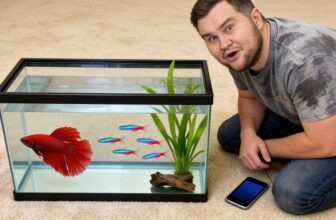
Skip the betta roommate—they’ll shred those fancy tails faster than you can say “impulse purchase.”
There’s more nuance below if you’re still tempted to bend these rules.
At A Glance
- Stock 5–6 guppies maximum, or 3–4 for beginners, to prevent overcrowding and water quality crashes.
- Maintain a 1:2 or 1:3 male-to-female ratio to reduce aggression and uncontrolled breeding.
- Account for equipment like filters and heaters reducing usable swimming space in the tank.
- Perform weekly 25% water changes, increasing to 30% with six guppies to maintain water quality.
- Consider single-gender tanks or fry management plans to avoid population explosions from monthly breeding.
How Many Guppies in a 10-Gallon Tank? The Direct Answer
So how many guppies can you actually squeeze into a 10‑gallon tank before things go sideways? Five or six, max.
Start with three or four if you’re new—nobody’s judging, we’ve all nuked a tank before.
Every beginner nukes a tank eventually—start small, learn fast.
You’ll need decent aquarium lighting for your plants, and you’ll absolutely need water cycling finished before adding fish. No shortcuts.
- 5–6 guppies max for a 10‑gallon
- Beginners stick to 3–4
- Filter and heater steal space, plan accordingly
Keep males to females at 1:2, minimum three guppies total. Smaller groups feel lonely, larger groups crash your water. Simple math, messy reality. Regular testing of ammonia, nitrite, and nitrate every 7 days prevents toxic buildup that damages gills and stresses fish.
Why the “One Gallon Per Inch” Rule Fails for Guppies
The “one gallon per inch” rule sounds tidy on paper, but guppies make it fall apart fast. You count your 1.5‑inch adults, do the math, and suddenly you’re cramming six or seven into your fish tank. Then reality hits.
Your filter and heater steal precious gallons. Plants, gravel, decorations—more gone. That “10 gallons” shrinks fast, and your water chemistry turns rebellious. Ammonia spikes, nitrates climb, and your “perfect” math means sick fish.
- Active swimmers need horizontal space, not just volume
- Waste production outpaces small filtration capacity
- Fry appear constantly, breaking your count entirely
- Stable parameters demand buffer room you’ll never have
Skip the calculator. Stock lighter, test often, breathe easier.
Female guppy gestation lasts 21‑30 days, varying with temperature and stress, so your population can explode before you notice.
Male vs. Female Guppies: How Gender Affects Stocking
Since guppies multiply like gossip at a family reunion, you can’t just toss any mix of males and females in your tank and hope for peace. Nail your gender ratio: stick to one male per two, or even three, females. Anything tighter spells trouble.
You’ll want solid water flow—nothing hurricane-force, just enough to distribute heat evenly for temperature stability around 76-80°F. Pair that with consistent lighting cycles, roughly 8-10 hours daily, or your fish stress out and your plants sulk. Mess this up, and you’re running a guppy daycare with zero exits.
Bottom line: single-gender tank, or that 2:1 ratio. Your filter—and your sanity—will thank you. Avoid placing guppies with large-mouth species like bettas or cichlids, as they will view the guppies as prey.
The Danger of Keeping Two Male Guppies Together
If you’re thinking two male guppies sounds like a reasonable starting point, you’re about to graduate from rookie mistake, class of whatever year this is.
Two males in ten gallons? That’s a recipe for misery, my friend.
Two males in ten gallons? That’s a recipe for misery, my friend.
You’ll witness:
- Endless aggression cycles where dominance shifts hourly
- Territorial disputes over every plant, rock, and water molecule
- Fin-nipping that’d make a barber wince
- Stress hormones poisoning your water faster than you can test it
Guppies aren’t bettas, indeed, but males pack serious attitude. They’re basically tiny frat boys with fins, and your tank becomes their cramped studio apartment. No one thrives there.
Bottom line? Skip the double-dude disaster.
This behavior is similar to how Tiger Barbs require a group of six or more to reduce their own fin-nipping tendencies.
Equipment That Steals Your 10 Gallons: Filters and Heaters
Let’s quit obsessing over fish drama and talk hardware, since your filter and heater are quietly robbing you of precious swimming room.
That bulky hang-on-back filter heater? It’s eating two gallons easy, and your sub heater’s space usage tucks another gallon into the corner.
You’re left with maybe seven gallons of actual water—filter heater capacity loss is real, friend.
Skip the oversized biofilter designed for forty-gallon tanks; you’re just burning money on heater power consumption and filter heater noise level hum.
A slim internal filter with gentle water flow handles your bioload without the racket.
Heater temperature spikes kill guppies fast, so grab one with a reliable thermostat—spend fifteen bucks, not fifty.
Filter heater placement matters more than you’d think. Hide it behind plants, indeed, but don’t block intake or you’ll face filter heater clogging headaches by Tuesday.
Heater overheating happens when you ignore filter heater maintenance; rinse your sponge monthly or watch your temperature drift into the danger zone.
Heater energy cost adds up, especially with poor filter heater efficiency. A low-wattage heater power draw—fifty watts max—keeps bills sane.
Heater safety first though: unplug during water changes or rethink your life choices.
Bottom line? A compact filter heater upgrade saves space, cash, and fish lives.
Consider a model like the NICREW Slim for its whisper‑quiet 3W motor and under‑10‑inch footprint.
Why Every 10-Gallon Guppy Tank Needs Live Plants
You can stuff your tank with plastic castles and neon gravel, absolutely, but live plants are the real MVP here—they work during your sleep, and you don’t even have to pay them overtime. In a cramped 10-gallon, every advantage counts, and greenery delivers where gadgets can’t.
Live plants are the real MVP—they work during your sleep, and you don’t even have to pay them overtime.
- Plant filtration scrubs ammonia and nitrites, letting your filter breathe easier
- Nitrate cycling keeps those end-stage nasties in check, so your water stays crystal
- Fry hideouts boost survival rates, since guppies breed like it’s their job
- Stress drops when fish duck into foliage instead of pacing glass
Skip the fake ferns. Your guppies—and your sanity—will thank you.
Budget-friendly green plastic plants can still provide foliage cover for fry and shy fish in a 10-gallon community tank.
How Many Water Changes for a Stocked 10-Gallon?
Live plants bought you some breathing room, but they’re not a free pass to skip the siphon hose.
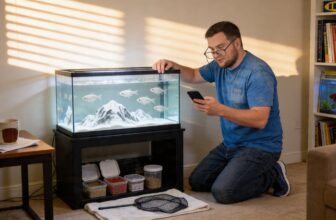
You’re changing 25% weekly, minimum. Maybe 30% if you’re pushing six guppies. Your filter filtration handles the grunt work, certainly, but in ten gallons? Waste piles up fast. For a reliable start, consider a model like the Laifoo Siphon Vacuum with its pinch‑ball activation for instant flow control. No elevator pitch here—test your water cycling parameters weekly with a $15 API kit. Ammonia reads above zero? You’re behind schedule.
- Skipping changes = nitrate soup, fin rot, funeral planning.
- Clean gravel, don’t just top-off evaporated water—that concentrates toxins.
Bottom line: weekly siphoning keeps your squad alive. Neglect it, and you’re just keeping plants damp.
7 Warning Signs Your 10-Gallon Is Overcrowded
How quickly does a 10-gallon turn from cozy apartment to clown car? Faster than you’d think, friend. Overcrowding sneaks up, and suddenly you’re hosting a watery house party nobody RSVP’d for.
Watch for these red flags:
- Algae blooms turning your tank into a green smoothie
- Temperature spikes frying fins since your heater can’t keep up
- Nitrate spikes from waste that your filter’s crying about
- Fish gasping at the surface, like you after climbing three flights of stairs
Your guppies deserve breathing room, not a rush-hour subway car. Scale back before you’re scraping algae at midnight—again. A gentle bubble flow from a dense foam sponge filter can minimize stress on sensitive fry while maintaining clear water.
How 3 Guppies Become 30: Breeding Realities in Small Tanks
Overcrowding doesn’t always arrive with fanfare—sometimes it hitchhikes in on the back of a pregnant female you didn’t know you had.
Welcome to guppy math, where three becomes thirty faster than you’d think. Breppy growth turns your modest trio into a lively colony, and fry mortality—baby guppy death rate—climbs when space vanishes.
| Batch Size | Monthly Impact | Tank Reality |
|---|---|---|
| 20-50 fry | Population doubles | Filter overload |
| 6-8 survivors | Still overcrowds | Water crashes |
| Repeat monthly | You’re doomed | Emergency intervention |
That “starter trio”? They’re prolific livebearers. Females store sperm, dropping fry monthly for half a year. Suddenly you’re the neighborhood fish guy, offloading bags at the local shop—if you’re lucky. In a cramped tank, poor water quality shortens lifespan, similar to tomatoes wilting on hot concrete.
Skip the chaos: run single-gender tanks, or accept you’ll need that fry tank sooner than planned.
When You Need a Separate Fry Tank (And How to Set It Up)
Sooner than you’d hoped, you’ll find yourself staring at a tank full of impossibly tiny copies of your original fish, each one expecting room service and clean water on a budget you didn’t plan for.
A fry tank becomes vital, not optional, when your main tank can’t handle the load.
Here’s your rapid-response breeding tank setup:
- Use a 10-gallon minimum with sponge filter (gentle, no fry casualties)
- Keep water temperature monitoring constant at 78-80°F (a cheap heater prevents disaster)
- Add java moss or guppy grass—cheap cover, happy babies
- Perform daily 25% water changes; fry tolerate zero ammonia
Move fast, or you’ll watch your tank crash.
Fry development begins with yolk sac sustenance for the first two days, transitioning to infusoria on day three.
Single-Gender Guppy Tanks: Skip the Population Explosion
Why keep a tank that’s basically a fish soap opera on constant repeat? You’ll dodge the drama—and endless fry—by choosing one gender.
Five or six males flash their colors without turning your 10‑gallon into a nursery.
You’ll still nail your temperatureal pH (aim for 7.0–7.8, it’s just fancy talk for water chemistry) and stick to a consistent lighting schedule, 8–10 hours daily, so algae doesn’t crash the party.
- No surprise babies eating your filter space
- Easier water quality, fewer emergency changes
- All that personality, zero population math
Pick your team, commit to the routine, and actually enjoy keeping fish instead of running a maternity ward.
Tank Mates That Fit in a 10-Gallon With Your Guppies
Adding tank mates to a 10-gallon guppy tank is a bit like inviting extra passengers into a compact car—technically possible, but you’ll feel every inch of missing space.
You’ll need to drop your guppy count to 2-3, period.
Your substrate choice matters here: dark gravel keeps shy bottom-dwellers visible, sand suits Corydoras cats perfectly. Dim your tank lighting; bright LEDs stress cryptic species like shrimp.
Consider these compact companions:
- Cherry shrimp – tiny, peaceful, they’ll clean while you watch
- Nerite snails – algae-eating machines, zero attitude
- Pygmy Corydoras – schooling bottom cleaners, absolutely adorable
- Ember tetras – small, calm, they won’t nip fins
Skip mollies, swordtails, anything over two inches. You’re building a Tiny Fish Club, not a crowded subway.
Why You Can’t Keep Bettas With Guppies in 10 Gallons
Since a 10-gallon tank leaves nowhere to hide, you’re gambling with fish lives when you mix bettas and guppies. Betta aggression turns that cramped tank into a death match, and you’re the ref who can’t stop it.
A 10-gallon tank forces bettas and guppies into a death match you can’t referee.
Here’s why it fails:
- Betta aggression spikes in tight quarters—your guppies’ flowing fins look like rival males waving red flags
- Water temperature needs clash: bettas want 78-80°F, guppies tolerate 72-78°F—someone’s always uncomfortable
- No room to establish separate territories means constant stress, fin-nipping, and casualties
Skip this combo entirely. You’ll save money on replacement fish and therapy for your guilt.
Fatal Stocking Mistakes Beginners Make in 10-Gallon Tanks
When you’re staring at that empty 10-gallon tank, the temptation to fill it fast hits like a sugar rush—except this impulse buy can turn your fish room into a graveyard. You’re not alone in this, we’ve all been there, but let’s stop the body count before it starts.
- You ignore that filter filtration capacity, stuffing ten guppies into a space rated for five, then wonder why your ammonia spikes like a bad stock market day.
- You mess up your lighting cycle, leaving lights blazing 24/7 so algae turns your water into green soup, oxygen plummets, and your fish gasp at the surface like bad actors in a B-movie.
- You skip the male-to-female ratio entirely, dumping in whatever’s cheapest, then watch males harass females to death while you Google “why are my guppies dying” at 2 AM.
- You add “just one more” tank mate, since that corydoras looked lonely, not realizing you’ve breached the tipping point where waste outpaces your bacteria colony’s appetite.
Test weekly, change water religiously, respect the one-gallon-per-inch rule, and maybe, just maybe, you’ll join the ranks of guppy keepers who don’t flush their failures.
Frequently Asked Questions
Can Guppies Live in a 10-Gallon Without a Filter?
No, you shouldn’t keep guppies in a 10‑gallon without a filter—they’ll suffer from toxic ammonia buildup faster than you’d think, and your filterer maintenance routine becomes a nightmare of daily water changes just to keep them alive.
- Community dynamics collapse without filtration—waste accumulates, bacteria colonies can’t establish, and your fish turn sluggish, then sick.
- Guppies are messy for their size, producing more waste than you’d expect from little 1.5‑inch bodies.
- Plants help, but they won’t replace a $25‑40 hang‑on‑back filter processing 100+ gallons per hour.
You’ll spend triple the effort on a filterless setup, and your fish still won’t thrive—just grab a basic filter, run it baffled if flow’s too strong, and let your guppies actually belong somewhere stable.
Bottom line: Skip the experiment. Filtered tank, happy guppies, zero regret.
How Long Do Guppies Live in a 10-Gallon Tank?
You’ll typically see your guppies clock 1–2 years, though push 3 if you’re diligent.
Tank capacity directly shapes guppy lifespan—overcrowding a 10‑gallon accelerates illness, whereas stable water stretches their time. Stick to 5–6 adults max, test weekly, and change water religiously.
Live plants help, too.
Bottom line: your fish won’t magically live longer in cramped quarters, but with care, you’ll get a solid run.
What Temperature Should a 10-Gallon Guppy Tank Be?
- Temperature stability matters more than hitting exact numbers; swings stress them out worse than a Monday morning.
- Pair that with a pH range of 6.8–7.8—think of pH as your water’s “mood,” where 7 is neutral, below is acidic, above is basic.
Grab a reliable heater ($15–$25) and test weekly. Your guppies’ll thank you—or at least stop sulking in the corners.
Do Guppies Need a Bubbler or Air Stone?
You don’t strictly need one, though you’d think otherwise watching fish gasp at the surface.
Air stones help, certainly. They boost surface agitation, which is one oxygenation method among many. Your filter’s outflow already does this job, creating bubble-driven water movement.
But here’s the thing: in a planted 10-gallon, oxygenubbler benefits include backup aeration during hot spells or power outages, when dissolved oxygen crashes fast and your guppies pay the price.
Cheap insurance, indeed.
Can I Keep Different Guppy Strains Together in 10 Gallons?
Yes, you can keep different guppy strains together, but you’ll lose control of strainppy color genetics pretty fast.
In a 10-gallon tank, guppy breeding ratios become chaotic—females store sperm, so even one male means surprise fry with muddled patterns.
Stick to single-sex groups, or accept that your “designer” project turns into a participation trophy situation.
It’s fine if you’re casual, just don’t expect show-quality results.
Rounding Up
Stick to five or six guppies, max—your tank’s not a clown car. Remember, “an ounce of prevention beats a pound of cure,” so under-stock, over-filter, and let plants do the heavy lifting. Skip the impulse buys, test your water weekly ($15 kit, worth every penny), and don’t play matchmaker provided you’ve got a plan for fifty fry. Your future self, the one not doing emergency water changes at 2 a.m., will thank you.