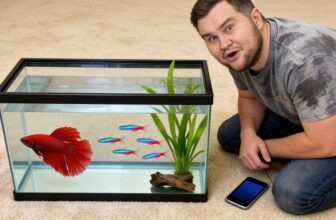
Tetras range from penny-sized embers glowing candle-orange in planted 10-gallons to cardinals whose full-body red stripe outshines their neon cousins, and they’ve got needs that vary—soft, tea-stained water for electric stripes, hard water tolerance for bloodfin toughness.
You’ll find tight-schooling rummy-noses, lone-wolf personalities in some lines, and Congos that’ll laugh at your nano tank ambitions.
Fifteen distinct species means fifteen different water chemistry puzzles, temperature sweet spots, and schooling minimums to respect.
Keep scrolling—there’s a tetra for every tank, and probably one that’s already outsmarted your setup.
At A Glance
- Tetras thrive in specific water conditions: soft, acidic water for most species, with temperatures ranging 64–84°F depending on type.
- Schooling behavior is essential; groups of six to ten or more reduce stress and enhance natural color displays.
- Dark substrates, dense planting, and dim lighting intensify tetra coloration, particularly for Ember, Black Neon, and Flame Tetras.
- Distinctive color patterns vary widely, from uniform amber-orange (Ember) to full-body red stripes (Cardinal) to iridescent racing stripes (Black Neon).
- Minimum tank sizes range from 10 gallons for smaller species to 20–30 gallons for active swimmers like Lemon and Emperor Tetras.
Ember Tetra: Orange Glow for Nano Tanks
Though small tanks often feel like an afterthought in the aquarium world, the Ember Tetra turns that notion on its head with a color payoff that’d make larger fish jealous. We’re talking uniform amber-orange, like someone lit a candle inside each fish.
Live candles swimming through your tank—Ember Tetras prove size never limits brilliance.
Now, for water parameters, they’re not divas—73-84°F, neutral pH, soft-to-medium hardness. They’ll roll with it.
Your nano tank setup needs:
- A group of 8+ (they’re shoalers, not loners)
- Gentle filtration
- Plants for confidence
I mean, they’re beginner-friendly, but skittish without cover. Dark substrate makes them pop. Ten gallons minimum, though bigger schools need more space.
They’re the small-tank community everyone wants in on.
When selecting equipment for these compact setups, a 2‑gallon Smart Aquarium Kit offers features like gentle triple‑filtration and color‑adjustable LED lighting that complement the Ember Tetra’s needs without overwhelming their delicate fins.
Neon Tetra: The Blue-Red Classic Everyone Recognizes
When you walk into any pet store, the Neon Tetra‘s probably the first fish you see, and there’s a reason for that—it’s the blue-red classic everyone recognizes, the one that launched a thousand aquariums.
Now, here’s what makes them click:
- That stripe ain’t paint—coloration genetics give that neon-blue its electric punch, red below finishing the look.
- Middle-water nomads—their trophic habitat keeps them cruising between surface and bottom, never lonely, always shoaling.
- Soft water, warm heart—pH 5.5-7.0, basically comfort zone for beginners who want cred.
- Small tank, big personality—10-20 gallons, though they’d thank you for more friends.
I mean, everyone’s got ’em, but no one’s tired of ’em.
A well-designed sump baffle system—similar to those used in advanced reef setups with adjustable chambers and noise-reducing components—can help maintain the stable water parameters these sensitive fish require by ensuring gentle, turbulence-free filtration.
Green Neon Tetra: More Color, Less Common Than Its Cousin
Neon Tetras get all the glory, crowded into every pet store tank and plastered across aquarium starter kits, but their quieter cousin’s been swimming circles around them in the color department. The Green Neon Tetra packs a more vivid, almost electric blue stripe, and that namesake green background gives tropical variations a richer, more saturated look than the standard model.
They’re compact—barely an inch—and peaceful enough for any community setup, though they won’t put up with rowdy tank mates.
Breeding challenges exist. Water chemistry’s picky, and fry survival rates stay frustratingly low.
Worth it though.
Neon or Cardinal: How to Tell These Look-Alikes Apart
Key Differences Between Neon and Cardinal Tetras
Why do so many aquarists swear they’ve got Cardinals when they’re actually squinting at Neons? Tetra identification trips up even seasoned hobbyists, so here’s color differentiation that’ll stick:
- Stripe length — Cardinal red runs the full body, gills to tail; Neon red stops mid-body, like it’s shy.
- Blue intensity — Cardinals glow deeper, almost electric; Neons flash brighter but thinner.
- Size check — Cardinals stretch slightly longer, roughly two inches versus Neons’ inch-and-a-half.
- Price tag — Cardinals cost more, usually; if it’s cheap, it’s probably Neon.
Now you’re in the know, not the confused.
Cardinal Tetra: Fuller Red Stripe for Planted Tanks
Even though the Cardinal Tetra carries a price premium that makes hobbyists wince at the register, that uninterrupted scarlet ribbon running from gill to tailfin justifies every extra penny in a planted tank. For the ideal substrate to showcase their brilliant coloration, consider natural-mineral dark sand that provides high contrast without dyes.
| Feature | Specification | Why It Matters |
|---|---|---|
| Adult Size | ~2 inches | Needs space, but rewards with presence |
| Red stripe | Full body length | Not partial like its Neon cousin |
| Lighting | Low to moderate | Brings out blue and red without stress |
| Group Size | 8+ individuals | They’ll belong, and you’ll belong watching them |
| Tank Size | 10-20 gallons | Manageable, though bigger’s always better |
Now, here’s the thing: that red stripe glows under proper lighting, sure, but dimmer setups actually deepen the red. I mean, we’re talking mood lighting for fish—who knew? They’re intermediate-level fish, mostly because they demand stable parameters and won’t forgive sloppy water changes. But get it right, and you’ve got a living ribbon weaving through stems and moss.
They shoal tight, these Cardinals, so you’ll want enough plants to break sightlines without blocking their swimming lanes. Driftwood, tannins, soft substrates—it’s Amazon blackwater cosplay, and they’re here for it. Feed small, often, varied. They’ll thrive, you’ll watch, everyone’s included.
Black Neon Tetra: Two Stripes and Blackwater Heritage
If you’re looking for a tetra that keeps things simple without being boring, the Black Neon Tetra delivers—two iridescent stripes running lengthwise down a black-green body, like racing stripes on a very small, very wet sports car.
Native to blackwater habitats where tannins stain everything tea-brown, they’ve adapted to softer, slightly acidic conditions. Now, water chemistry matters here—think pH 5.0-7.5, warm temperatures, and gentle filtration that won’t blast them around.
Their breeding behavior? Scatterers, mostly, though they’ll need those same soft, acidic parameters to trigger the urge.
Quick wins for your setup:
- Dark substrate brings out those racing stripes—trust us, it’s worth it.
- Leaf litter mimics home, releases tannins they’ll actually appreciate.
- Keep them in groups of six or more; they’re shy otherwise.
- Avoid bright lights—they’re not sunbathers, these ones.
Maintaining stable water temperatures between 75-80°F (24-27°C) is crucial for their health, so consider using a digital float thermometer with suction-cup mounting for accurate, continuous monitoring.
Serpae Tetra: Fiery Reds When Fed Protein-Rich Foods
Although they’re often sold as beginner fish, Serpae Tetras really come alive—almost literally—when you dial in their diet, particularly protein-rich foods that turn their reddish-brown bodies into something approaching properly fiery.
Now, here’s the thing about their breeding habits: they’re not impossible, but they’re finicky. They need soft water, dim light, and some privacy. I mean, wouldn’t you?
A protein-rich diet doesn’t just color them up—it primes them for spawning.
| Diet Type | Color Result |
|---|---|
| Flake only | Dull, washed-out |
| Frozen bloodworms | Decent red |
| Live brine shrimp | Properly fiery |
Keep them in groups, obviously. They’re shoalers, not loners.
For aquarists planning extended travel, USB rechargeable feeders with months-long battery runtime ensure your Serpae Tetras receive consistent protein-rich portions even while you’re away.
Flame Tetra: Brazilian Fire Colors in Slow Water
Serpae Tetras fire up with protein, undoubtedly, but let’s talk about a cousin who brings the heat without the dietary drama—the Flame Tetra.
Now, this Brazilian native shows up in coastal rivers where water moves like honey, slow and thick with tannins. That’s the Flame Tetra habitat, and replicating it isn’t rocket surgery: fine sand, dense plants, maybe some driftwood for ambience. Maintaining stable water temperature is crucial for these sensitive fish, so consider using a digital temperature controller to prevent harmful fluctuations that could stress your school.
- Tank size: 10 gallons minimum, though they’ll thank you for more swimming room.
- Water: Soft, acidic, dimly lit—think rainforest floor at noon.
- Schooling: Keep six or more; they’re tight-knit fish.
- Flame Tetra breeding: Scatter eggs among plants, remove adults after spawning.
I mean, they’re beginner-friendly, colorful, and low-drama. What’s not to love?
Lemon Tetra: Yellow Spots and Peaceful Temperament
Now, picture someone dumped a handful of lemon drops into your tank—not quite, but close. The Lemon Tetra brings exactly that vibe, with its shiny silver body and vivid yellow spots dotting head, tail, and fins, plus eyes that glow bright red like it’s perpetually surprised.
These little charmers, maybe 1.5 inches, want company—six minimum, ten’s better. Tetra tank setup? 20 gallons, 68–82°F, slightly acidic water they forgive if you’re close enough. Plants help everyone feel at home.
Lemon Tetra breeding? Scatter eggs, remove parents after, keep water soft. They’re beginners for a reason, though fry need tiny foods.
To keep their planted environment thriving, consider using a copper-free gel formula that provides essential nutrients without harming these sensitive fish.
Diamond Tetra: Rainbow Shimmer From Lake Valencia
Moving past those bright lemon drops, let’s wander into something a little more refined, something that catches light like a prism in a sunbeam. The Diamond Tetra hails from Lake Valencia habitat waters in Venezuela, where submerged plants and gentle currents sculpt its legendary iridescent coloration.
Prisms in fish form, flashing green, gold, blue—where light becomes living art.
- Catching sideways light, their scales flash green, gold, blue—pick a color, they’ve got it
- Long, see-through fins catch drift like silk scarves in a breeze
- Feed them frozen brine shrimp or bloodworms and watch the rainbow intensify
- They’re social creatures, so you’ll want six or more; anything less feels lonely, and lonely fish dull their shine
To truly make their iridescent scales pop, consider using an aquarium light riser that spreads illumination evenly and eliminates dim corners where these shimmering fish might hide their colors.
Emperor Tetra: Purple Depths in Dim Light
Now, these aren’t exactly starter kit fish, though they’re close. Think beginner-intermediate, around 1.5-2 inches, wanting 20-30 gallons with plants to hide in, since they’ll use them.
Schools of six-plus keep the peace, and they’ll reward you with movement that feels, well, intentional.
Keep water typical tropical—warm, neutral, clean—and they’ll do their part.
Dark substrate helps. Floating plants help more.
There’s no Bloodfin here; that’s coming. For now, just trust the shadows.
If you’re planting heavily for these fish, consider adding slow-release root tabs deep in the substrate to feed your aquatic plants and maintain that shadowy planted environment they prefer.
Bloodfin Tetra: Hardiness From the Paraná River Basin
As the Emperor Tetra asks for shadowy complexity, the Bloodfin Tetra arrives with fewer demands and just as much payoff—silver bodies flashing under your lights, indeed, but it’s that tail that hooks you.
- Paraná water parameters stay forgiving: think 64–82°F, pH 6.0–8.0, and they’re not fussy about softness.
- Diet specialization? They’re not picky—flakes, small live foods, maybe some brine shrimp, and they’ll thrive.
- That blood-red tail fin pops best against dark gravel and planted corners.
- Gather six or more; they shoal loosely but appreciate company, and you’ll feel like you’ve joined their club.
- Java Fern works beautifully in their tank, offering soft fronds that won’t snag those delicate fins while thriving under the same low-to-moderate light conditions Bloodfins prefer.
Rummy Nose Tetra: Tight Schools and Red-Head Alerts
Tight Schools and Red-Head Alerts
Why settle for scattered fish when you could have synchronized swimmers? The Rummy Nose Tetra delivers. I mean, that entire head—bright red like a living stop sign—tells you everything about tank conditions.
Now, here’s the deal:
- Keep six or more, obviously
- Watch the red fade—that’s schoolhead stress talking
- Use diet enrichment (bloodworms, quality flakes) to keep color crisp
These fish school tighter than almost anything in your local shop, silver bodies striped black-and-white, moving as one organism across the middle water column. At roughly 2.5 inches, intermediate care, they’re worth the 20-gallon minimum.
Peaceful. Predictable. Perfect company.
Black Skirt Tetra: Long Fins for Mid-Size Communities
Long Fins for Mid-Size Communities
You’ve probably seen them gliding through pet store tanks like aquatic ballerinas in mourning, and that’s exactly what the Black Skirt Tetra brings to a community setup—elegant drama without the attitude.
Now, here’s your brevet for building connection with these fish:
Your brevet for connection starts here: habitat, schools, and South American river vibes.
- Habitat matters—plant dense corners, give them South American river vibes with warm, soft water.
- Coloration size combo hits different: that gray-silver body with twin black stripes? Striking against green backdrops.
- They’ll hit about 3 inches, so 15-20 gallons keeps everyone comfortable.
- Groups of 5+—these aren’t solo artists, they’re an ensemble cast.
Congo Tetra: Size and Color for 30-Gallon+ Setups
Size and Color for 30-Gallon+ Setups
When the light hits just right, a Congo Tetra doesn’t just swim—it throws a private light show for anyone paying attention, half its body flashing electric blue whereas gold, violet, and orange accents ripple through those long, flowing fins like someone spilled a jewelry box into your tank.
Now, these guys need space. At three-plus inches, six together minimum, you’re looking at thirty gallons, easy. I mean, they cruise. They’ll graze algae off leaves—nice bonus for algae control—though they’ll nibble those same leaves, so maybe not your prize swords.
Warm tropical habitat, around 76°F, keeps their colors popping. Soft water, neutral pH, they’re not demanding exactly, but they want what they want. Group them, watch them shimmer, feel like you’ve joined something. You have.
Frequently Asked Questions
Can Different Tetra Species School Together?
Yes, different tetra species can school together, though mixed school compatibility varies by temperament and size.
Mixed species socialization works best with peaceful types—neons, cardinals, embers—sharing similar water needs. They’ll loosely shoal, not true school, which is fine.
Avoid pairing nippy serpaes or buenos aires with long-finned neighbors. Groups of 6+ per species reduce stress, create that lively community tank vibe everyone’s after.
Do Tetras Need Air Stones or Extra Circulation?
Most tetras don’t strictly need air stones in a well-balanced tropical tank, though they appreciate gentle water movement. Your filtration choice matters more—canister or hang-on-back filters usually provide adequate oxygen exchange through surface agitation.
Now, some tetras hail from slow, murky waters, so blasting them with currents stresses them out. It’s about reading the room, or tank, really. Add an air stone if your stock runs high, temperatures creep up, or your filter’s more of a whisper than a wave. I mean, better safe than sorry, but don’t overthink it. Test, observe, adjust.
What’s the Lifespan of Most Tetra Species?
Most tetra species live three to five years with decent care, though some—like Neons—burn bright and fast, maybe three if you’re lucky.
Others, say Black Skirts or Congos, stretch toward five, even seven, when water’s clean and stress stays low.
The tetra lifespan isn’t a promise, it’s a negotiation.
Average longevity swings wildly with tank size, diet variety, and whether you’ve got the patience for weekly water changes.
Now, genetics play their part too—some fish arrive already halfway done.
Here’s the blunt truth: three years of healthy, colorful schooling beats six years of dull survival.
Aim for thriving, not just living.
Will Tetras Eat Shrimp or Other Invertebrates?
Most tetras won’t actively hunt healthy adult shrimp, though shrimp predation happens with small or molting individuals.
Their invertebrate diet leans opportunistic— they’ll snatch baby shrimp, dead ones, maybe a sluggish snail. It’s not malice, it’s buffet logic.
Now, larger tetras (Congos, Buenos Aires types) pose bigger threats. They’ll test a shrimp’s hustle.
Keep shrimp in planted tanks with cover, and everyone’s odds improve. It’s about managing risk, not guarantees.
How Many Tetras Fit per Gallon of Water?
Tetra tank size depends on the species, but here’s the rough math: one gallon per inch of fish, though that’s optimistic, honestly.
- Neon tetras, ember tetras: 10 gallons for 6 fish, so roughly 1.5 tetras per gallon
- Black skirt tetras, bloodfin tetras: 20 gallons for 6-8 fish, closer to 1 per gallon
- Congo tetras: 30 gallons minimum for 6; they need space, they’re fancy
Now, tetra feeding habits factor in—more food, more waste, more water needed. I mean, you can’t cheat biology.
Break the rule, and they’ll stress, nip fins, sulk. Nobody wants sulking fish.