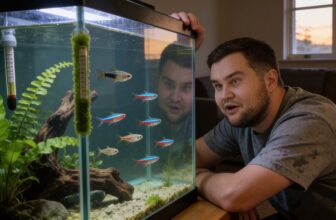
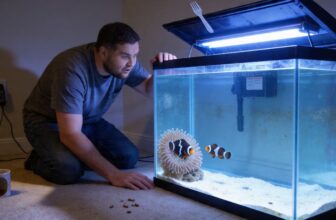
You’ll need at least a 20‑gallon tank for a single ram, though that compact 5‑gallon desktop setup? It’s strictly for quarantine or a breeding pair, not long‑term living.
Keep water at 78‑85°F, pH 6.0‑7.5, with zero ammonia and nitrite—soft, acidic water isn’t optional, it’s critical.
Use fine sand substrate, add live plants like Anubias or Java fern, and stick with peaceful tank mates like neon tetras or corydoras.
Feed high‑quality omnivore flakes daily with frozen brine shrimp or bloodworms for variety, but never overfeed—they lose interest fast.
For breeding, bump the temperature to 84°F, provide flat stones and Indian almond leaves, then keep water pristine; eggs hatch in 24‑48 hours.
Skip aggressive cichlids or bettas to avoid fin‑nipping drama.
Water quality is your ram’s biggest threat—test weekly, change 25‑30% each week, and quarantine new fish to prevent ich or flatworms.
The bottom line: stable parameters and a calm setup make for a bold, healthy fish.
There’s more to mastering this than just the basics.
At A Glance
- Provide a 20‑gallon tank minimum for one ram or a bonded pair.
- Maintain water temperature 78‑85 °F and pH 6.0‑7.5 for health.
- Feed an omnivore diet with brine shrimp, bloodworms, and blanched vegetables.
- Breed at 84 °F using flat stones and Indian almond leaves for spawning.
- Keep ammonia and nitrite at zero; perform weekly 25‑30% water changes.
Choose the Exact Tank Your Ram Cichlid Needs
So, what size tank should you actually buy for your ram cichlid?
Don’t panic—here’s the short answer: a 20‑gallon (75‑L) minimum for a single or a bonded pair.
Don’t panic—here’s the short answer: a 20‑gallon minimum for a single or bonded pair.
If you’re dreaming of a community setup with dither fish, jump to 30 gallons (114‑L).
Trust me, skipping this step means you’re fighting ammonia spikes and stressed fish.
Rams hate cramped, dirty water. You want them thriving, not surviving.
Go bigger if you can—they’ll repay you with bolder colors and calmer behavior.
Bottom line: 20 for a pair, 30 for community.
You’ve got this.
For those seeking a desktop breeding or quarantine tank, consider a compact option like the Vimvins 5‑Gallon frameless tank for its quiet filtration and adjustable lighting.
Alternatively, for a ram cichlid pair, a standard 10-gallon glass aquarium with a self-cleaning filter can serve as a dedicated breeding tank.
Set the Perfect Ram Cichlid Water Parameters
Now that you’ve got the tank size sorted, let’s dial in the water parameters—because rams are divas about their chemistry, and getting it right is non‑negotiable.
Keep your temperature steady between 78‑85°F (26‑29°C), you’re basically their personal climate control.
Ammonia and nitrite must sit at zero—these fish crash fast with any waste buildup.
Aim for pH between 6.0‑7.5 and hardness around 6‑14 dH (general hardness, basically mineral content). A reliable digital pH meter helps ensure precise readings for this critical parameter.
You can use a 7‑in‑1 test kit like the HOVIRAN or API GHKH to monitor pH, hardness, nitrate, and nitrite in just 30 seconds.
Grab a reliable heater like a Fluval E; don’t cheap out.
Test weekly, adjust gently.
Stable water means happy, colorful rams you’ll be proud to show off—you’ve got this.
Why Soft, Acidic Water Is Critical for Rams
Since rams evolved in those tea‑stained, softly acidic waters of the Orinoco basin, replicating that chemistry isn’t just a nice idea—it’s survival. You’re giving them what their bodies expect, so they thrive instead of just surviving.
- No ammonia stress – soft, acidic water prevents toxic spikes that kill them in hours.
- Brighter colors – tannins release their natural reds and blues, making your tank pop.
- Bold behavior – stable chemistry makes them confident; you’ll see them patrol, not hide.
- Easier breeding – pairs spawn readily when water matches their home waters’ pH.
You’re not just keeping fish; you’re recreating their world. Get an RO/DI unit or use Indian almond leaves. Your rams will thank you by living their best lives. Using JNW Direct test strips helps you precisely monitor these soft water conditions weekly.
For stable chemistry, the General Buffering Principle ensures consistent acid neutralization to prevent pH swings.
Select the Best Substrate, Plants, and Decor for Rams
Before you dump a bag of gravel into a 20-gallon tank, hear this: rams evolved in sandy, leaf‑littered riverbeds, not the neon‑colored gravel you see at pet stores—so skip the unnatural stuff and go straight for fine sand, which lets them dig and sift without scraping their bellies.
Pool filter sand works great at $10 for 50 pounds.
Now, load up on anubias, java fern, and amazon sword—they thrive under low light and poor water.
Add driftwood and flat river rocks for spawning spots.
Caves? Use coconut halves. They’ll feel safe, and you’ll feel like you’ve nailed it.
Placing your aquarium on a leveling mat can prevent glass cracking and reduce vibration from pumps and filters.
A clear mesh cover prevents jump-prone fish from escaping while maintaining high light transmission for plants.
Pick Safe Tank Mates for Your Ram Cichlid
What’s the best way to keep your ram from turning into a nervous wreck? Choose tank mates that match its chill vibe and warm-water needs. You’re building a little community, not a battlefield. Stick with peaceful, likewise sized species that won’t bully your ram or stress it out.
Build a peaceful community, not a battlefield, to keep your ram stress-free and thriving.
- Neon Tetras – Their bright colors and calm nature make them perfect, low-key buddies.
- Corydoras Catfish – These bottom-dwellers mind their own business, cleaning up leftovers.
- Otocinclus – Tiny algae-eaters that never start trouble, just gentle grazers.
- Cherry Shrimp – Hardy, colorful, and easygoing, they add life without drama.
Avoid aggressive fish like cichlids or bettas. Your ram thrives in harmony, not chaos. Remember that maintaining shared humor through gentle, playful interactions with your tank mates can reduce stress, just as fish puns create bonding and ease in social settings. To further support harmony, ensure tank mates are compatible with dim lighting and soft substrate to prevent stress.
Feed Your Ram Cichlid for Maximum Color and Health
Good news: you’ve got the right tank mates lined up, so your ram isn’t stressing out over bullies. Now, focus on its fuel. Feed a high-quality omnivore flake as a base, then rotate protein sources—live or frozen brine shrimp, bloodworms, and mysis shrimp. Ram cichlids thrive on variety, just like you do. Include blanched veggies like zucchini or spinach for fiber, which boosts digestion and color. For added convenience, you can use an automatic feeder with precision portion control to maintain consistent feeding schedules while you’re away. Adding a small amount of evaporated sea water salt to the tank can provide essential electrolytes that support gill function and aid in disease recovery.
| Protein Source | Frequency | Color Benefit |
|---|---|---|
| Brine shrimp | 3x weekly | Red/orange intensity |
| Bloodworms | 2x weekly | Shimmer & scale contrast |
| Spirulina flake | Daily | Iridescent blue pop |
Stick to this mix, and your ram will flash colors that scream “I belong here.” Skip the junk food—your fish deserves better.
Follow This Ram Cichlid Feeding Schedule and Portion Guide
Since you’ve got the right tank mates and diet nailed down, let’s lock in the actual feeding schedule and portion guide. You’re in this together, and consistency builds trust.
- Feed adult rams a pinch of flakes once daily—think a sprinkle, not a dump—so nothing rots.
- Offer one daily protein rotation: live brine shrimp, frozen bloodworms, or mysis—variety keeps them lively.
- Include blanched veggies twice weekly, softened for easy digestion, since they’re not picky—they’re part of your crew.
- Watch portions: stop when they lose interest in 30 seconds; overfeeding ruins water quality and friendships.
Also, maintain stable water parameters to keep your ram cichlid healthy and reduce stress. An acrylic skimmer stand can help stabilize your filtration setup and reduce noise.
How to Tell Male and Female Ram Cichlids Apart?
How do you actually tell a male ram cichlid from a female without second-guessing yourself every time? Look for these dead giveaways.
Males are larger, with a slimmer body and a rounder forehead—think of a little football. Their pectoral fins are twice as long, nearly reaching the tail fin. The dorsal fin’s second ray sticks up higher, and that black side spot? Flat and matte.
Females are smaller and stockier, with a pointed forehead. Their belly glows pink‑orange when ready to spawn, and that side spot sparkles with iridescent blue scales. You’ll spot it once you know the trick. Maintaining stable water parameters prevents stress and supports these visual cues. Use weekly water tests and gradual partial changes to keep conditions within a safe range.
Set Up a Dedicated Ram Cichlid Breeding Tank
If you’re ready to move from spotting the differences to actually breeding them, setting up a dedicated tank is where the fun begins.
You’ll want a 10-gallon breeder with a sponge filter—low flow keeps eggs safe.
Here’s what’ll make your pair feel like royalty:
- Flat river stone for egg-laying, placed under a gentle light.
- Indian almond leaves to stain water tea-brown, just like home.
- Dense Java moss for fry cover; parents won’t stress.
- Slow-adjust heater, hitting 84°F—crank it 1 degree daily.
You’re building them a sanctuary, not just a tank.
They’ll thank you—eventually.
For optimal egg observation, position the flat stone caves facing the glass to easily monitor spawning activity.
Maintain stable water parameters through weekly tests to prevent stress and disease in the breeding pair.
Trigger Spawning in Your Ram Cichlids
Once your breeding tank’s set up and the water’s stained a cozy tea-brown, it’s time to convince your pair that romance is on the menu.
Raise the temp to 84°F by two degrees each day—they’ll get the hint. Offer live brine shrimp, since nothing says “let’s mate” like wiggling snacks.
Flat rocks become their performance area; they’ll clean one for egg-laying. Keep the lighting dim, mimicking those slow Orinoco evenings.
You’re not micromanaging; you’re setting the mood. Watch for that pink belly on your female—she’s ready. No rush, but they’ll know what to do.
If the female shows a dark gravid spot near her tail, she may be carrying eggs and ready to spawn.
Maintain a steady temperature of 75‑80°F to support egg incubation once spawning occurs.
Care for Ram Cichlid Eggs and Fry
After the egg‑laying spectacle, your job is mostly to stay out of the way. Those parents are pros, gently fanning and guarding. You’ll feel a swell of pride watching them.
- Watch the water — keep ammonia and nitrite at zero, or fry will vanish before your eyes. Use a reliable test kit for ammonia nitrogen detection to catch spikes early.
- Skip the filter tube — it’ll suck up tiny fry; replace it with a sponge pre‑filter. You can also use a protective inlet cover during water changes to prevent fry from being drawn in.
- Leave them be — parents move stray fry; don’t poke or hover, you’re just furniture.
- Feed infusoria — microscopic lives from your Java moss; they’re perfect first meals.
You’re part of their world now.
Prevent Ich, Flatworms, and Other Ram Cichlid Diseases
Ram cichlids are basically water‑testing ninjas with a flair for dramatic illnesses, so your best weapon is a clean tank—not a medicine cabinet.
You’ll spot ich first: tiny white salt-like grains on fins, making your ram flash against decor.
Flatworms? They glide like tiny ghosts on the glass.
Catch them early—quarantine new fish for two weeks, and always dip plants in alum solution (one tablespoon per gallon, soak for 15 minutes).
That’s your first line of defense.
You wouldn’t skip a safety net, right?
For parasites, a freshwater dip (three minutes) works wonders.
You’ve got this—stay sharp, keep stable temps, and you’re part of the club that wins.
To prevent this, regularly test water parameters to keep ammonia and nitrite at zero while maintaining stable pH between 6.5‑7.5.
For repairing cracked decor or bonding rocks during rescapes, use a reef-safe epoxy putty that cures underwater without harming fish or water chemistry.
Why Water Quality Is Your Ram’s Biggest Threat
So, what’s really trying to kill your ram cichlid? Spoiler: it’s you, through your water. These fish are exquisitely sensitive, and even a tiny ammonia spike (1 ppm is lethal) will send them downhill fast. You’re not just keeping a fish; you’re managing a chemistry set with fins. Forget water quality, and you’re basically handing them a death sentence.
Here’s what happens when you slack off:
- Ammonia and nitrite poison their gills, causing frantic gasping.
- Waste buildup triggers ich, a parasite that looks like white salt grains.
- Poor pH swings stress them into lethargy and refusal to eat.
- Dirty tanks let flatworms breed, eating their slime coat alive.
Test weekly. Change water like clockwork. Your ram’s life depends on it. Use a non‑phosphate buffer to stabilize pH swings without fueling algae blooms.
3 Signs You’re Ready for a Ram Cichlid
Three clear signs tell you that you’re ready to take on a ram cichlid—and they’re less about ambition and more about discipline.
First, you don’t flinch at 0 ppm ammonia; your test kit’s your best friend. Second, you’ve got a cycled 20‑gallon tank with soft, acidic water—no shortcuts. Third, you accept daily water changes like morning coffee.
| Sign | What It Looks Like | Why It Matters |
|---|---|---|
| Water mastery | Ammonia=0, pH 6.0, temp 84°F | Rams die fast in bad water |
| Tank ready | Planted, sand, driftwood | They need hiding spots |
| Diet care | Live/frozen foods daily | Color and health depend on it |
If this sounds like you, welcome to the club. You’re ready.
Frequently Asked Questions
Can Ram Cichlids Be Kept in a Planted Tank?
Absolutely, you can keep ram cichlids in a planted tank—in fact, they thrive there.
These fish come from slow, densely planted waters, so replicating that with sand substrate, driftwood, and plants like Anubias or Java fern reduces stress.
You’ll want low flow (sponge filters work great) and soft, acidic water—RO water with Indian almond leaves mimics their natural tannin-rich home.
It’s not just possible; it’s practically required for them to feel secure.
How Long Does It Take for Ram Cichlids to Reach Full Size?
You’re looking at about 4–6 months for them to hit full size, which is 2–3 inches.
Growth speed depends entirely on your water quality and diet—no shortcuts here.
Keep parameters stable (pH 6.0–7.5, temp 78–85°F) and feed high‑quality protein daily.
Mess that up, and they’ll stall or die.
It’s a marathon, not a sprint.
You’ve got this, just stay consistent.
Do Ram Cichlids Need a Light Cycle in Their Tank?
You don’t need a strict light cycle, but you absolutely should use one.
Without it, algae runs wild and your plants suffer—rams love dim, tannin-stained water, not a blazing sun.
Set a timer for 8–10 hours daily; it’s cheap (like $15) and keeps things stable.
They’ll spawn more, stress less, and you’ll avoid the “why is my tank green?” dad moment.
Bottom line: light cycle = easier life for both of you.
Can Ram Cichlids Live With Other Dwarf Cichlids?
Can you keep ram cichlids with other dwarf cichlids? No, you really shouldn’t.
Rams are territorial during spawning season, and other dwarf cichlids—like apistos or kribensis—will trigger constant fights. You’d need a massive, heavily-planted 40-gallon tank just to manage borders, but it’s still a roll of the dice. Stressed fish get sick fast.
For your sanity, stick to peaceful tank mates like tetras or corydoras. Your rams will thank you, and you’ll avoid a tiny fish soap opera nobody wants.
What Is the Easiest Way to Breed Ram Cichlids?
The easiest way? Set up a dedicated 10‑gallon breeding tank. Use a sponge filter for low flow, add flat rocks for egg‑laying, and raise the temp gradually to 84°F. Feed live brine shrimp daily. That’s it.
You’ll need stable water—no ammonia, soft, acidic—so Indian almond leaves help. Parents guard the fry, so don’t stress. You’ll get 3‑5 day hatches, and honestly, it’s simpler than you think. Just keep conditions consistent, and you’re golden.
Rounding Up
So here’s the truth: keep it simple, keep it stable, and don’t overthink it. You’ve got the gear—a solid filter, a heater set to 84°F, and driftwood for tannins. Now just test your water weekly. That’s it. Skip the shortcuts, skip the impulse buys, and your ram cichlid will reward you with neon colors and bold attitude. Bottom line: nail the chemistry, enjoy the fish. You’ve got this.