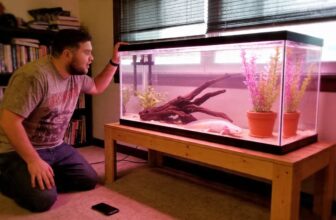
You stand before a glass tank, watching a shadow pulse with faint blue light. That pulse is electricity, a language you cannot hear. The Black Ghost Knife Fish speaks in currents, steering black water without eyes. You wonder what it senses that you cannot. The mystery waits in the dim corner of your room, patient, ancient, asking you to listen closer.
At A Glance
- Black Ghost Knife Fish generate weak electric fields for nocturnal navigation and hunting invisible to human eyes.
- Their scaleless skin and fin-based locomotion create an otherworldly, ghost-like appearance in dim aquarium lighting.
- Solitary nature and territorial aggression make multiple specimens coexisting a rare, unexplained phenomenon in captivity.
- Captive breeding remains unreported, shrouding their reproduction in mystery despite decades of aquarium keeping.
- They perceive human presence through electroreception and rhythm detection, forming subtle bonds invisible to observers.
What Tank Size Do You Need?
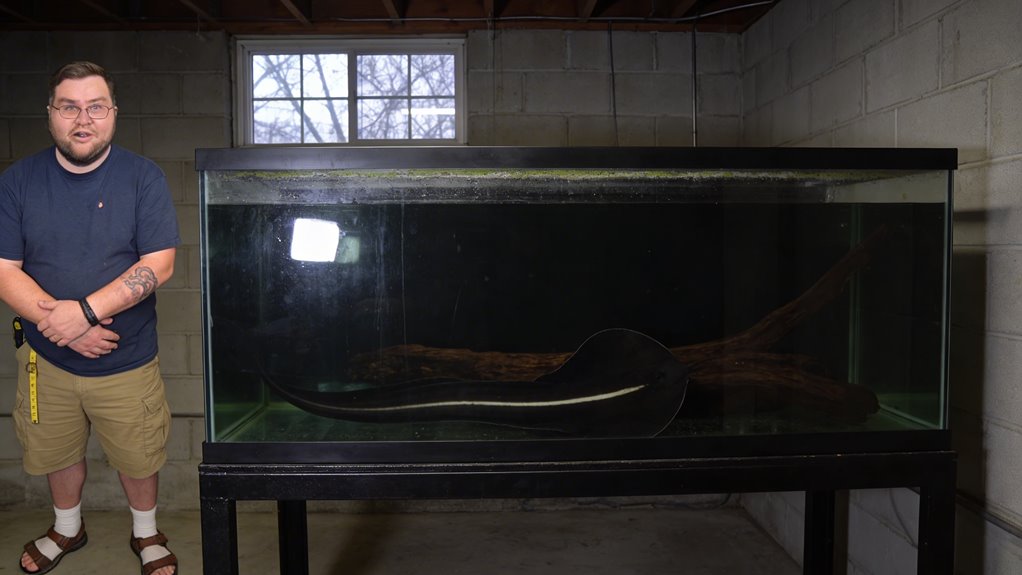
So, you’re eyeing that sleek, black knife-shaped fish at the pet store, and you’re wondering where it’ll live.
You’ll need one hundred gallons, minimum, for a single Black Ghost Knife Fish.
These creatures grow twenty inches long, and they’ll live ten to fifteen years with proper care.
Their electricnetic navigation—meaning they sense weak electric fields around their bodies—requires open swimming space.
Their nocturnal behavior means they’re active at night, exploring every corner after dark.
Add eighty to one hundred more gallons for each additional fish, or they’ll fight over territory.
You’re building their forever home.
How Do You Set Up Their Habitat?
Now that you’ve chosen a tank big enough for a lifetime, you’ll fill it with water between 73 and 80 degrees Fahrenheit, which feels like a warm bath to your hand.
You’ll spread fine sand two inches deep across the bottom, softer than playground gravel, so their scale-less skin stays safe from cuts.
Your electric habitat design means hiding spots matter more than open water.
Stack smooth driftwood, caves, and tall plants like you’re building a cozy neighborhood where everyone knows each other’s secrets.
Install nocturnal lighting, dim and blue like evening coming early, since they hunt at night when the world feels quieter and safer.
You’re making a home where they belong.
What Water Conditions Do They Need?
If you’ve built their home with soft sand and shadowy caves, you’ll want to make certain the water itself welcomes them like a familiar room.
Keep the temperature steady at seventy-three to eighty degrees Fahrenheit, warm like a summer afternoon. You’re aiming for six point five to eight point zero pH, so test weekly for pH stability, their health depends on it. Soft water, zero to ten KH, feels gentle against their scaleless skin.
Their electric flow, the invisible signals they send through the water, works best when conditions stay constant. You’ll feel calm knowing you’ve created this safe place.
What Should You Feed Them?
A frozen cube of bloodworms, dark red and thumbnail-sized, holds more nutrition than you’d guess. You thaw it, drop it in, and watch your black ghost knife fish hunt. This matters since their electric diet relies on protein-rich foods to power those navigation pulses you can’t see but they can’t live without.
Here’s what works:
| Food Type | How Often | Why It Matters |
|---|---|---|
| Bloodworms | Daily staple | Builds electric organ tissue |
| Brine shrimp | Twice weekly | Adds variety, prevents boredom |
| Prawn bits | Weekly treat | Supports long-term health |
Your feeding schedule shapes their whole life. Skip flakes—they won’t touch them, and you’ll waste money. Feel proud when they thrive.
How Often Should You Feed Them?
Twice each evening, you drop food into the dark water, and your black ghost knife fish wakes from its daytime hiding.
You’re matching its nocturnal hunting rhythm, the ancient pattern its ancestors followed in murky South American rivers. Feed small portions, enough to vanish in two or three minutes, and you’ll feel the quiet satisfaction of caring well.
Your fish finds food through feedingasonic communication, sensing electrical fields around living prey. This invisible language connects you to its mysterious world.
Skip a day occasionally; you’re preventing waste from clouding its home. Trust builds slowly, like friendship, through patient, predictable care.
What Fish Can Live With Them?
Your black ghost knife fish glides through the dim tank, its two white tail bands flashing like signals in the dark water.
You’re building a nocturnal aquarium, a community where everyone belongs.
Choose large, peaceful neighbors who share your electric fish tank’s calm rhythm. Silver dollars swim well, their flat bodies catching what little light you provide. Electric Blue Acara bring quiet color without starting trouble. Rope fish and bichirs understand night life, hunting when others sleep. Large catfish rest on soft sand, respecting space.
Avoid small, darting fish that trigger hunting instincts. Skip fin-nippers who’d damage scaleless skin.
You’re curating harmony, not just adding bodies.
Can You Keep Multiple Together?
Why would you want two shadows swimming where one already lives?
You’ll need courage, friend, and a very large tank.
Consider these truths:
- One knife fish needs 100 gallons minimum, like a small bedroom for a solitary ballet.
- Two require 200 gallons or more, so their electric migrations never collide in cramped water.
- Nocturnal breeding remains mysterious, unreliable, nearly impossible in home aquariums.
They’re lonely beauties, content with ghost-lit solitude. If you must share their space, add gentle giants—silver dollars, catfish—never another knife. Two shadows fight for territory where one belongs.
Choose wisely. You’ll belong to them longer than they belong to you.
How Big Do They Get?
A single black ghost knife fish stretches to the length of a grown man’s forearm, about 18 to 20 inches from nose to tail when fully grown.
You’ll need a tank at least 100 gallons for one fish, since this electric species doesn’t stop growing when cramped.
Their size feels impressive, doesn’t it? Like holding something rare.
They use weak electric fields for electric navigation, sensing their world without eyes in murky water. That same system needs space to develop properly.
You’ll watch yours patrol the bottom, confident in its bulk.
Ten years you’ll share, sometimes fifteen.
Plan for a decade together, sometimes more.
Plan accordingly.
What Health Problems Should You Watch For?
Look out for skin troubles first, since these fish wear no armor—no scales cover their long, dark bodies.
- Watch for cuts that won’t heal, since infections spread fast on soft skin.
- Notice Ich, those tiny white spots, and catch it early before your fish feels worse.
- Check for sensitivity defects illness, where the electric organ weakens and your fish can’t navigate properly.
Your fish depends on weak electric fields to find food and friends. When that electric sense fails, they grow confused and stressed. Keep their water clean, test it weekly, and you’ll protect the companion who’s chosen to share your home.
Is Breeding Possible?
Since the black ghost knife fish hides its secrets well, you won’t find easy answers about helping them raise young.
Some mysteries remain locked behind the black ghost knife fish’s silent, electric gaze.
You’ll enter uncertain territory when you consider breeding. Electric organ genetics, the inherited blueprint for their faint powers, remains mysterious to science. You can’t yet predict which traits pass from parent to child.
Their electric communication patterns—the pulses that help them find partners in dark waters—are similarly elusive in tanks. You might watch two fish exchange signals for months without result.
Most keepers, you included, accept observation over success. The community shares your patient curiosity, bonding through questions rather than answers.
Understanding Their Unique Electric Sense
Your fish carries a hidden flashlight, one you can’t see but it uses constantly. This electric navigation creates a living map of its world, feeling obstacles, prey, and friends without eyes.
This sensory adaptation means you’re witnessing evolution’s quiet miracle. Your ghost knife fish belongs to a lineage that traded sight for something deeper, and now you share that secret.
Consider how trust builds through invisible signals:
- You learn its rhythms, when it stirs and when it rests.
- It learns your presence, your footsteps, your care.
- Together, you create a home where neither of you is truly blind.
Welcome to this club.
Frequently Asked Questions
Why Do They Have White Tail Bands?
You see a white tailband on your black ghost knife fish since it sends signals. The band pattern helps others know, “This fish belongs here.” In dark rivers, that stripe glows like a dim flashlight, saying friend, not food. You feel glad knowing nature gives tools for connection, even underwater. Your fish wears its white tailband like a quiet name tag, helping it find its place.
Are They Dangerous to Humans?
No, they aren’t dangerous to you.
These fish create weak electric fields—like tiny living batteries—to find food and navigate dark waters, but you can’t feel their electricity at all. Their electricelectric diet of worms and shrimp keeps them gentle, and across their habitat range in South American rivers they’ve never harmed a person. You might feel curious touching their smooth, scaleless skin, but you won’t feel fear.
How Do They Navigate in Complete Darkness?
You’ll find they navigate through elect sensing, a built-in radar using weak electric fields. Their bodies create these pulses, like invisible flashlights, revealing obstacles and prey. This powers their nocturnal hunting when eyes fail them. You’re witnessing nature’s backup plan—feeling without touching, mapping without light. It’s quiet confidence, trusting what you cannot see, the same way you memorize your home in darkness.
Can They Regenerate Damaged Electric Organs?
You’ll find that scientists haven’t fully mapped electric organ regeneration in these fish, though related species show limited tissue repair abilities. The electric organ, which creates navigation signals, contains specialized cells called electrocytes. When damaged, some neighboring cells may divide and replace lost tissue, but complete restoration remains uncertain. Researchers continue studying this mystery, hoping to understand how these remarkable organs heal themselves.
Do They Sleep During the Day?
Yes, they sleep during the day.
You’ll find them hiding in dark caves, driftwood, or dense plants when the sun’s up. Their nocturnal feeding means they’re wired to hunt at night, so daytime feels like bedtime to them. Keep their habitat preference in mind—dim lights, shadows, cozy spots—and you’ll see them resting still, barely moving, saving energy for evening adventures. It’s like they’re wearing tiny pajamas you can’t see.
Rounding Up
You’ve walked through the quiet world of the Black Ghost Knife Fish, learning how its electric sense works like invisible touch, mapping dark water the way you might feel your way through a strange room at night.
These fish ask for patience, warm soft water, and space to drift.
You give them that, and they give back mystery—a living reminder that some beauty stays hidden, humming just below what you can see.