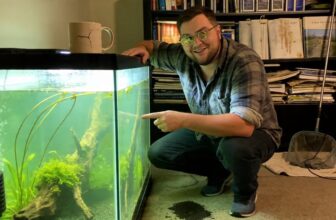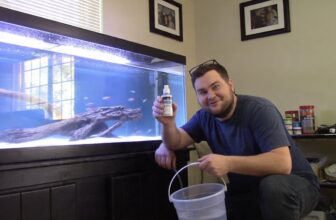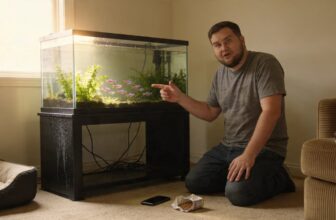
A 15‑gallon tank works, but it’s a compromise you’ll feel.
You get enough room for a betta, a gentle sponge filter, a 50W heater with ±2°F accuracy, and maybe six neon tetras or three female platies.
Water stays stable-ish, though you’ll test ammonia weekly with a $12 liquid kit and change 25% of the water religiously.
Skip a week and you’re gambling.
Surface area beats a bowl, tall plants break sight lines, and driftwood costs $15 at most pet stores.
The real kicker: if your betta’s a brawler or you want a mini sorority later, you’ll be tank shopping again within a year.
Go 15 if you’re disciplined, go 20 if you’re realistic about your follow-through.
There’s more below on filters, cycling, and the one mistake that kills most setups.
At A Glance
- Choose a 15‑gallon rectangular tank for stable water parameters and horizontal swimming space.
- Install a gentle, adjustable filter with pre‑filter sponge to protect flowing fins.
- Add a 25–45 W heater with ±1.8 °F accuracy placed horizontally near filter outflow.
- Plant densely with Java fern and Anubias to create sight breaks and reduce aggression.
- Cycle the tank 2–4 weeks before adding fish, then perform weekly 25 % water changes.
Is a 20‑Gallon Tank Worth It for Your Betta?
Here’s what you’re actually buying with those extra five gallons. You get room to breathe, literally. Your betta isn’t cramming into a shoebox, you’re giving him a studio apartment with a view. That space means stable water parameters—less panic, fewer crashes, and water testing becomes a monthly shrug instead of a weekly crisis. You’ll hit 78–80°F without fighting microclimates, too. A self‑cleaning design can extend your maintenance intervals to 2–3 weeks, reducing hands‑in‑water time even further.
- Swimming space reduces aggression (even betta breeding pros start here)
- Filter options open up—sponges, hang‑backs, whatever
Sure, it’s bulkier. You’ll trip over it once, guaranteed. But your fish lives longer, acts bolder, and you stop Googling “why is he hiding.”
Worth it? Obviously.
What You Gain: and Lose: With Smaller Tanks
Smaller tanks promise convenience until they don’t.
You gain countertop real estate and a lighter wallet, certainly. You lose swimming room, which cranks Betta behavior into overdrive—hello, glass-surfing stress. Tank aesthetics? You’re stuck with one sad silk plant and a gravel patch the size of a dinner plate. Water parameters swing like a moody teenager. Consider a tank with adjustable flow water current to better suit your betta’s natural environment.
| What You Get | What You’re Missing |
|---|---|
| Lower price, easy relocation | Stable water chemistry |
| Fits tight spaces | Natural Betta behavior exploration |
| Simple maintenance routine | Lush aquascaping options |
| Lighter cleaning load | Compatible tank mates |
Choose wisely. Your betta’s watching.
5 Features Every Betta Tank Kit Must Have
Skip kits missing these. You’re building a home, not buying decor.
A cover with high light transmission supports healthy plant growth and prevents bettas from jumping out.
Best 20‑Gallon Kits: Marina vs. Tetra vs. Aqueon
Once you’ve nailed down your must-have features—smooth substrate, gentle flow, the whole deal—you’re left staring at three starter kits that all claim to be “perfect” for bettas.
Marina ($90-110): Quiet clip-on filter, bright LEDs, but no heater included. Subpar filter guard—cover it with silk plants, trust me.
Tetra ($100-130): All-in-one with 100W heater, thermometer included. Filter’s decent, though cartridges drain your wallet long-term. LED’s meh for demanding plants.
Aqueon ($95-115): Beginner-friendly with indicator-light filter, included heater. Check water hardness; Betta genetics prefer softer conditions, and that stock heater runs hot.
Verdict: Aqueon wins for plug-and-play ease, but snag a reliable heater. Beginners should prioritize adjustable thermostats over fancy lighting for betta health.
Picking a Filter That Won’t Batter Your Betta’s Fins
Betta fins are tissue-paper delicate, so a filter that treats your tank like a Jacuzzi is basically asking for shredded tail curtains.
You’re chasing balance: clean water without the boxing match. Here’s the play:
- Sponge filters give you gentle currents and zero intake danger, plus they’re dirt cheap at $10–15
- Adjustable hang-on-back units let you dial back filter flow until your betta stops surfing the glass
- Pre-filter sponges wrap around intakes, adding fin protection for $3–5
- Look for low-noise ratings—your bedroom tank shouldn’t sound like a mini fridge
- Choose a HOB model with quiet motors ≤40 dB to keep the tank mellow without rattling your sleep.
I learned this the hard way. Skip the turbulence, adopt the mellow. Your betta’s tail will thank you.
Where to Place Your Heater for Steady 78–80°F Water
Since your betta’s basically a tropical diva who’ll sulk (or worse) if the water dips below 78°F, heater positioning isn’t something you eyeball and hope works. You want temperature consistency across the tank, not a sauna near the filter and an ice bath by the plants.
| Heater positioning spot | Why it works |
|---|---|
| Near filter outflow | Spreads warm water evenly, no cold pockets |
| Horizontal, mid-tank | Prevents hot layering on top, better circulation |
| Away from substrate | Avoids overheating bottom dwellers |
| Not touching glass directly | Prevents cracks, heat damage |
| Hidden behind décor | Looks cleaner, still functions fine |
Models with digital display thermostats that maintain ±1.8 °F accuracy use electronic chip technology for reliable temperature control. Stick it right, your betta stays cozy. Wing it, and you’re explaining to a grumpy fish why he’s shivering.
How Much Substrate You Actually Need (and What Type)
If you’re staring at empty tank bottoms and wondering whether you need a mountain of gravel or just a sprinkle, relax, you’re about to get the dirt on dirt.
For a 20-gallon, you need 2–3 inches, roughly 5–7 pounds. That’s substrate budgeting 101.
- Aim for 2–3 inches depth to anchor plants without stealing swim room
- Pick fine, smooth grain size to protect those flowy betta fins
- Steer clear of sharp gravel that turns fins into shredded ribbons
- Budget roughly $15–$25; cheap insurance against heartbreak
Fifty bucks says you’ll overthink it anyway, 5–7 pounds, smooth grains, done. Welcome to the club, we’ve all stood confused in the substrate aisle. For optimal bacterial colonization, consider a natural stone option like Aqua Natural Midnight Pearl with 2–4 mm grain size.
Choosing Plant Lights That Won’t Overwhelm Your Betta
Even though your betta couldn’t care less about your plant obsession, you’re still going to need lights—and the wrong ones will turn your tank into either a dark cave or a blinding interrogation room. You’re chasing that sweet spot: enough LED spectrum for your java fern to actually grow, not so much your betta starts wearing sunglasses.
| What You’re Dealing With | Why It Actually Matters |
|---|---|
| Blinding white LEDs | Stresses your fish, promotes algae parties |
| Dim corners | Plants go yellow, tank looks sad |
| Adjustable dimmers | You control the vibe, fin safety wins |
| 6500K full spectrum | Photosynthesis happens, naturally |
| 8–10 hour timers | Routine your fish can predict |
You’ll want 1–2 watts per gallon—nothing fancy, just functional. Clip-on fixtures work, hanging pendants look cooler, both keep your betta’s fins from melting under heat. Avoid bargain bin strip lights; they flicker, fade, and fry.
Bottom line: Buy once, dim often, and watch your betta actually use the plants thrive with uniform PAR distribution to prevent shadows and polyps stress.
Tank Mates That Thrive With Bettas in 20 Gallons
Why settle for a lonely betta when 20 gallons gives you room to build an actual community? You’ve got space, so use it wisely—breta compatibility matters more than you’d think, and water chemistry keeps everyone breathing easy.
A 20-gallon tank transforms your lonely betta into the centerpiece of a thriving underwater community—if you choose wisely.
Here’s your crew:
- Tetras: peaceful, short-finned, need six-plus buddies to feel secure
- Mollies: three inches max, mellow colors, won’t trigger your betta’s inner diva
- Platies: live-bearing, low-drama, practically raise themselves
- Female guppies: duller tails, zero competition for the spotlight
Skip the flashy males—your betta’s ego can’t handle the competition. Test your parameters weekly, keep that pH stable using a digital pH meter and accurate calibration solutions, and you’ll have a tank where everyone actually gets along.
Plants and Décor That Reduce Territorial Aggression
You’ve picked your tank mates, now give them somewhere to hide when your betta’s having a mood.
Vertical foliage—tall plants like Java fern or Anubias—creates sight breaks, breaking up aggression before it starts.
Driftwood islands (think small driftwood pieces grouped together) carve out distinct territories so everyone’s got “their spot.”
You’ve picked your tank mates, now give them somewhere to hide when your betta’s having a mood.
Vertical foliage—tall plants like Java fern or Anubias—creates sight breaks, breaking up aggression before it starts.
Driftwood islands (think small driftwood pieces grouped together) carve out distinct territories so everyone’s got “their spot.”
You’re not just decorating, you’re engineering peace.
Dense planting additionally filters water naturally, which, bonus, means less grunt work for you.
Using Classic SandPlay Natural Aquarium Sand ensures fine, pre-washed grains that anchor plants and trap impurities effectively.
Aim for 2-3 inches of substrate to anchor everything properly.
Skip open swimming lanes that turn into boxing rings.
Crowded tanks with nooks feel safer, smoother, saner.
Plant smart, keep fins intact.
Your First Week: Setup Checklist
Before you even think about adding water, you’ll need a plan that won’t leave you scrambling for supplies at 9 p.m. on a Tuesday. Gather your tribe of supplies: tank, heater (2–3 watts per gallon), low-flow filter, and silk plants that won’t shred betta fins.
Gather your tribe of supplies before the water flows—no one wants a 9 p.m. scramble.
You’re building a home, not just filling a box.
- Rinse substrate (gravel or sand) until water runs clear
- Install equipment, fill slowly, dechlorinate
- Start water cycling—let beneficial bacteria colonize for 2–4 weeks
- Test parameters (pH, ammonia, nitrite) weekly
- Plan Betta acclimation using drip method, never dump-and-pray
Patience now means fewer casualties later, and you’ve got this.
Weekly Maintenance That Keeps Parameters Stable
Since your tank won’t stay pristine on good intentions alone, you’re committing to a weekly ritual that keeps ammonia spikes and pH swings from crashing your betta’s mood—or worse.
Start with water cycling: swap out 25% weekly, no more, no less. This maintains water health without shocking your fish. Test parameters with a liquid kit—strips lie, and you deserve the truth.
For algae control, scrape glass, prune plants, and dim that light if green stuff explodes. It’s not a salad bar.
Finally, equipment redundancy saves you. Keep a backup heater and sponge filter stashed. When your primary fails at 2 AM, you’ll actually sleep.
5 Tank Size Mistakes That Stress Bettas
Choosing the wrong tank size for your betta isn’t just a rookie move—it’s a slow-motion disaster that’ll have your fish sulking in corners, fins clamped, wondering where it all went wrong.
You’re cramming him into torture chambers. Here’s your hit list:
- Under 5 gallons—ammonia spikes faster than you can blink, wrecking water chemistry (that’s the balance of pH, ammonia, nitrite, and nitrate levels).
- Bowl-shaped tanks—no surface area for gas exchange, and your betta’s maze organ suffocates.
- Tall, narrow tanks—betta temperament demands horizontal territory, not vertical climbing gyms.
- Overcrowded community tanks—stress hormones pollute the water, inviting fin rot.
Get it right, and you’ll belong to the club of keepers whose bettas actually flare with health, not fear.
When to Upgrade to a Larger Setup
Your betta’s been giving you that look—the one that says he’s tired of bumping his tail on the same four plants, and honestly, you’re getting a little tired of the water-change gymnastics yourself. It’s time.
You’ve mastered the basics, but here’s your signal: water testing shows parameters swinging wildly between changes, or you’re actually considering betta breeding (which, let’s be real, needs far more space than you’ve got). A 20-gallon solves both, giving you stability and room for proper grow-out.
Stop wrestling with cramped quarters. Upgrade when you’re ready to join the ranks of keepers who don’t panic at every ammonia spike.
Your 20‑Gallon Betta Tank Budget Breakdown
Building a proper 20‑gallon betta setup will run you between $150 and $300 if you’re smart about it, or roughly the cost of five fancy coffee drinks per week for a month—your call on priorities.
You belong here, trust me. Here’s where that money goes:
- Tank and hood: $60–$100 for glass, maybe a kit with LEDs.
- Filtration and heating: $40–$80—get low‑flow, betta‑safe gear.
- Gravel and plants: $30–$60, go dark substrate, it hides debris.
- Budget friendly décor and DIY enrichment: $20–$60, think PVC tunnels, coconut caves, no shame in craft store driftwood.
You’re building a home, not just a tank.
Frequently Asked Questions
Can Bettas See Their Own Reflection in Glass Walls?
Yes, your betta sees his reflection in glass walls, causing reflection stress.
You’ll watch him flare at his “rival,” your poor confused drama queen.
Tank depth helps; when you maintain 2–3 inches of gravel, he looks down, not out.
Dark backgrounds work magic, too.
It’s like he’s obsessed with bathroom mirror selfies—constantly, vainly, hilariously.
Reduce glare, add plants, and you’ll calm his fragile ego.
That’s your only simple fix.
Do 20-Gallon Tanks Need Air Stones or Bubblers?
You really don’t need air stones if your filter filtration creates proper surface agitation like a steady heartbeat.
Plant substrate and pump maintenance matter far more than bubbles, honestly.
Temperature stability keeps your betta breathing easy in any twenty-gallon tank setup.
Just guarantee your filter breaks the surface—that’s the real MVP here, providing oxygen exchange without unnecessary gadgets cluttering up your beautiful pristine twenty-gallon aquarium environment at all, trust me.
How Long Do LED Lights Typically Last in Aquarium Kits?
Expect roughly 30,000 to 50,000 hours of LED lifespan from aquarium kit lights, so you’ll delay bulb replacement for 3 to 6 years.
That’s solid value, though cheap LEDs burn out faster, so check those specs before purchasing.
If yours flickers, swap it immediately, except you enjoy squinting.
Keep receipts handy, friend.
Remember, these lights age like dad jokes, painfully.
Bottom line: buy quality once, stress less later about your tank’s glow.
Should I Quarantine New Plants Before Adding Them?
Yes, you should quarantine new plants.
Soilarantine protocols protect your tank from pests, snails, and nasty algae hitchhiking on leaves.
You wouldn’t invite strangers to sleep over without checking their pockets, right?
Rinse them in tap water, dip them in diluted bleach—one part bleach to nineteen parts water, that’s 5%—then rinse again.
This preserves plant health and saves future headaches.
Better safe than sorry, friend, so do trust me.
Can I Use Tap Water Directly in My Betta Tank?
Using tap water straight from the faucet is like inviting chaos to a dinner party—it never ends well.
You’ll poison your betta with chlorine, a chemical disinfectant water companies add that burns fish gills. Skip the drama: treat tap water with dechlorinator first, match the tank’s temperature to avoid temperature shock, and test hardness adjustment needs. Your fish deserves better than a chemical bath, trust me.
Rounding Up
You’ve got this, really. A 20‑gallon tank isn’t overkill—it’s breathing room (literally) for your betta and sanity for you. Skip the cramped bowls, adopt stable water parameters, and laugh when your fish ignores that $15 cave you bought. The Marina kit wins for plant lovers, Tetra for tight budgets. Either way, you’re building a tiny ecosystem, not just a fish prison. Upgrade. Your betta’s fins will thank you, and you’ll sleep better, too.