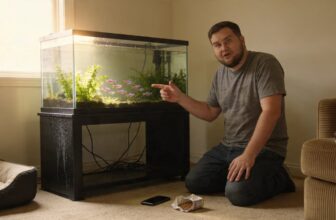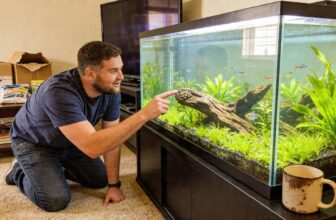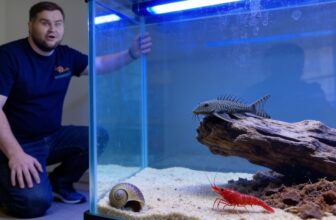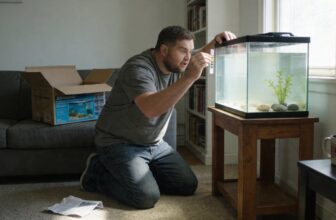
Start with 20 gallons—more water equals easier chemistry, fewer changes, dead fish.
Rinse substrate until the sink runs clear, slope it, bury your stones so they don’t landslide when plecos bulldoze past.
Cycle the tank: bacteria need 3–6 weeks, ammonia to nitrite to nitrate, test strips until zeros appear.
Quarantine everything—ich hitches rides on “healthy” guppies, always.
Now, 30 minutes weekly, siphon, scrape, done.
Style comes later; stability first.
And there’s a trick to skipping the usual three-month massacre that most beginners never hear about.
At A Glance
- Choose a tank of at least 20 gallons with accessible location, stable surface, and nearby power outlets.
- Rinse substrate thoroughly, slope it slightly, and arrange hardscape before adding water slowly.
- Install filter rated for 1.5× tank volume, heater near flow, and full-spectrum LED on a timer.
- Cycle the tank 3–6 weeks until ammonia and nitrite read zero and nitrates stay below 20 ppm.
- Stock hardy species first, quarantine new fish 2–4 weeks, and perform weekly 20–25% water changes.
Start Here: What Aquarium Setup Actually Involves
Setting up an aquarium, at its core, is less about filling a glass box with water and more about building a functioning underwater neighborhood where fish can actually thrive, not just survive.
An aquarium isn’t a glass box filled with water—it’s a neighborhood where fish thrive, not just survive.
Now, this means budget budgeting matters—you’ll sink funds into substrate, filtration, and a lighting setup that actually grows plants, not just makes things glow purple.
I mean, it’s easy to get lost in the hobby’s voice, that whisper saying *buy more*. Resist. Start modest.
The tank becomes yours—functional, warm, alive. Your fish notice. They school together, darting through water you prepared, and somewhere in that glass: you belong, too.
Many beginners underestimate how tank capacity vs. crowding affects fish stress levels, with larger volumes requiring less frequent water changes and reducing mortality rates.
Pick a Tank Size That Fits Your Space and Fish
Now that the groundwork’s been laid—budget wrestled, purpose clarified—it’s time for the glass box itself. Beginners flock to petite tanks, seduced by countertop convenience and gentler price tags, yet budget constraints often betray them: small water volumes fluctuate wildly, demanding vigilance novices rarely possess. For those specifically keeping bettas, 3‑gallon setups represent a practical compromise between space constraints and the stability needed to prevent stress and disease in these delicate fish.
Twenty gallons, minimum, forgives beginner mistakes—temperature swings, missed feedings, overzealous stocking. Measure twice, literally; space determines not just placement but maintenance access, cord routing, that awkward stretch during water changes. The right tank welcomes you into the hobby rather than testing your patience.
- Minimum viable volume: twenty gallons stabilizes chemistry for beginners more reliably than ten
- Footprint reality: depth and width matter more than height for most community fish
- Location logistics: proximity to outlets, away from windows, with room for your elbows
- Future-proofing: buying the largest tank your space and budget constraints allow prevents costly upgrades
Choose Your Aquarium Style (Before You Buy a Thing)
Why stumble blindly into aisles of driftwood and substrate bags when a clear vision prevents every regrettable impulse buy?
A defined aquascape theme—lush jungle, rocky cichlid refuge, zen minimalism, or betta oasis—creates instant belonging for fish and keeper alike.
Now, match every element to that vision. Soft sand for bottom-dwellers, caves for line-of-sight breaks, and hardy plants like Java fern or Anubias that forgive beginner mistakes.
Themeular lighting, chosen later for ambiance, should complement—not drive—the aesthetic.
Plan hiding spots, open swimming zones, and substrate texture together. I mean, coherence beats chaos. Smart vision here streamlines every purchase after, sparing regret and dollars both.
Once your theme is locked in, enhance the backdrop with a static-cling background that requires no adhesive or tape and can be repositioned without residue, letting you experiment freely as your style evolves.
Select Filters, Heaters, and Lights for Your Tank Size
With the vision locked and the glass box sitting empty, attention shifts to the machinery that keeps it alive. Now, filter placement matters—tuck intakes into back corners, hide them behind tall plants, keep flow gentle enough that fish aren’t doing backflips. Energy efficiency isn’t just virtuous, it’s wallet-friendly: LED lights run cool and last years, adjustable heaters click on only when needed. Match wattage to gallons, usually 3-5W per liter, though your mileage may vary. For reliable water circulation, choose a pump with dry-run protection to prevent damage if water levels drop unexpectedly.
Before the fish come the fundamentals: filter flow gentle enough for living fins, heaters that sip electricity, and lights built to last.
- Choose filters rated for 1.5× your tank volume, minimum
- Position heaters low, near filter outputs for even heat distribution
- Select full-spectrum LEDs, 8–10 hours daily
- Invest in timers; fish appreciate consistency, and so does your electric bill
Rinse Substrate and Build Hardscape (In the Right Order)
And yes, that driftwood probably needs soaking separately unless you enjoy tannin tea.
- Substrate rinsing: Dump gravel or sand into a bucket, run water, stir like you’re panning for gold. Rinse until it’s mostly clear, probably fifteen, maybe twenty minutes—who really counts. Cloudy water on day one? Rookie scarlet letter. For instant nitrogen cycling, consider a bio-substrate with live nitrifying bacteria that doesn’t require rinsing.
- Hardscape sequencing: Big rocks back, caves middle, tiny stuff forward. Depth, dimension, places to hide.
Now layer substrate, slope it slightly, bury those stone bases so nothing shifts. Driftwood last, angled just so, creating tunnels and breaks in sightlines.
This is your foundation. Fish need to feel safe here, same as you do.
Plant Your Aquarium With Beginner-Friendly Species
So you’ve got your hardscape locked in, your substrate settled like wet concrete at a construction site that actually went right, and now the tank stares back, all stone and possibility, waiting for the living stuff.
Begin with survivors. Java fern and Anubias forgive incompetence, thriving in shadows where fancy plants surrender. Check lighting needs before buying—low-tech tanks demand humility, not high-wattage dreams. Amazon swords and Cryptocoryne fill midground gaps, their root systems drinking quietly beneath the surface. Plant compatibility matters since nothing stings like watching your vision rot.
- Anchor rhizome plants to wood, never bury them
- Cluster Cryptocoryne for natural density
- Position tall stems behind rocks for forced perspective
- Accept some melting; new leaves reveal true adaptation
For effortless surface coverage that multiplies on its own, add floating water spangles to shade your tank and suppress algae without any trimming required.
Let the green claim its territory.
Fill, Treat, and Test Your Water Before Adding Anything
The tap stuff’s fine for humans, deadly for gills—chlorine removal comes first, always.
Tap water’s a silent killer for fish—strip that chlorine before anything else. No exceptions.
Now, fill slowly. Place a plate on the substrate, pour onto that, or you’ll dig craters where you just arranged everything. I mean, patience here, right?
Add dechlorinator—follow the bottle, probably a capful per ten gallons, though who trusts those lines anyway. A concentrated formula like Seachem Prime can treat thousands of gallons from a single bottle, making it economical for both small and large setups.
Next, fire up equipment, check water hardness (those minerals fish feel in their bones), and test pH, ammonia, the works. Parameters matter. Get them stable.
And wait. Seriously. No shortcuts here.
The tank needs pure, proven water before anything living arrives.
Cycle Your Aquarium: The 3–6 Week Wait You Can’t Skip
Water parameters look stable, dechlorinator’s done its job—great. Now begins the real work: patience, three to six weeks of it, minimum.
The nitrogen cycle doesn’t care about your timeline. Beneficial bacteria need time to colonize filter media, substrate, every surface really, converting toxic ammonia to nitrite to relatively harmless nitrate.
- Dose ammonia to 2–4 ppm, or use a commercial kit, start the cycle
- Nit cycle monitoring means testing daily, watching the ugly spike-and-fall drama unfold
- Nitrate control through 10–25% water changes keeps levels below 20 ppm
- Temperature steady at 75–80°F, since cold bacteria are lazy bacteria
Cloudy water? Algae? Normal. The wait builds the foundation every thriving tank shares. Once cycled, consider adding a 3 W UV sterilizer to handle green water outbreaks common in new tanks under 20 gallons.
Confirm Your Tank Is Fully Cycled and Ready for Fish
Once you’ve stared at an empty, bacteria-stewing tank for a month or two—watching water go cloudy, then clear, then cloudy again—the urge to chuck fish into the thing becomes almost physical.
But I mean, seriously, don’t.
Cycle verification demands patience. Daily water testing tracks the nitrogen journey: ammonia spikes, nitrite nightmares, finally—nitrates. You’re hunting for zeros.
Ammonia: 0 ppm.
Nitrite: 0 ppm.
Nitrate: maybe 5–20 ppm, give or take.
The bacteria colony, that invisible workforce, needs proof of employment. Test kits don’t lie, though your eyes might.
Wait for it. The tank will forgive haste, but fish rarely do.
For rapid daily checks during this critical cycling phase, consider using ion-selective membrane strips that deliver results in about 60 seconds with improved color accuracy.
Stock With Hardy Fish First: Save Dream Species For Later
Resist the siren song of that electric blue ram or pearlscale butterfly you’ve been screenshotting for weeks.
Novice keepers often rush toward delicate species fish, sabotaging community trust before it forms. Hardy starter species—zebra danios, cherry barbs, platies—establish visual balance through movement and color without demanding perfection.
Start with fish that forgive your mistakes, not ones that punish them.
- They forgive ammonia blips, clumsy feeding, fluctuating temperatures
- Active schooling creates immediate life and depth in sparse planted tanks
- Successful husbandry builds confidence for future upgrades
- Established colonies signal readiness to fellow enthusiasts
And really, there’s belonging in patience. The dream discus or crystal shrimp will wait. Mastery earned through humble beginnings carries more weight in aquarium circles than premature prestige ever could. Once your tank stabilizes, you can explore slow-sinking granules like those designed for natural foraging behavior in species such as fancy Orandas.
Quarantine Every New Fish (Even From Reputable Stores)
Quarantine Basics
Since even the shiniest store tank can hide microscopic trouble, quarantine isn’t paranoia—it’s insurance. Store borne pathogens ride in on the healthiest-looking fish, and one outbreak can crash a community tank like dominoes in a draft.
Quarantine protocols are simple:
- Set up a bare 10–20 gallon tank with heater and sponge filter
- Observe new fish 2–4 weeks, watching for ich, fungus, or listlessness
- Treat only if symptoms appear—no need to nuke what isn’t sick
Now, beginners often skip this. I mean, the tank looks so lonely, right? But patience here separates thriving aquarists from those posting “what went wrong” threads at 2 a.m.
Feed Varied Diets Without Clouding Your Water
Feeding Without the Cloud
Three things tank water and soup broth share: both cloud when overfed, both improve with restraint, and both reveal the cook’s impatience.
Now, nutrient control matters here—excess food breaks down, feeds algae, turns your paradise into pea soup. I mean, nobody wants that.
Feed small, feed varied, and stop before the five-minute mark. Your fish will thank you, or they won’t, fish are cagey like that.
- Rotate proteins, flakes, and frozen treats to cover nutritional gaps
- Target-feed with a pipette or ring to reduce waste drift
- Fast one day weekly—fish handle it fine, honestly
- Skim uneaten bits quickly for algae suppression and clarity
And remember: a hungry fish is a healthy fish, mostly.
Weekly Aquarium Maintenance in 30 Minutes or Less
Now, the clock is your friend here, or at least not your enemy. Weekly upkeep fits a sitcom episode, commercials included.
Weekly 30-Minute Clean
- Dip strips, check pH, ammonia, nitrites—water testing means knowing before showing.
- Siphon 20‑25% into a bucket, matching temperature like a fussy barista.
- Wipe glass, scrape décor—algae control, since green fuzz ages glass like bad lighting.
- Rinse filter sponges in old tank water, never tap, or you’ll murder the good bacteria.
And yes, skip the gravel vacuuming obsession. Plants eat fish waste, mostly. The tank forgives small shortcuts.
Spot Stress and Illness Before They Wipe Out Your Tank
Spotting Sick Fish Before It’s Too Late
Water just right, glass wiped clear, and the tank hums along—until it doesn’t. Early detection separates thriving communities from early mortality, and the signs hide in plain sight—if one knows where, and when, to look.
- Fins clamped tight, color pale, hiding when boldness ruled yesterday
- Gasping at the surface, scraping against gravel, spots that weren’t there
- Appetite vanished, waste stringy and white, swimming off-balance now
- Breathing rapid, gills flared red, isolation from the shoal’s easy rhythm
Watch daily. Act quickly. The tank rewards those in the loop.
Frequently Asked Questions
Can I Use Tap Water Without a Conditioner?
No, tap water requires conditioner.
Chlorine and chloramines, standard disinfectants in municipal supplies, attack fish gills and destroy beneficial bacteria colonies vital for the nitrogen cycle.
The fix is simple—liquid dechlorinator, roughly one drop per gallon, neutralizes these chemicals instantly.
Without it, fish stress, gasp, or die within hours.
So, conditioner isn’t optional. It’s survival.
Budget brands work fine; just read labels for chloramine neutralization, not chlorine-only formulas.
How Loud Is Aquarium Equipment at Night?
Most quality equipment lands somewhere between whisper-quiet and gentle hum—think laptop fan, maybe 30-40 decibels.
Now, nighttime noise usually comes less from the motor itself and more from equipment vibrations against the cabinet, or water trickling from a hang-on-back filter.
Cheap pumps grind, good ones purr. Submersible filters, honestly, are nearly silent—just that soft gurgle people find weirdly soothing. But air pumps? Those rattle.
Fix the buzz:
- Place filters on foam pads, silicone mats, or folded hand towels
- Check that filter intakes aren’t sucking air—loud splashing means low water
- Tighten loose impeller housings; debris makes them whine
- Skip air stones if sleep matters, or bury the pump in a closet with long tubing
I mean, some people *like* the white noise. Others move tanks out of bedrooms entirely. There’s no shame either way.
Should I Turn off Lights When Adding New Fish?
Dim the lights, don’t kill them—fish panic in stark brightness, and acclimation timing matters.
Keep your normal light schedule running, maybe knock it down thirty percent for the first few hours. Float the bag, match temperatures, then release.
New arrivals need calm, not sensory overload.
So: lights on, low, steady. They’ll find their corners, settle in, figure out who’s boss. Patience wins.
Do I Need an Air Pump for My Filter?
Pump pump selection hinges on filter capacity, not tank size alone.
Hang-on-back units often splash enough for surface aeration, so air pump necessity drops.
Canister filters? Usually need supplemental agitation.
Check filter specs—gallons-per-hour matters less than oxygen distribution, really.
- Sponge filters: mandatory air pump
- Internal powerheads: built-in aeration
- Wet/dry trickle towers: atmospheric oxygen, no pump needed
The deadpan truth? Over-aeration harms less than stagnation, but bubbles are partly theater.
Prioritize filter aeration matching bioload, not aesthetics.
Can Fish Recognize Their Owner?
Fish can recognize their owner through consistent sensory cues—sound vibrations, footstep patterns, even facial configuration at tank glass.
Studies confirm memory spans months, linking specific owner behavior with food rewards.
Familiarity builds gradually, fish schooling toward the same human repeatedly.
Recognition differs from mammalian attachment, yet exists as learned association.
Some species, bettas and cichlids especially, demonstrate this plainly, tracking movement with obvious intent.