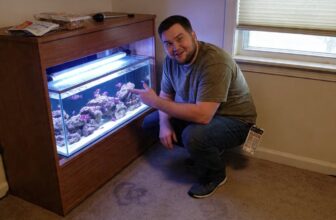
You’ll want a 55-gallon tank minimum, though 30 gallons works if you’re okay with a grumpy roommate.
Set up low rockwork with ledges and caves, keep the water at 72-80°F with reef-grade LEDs creating dim hiding spots.

Create dim hiding spots with adjustable brightness for your hawkfish.

Provides ledges and caves for secure perching and territory.

Monitor water temperature to keep your hawkfish comfortable.
Check discountedAquarium Lightingon Amazon
Feed small meaty stuff – mysis, brine shrimp, krill – twice daily, maybe a late-night snack since they’re secret night hunters.
Don’t pair them with cleaner shrimp or small crabs; think clownfish, tangs, or purple firefish instead.
Watch for color fade or rapid breathing, quarantine new arrivals, and if you’re lucky enough to spot a male-female pair doing that weird shadow-dance, you’ve got maybe a three-week window to condition them before spawning magic might happen.
There’s more to the story if you’re curious.
At A Glance
- Electric red-orange body with black dorsal stripe and dark mask; check markings against veteran photos to avoid misidentification.
- Minimum 55-gallon tank with low rockwork, caves, moderate flow, and dim pockets for security perching behavior.
- Feed small meaty foods twice daily plus late-evening snack; soak pellets soft and avoid over-feeding.
- Compatible with middle-upper dwellers like clownfish and tangs; avoid cleaner shrimp, bottom-dwellers, and vulnerable invertebrates.
- Breed by conditioning pair with rich foods, simulating dusk, and transferring eggs to 100-gallon rearing tank for 21-day incubation.
Flame Hawkfish: What You Need to Know First
This 3–4 inch fireball stakes territory at your tank’s bottom, perching on rock ledges like it’s judging your life choices. You’ll watch it dart, hide, and continuously scan for predators – even during resting, which, I mean, relatable.
Behavior aquaculture research shows these fish thrive when we replicate their wild routines: daytime watching, nighttime cave-dwelling. And habitat restoration efforts in their Pacific reef homes remind us that your tank’s structure – ledges, caves, coral-matching décor – isn’t decoration, it’s survival.
A stable thermal environment supports this territorial behavior, making temperature control devices valuable for maintaining the consistent conditions these fish need to establish secure perching zones.
Flame Hawkfish Identification: Markings and Lookalikes
Before you commit water and worry to a flame hawkfish, you’ll want to be absolutely certain you’re getting what you pay for. That electric red-orange body, the jet-black racing stripe down the dorsal fin, the dark mask around the eyes – you’ll memorize these marks, trust me.
Color pattern variations crop up, indeed. Some specimens lean more coral than scarlet, others practically glow. Regional differences, diet, stress – who knows exactly, I mean, fishkeeping’s half educated guess anyway.
Mimic species identification matters since the market’s full of pretenders. The coral hawkfish plays copycat with similar hues, but lacks that signature eyering. Longnose hawkfish stretch thinner, paler. Check your sources, join the forums, compare photos with veteran keepers, and you’ll spot the real deal.
Just as betta keepers scrutinize glass wall thickness and filtration specs to ensure proper tank selection, discerning aquarists must examine flame hawkfish markings with equal precision to avoid costly misidentifications.
Flame Hawkfish Reef Safety: Corals, Shrimp, and Invertebrate Risks
So you’re staring at that flame hawkfish in the shop tank, wondering if it’ll play nice with your coral garden or turn your prized cleanup crew into an all-you-can-eat buffet, right?
Here’s the deal: coral predation isn’t your main worry – those clumsy fins might scratch delicate polyps, certainly, but they won’t systematically nuke your LPS garden. Invertebrate safety? That’s where you’ll sweat.
These ambush hunters eye your cleanup crew like mobile snacks. Your peppermint shrimp, hermit crabs, feather dusters, and small snails rank as easy prey. Now, larger shrimp might survive, but juvenile cleaners? Toast.
| Risk Level | Tankmate |
|---|---|
| High | Cleaner shrimp, small hermit crabs |
| Moderate | Feather dusters, ornamental snails |
| Low | Large coral colonies, hardy LPS |
| Minimal | SPS corals, clams (adult) |
| Typically safe | Fish-only species, fast swimmers |
Stick to robust corals and skip the delicate shrimp if you want peace, not daily disappearances. Maintaining calm water flow through proper sump design – similar to the turbulence reduction achieved with acrylic disk silencers – helps minimize stress on both flame hawkfish and their more vulnerable tankmates.
Tank Size for Flame Hawkfish: Minimum vs. Ideal Setup
Since you’re probably wondering whether that thirty-gallon tank your buddy offloaded will cut it, let’s get real about space – the kind that keeps a flame hawkfish from turning into a stressed-out, surface-gazing jumper.
A thirty-gallon tank size works, technically. Your flame hawk, barely three inches of furious red, claims territory fast. But cramped quarters mean anxiety, and anxious hawkfish launch themselves into lids, or worse, floors.
Now, the ideal setup? That’s fifty-five gallons minimum, more if you’re dreaming of a little group. Give them ledges, caves, breathing room – because belonging means letting your fish actually belong somewhere.
The curved glass front found in bow-front aquariums can increase the viewing angle by approximately 33%, though this design reduces usable interior volume and may create dead spots behind the curve that require stronger filtration flow.
Flame Hawkfish Water Parameters and Filtration
If you’ve ever stared at your tank wondering why your flame hawkfish looks about as lively as a submarine sandwich, chances are your water’s doing something funky – maybe it’s the pH, maybe it’s the nitrates, or maybe you just haven’t checked since last Tuesday.
Keep your parameters tight: 72-80°F, pH 8.1-8.4, salinity 1.025-1.026. Water flow matters – moderate, not blast-furnace territory, but enough that oxygen touches every corner. Your filtration media needs attention too: mechanical, chemical, biological layers working together. Skip the sludge. Test weekly, change 15-25% water, and your hawkfish perks right up. While planted marine refugia aren’t typical for hawkfish tanks, understanding chelated iron forms can help if you maintain macroalgae for nutrient export in your sump.
Rockwork and Lighting: Building Bottom Territory
Start with what the fish actually wants, not what the tank store upsold you.
Your Flame Hawk craves bottom territory – tight caves, overhangs, and ledges where those modified pectoral fins can perch. Stack your rockwork low, creating tunnels and crevices with rough rock texture that grip their fin-rays. Skip tall towers; they live at the base, remember?
Now, lighting design matters more than you’d think. They’re not sun-worshippers, but you’ll want moderate-to-strong light – think reef-grade LEDs – that supports corals above while casting dim pockets below. That shadow-play? That’s their security blanket.
When rearranging rockwork or placing delicate coral frags to create these shaded pockets, long aquarium tweezers give you the precision and reach to work around established structures without disturbing your hawkfish’s claimed territory.
Build it right, and you’ll watch them claim their corner like they invented it.
Flame Hawkfish Diet and Feeding Schedule
Once your hawk’s got its perch sorted, you’ve got to keep the thing fed – and this is where a lot of keepers miss the mark. These guys are ambush predators, pure and simple, so you’ve gotta work with their wiring, not against it.
Feed small, meaty meals twice daily – think mysis, brine shrimp, bits of krill. Now, here’s the insider move: supplement with nutrient rich pellets, soaked first so they sink soft. Your hawk’ll snap them from midwater like it’s doing you a favor. For keepers running planted reef displays, copper-free fertilizers ensure any botanical supplements added to the system won’t harm sensitive invertebrates that might share the habitat.
And don’t forget, they’re built for nighttime hunting instincts even in captivity. A late evening snack, maybe ****9 PM, keeps ’em sharp, satisfied, and less likely to eye your shrimp with bad intentions. Skip this, and you’re asking for trouble.
Flame Hawkfish Tankmates: Compatible Fish and Pairing Rules
Now that your flame hawk‘s settled into its territory, you’re probably wondering who else can join the party without turning the tank into a gladiator pit.
Here’s the deal: your flame hawk stakes its claim at the bottom, so you’ll want tankmates who understand boundaries – fish that cruise the middle and upper levels, keeping that pumpkin pepper coloration safely out of turf wars.
Think clownfish darting through anemones, or tangs gliding above the reef.
And coral symbiosis matters here, since a well-structured reef gives everyone their own perch, their own hidey-hole.
Avoid bottom-dwellers like lawnmower blennies or mandarin gobies – they’ll trigger your hawk’s defensive instincts faster than you can say “incompatible.”
Purple firefish, rabbitfish, and most angelfish species work beautifully.
You want a community, not a cage match.
Just as hose length variations determine which water change equipment suits different tank configurations, choosing the right vertical zones for your tankmates keeps territorial disputes from spilling over.
Managing Flame Hawkfish Aggression: Territory and Conflict
So you’ve got your flame hawk perched on its rock like a tiny red landlord, and suddenly the tank feels smaller than you remembered – because territory, to these fish, isn’t just space, it’s *identity*. You’re not just dealing with aggression; you’re managing a whole territory hierarchy where every ledge means status.
Now, conflict mitigation isn’t about bigger tanks – though that helps – it’s about *flow*. Break sightlines with rockwork stacks, increase vertical space so rivals occupy different real estate. Avoid cramped bottom zones; your hawkfish needs room to rule without, you know, *actually* dueling to the death over three inches of rubble.
Flow, not footage – break sightlines, stack vertical, and let your hawkfish rule without the eye-for-an-eye drama.
I mean, drama’s fun until someone’s missing an eye.
Consider incorporating gentle bubble flow filtration systems to minimize additional stress on inhabitants during territorial disputes.
Flame Hawkfish Health: Disease Signs and Common Problems
You’ve got your hawkfish’s temper sorted, its territory mapped like a tiny red kingdom with clear borders and escape routes, but here’s the thing – all that behavioral stability means nothing if you’re missing the early whispers of trouble. Now, health cracks before behavior breaks, so watch for these telltales:
- Faded color, rapid breathing, or that telltale salt‑like dusting of marine ich
- Lethargy, hiding more than perching, refusing meals
- Visible parasites, tattered fins, or cloudy eyes
Paras stress hits fast in hawkfish. Quarantine newcomers. Target parasite treatment with copper‑based meds, but mind your inverts – they’ll protest. Test water, keep oxygen high, and trust your eyes. Early catching saves kingdoms.
Supplementing with a marine fish vitamin formula can support immune resilience and color vibrancy through bioavailable full‑spectrum nutrients during recovery periods.
Sexing Flame Hawkfish: Male or Female Markers
Social Hierarchy and Behavioral Markers
Since a Flame Hawkfish looks basically identical whether it’s packing eggs or sperm, you’re gonna need more than a casual glance to tell who’s who in your tank.
Your crew’s social ladder reveals everything. Watch these markers:
- Size hierarchy – dominant fish grows larger, claims the prime rock real estate, and yes, that’s your male emerging through hormonal cycles triggered by status, not birthright.
- Behavioral cues at dusk – females hover higher, displaying subtle submission while males patrol below, territorial and twitchy.
- Pair dynamics – two fish shadow-dance before spawning, the smaller following, circling, waiting for permission.
You’ve gotta observe, not assume.
Breeding Flame Hawkfish: Spawning Triggers and Egg Care
Spawning Triggers and Egg Care
Now, here’s your roadmap:
| Step | Action | Timeline |
|---|---|---|
| 1. Condition pair | Feed nutrient-rich pellets, mysis, krill | 2-3 weeks prior |
| 2. Trigger spawn | Raise temp slightly, simulate dusk | Evening routine |
| 3. Collect eggs | Transfer to 100+ gal rearing tank | Immediately post-spawn |
| 4. Incubate | Maintain pristine, stable water | ~21 days |
| 5. Feed fry | Rotifers, then copepods, then brine shrimp | Day 1 onward |
Fry nutrition means tiny, frequent meals – protein-packed, relentless. You’ll lose some. That’s breeding.
Selecting Healthy Flame Hawkfish: Red Flags at the LFS
When you spot that flash of scarlet hunched on a rock at the local fish shop, you’ll want to look past the pretty colors – because flame hawkfish are territorial little brutes in the wild, and stress shows up fast in captivity if they weren’t handled right.
- Clouded eyes or erratic flashing signal parasites, not the bold perching you’d see across their Pacific habitat range from Fiji to Tahiti.
- Labored breathing means they’ve struggled in transit, and stressed females won’t shift to show natural breeding behavior later.
- Hiding excessively behind heaters – hawkfish should perch openly, watching, always watching.
Flame Hawkfish Longevity: Extending Your Fish’s Lifespan
Extending Your Fish’s Lifespan
You’ve sorted the healthy from the half-dead at the shop, and that scarlet sentry is now acclimating in your tank – so the real work begins.
Now, here’s the thing about stress reduction: flame hawkfish last 5–10 years when you don’t mess with them too much. I mean, certainly, water changes matter, but stability wins. Keep that temperature around 75–78°F, nitrates low, and quit rearranging the rockwork every weekend.
The secret to a decade with flame hawkfish? Stability, not fussing – let them be.
Genetic diversity? Keep three to five together in 100+ gallons. They sort out dominance, form little gangs, and live longer. Solitary fish stress, bicker less, but fade faster. Give them crewmates. Let them posture. They’ll watch, perch, quietly outlive your regrets.
That’s the secret, really: stable water, social life, hands off.
Frequently Asked Questions
Do Flame Hawkfish Jump Out of Tanks?
Yes, you’d better watch out for tank jumping with these red perches. When startled – and they’re jumpy, always checking for threats – you’ll see escape behavior kick in fast.
They dart upward, no grace at all, and they’ll clear rimless tanks like it’s their job.
Now, a tight lid isn’t optional, I mean it’s crucial. Give them caves, keep them calm, and you’ll dodge the heartbreak of finding your hawkfish behind the couch.
Can Flame Hawkfish Change Sex More Than Once?
No, you won’t see your flame hawkfish flip-flopping genders like a hormonal revolving door.
They’re sequential hermaphrodites, indeed – born female, dominant one becomes male through sex reversal – but that’s typically a one-way ride.
Once hormonal plasticity pushes her to him, he stays put.
Think of it less “choose your own adventure,” more “elevator to the top floor, broken call button.”
Do Flame Hawkfish Sleep During the Day?
No, they don’t. You’re watching a daytime perch-sitter, not a napper.
Now, their Nocturnal activity kicks in after dark – that’s when they hole up in caves, resting as you’re probably scrolling your phone.
Their Light sensitive behavior keeps them alert, eyes scanning for threats even when they look still.
I mean, they’ll dash if spooked, indeed, but actual sleep? That’s a nighttime thing. They’re built for watching, not dozing.
Are Flame Hawkfish Sensitive to Copper Medications?
Yes, you’ve got a fish with real copper sensitivity here. Flame hawkfish, like most hawkfish, show poor medication tolerance – you’ll risk losing them fast with standard copper treatments for ich or parasites.
Now, you’re not stuck. Use alternative dips, hyposalinity, or formalin-based meds instead.
I mean, always quarantine first, test on a dose, and watch like a hawk.
Seriously, that metallic cure-all? Skip it.
Can Flame Hawkfish Be Trained to Hand-Feed?
Yes, you can train them. Start with hand feeding techniques – hold shrimp or pellets still near their perch, maybe six inches away, and wait. They’ll stare, dart, grab.
Now, cue based conditioning: tap the glass once before each meal. They learn fast, linking sound to food.
Be patient, they’re jumpy fish, but persistence pays off in about two weeks, sometimes less.
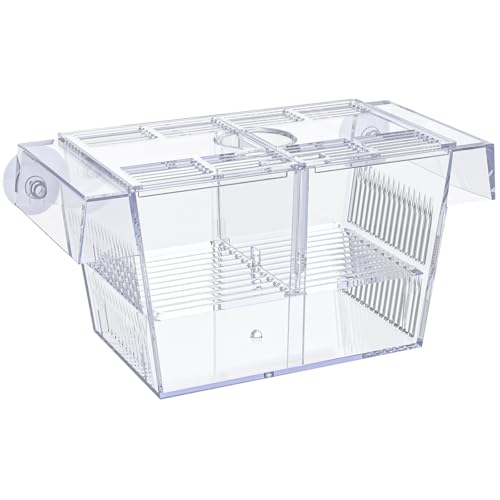
Isolate eggs or fry for safe rearing and easier monitoring.

Hatch live food to feed fry and condition breeding pairs.

Monitor ammonia and pH to ensure healthy breeding conditions.
See today's best deals onAquarium Breeding