A tiny yellow snail clings to a new aquarium plant, no bigger than a grain of rice. It’s a bladder snail, and it’s already laying eggs. One snail becomes hundreds before the owner notices. The tank seems peaceful, then filters clog overnight. Some call them pests; others see living water testers. There’s a reason seasoned keepers watch these snails with wary respect.
At A Glance
- Bladder snails hitchhike on store-bought plants and rocks, entering tanks unnoticed through maintenance gaps.
- These hermaphrodites self-fertilize and lay 40-egg capsules, doubling populations monthly when food is abundant.
- Translucent yellow, left-handed shells under 0.5 inches distinguish them from thicker-shelled, right-handed pond snails.
- They thrive in 64–84°F water with 7.0–8.0 pH and 12–18 dGH hardness for proper shell development.
- Assassin snails, yoyo loaches, and reduced feeding control overpopulation without harmful chemical treatments.
What Are Bladder Snails and How Did They Get Here?
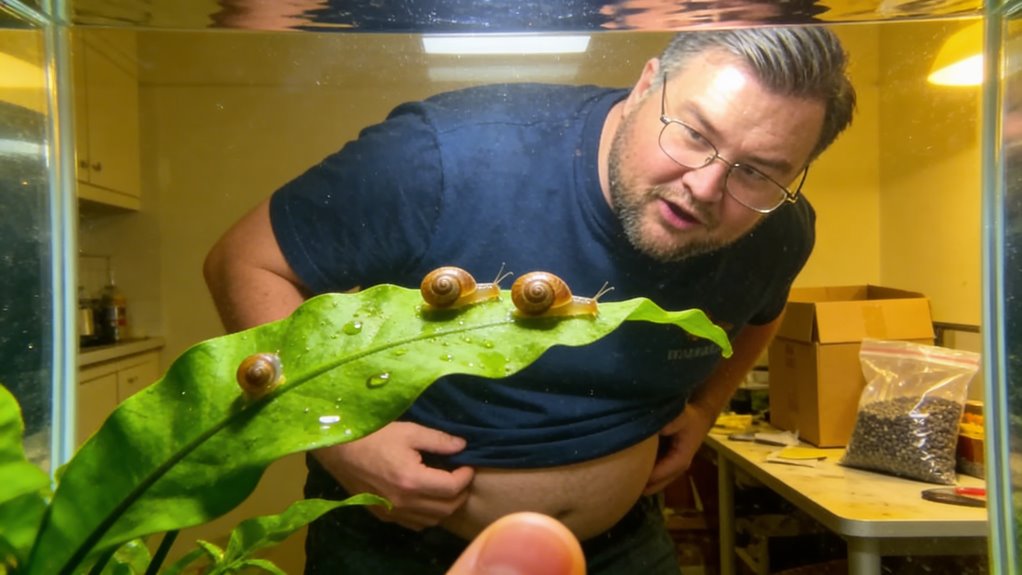
A tiny, glass-yellow shell, no bigger than a pencil eraser, often rides into home aquariums hidden inside a clump of store-bought plants or stuck to the underside of a decorative rock.
Bladder snails aren’t fancy pets someone’s seeking out.
They’re unintended aquarium hitchhikers, stowaways catching free rides across continents through the global plant trade. Their bladder snail origin stretches back to European and Mediterranean freshwater systems, though now they’re nearly everywhere water stays still. A single snail, hardly visible, becomes many. Their translucent bodies, gray with dark splashes, pulse with quiet persistence. No one invites them, yet they belong—reminding us that life finds openings, even the ones we didn’t mean to leave.
Bladder Snails vs. Pond Snails: Identification Guide
When you’re kneeling beside a tank, nose nearly pressed to the glass, it’s easy to mistake one small snail for another.
Bladder snails and pond snails differ in shell morphology and reproductive timing. Bladder snails wear thin, see-through yellow shells, shaped like tiny eggs with left-handed spirals. Pond snails carry thicker, brown shells that twist right. This matters since bladder snails mature faster, laying eggs within weeks, as pond snails wait months.
| Feature | Bladder Snail | Pond Snail |
|---|---|---|
| Shell color | Translucent yellow | Opaque brown |
| Spiral direction | Left (sinistral) | Right (dextral) |
| Size | 0.1–0.5 inches | Up to 2.5 inches |
| Shell thickness | Thin, fragile | Thick, sturdy |
| Trapdoor (operculum) | Absent | Present |
Knowing your snail brings calm confidence to your aquarium community.
Are Bladder Snails Good or Bad for Your Tank?
Small shells on the glass spark big questions in any tank keeper’s mind.
These creatures aren’t simply good or bad, friends, they’re tools that need tending.
Their shell morphology—thin, translucent, sinistral spirals—means they’re delicate, vulnerable, quietly revealing water health through their presence or absence.
Reproductive timing accelerates when food abounds; one snail becomes many in weeks, not months, which feels overwhelming if you’re unprepared.
Yet they scour algae, sift debris, join the tank’s living community without invitation but with purpose.
Keep them welcome through balance, through care, through attention.
Every keeper decides: nourishment or nuisance, companion or chore.
Why Bladder Snail Populations Explode
Though a single bladder snail barely fills a pencil eraser, it carries within its translucent shell the seeds of remarkable increase.
Each snail’s hermaphroditic, meaning one snail fertilizes itself and lays fertile eggs within weeks.
A single capsule holds forty tiny eggs, hidden beneath leaves, invisible until hundreds hatch.
They’re eating machines fueled by leftover fish food, decaying plants, and algae blooms.
Without population control methods like assassin snails or careful feeding, numbers double monthly.
Chemical treatments tempt frustrated keepers, yet poison their fish and disrupt the tank’s living balance.
Understanding this cycle brings calm, not alarm.
Should You Keep or Remove Your Bladder Snails?
Three small snails, no larger than a grain of rice, drift through the water column like tiny balloons filled with hope and air. They ride the current, and aquarists feel that same uncertainty.
Market demand for bladder snails divides the community. Some see pests; others see unpaid janitors. Their snail genetics—resilient, adaptable—mean survival in overlooked corners. They scrub algae, recycle debris, and ask nothing in return.
Yet overpopulation strains filters and patience alike. The choice belongs to each keeper. Balance demands honesty about one’s own limits, and there’s no shame in either welcome or farewell.
How to Care for Bladder Snails You Want to Keep
Since bladder snails often arrive uninvited, their care begins with recognition, not selection.
These small creatures need clean homes, so tank filtration matters. A gentle filter keeps water moving without sucking up baby snails. Snail breeding happens fast, so checking under leaves weekly shows new egg capsules, each holding 10 to 40 tiny eggs.
Feed lightly. Extra food means more snails, and more snails strain the system. Let them eat algae and leftovers instead. One crushed eggshell gives calcium for strong shells.
Keeping them feels like tending a small garden. You didn’t choose them, but you choose kindness now.
Water Conditions Bladder Snails Thrive In
A thermometer pressed against the glass tells you what the snail feels.
Bladder snails need water between 64 and 84 degrees Fahrenheit, the kind that won’t shock their small bodies. Their pH preferences lean toward 7.0 to 8.0, slightly basic water that feels stable and safe. Shell morphology depends on calcium; without it, their thin, translucent homes grow weak and cracked. Hardness of 12-18 dGH gives them the minerals they need to build strong, spiral shells with those four or five left-handed whorls you can count.
| What the water gives | What the snail feels |
|---|---|
| Steady warmth | Safety, like a held hand |
| Proper pH | Balance, like a calm morning |
| Enough calcium | Strength to grow whole |
| Right hardness | Belonging in this small world |
| Clean stability | Peace, finally |
What Bladder Snails Eat (Without Overfeeding Your Tank)
The leftover fish flakes drifting down like tiny snowflakes tell you what the snail already knows.
Bladder snails eat algae, decaying matter, and uneaten food. They find comfort in Algae competition, keeping glass clean alongside fellow scavengers. Their small shells need Calcium supplementation—crushed eggshells or cuttlebone keep them strong. Overfeeding invites trouble; extra food means baby snails everywhere. Feed fish only what they finish in two minutes, and the snail population stays gentle. These helpers belong in balanced tanks, not chaotic ones. Give them purpose through restraint, and they’ll reward you with steady, quiet service.
Which Tank Mates Eat Bladder Snails
Some creatures view the bladder snail not as pest, but as prize.
Assassin snails hunt them patiently, tunneling through gravel with their siphons like straws searching for juice.
Yoyo loaches shred shells with glass-sharp teeth, whereas betta fish pick off hatchlings like berries from low branches.
Green spotted puffers crunch through calcium walls, and crayfish dismantle snails with surgeon claws.
| Predator | Behavior | Feeding Impact |
|---|---|---|
| Assassin snail | Burrows, stalks slowly | 1-3 snails daily |
| Yoyo loach | Active shoaling hunter | 5-10 snails daily |
| Betta fish | Surface ambush | Targets juveniles mainly |
| Green spotted puffer | Crushes shells | 2-4 snails daily |
| Crayfish | Dismantles with claws | Variable, opportunistic |
Predator compatibility shapes community peace. Feeding impact varies by temperament and tank size. Choose hunters matching your water, your plants, your calm.
How to Remove Bladder Snails Completely
Where does one even begin when the tank glitters with shells no one invited? One starts with patience, friend, and a steady hand.
Bladder snails spread through snail migration, hitching on plants, driftwood, or gravel from other tanks. Their shell morphology—thin, translucent, left-handed spirals—makes them easy to miss until they’ve settled in.
To remove them completely, one must break their cycle. Reduce feeding, so scraps don’t call more. Add assassin snails or loaches, letting nature balance itself. Check new plants in quarantine tanks for two weeks. Vacuum gravel weekly, removing egg capsules hidden beneath leaves.
Complete eradication takes six to eight weeks of consistent care. Some find comfort in this rhythm, this tending. The tank becomes theirs again, slowly, through small faithful acts.
How Long Bladder Snails Live and What Extends Lifespan
While bladder snails are small, their lives follow patterns anyone can learn to read.
Most live one to two years, though some pass sooner from stress or hunger. A stable home stretches their timeline, giving them territory to investigate and meals to find.
Most live one to two years—stress and hunger steal time, while stability offers territory to investigate and meals to find.
- Clean water removes poisons that wear snails down quickly.
- Steady food—algae, debris, leftovers—fuels their days without forcing desperate searches.
- Calcium sources, like crushed eggshells or cuttlefish bone, build strong shells that protect their soft bodies.
- Moderate numbers prevent overcrowding, reducing competition that shortens life.
These small creatures teach patience: gentle care returns steady presence in the tank’s quiet corners.
Frequently Asked Questions
Can Bladder Snails Survive Out of Water?
No, bladder snails can’t survive out of water long-term. Their water tolerance depends on dampness retention, since oxygen diffusion requires wet surfaces. They’re pulmonary snails, breathing air, yet desiccation resistance remains low. Shell integrity weakens without calcium-rich water. Temperature tolerance drops outside 64-84°F ranges. Brief escapes happen—snails float, crawl out—but they retreat quickly. Survival beyond hours proves rare, feeling like a quiet desperation, dampness fleeing, life shrinking.
Do Bladder Snails Sleep or Rest During the Day?
Bladder snails don’t sleep like people do, but they’ve got rest rhythms all their own. Their day cycle includes periods of daytime inactivity where they slow down, cling to plants or glass, and take rest periods. These rest patterns aren’t true sleep behavior—more like quiet moments in their rest cycles. Their diurnal rest comes between bursts of scavenging, showing rest tendencies that help them save energy while staying alert.
Why Do Bladder Snails Float Upside Down Sometimes?
Bladder snails float upside down when they’ve gulped air into their lung, creating bubble-gas dynamics that pull them to the surface. They’re pulmonary snails, so they breathe air like we do, and sometimes they hold too much.
When this happens, the trapped air prevents proper substrate adhesion, leaving them bobbing helplessly until they release the bubble. It’s not illness, just a temporary buoyancy mishap, and they’ll right themselves when ready.
Can Bladder Snails Carry Diseases Harmful to Fish?
Bladder snails don’t commonly carry diseases that’ll hurt fish directly. They aren’t typical pathogen vectors for aquarium illnesses.
However, they can contribute to disease transmission indirectly. When water quality degrades from snail overpopulation—excess waste, ammonia spikes—fish become stressed and vulnerable to sickness. The snails themselves aren’t the disease, but their numbers can signal conditions where fish fall ill. Managing their population protects everyone’s health.
How Do Bladder Snails Find Food Without Eyes on Tentacles?
Bladder snails find food through chemical detection, not eyes. Their thread-like tentacles wave through water, picking up chemicalal cues from decaying plants, algae, or leftover fish food. These signals tell the snail exactly where to crawl, like a nose following fresh-baked cookies. They’ll stay put until every bit’s gone, feeling satisfied and purposeful in their slow, steady search.
Rounding Up
Bladder snails measure ½ inch at maturity, no operculum protecting soft tissue. One hermaphrodite lays 40 eggs monthly in calcium-rich water above 7 pH, doubling populations fast. They hitchhike on store plants, spreading worldwide since European origin. Control means manual removal, assassin snails, or loaches—predators eat the thin shells. Clean substrate, skip overfeeding, maintain 64-84°F. They’re scavengers, not villains; overpopulation signals imbalance, not invasion. Keep them if algae control matters, remove if filters clog. lifespan tops 2 years. Aquarium ecosystems teach restraint: observe, adjust, coexist.