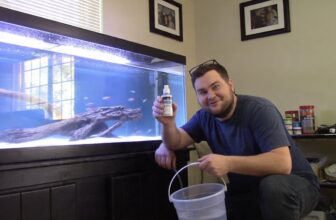
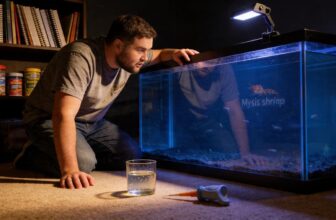
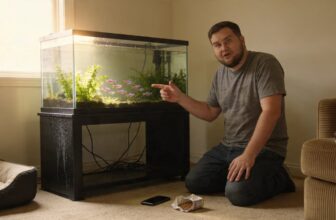
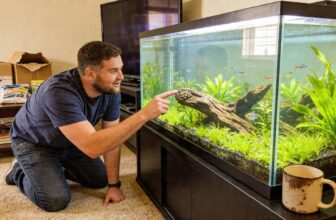
The Aqueon MiniBow 5 edges out the competition at roughly $60–$75, and here’s why: it’s got SmartClean filtration—lift a cartridge, water drains out the base, no buckets, no tears—plus a raised base that’ll actually keep your desk dry, unlike that “leak‑proof” mug you still have nightmares about. The low‑profile LED hood won’t bulk up your workspace, and the complete kit means you won’t be three Amazon tabs deep, wondering why a separate filter costs more than your groceries.
Temperature swings hit five‑gallon tanks hard—water heats fast, cools faster—so stick to a betta or a shrimp squad, cap it at five small fish max, and you’ll dodge the “soup kitchen” summer meltdown. Weekly 25–30% water changes keep things crisp, the gravel vac handles the rest, and you’ll spend more time watching your fish than wrestling with maintenance.
For desk dwellers who want sleek, simple, and under a Benjamin, this is your tank—though the why and how of keeping it alive gets more interesting from here.
At A Glance
- Our top pick is the Aqueon MiniBow 5 for its SmartClean system, low-profile LED, and sleek raised base.
- Koller 6-Gal AquaView 360 offers 360° visibility and three-stage filtration at excellent value.
- Marineland Portrait 5 features hidden filtration and quiet operation for minimalist aesthetics.
- Complete kits under $90 bundle filter, heater, and lighting, beating separate purchase costs.
- Weekly 25-30% water changes maintain crystal-clear water in compact 5-gallon setups.
What Makes a Small Fish Tank Worth Buying?
A small fish tank is worth your money if it fits your life without turning you into a reluctant janitor. You’re buying peace, not assignment.
Small tanks win on price comparison—you’re looking at $40–$80 versus triple digits for serious setups. That’s coffee money, not car payment.
Small tanks run $40–$80, not triple digits. Coffee money, not car payment.
Aquarium aesthetics matter since this thing lives where you live. A sleek 5‑gallon on your desk beats a bulky eyesore you’ll hide behind a fern. LED lighting, hidden filtration, clean lines—you want guests to notice, not pity you.
Bottom line: buy smart, not small for small’s sake.
Look for models with three‑stage filtration to ensure comprehensive debris and chemical removal with minimal effort.
Why the Aqueon MiniBow Won Our Top Spot
While plenty of tanks claim to be beginner-friendly, the Aqueon MiniBow actually delivers without the usual headaches. You’ll appreciate the user friendly assembly—seriously, no engineering degree required, just snap, click, done.
| Feature | Why It Matters |
|---|---|
| Raised base | Keeps your floor dry, looks sleek |
| Low-profile LED hood | Clean lighting without bulk |
| Complete kit included | You start immediately |
The Aqueon MiniBow nails design aesthetics, balancing compact footprint with modern lines that won’t clash with your decor. For extra jump prevention and light transmission, consider adding a clear mesh lid from our recommended covers. It’s the tank that welcomes you into the hobby without the “what did I get myself into?” regret.
SmartClean Filtration: 2-Minute Water Changes Explained
If you’ve ever postponed a water change since it felt like too much work, you’re not alone, and honestly, we’ve all been there, staring at the bucket like it’s a personal insult.
Enter SmartClean efficiency. The Aqueon MiniBow’s built-in system makes your 2‑minute waterChange actually—wait for it—two minutes. Here’s how you join the low-maintenance club:
- Lift the filter cartridge; water drains through the base.
- Remove 30% of water without disturbing your fish. (They’ll thank you, probably.)
- Pour fresh, treated water back in.
- Snap the cartridge down; you’re done before your coffee cools.
Small tank, zero excuses.
You can also use a water conditioner like Seachem Stability to prevent New Tank Syndrome during water changes.
Which Fish Actually Thrive in 5 Gallons?
Five gallons isn’t a mansion, but it’s not a closet either—you just need to know who actually belongs there.
Skip the goldfish, seriously, they’re messy roommates. Betta splendens? Now you’ve found your people. Fancy types thrive here, fin‑nipping tankmates need not apply. Shrimp colonies—cherry, cherry, amano—build little societies you’ll actually watch. Small snails, nerite or mystery, keep glass clean without drama.
Goldfish are out, bettas are in—fancy fins, shrimp societies, and snails that actually clean up their act.
Your fish tank health depends on picking residents who won’t outgrow these ps tank designs. One betta, maybe five shrimp, done. Overstocking kills the vibe, and the fish. Bottom line: less is more, choose wisely, enjoy the tiny world you’ve built. For micro tanks, gentle filtration mimics slow streams and protects delicate residents from strong currents.
6 Best Small Fish Tanks: Ranked for Beginners
Where do you even start when every aquarium claims it’s “perfect for beginners”? You’ve got six solid options here, and we’ve ranked them by how forgiving they’ll be when you inevitably forget a water change. Here’s your field guide:
- Koller 6-Gal AquaView 360 — 360° design, budget aesthetics that don’t scream “dorm room,” and a detachable base for easy cleaning
- Aqueon MiniBow 5 — SmartClean tech, low-profile LED, raised base for desktop placement
- Marineland Portrait 5 — Hidden filtration, sleek glass, quiet operation
- Tetra Crescent — Curved front, starter kit value, compact footprint
You’ll notice we skipped the minuscule 1-gallon torture chambers. Your fish deserve better, and frankly, so does your sanity. For advanced setups, an optional Inland Seas plumbing kit allows hidden rear plumbing for a cleaner aesthetic.
What the 6-Gal Koller AquaView Does Best
When you’re hunting for a starter tank that doesn’t punish every rookie mistake, the Koller 6‑Gal AquaView 360 leans hard into one simple promise— you can actually see your fish from any angle, and you won’t need a master’s degree in plumbing to keep it running.
This polycarbonate cylinder delivers true 360° visibility, wrapping unobstructed views into a designelt design that mimics glass without the weight or shatter risk.
You’ll appreciate the price competitiveness, too—under fifty bucks lands you a complete kit with a surprisingly competent three‑stage filter. The detachable base pops off in seconds, since nobody enjoys wrestling tanks during water changes. Hook shelving, desktops, cramped apartments—it fits where bulky kits won’t.
Beginners find immediate community here, sharing setups rather than troubleshooting nightmares. The learning curve stays gentle, the costs stay low, and your living room stays un‑flooded.
Acrylic offers >90 % light transmission and is less prone to cracking than standard glass.
LED Lighting for Small Tanks: Essential vs. Gimmick Features
Here’s what actually earns your dollars:
- White and blue diodes only—skip the RGB circus
- LED longevity rated 20,000+ hours, or you’re buying twice
- Adjustable brightness, since your betta isn’t clubbing
- Built-in timer options (4hr/8hr/always-on), not memory-sucking remotes
If you want reliable performance at a low cost, an option like the Pawfly 11 W clip‑on delivers respectable PAR for low‑demand plants without the extra flash.
Spend $20-40 on clean white-blue systems. Your fish sleep normal, and you skip the regret.
Small Tank Pollution: How Fast Until Water Quality Crashes?
Since you’ve squeezed a living ecosystem into something smaller than a shoebox, you’re basically running a chemistry experiment with no margin for error—small tank pollution doesn’t creep up on you, it sprints.
Fish biology works against you here. Your pets eat, they poop, ammonia spikes—sometimes within 24 hours. In a 5‑gallon tank, one missed feeding clouding the water chemistry can crash everything.
You’re testing like a mad scientist, or you’re losing fish. No middle ground.
- Ammonia/nitrite: deadly at 0.25 ppm, which hits fast
- Biofiltration: barely established in tiny volumes
- Fix: 30% water changes twice weekly, minimum
Bottom line: you wanted low maintenance, you got a part‑time job.
To avoid this, consistently apply the two‑minute rule to prevent uneaten food from generating waste.
Temperature Swings: Why Small Tanks Overheat Faster
A cup of coffee goes lukewarm in minutes, and your 5‑gallon tank? It mirrors the drama. Small volume means zero thermal stability—you’re managing rapid temperature fluctuations that stress your fish and test your sanity, no padded cell required.
Small volume, zero thermal stability—rapid temperature swings that stress your fish and test your sanity.
Here’s why you’re sweating:
- Less water mass equals faster heat absorption from lights, sun, or that vent you forgot about.
- Your heater cycles on, off, on—tiny tanks can’t smooth the spikes.
- Room temp swings hit hard; there’s no buffer, like a bicycle with no helmet.
- Summer afternoons turn your desktop oasis into a soup kitchen.
Buy a reliable heater, park the tank away from windows, and join the club of paranoid thermometer-checkers. Welcome.
A temperature display helps you monitor these rapid changes, as seen on some smart aquarium models.
Water Change Schedule: How Often Is Too Often?
If you’re staring at your 5-gallon tank wondering whether to change water weekly, daily, or perhaps every full moon, you’re asking the right question—and probably overthinking it. You’re part of a community that wants thriving fish, not chemistry experiments.
For consistent feeding, an automatic feeder with USB charging eliminates disposable battery waste and supports long trips.
Here’s your cheat sheet:
| Tank Size | Change Frequency | Volume to Replace |
|---|---|---|
| 5 gallons | Weekly | 25-30% |
| 5 gallons, heavy stock | Twice weekly | 20% |
| With budget filter | Weekly minimum | 30% |
| Crystal-clear goal | Weekly + spot clean | 25% |
| Post-feeding cloudiness | Immediate partial | 10-15% |
Your Aqueon’s SmartClean tech helps, but don’t skip weeks. A cheap filter works harder when you’re consistent. Test strips beat guessing. Clean water keeps fish alive, and honestly, that’s the whole point.
Overstocking Rules: How Many Fish per Gallon?
You’ve nailed the water change rhythm, but now you’re staring at that Aqueon MiniBow 5-gallon, wondering how many neon tetras you can cram in before things go sideways. Spoiler: fewer than you hope.
Stock density guidelines aren’t suggestions—they’re survival math. Fish species ratios matter more than gallons per fish.
Four hard truths:
- That 5-gallon tank holds about 4-5 small fish, max.
- Neon tetras need schools of six, so… yeah, math hurts.
- Subtract filter space; you’re working with four actual gallons.
- Bioload spikes fast in cramped quarters.
Overstock and you’ll join the walking dead of hobbyists, wondering why everyone’s floating.
Cleaning Without the Mess: Gravel Vac and Algae Tips
How do you manage to make more of a mess cleaning the aquarium than your fish do living in it? We’ve all been there—water everywhere, gravel scattered, dignity lost. Here’s the fix.
Grab a gravel vacuum (basically a siphon with a wide tube), and you’ll suck debris straight from the substrate without dumping half your tank. For algae control, scrub weekly with a magnetic glass cleaner, limit light to 8 hours daily, and don’t overfeed—that’s free fertilizer for green gunk.
Small tanks punish sloppy habits. Stay consistent, and you’ll spend more time enjoying your fish than apologizing to your desk.
Complete Kit vs. Separate Components: Real Cost Breakdown
You’ve got the siphon down, the glass is spotless, and now you’re staring at the real puzzle—do you grab a boxed kit with everything included or build your own setup piece by piece? Let’s crack this budget cost mystery without putting you to sleep.
Complete Kit Wins When:
- You’re chasing simplicity, not glory
- DIY assembly sounds like a Saturday you’d rather forget
- Matching filters to tanks feels like algebra
- You’d rather spend $60–90 once than hunt bargains
Kits like the AquaView 360 or Aqueon MiniBow bundle essentials—filter, LED, hood—at prices DIY rarely beats. Buying separate? You’ll nickel-and-dime past $120 fast. If you’re oddly passionate about comparing flow rates at 2 AM, kits keep you sane and swimming sooner.
First Tank Setup: 10 Steps From Unbox to First Fish
Where do you even start once that box lands on your doorstep?
First, breathe. You’re joining thousands who’ve fumbled through this.
Your 10-step setup:
- Budget realistically—kits cost $30–$80, but budgetfish species add $5–$15.
- Inspect everything; missing parts kill momentum.
- Rinse gravel, décor—no soap, ever.
- Position your aquarium away from windows; temperature swings wreck health.
- Install filtration first—it’s your lifeline.
- Fill slowly, treat water with conditioner.
- Cycle 2–4 weeks; patience prevents heartbreak.
- Test parameters; stability beats perfection.
- Add compatible species slowly—research compatibility obsessively.
- Maintain weekly; cleaning’s easier than recovery.
Lighting? Match your aesthetics, not coral-reef dreams.
Bottom line: rush the setup, mourn the fish.
Frequently Asked Questions
Can I Keep a Turtle in a 5-Gallon Tank?
No, you can’t keep a turtle in a 5-gallon tank.
Even a tiny turtle needs way more space—think 10 gallons per inch of shell, minimum.
Your turtle will outgrow that fast, and tank filtration can’t handle the waste load; turtles are messy, like tiny underwater roommates who never flush.
You’ll face ammonia spikes, stunted growth, and a cranky reptile.
Upgrade to 20+ gallons, or try a fish instead.
Do Small Tanks Need an Air Pump or Bubbler?
You’re unboxing your 5-gallon kit, wondering if bubbles are mandatory. Verdict: you don’t need an air pump, technically, if your filter pump agitates the surface, but you’ll face trickier filter maintenance without one.
We hobbyists know stagnant water kills fish, so a bubbler helps, especially in compact tanks.
Skip it, and you’re cleaning weekly—trust me, I’ve learned the hard way. Just grab one, your fish will thank you.
How Long Should I Cycle Before Adding Fish?
You’ll want to cycle for 4–6 weeks before adding fish.
The nitrogen cycle timing matters—your tank’s invisible ecosystem needs that long to establish beneficial bacteria that convert toxic ammonia to safer nitrates. Test daily; you’ll know the cycle duration is complete when ammonia and nitrite hit zero, nitrates appear, then you’re set.
Patience wins here. Trust the process, test your water, don’t rush—your future fish will thank you, probably silently, since they’re fish.
What’s the Best Location to Avoid Direct Sunlight?
Pick a spot away from windows, and you’ll dodge algae blooms and temperature swings that stress your fish.
- Sunlight avoidance means choosing interior walls or shaded corners, where harsh rays won’t trigger green water nightmares or overheat your tank
- Temperature control stays manageable in stable room temps, protecting sensitive bettas from baking in afternoon sun or chilling near drafts
East-facing rooms work if you use sheer curtains, but basements and hallways beat south windows every time.
Can I Use Tap Water Without Conditioner?
Don’t do it. Tap water contains chlorine, a chemical disinfectant that burns fish gills—think of it as inhaling bleach fumes, not fun.
You’ll need conditioner. It neutralizes chlorine instantly, plus tackles chloramine and heavy metals.
Water hardness and pH matter too. Most fish tolerate 6.5–7.5 pH, but sudden swings kill faster than steady “wrong” numbers. Test kits run $10–15, cheap insurance against tank disasters.
Bottom line: condition every time, no exceptions.
Rounding Up
The Aqueon MiniBow wins, hands down. SmartClean saves your sanity, two-minute water changes beat syphon spills, and your fish won’t cook in summer heat. Remember: good things come in small packages, but only if you’re not cramming ten neon tetras into a shoebox. Stick to five gallons minimum, one betta or six shrimp, and you’ll actually enjoy this hobby.
Bottom line: Start here, start smart, skip the regret.