You hold a tiny, striped shell no bigger than a grape, and inside waits a hunter that will spend three years patrolling your aquarium sand. Assassin snails operate with patience you might recognize, waiting until dark to burrow and stalk, their foot sensing vibrations like fingers reading braille, then drilling through prey shells with a straw-like tongue called a proboscis. They need room, ten gallons each, plus five more for every pair, and sand grains between half and two millimeters so they can tunnel properly. The wrong gravel traps them, the wrong neighbors eat them, and overfeeding spoils their useful hunger. What makes them breed remains quietly mysterious.
At A Glance
- Keep assassin snails in fine sand substrate at least 2 inches deep for healthy burrowing behavior.
- Feed 2-3 live pest snails weekly plus supplemental protein to maintain proper nutrition.
- Maintain stable water parameters between 70-80°F and pH 6.5-7.5 with adequate calcium.
- House in minimum 10 gallons per snail with gentle flow, driftwood caves, and dim lighting.
- Expect 2-3 year lifespan with balanced care, potentially reaching 5 years under excellent conditions.
What Is an Assassin Snail? (Identification & Behavior)
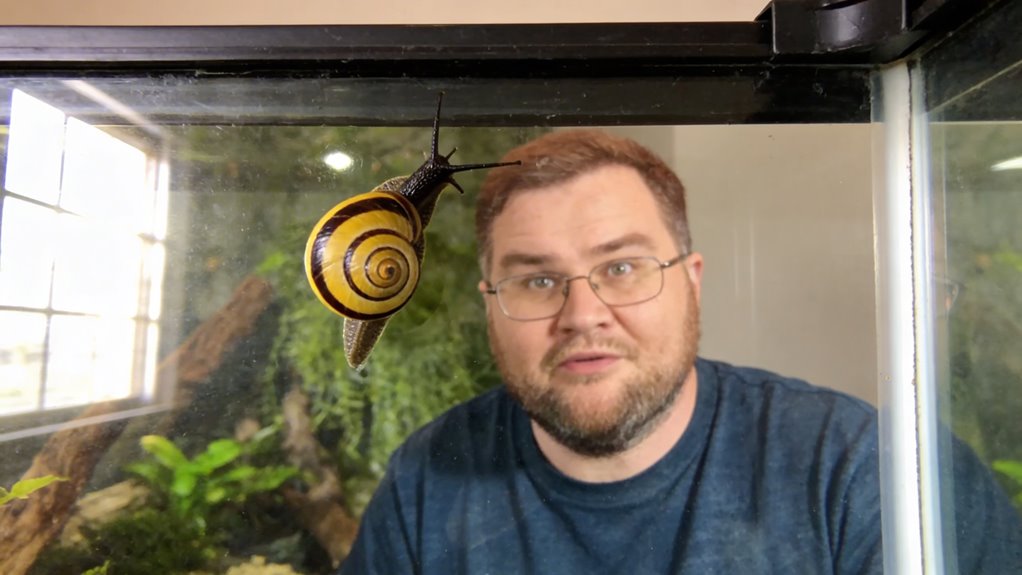
The assassin snail stands out in your tank like a tiny, striped sentinel. Its conical shell wears brown and yellow bands, earning the nickname “Bumblebee Snail,” and you might feel a small thrill spotting that pattern against your sand.
That shell isn’t just pretty; it’s snail camouflage that helps the assassin blend into leaf litter, waiting. Your snail’s body, light beige with dark speckles, disappears against the substrate too.
You’ll mostly observe nocturnal activity, since these creatures hide by day. They burrow into fine sand, emerging after dark to investigate. This rhythm feels peaceful, like sharing space with a quiet roommate who keeps their own schedule.
How Do Assassin Snails Control Pest Snails?
Your assassin snail‘s patient hiding pays off when tiny trumpet snails begin covering your glass. You watch your tank transform through natural pest suppression, feeling part of a balanced underwater world. Your assassin emerges, soft foot pressing forward, hunting with slow precision.
- Burrow and wait: You see it sink into sand, becoming invisible patience.
- Track vibration: Your snail feels prey moving through the glass.
- Seize and consume: The proboscis strikes, drilling into pest shells for protein.
- Reduce reproduction: You notice fewer eggs, less crowding.
This ecological impact restores harmony without chemicals. You belong to something ancient, watching cycles complete themselves.
How Long Do Assassin Snails Live?
When you lift the tank lid to drop in flakes, you might spot your assassin snail clinging to glass, its striped shell no bigger than a fingertip. You’re witnessing a creature that can accompany you for years with proper care.
Most assassin snails live two to three years, though some reach five. Longevity genetics play a role, as does your attention to their needs. Lifespan variation depends heavily on diet and water quality.
| Factor | Impact on Years |
|---|---|
| Poor diet | Often under 2 years |
| Balanced feeding | 2–3 years typical |
| Excellent care | Up to 5 years |
| Stable parameters | Extends longevity |
What Tank Size Do Assassin Snails Need?
A kitchen measuring cup holds eight ounces, but you’ll need something much bigger for these striped hunters.
You’ll want at least 10 gallons for one assassin snail, that’s your starting tank capacity.
Add 5 more gallons for every pair you keep, that’s how you respect the ideal size limits.
Space is respect: five extra gallons per pair, no exceptions.
Here’s what fellow keepers have learned:
- One snail, 10 gallons—simple start
- Two snails, 15 gallons—room to roam
- Six snails, 30 gallons—the sweet spot for breeding
- More than eight, consider 40+ gallons—crowding causes stress
You belong in this community when you give your hunters space to thrive.
Why Do Assassin Snails Need Fine Sand Substrate?
The measuring cup you set aside earlier won’t help here, but the sand in your hand matters more than you’d expect.
You need fine sand as your snail’s burrowing behavior depends on it. The correct substrate grain size lets them vanish completely, waiting for prey. Coarse gravel tears their soft bodies, leaving them exposed and afraid.
| What You Imagine | What Actually Happens | What Your Snail Feels |
|---|---|---|
| Gravel looks natural | Tentacles scrape, wounds form | Pain, hiding above ground |
| Sand seems messy | They burrow in seconds | Safety, belonging, peace |
| Any bottom works | Wrong grains block instinct | Stress, shortened life |
| Deeper layers hide nothing | Two inches minimum depth | True home, real rest |
| You decide aesthetic | They decide survival | Trust, or its absence |
Choose sand between 0.5 and 2 millimeters, two inches deep. You’ll watch them thrive, not merely survive.
What Water Conditions Keep Them Healthy?
Your thermometer and test strips sit on the counter, waiting like tools for a familiar task. You want your assassin snails to thrive, not just survive, in the community you’ve built.
- Keep the water between 70–80°F, as temperature stability matters more than hitting one perfect number.
- Hold pH balance at 6.5–7.5, and mind your calcium hardness so their striped shells grow strong.
- Run a filter with filtration efficiency that maintains gentle flow rate; they dislike wrestling with current.
- Stay faithful with water changes, watch nitrate control, and notice you feel calm when routines protect fragile lives.
What Do Assassin Snails Eat? (Diet Beyond Pest Snails)
Clean water keeps a body sound, but no creature lives on care alone. Your assassin snail needs real food, and you can provide it.
These hunters love pest snails, three or four weekly, crushed for easy eating. When those run low, you’ll watch them accept bloodworms, brine shrimp, or sinking carnivore pellets every second day. They don’t eat plants, so your java fern stays safe.
Wormalgae consumption happens sometimes, a small bit of debris from the glass, but don’t rely on it. Nututrient enrichment comes from varied protein sources, keeping their conical shell strong and that bumblebee stripe bright.
You’re part of their survival now.
Which Fish Are Safe With Assassin Snails?
Choosing tank mates demands patience, since you want peace beneath the water’s surface.
Building a peaceful aquarium community requires careful patience and thoughtful selection of compatible tank inhabitants.
You must study aqu behaviors, since every creature has habits that shape your tank’s harmony. Assassin snails move slowly, burrow in sand, and ignore fish entirely. Their compatibility shines with gentle neighbors who won’t nip shells or compete for territory.
Consider these safe companions:
- Neon Tetras — small, peaceful swimmers who stay above your snails.
- Corydoras Catfish — gentle bottom-feeders that scavenge without disturbing buried friends.
- Guppies — colorful, calm fish who add life without threat.
- Cherry Barbs — active but kind, creating community without chaos.
You’re building a home where everyone belongs.
How Do Assassin Snails Breed in Captivity?
When you understand how these striped hunters make new life, you’ll feel a quiet wonder at nature’s patience.
You’ll notice their breeding patterns begin with a slow movement, one snail following another for hours across glass or stone. You can’t tell male from female by shell coloration or size, so you keep six or more together and trust chance.
The female glues her yellowish egg capsule, about the size of a sesame seed, to something solid. You wait roughly four weeks. Then you spot tiny replicas, no bigger than a grain of rice, burrowing into sand.
How Many Assassin Snails Should You Start With?
Where exactly do you place your first few assassin snails so they thrive, not merely survive? You start with six, minimum, tucked into a ten-gallon tank with fine sand. Their brown and yellow stripe patterns, the charming “bumblebee” snail coloration, ripple through your water like living ribbons. You’re building a little society here, watching them burrow and emerge at dusk. The tank aesthetics deepen with their slow, deliberate presence.
Here’s your starter plan:
- Count six snails for good breeding odds
- Add five gallons per two extra snails
- Choose fine sand, half-inch deep minimum
- Position them near driftwood, where they feel hidden and safe
5 Assassin Snail Care Mistakes to Avoid
The assassin snail’s operculum—that hard little trap door on its shell—needs you to notice it, since this lid tells you when something’s wrong.
You hurt these little hunters when you choose wrong.
| Mistake | Why It Matters | What You Do Instead |
|---|---|---|
| Over substrate | Coarse gravel tears their tentacles, stops burrowing | Fine sand, 1-2 inches deep |
| Wrong feeding | They starve without enough pest snails to hunt, or overeat and foul water | 2-3 pest snails weekly per assassin |
| Ignoring predator behavior | They hide, stop hunting, feel unsafe | Dim lights, give driftwood caves |
| Mixing with true predators | Cichlids, loaches eat them, end their 2-5 year life early | Gentle fish like tetras, Corydoras |
You belong to a circle of people who notice small lives.
Frequently Asked Questions
Will Assassin Snails Eat My Aquarium Plants?
No, assassin snails won’t eat your aquarium plants. Their plant control behavior focuses on hunting other snails, not greenery. Since they’re carnivores, you can relax about your vegetation. Their habitat preferences include burrowing in sand and hiding near rocks, leaving leaves alone. You’ll notice them ignoring plants entirely, even at night when they’re most active. Your aquatic garden stays safe as they patrol for pests.
Do Assassin Snails Carry Diseases Harmful to Fish?
Assassin snails pose minimal disease transmission threat to your fish. These critters don’t carry significant pathogen risk, unlike some wild-caught species, since most aquarium stock is captive-bred. You’ll want to quarantine any new snail for two weeks, just like you’d isolate a new kitten from your household pets. This simple habit protects your whole tank community. Healthy assassins keep themselves, your fish—they’re safe neighbors in your underwater home.
Can Assassin Snails Flip Themselves if Upside Down?
You’ll notice your assassin snail struggling when it’s flipped, but don’t worry, it’ll manage. Its muscular foot pushes against surfaces, as shell mechanics help with balance. Their behavior behavior shows patience—they’ll slowly twist, using the operculum as exploit. It takes time, sometimes minutes, and they might need nearby rocks or plants to grip. They feel vulnerable upside down, but they persist, righting themselves eventually unless the surface is too smooth.
Why Did My Assassin Snail Stop Moving?
Your assassin snail likely stopped moving because of movement stress or shell damage, both common in aquarium life. Check if the temperature stays between 70–80°F, as cold water slows their metabolism dramatically. Inspect the shell for cracks or erosion, which cause pain and hiding. Make sure you’ve fed them live prey lately—hunger weakens them. They’ll recover with stable conditions, like a neighbor needing quiet after a hard day.
Are Assassin Snails Legal in All States?
No, assassin snails aren’t legal everywhere. You’ll need to check regulation variation in your state, since some places ban them. Certain areas enforce habitat restrictions, fearing they’ll harm local ecosystems if released. Before you buy, contact your state’s wildlife agency, and you’ll feel relieved knowing you’ve done right by your community.
Rounding Up
A small, yellow-striped shell sits on your palm, warmed by your own heat.
You have learned the slow work of patience now—how these hunters need soft sand, steady water, and time measured in years, not days. You know the mistake of rushing, the comfort of gentle fish nearby, the quiet pride when baby snails appear.
Keep your tank clean, your hands gentle, your expectations modest.
Your assassin snails will reward you with calm purpose, a five-year promise kept in glass.