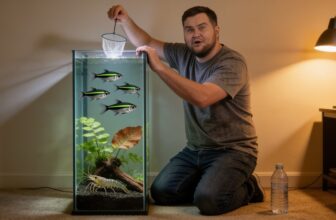
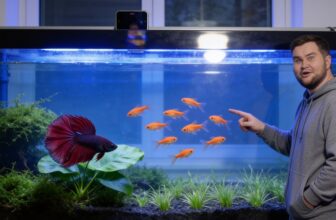
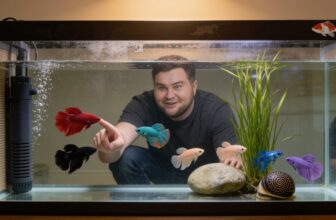
Your GloFish aren’t born mean, but stress flips their switch.
Bright LEDs feel like an interrogation room to these genetically fluorescent fish, cramped tanks turn them into cage fighters, and undersized schools—fewer than six—make Tiger Barbs especially vicious fin-nippers.
Tetras and Danios stay calmer but snap when water quality crashes or they’re crowded.
The fix?
Bigger schools diffuse tension, dim lighting with floating plants cuts anxiety, and 20+ gallons gives everyone personal space.
Ignore this and you’ll own a neon gladiator arena; apply it and they go back to being low-drama showpieces.
There’s more to the story below.
At A Glance
- GloFish are naturally peaceful but turn aggressive when stressed by bright lights, overcrowding, or poor food distribution.
- Tiger Barb GloFish show the highest aggression, frequently chasing and fin-nipping weaker tank mates.
- Schools below six fish trigger bullying behavior, while proper groups of six to eight reduce territorial conflict.
- Harsh LED lighting amplifies anxiety due to genetic fluorescence modifications, making dim, shaded environments essential.
- Water quality crashes, especially pH spikes and nitrate buildup, act as chemical stressors that spark aggressive reactions.
GloFish Temperament: Naturally Peaceful But Prone to Stress Aggression
When GloFish carry a reputation for being the neon‑lit wallflowers of the aquarium world, you’ll find they’re typically peaceful creatures—until stress flips their switch.
Their genetic variation—basically, the lab‑tweaked DNA that makes them glow—doesn’t make them mean, but it can heighten light sensitivity, and harsh lighting? That’s asking for trouble, my friend. Using lights with predictable light rhythms can help reduce fish stress and maintain calm behavior.
You’re dealing with fish that want community, not conflict.
Stress aggression comes from elsewhere—overcrowding, skittish tank mates, or that one guy hogging the food.
Stress aggression comes from overcrowding, skittish tank mates, or that one guy hogging the food.
They aren’t born fighters; they’re pushed.
Give them space, keep things calm, and you’ll see those colors shine without the drama.
Which GloFish Species Show the Most Aggression?
Not all GloFish play nice, and if you’re stocking a tank, you’ll want to know who’s likely to start the trouble.
Tiger Barb GloFish top the naughty list. You’ll see them chase, nip fins, and typically act like tank bullies when stressed. Their breeding genetics trace back to naturally feisty barb species—no amount of neon glow changes that wiring.
Tetras and Danios? Much chiller crew, though even they’ll snap under pressure.
Here’s the kicker: lighting influence matters more than you’d think. Harsh, bright LEDs crank everyone’s anxiety to eleven, turning mild-mannered fish into jerks. Dim it down, add plants for shadowy hideouts, and you’ll cut the drama significantly. Adding floating plants to create dappled shade can further reduce stress.
Barbs need bigger schools—six minimum, ten’s better—to spread aggression around. Skip that, and you’re basically running a fish fight club.
Bottom line: pick Tetras or Danios for peace, Barbs only if you’re ready to manage their attitude.
Tank Size: The Foundation That Prevents Most Aggression Problems
You’ve sized up which fish bring the attitude, now let’s talk about the real estate that keeps them from acting on it. Cramped quarters turn peaceful GloFish into grumpy roommates fighting over elbow room. You need space—or you’ll watch your neon investment turn into a gladiator pit.
| Tank Size | Stocking Limit | Why It Matters |
|---|---|---|
| 10 gallons | 6 small GloFish | Minimum survival, not thriving |
| 20 gallons | 10-12 fish | Room to establish personal bubbles |
| 30 gallons | 15-18 fish | Schools spread out, tension drops |
| 40+ gallons | 20+ fish | Territorial instincts fade |
| 55+ gallons | Mixed community | Your lighting filtration handles bioload, light intensity stays adjustable |
Bigger tanks forgive your mistakes. Skimp on space, and you’re the referee in a tank-wide grudge match nobody wins. For example, the GloFish 20‑gallon Curved System includes a quiet, low‑noise pump and three LED modes that help maintain stable conditions, reducing stress and aggression.
Why Your GloFish Barb Keeps Fin Nipping (And How to Stop It)
If you’ve got a GloFish Barb, you’ve probably watched it turn into a tiny aquatic chainsaw, and you’re wondering what you did wrong. You’re not alone—Barbs are notorious fin nippers when stressed.
You need to check these triggers:
- School too small—Barbs get anxious alone, they need six-plus buddies
- Color triggers—hyper-bright GloFish colors can overstimulate tankmates
- Lighting adjustments—harsh 24/7 glow stresses everyone out
- Boredom—no plants to break sightlines means chase city
- Wrong tankmates—long-finned fish look like snack ribbons to them
Dim those LEDs, add a timer, and school up properly. Your Barb’s just nervous, not evil. To further reduce stress, ensure your substrate is soft, fine sand which protects delicate barbels and encourages natural foraging.
How School Size Affects Stress and Aggression in Barbs and Tetras
Barbs and Tetras aren’t wired to go solo. School density matters—too few fish, and stress spikes; too many, and crowding impact triggers chaos.
You need balanced group dynamics for proper stress reduction. Five to six fish minimum, tough eight to ten’s your sweet spot. Here’s what changes:
- Social hierarchy finds its groove, reducing jostling for rank
- Collective behavior distributes environmental pressure across the shoal
- Stress mitigation happens naturally when fish feel safe in numbers
- Aggression triggers fade as aggression control becomes self-regulating
Maintaining a minimum group size of six to eight fish is essential for safety and social health.
Small schools? Your Barbs turn into fin-ripping bullies. Tetras? They just hide, stressed and pale.
Bottom line: skimp on school size, and you’re asking for trouble.
Water Quality Problems That Turn GloFish Aggressive
Water quality isn’t just about keeping fish alive—it’s about keeping them sane, and when you let things slip, your GloFish transform from glowing ornaments into gladiators.
Water quality isn’t about survival—it’s about sanity. Let it slip, and your GloFish become gladiators.
pH spikes crank their stress to eleven, making them lash out at tankmates they’d normally ignore. You’re basically asking them to live in a chemical thunderstorm. Nutrient imbalance? That’s algae-fueled chaos, and suffocating fish bite first, ask questions later. You’re part of a community that doesn’t gaslight fish into aggression, right?
- Test water weekly with liquid kits, strips lie
- Change 25% weekly, not just when it looks gross
- Buffer pH slowly, no dramatic swings
- Feed sparingly, excess nutrients wreck balance
- Quarantine new plants, they’re Trojan horses for trouble
Stable water equals stable fish. Period.
Using lab-accurate test strips ensures you detect harmful nitrate and nitrite levels before they trigger aggressive behavior.
Gender Ratios That Spark Mating Aggression: and the Ideal Male-to-Female Balance
Stack your tank with too many males and you’ll quickly watch your peaceful school devolve into a nonstop underwater cage match, fins flashing like warning signs nobody bothered to read. You’re triggering breeding dynamics that’d make a nature documentary blush. For surface-level stress, consider using a passive surface skimmer like the UtySty US‑396 to reduce visual tension and oil film buildup.
The male ratio drives everything. Hormonal triggers spike, hierarchy formation kicks into overdrive, and suddenly your tank’s running a dominance hierarchy nobody voted for. Reproductive timing gets messy fast.
Here’s your cheat sheet:
| Problem | Solution |
|---|---|
| Excess males | 1 male per 2-3 females |
| No social buffering | Add females for mate selection |
| Constant chasing | Adjust male ratio downward |
| Stressed females | Guarantee hiding spots |
| Breeding chaos | Control reproductive timing |
Your bottom line: nail that balance, or you’re running a fish fight club.
How to Spot Bullying vs. Normal Chasing in GloFish
Watch for these telltale signs:
Fish bullying has telltale signs—learn to spot the difference between play and one-sided torment before it’s too late.
- One fish gets cornered repeatedly whereas others roam free
- The chase follows the same victim every time, like a bad habit
- Hiding becomes someone’s full-time job, not a hobby
- The pursuer’s body looks rigid, not loose and playful
- The chased fish darts frantically, not casually swimming away
Normal chasing? It’s mutual, brief, and everyone’s fins stay intact. Bullying? That’s a one-sided marathon of misery, and you’re the only bouncer who can stop it. A stressed fish may benefit from a filter with whisper-quiet motors below 40 dB to reduce environmental agitation.
Fin Damage, Missing Scales, and Other Signs of Serious Fighting
When aggression escalates past chasing into honest-to-goodness combat, your GloFish will start wearing the damage on their bodies—literally.
You’ll spot torn, ragged fins from fin nipping—a classic Barb move when they’re cramped or understocked—and missing scales that look like someone took sandpaper to your fish.
Stress aggression drives this; your tank’s basically a pressure cooker with fins.
Split tail fins, red streaks, and fish hiding in corners 24/7? Yeah, that’s not shyness—that’s battle fatigue.
Barbs especially turn into tiny piranhas when their school drops below six.
Count your fish, check your water, and quit blaming “just fish being fish.”
To prevent this, ensure the tank has schools of 6+ to reduce stress and prevent nipping.
Rearrange Your Tank to Stop Territory Wars (Quick Fix)
Why does your GloFish keep picking the same fight in the same corner? You’ve got a squatter, my friend. Fish claim real estate fast, and that bully’s marked his turf like a suburban dad with a riding mower.
Break his lease. Rearrange everything—rocks, plants, the plastic submerge you regret buying. Disrupt sightlines, create new neighborhoods. Your lighting lighting matters too; a harsh, constant glare stresses everyone out. Adjust your lighting schedule, give them dusk and dawn, not Vegas strip energy. Using a clear mesh cover with high light transmission can reduce stress by maintaining natural illumination while keeping jumpers contained.
- Move décor weekly until peace holds
- Add tall
- Add plants as visual walls
- Dim lights during “evening” hours
- Create multiple hiding caves
- Space feeding zones apart
Territory wars end when the map changes. Simple as that.
When to Isolate an Aggressive GloFish: and For How Long
Sometimes you’ve gotta play fish jailer, and that’s okay—we’ve all been there, staring at the tank as one GloFish turns the others into a buffet line.
When to isolate: You pull the troublemaker when you see torn fins, relentless chasing, or a victim hiding 24/7—basically, when your tank’s peace treaty collapses.
How long: 3–7 days in a separate tank, sometimes called a “timeout tank”—a small, cycled 5–10 gallon setup works fine.
Check your feeding schedule as they’re in solitary; hunger fuels bad behavior. Also, ask if their is habitat too cramped or barren.
Return them, watch closely. No improvement? That fish needs a permanent new home.
Adding More GloFish: When Dilution Stops Bullying (And When It Backfires)
Isolation works, definitely, but it’s a Band‑Aid, not a renovation—sooner or later you’re staring at the same bully, same victims, same headache.
Adding more GloFish can spread aggression thin, turning one target into many—think of it as creating a crowd where nobody stands out. But here’s the catch: toss too many bodies into tight quarters, and you’ve built a pressure cooker, not a community.
- Six to eight schooling species minimum, or you’re asking for nipping.
- Boost bre lighting gradually; sudden shifts spook everyone.
- Introduce diet variation—boredom sparks crankiness.
- Quarantine newcomers three days minimum.
- Watch your male-to-female ratios like a hawk.
Done right, dilution works. Done wrong, you’ve traded one problem for five.
Maintenance Routines That Keep GloFish Aggression Low Long-Term
Since aggression in GloFish is less about bad attitudes and more about bad maintenance, your weekly routine matters more than you’d think—skip it, and you’re basically inviting chaos to move in rent-free.
Light filtration keeps water pristine without blasting your fish around like socks in a dryer, whereas seasonal lighting—tweaking your timer to mimic natural day length—keeps hormone levels steady so your crew doesn’t get twitchy.
| Task | Frequency |
|---|---|
| Water test & 25% change | Weekly |
| Filter media rinse | Bi-weekly |
| Light timer adjustment | Seasonally |
| Décor inspection/rotation | Monthly |
Stick to this, and you’ll belong to the club of aquarists who actually sleep at night.
Which Fish Can Safely Live With Semi-Aggressive GloFish?
- Zebra Danios: speedy, tough, don’t start fights they can’t finish
- Corydoras catfish: armored bottom dwellers, ignore the chaos above
- Plecos: too big, too boring to harass
- Platies: hardy, quick, hold their own
- Rainbowfish: active schoolers that match light intensity needs without drama
Skip slow swimmers and delicate fins. You’re building a community, not a gladiator pit.
Frequently Asked Questions
Do Glofish Recognize Their Tank Mates Individually?
You won’t find individual recognition here. GloFish form a loose social hierarchy based on size and aggression, not names. They know “bigger tetra = move,” not “that’s Steve.” Think of it like high school cafeterias—cliques, not friendships.
- No faces remembered, just threats and opportunities
- Shifting pecking order keeps things spicy
Bottom line: buy a school, not a reunion. They’re glowing decoration with drama, not sentient roommates.
Can Aggressive Glofish Ever Become Peaceful Again?
You can absolutely turn your little neon torpedo back into a zen master.
Yes, aggressive GloFish can become peaceful again once you court stress triggers and execute a habitat shift.
You’ll want to bump up tank size, rejigger that décor like you’re feng shui-ing a studio apartment, and balance those gender ratios—because nobody likes a sausage party, not even fish.
Add hiding spots, maintain steady water parameters, and watch the magic happen.
Isolation helps too, temporarily.
Your glow-in-the-dark buddy isn’t doomed to be a jerk—just give them space, stability, and a decent squad, and they’ll chill out faster than you after missing a mortgage payment.
Do LED Lights Increase Glofish Aggression?
LED lights won’t make your GloFish aggressive—that’s a myth you’re safe to ignore.
The LED spectrum you pick actually matters for their stress levels, though harsh white light can spook them, whereas softer blues let them glow without freaking them out.
Tank density causes way more drama than any bulb ever could. Overcrowd them and you’ll see real aggression flare up fast.
Stick to gentle lighting, watch your stocking numbers, and you’ll keep the peace just fine.
Why Do My Glofish Fight After Water Changes?
You’re not imagining it—your GloFish get cranky after water changes since you’ve just flipped their world upside down.
Sudden shifts in temperature, pH, or hardness spike their stress stress through the roof, and in their panic they’ll lash out at tankmates, sparking territorial disputes over suddenly unfamiliar turf. They’re not evil, just freaked out.
Match new water to tank conditions, change it gradually, and they’ll chill out.
Is Fin Nipping Contagious Among Glofish?
Fin nipping spreads like a bad habit. It’s behavioral contagion—one stressed GloFish starts, others copy. You’ll see social infection when barbs, especially, pick up the habit from tankmates. Small schools make it worse.
- Break the cycle: upgrade from 10-gal ($30) to 20-gal ($40) minimum
- Keep six+ fish per species; isolation reduces copycat aggression
- Add plants ($15-25) for visual breaks
Bottom line: you’re managing a fishy bandwagon effect. Stop the first nipper, or you’ll referee a tank-wide tickle fight gone wrong, and nobody wants that job.
Rounding Up
You can keep GloFish harmony intact without becoming a full-time aquarium referee. Most aggression stems from tight quarters, skimpy schools, or hangry tankmates—not your fish having a bad personality day. Shell out for proper tank size, maintain plump school numbers, and feed like you mean it. When Barbs get nippy, add bodies or rehome the repeat offender. Your glowing pals aren’t brawlers by nature, just stressed-out roommates needing breathing room. Happy fishkeeping, and may your water changes be ever timely.