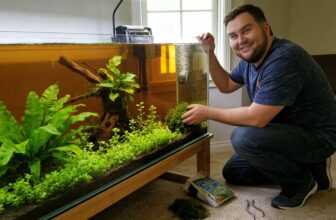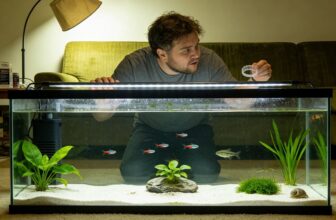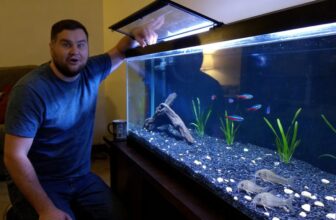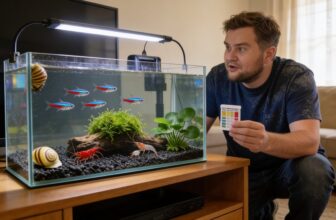
For lush planted growth, skip the outdated watts-per-gallon rule—it ignores depth and spectrum.
Aim for 5500–7000K color temperature, mimicking sunny freshwater.
For nano tanks under 20 gallons and 12-inch depth, grab the Fluval Planted Spectrum Nano (under $60, Bluetooth-controlled).
Need deeper coverage? Use a Finnex Stingray II.
Keep photoperiods short: 6–8 hours max.
Too much light invites algae, not growth.
Adjust brightness or duration if green fuzz appears.
Stick to these specs, and your plants won’t just survive—they’ll thrive.
Stick around for the full fixture breakdown.
At A Glance
- Target 5500–7000K color temperature for optimal freshwater plant growth.
- Match light depth to tank height; weak lights fail over 18-inch depths.
- Use PAR values (10–20 low, 40–60 high) instead of watts-per-gallon.
- Fluval Nano suits tanks under 12 inches; Kessil A160WE for deep tanks.
- Programmable timers with sunrise/sunset simulation reduce algae spikes.
Planted Tank Success Starts With the Right Light Spectrum
Since you’re about to drop cash on lights for your planted tank, the single biggest shortcut to success is nailing the right light spectrum. You want yellow-white light, 5500–7000K, mimicking a sunny day. That’s what freshwater plants crave, not that blue reef stuff. Get this wrong, and you’re just growing algae.
The single biggest shortcut to success is nailing the right light spectrum—5500–7000K.
- Target color: 5500–7000K for lush growth.
- Avoid blue-heavy lights—they’re for saltwater, not your java fern.
See, your plants use that warm glow to photosynthesize like champs. It’s not rocket science—it’s just matching their vibe. Nail the spectrum, and you’re already ahead of the crowd. Avoid these blue-heavy lights because they’re designed for reef tanks with pH targets like 8.3, not freshwater plant growth. Aim instead for fixtures with high PAR per watt efficiency to ensure healthy growth without overheating the tank.
Three Key Specs: Spectrum, Depth, and Coverage Width
You already know the spectrum: 5500–7000K, that warm sunny-day glow your plants are begging for.
Now, let’s lock in the other two specs your tank can’t live without.
- Depth: Your light must punch through the water column. For tanks over 18″ tall, skip weak clips; go with high-output fixtures like the Finnex Stingray II or Kessil A160WE.
- Coverage Width: One light won’t cut it for a 48″ tank. You’ll need two pendants linked together, or an adjustable leg model like the Current USA Satellite Plus PRO.
- Why It Matters: Wrong depth means leggy stems. Wrong width means dark corners. Get both right, and your plants throw a party.
Bottom line: measure twice, buy once. Your tank’s future self thanks you. Electrode longevity and maintenance are also critical for keeping any digital monitor accurate over time. For top-performing measurement tools, NIST-traceable accuracy ensures reliable readings every time.
Color Explained: 5500K vs 7000K for Freshwater Plants
When both glow like a sunny day, 5500K and 7000K actually serve slightly different jobs for your plants. 5500K leans warm and yellow—great for low-light plants like anubias, giving a natural, cozy look. 7000K shifts cooler and bluer, boosting growth for stem plants and mosses. For planted tanks, choosing a substrate with high surface area supports the beneficial bacteria that thrive alongside aggressive plant growth. Check the table:
| Kelvin Value | Best For | Visual Effect | Plant Response |
|---|---|---|---|
| 5500K | Low-light, hardy plants | Warm, golden hue | Steady, relaxed growth |
| 7000K | High-light, fast growers | Crisp, daylight tone | Aggressive photosynthesis |
Bottom line: match your plants’ needs, not just your eyes. If you’ve got a mixed tank, split the difference with a full‑spectrum RGBW fixture that supports Java fern growth and includes built‑in timer and sunrise simulation for a consistent 24‑hour cycle. You’ll belong to the savvy crowd that picks light for growth, not just wow.
What Replaced the Outdated Watts-Per-Gallon Rule
The old watts-per-gallon rule was about as useful as a screen door on a submarine—it never accounted for how deep your tank is or what plants you’re actually growing.
The old watts-per-gallon rule was about as useful as a screen door on a submarine.
You’ve likely replaced it with three smarter factors that actually matter:
- Tank depth and dimensions – Light penetration drops fast; a 12-inch deep nano needs far less punch than a 20-inch tall rectangle.
- Plant type and intensity – Low-light Java fern? Stick to 10-20 PAR. High-light carpet plants? Push 40-60 PAR; watts mean nothing here.
- Fixture spread and coverage – Your light’s output angle dictates if your whole tank glows or just a hot spot.
Modern submersible LEDs, such as the SEAOURA model, offer full‑spectrum lighting that supports plant photosynthesis with as little as 1 watt. For precise control over light duration, a programmable digital timer can automate sunrise and sunset phases to reduce algae spikes and fish stress.
Best LED Light for Planted Nano Tanks Under 20 Gallons
If you’re shopping for a planted nano tank under 20 gallons, the Fluval Planted Spectrum Nano is your clear winner—not since it’s flashy, but since it actually does the job without nickel‑and‑diming you.
You get app‑controlled sunrise‑sunset cycles, six band‑waves for lush plant growth, and a sleek black top that won’t ruin your aesthetic.
It handles tanks up to 12 inches deep, so low‑tech setups thrive.
No separate timers or controllers needed—just plug, pair, and watch your plants take off.
For under 60 bucks, it’s the community’s go‑to.
Belong to the club that gets it right.
Pair this light with a clear mesh aquarium lid for high light transmission while keeping fish secure.
To replicate this ultra‑quiet operation below 35 dB, choose a compatible HOB skimmer with a silicone seal similar to the Sicce Shark Nano.
Top Pick for Rectangular Tanks: Finnex Stingray II
Moving on from nano tanks, if you’ve got a standard rectangular setup—say a 20‑gallon long or a 40‑gallon breeder—the Finnex Stingray II is the pick that keeps popping up in forums for good reason.
It’s built for your tank’s exact dimensions, like a tailored suit but without the dry‑cleaning bill.
- Aluminum housing keeps it cool and sleek, so you don’t fry your plants or your wallet.
- Adjustable legs fit 12–48″ widths, meaning no drilling, no fuss.
- Three‑position color switch lets you toggle from white to moonlight mode—perfect for lazy evening gazing.
You’re getting bright, even coverage up to 20″ tall. It’s the straight‑forward workhorse your rectangular tank deserves. For a complete setup, pair it with a heavy-duty 55-gallon stand that offers a 1,200 lb capacity and built-in power outlets. The light pairs well with a weekly prevention dosing of a water clarifier to keep the view crystal clear.
Kessil A160WE Tuna Sun: Silent Power for Deeper Tanks
No subtlety here: the Kessil A160WE Tuna Sun is the spotlight specialist you call in when your tank goes deeper than 18 inches. It’s 100% silent—no fan hum to break your zen. You get a dimmable, programmable pendant that punches light straight down, perfect for that 24-inch tall freshwater setup. Pairing it with a dual‑stage regulator ensures stable CO₂ delivery for deeper tanks by maintaining steady flow even as cylinder pressure declines. For precise temperature monitoring in such deep tanks, use a digital thermometer with ±0.1 °C high precision to protect sensitive species.
No subtlety here: the Kessil A160WE Tuna Sun is the spotlight specialist for tanks deeper than 18 inches.
- Freshwater depth: handles up to 24 inches, coverage 20-40 gallons.
- Silent operation: zero noise, just pure photosynthesis.
- Mounting: grab the optional gooseneck; it’s sleek, not bulky.
Pair two with a Kessil link cable for wider tanks. Bottom line: if depth’s your challenge, this light’s your quiet champion.
Fluval Nano Plant Spectrum LED: App Control and Biotope Presets
Ever had a nano tank that felt like a miniature black hole, swallowing all your lighting attempts? The Fluval Nano Plant Spectrum LED fixes that, letting you take control via Bluetooth. It’s like having a lighting engineer in your pocket, minus the attitude.
- Biotope Presets: Choose from Amazon, Asian, or African river scenes. One tap, and your plants feel at home—no complicated guesswork.
- 24‑Hour Timer: Sunrise, sunset, and moonlight cycles automate perfectly. You’ll stop playing mad scientist with timers.
- 6‑Band Spectrum: Covers 5500‑7000K white plus red/blue for lush growth. Works great on tanks up to 20 gallons, max 12 inches deep.
Bottom line: It’s smart, simple, and makes your nano tank thrive. You’re in good company. Use straight tweezers to grasp thick stems and rhizomes when planting under this light.
For an even simpler setup, consider adding a Fluval 3D‑Printed Riser to achieve uniform illumination across the light fixture.
Penn-Plax Cascade Clip-On: Budget LED for Shallow Tanks
If your wallet’s feeling a little light but your nano tank still craves a glow, the Penn‑Plax Cascade Clip‑On is the budget-friendly answer you’ve been looking for.
This little guy shines on shallow tanks—think 5 gallons or less—its 12 high-powered red and blue LEDs pushing light where it’s needed.
No fancy timers here, just a simple on/off switch.
But for the price, you’re getting solid coverage in a stainless, 4.5-inch housing. It clips right on, no fuss.
The height’s fixed, so plan your scape accordingly.
It’s a no-frills win for keeping your tiny planted world alive without breaking the bank.
For even more versatility, consider models like the Pawfly Bluetooth Aquarium Light which offers app-controlled customization and 100,000 color options for nano tanks.
Alternatively, you could pair this light with a controller offering dual independent outlets for precise temperature management of your nano setup.
Current USA Satellite Plus PRO: Full-Spectrum With 24-Hour Timers
When you’re ready to ditch the guesswork of manual lighting, the Current USA Satellite Plus PRO steps in with full‑spectrum white plus RGB LEDs and a built‑in 24‑hour timer that actually works. It’s like a personal lighting assistant that you didn’t know you needed.
Ditch manual lighting guesswork with the Satellite Plus PRO’s full‑spectrum LEDs and built‑in timer.
- Sunrise & Sunset: 15‑minute fade‑ins and fade‑outs simulate dawn and dusk, so your tank wakes up slowly—just like you wish you could.
- Six Color Presets: Switch from “Coral” to “Plant” mode with one touch, adjusting the blend of white and RGB LEDs for specific plant health.
- 120‑Degree Reflector: Spreads light evenly across tanks up to 18 inches deep, so no shady corners for algae to hide.
You get predictable care, not guesswork. That’s the club you want to join. A similar approach to water flow and circulation is used in breeding boxes to prevent stagnation and promote oxygenation. The adjustable brightness levels also help manage algae growth by avoiding excessive light exposure.
Finnex Stingray II: Aluminum Build and Moonlight Mode for Freshwater
The Current USA Satellite Plus PRO is great if you want a programmable timer built right in, but sometimes you just want a light that works, looks good, and doesn’t need an app to prove it’s smart. The Finnex Stingray II’s aluminum chassis feels premium, not flimsy plastic. Its moonlight mode? Pure magic—soft blue LEDs for night viewing without shocking your fish. For turtles in larger tanks, a 500 W submersible heater with dual quartz tubes ensures even warmth across extensive water volume. Many aquarists combine this light with a HOB filter that features quiet motors ≤40 dB for a complete, low-noise setup.
| Feature | Why It Matters for You |
|---|---|
| Aluminum build | Dissipates heat, lasts years |
| Moonlight mode | Calm nighttime ambiance |
| 3‑position switch | Quick color tweaks |
| Adjustable legs | Fits 12‑48” tanks |
| High output | Grows low‑light plants easy |
You’re part of the crew that values sturdy, no‑fuss gear. For under $100, this light delivers. Bottom line: if you want reliability without the complexity, grab the Stingray II.
Single Light vs. Multiple Fixtures for Even Coverage
One light might get the job done, but two fixtures often save you from the dreaded dim spot—that shadowy corner where your Java fern just gives up.
Spreading coverage isn’t rocket science, it’s geometry.
- Matching your tank width – For a 36‑ to 48‑inch aquarium, a single pendant leaves a dark zone on each end. Two Kessil A160WEs linked via cable fix that, giving your plants a level playing field.
- Depth matters too – Nanos under 20 gallons? One Fluval Nano works. Taller tanks need two fixtures to penetrate the bottom without scorching the top.
- Embrace the pair – You’ll avoid algae‑friendly hot spots while ensuring your carpet plants get the light they crave.
Bottom line: measure your tank, then double up if needed—your plants belong in the light.
For smaller setups, using flat pieces 3.9‑5.9 inches low-profile driftwood won’t overwhelm the scape while still supporting biofilm growth.
To maintain healthy plant growth, aim for a 12-14 hour light cycle to mimic the stable parameters that keep Rosy Red Minnows calm and long-lived.
Adjust Photoperiod and Intensity to Prevent Algae
Since algae loves nothing more than an open buffet of light and nutrients, cutting off the all‑you‑can‑eat hours is your first defense. You’re the chef here, so set the timer to 8–10 hours max. Crank intensity too high, and you’re serving green soup.
| Light Level | Photoperiod |
|---|---|
| Low (nano) | 8 hours |
| Medium | 7 hours |
| High (CO₂) | 6 hours |
| Too bright | Algae fest |
Dim your fixture 20–30% if you spot green fuzz. Trust me, your plants won’t starve—they’ll thrive. For extra control, consider using an automatic feeder that operates on a reliable battery indicator to avoid unexpected feeding stops during your lighting schedule. You’ve got this, fellow tank whisperer.
Match Light Placement to Your Tank’s Dimensions
You’ve dialed in your photoperiod, but light placement is where most planted tank setups go lopsided. Get it wrong, and your plants grow sideways or not at all.
- Width matters: For a 36‑48″ tank, one light leaves dark edges. Use two pendants, like the Kessil A160WE ($150 each), linked with a cable for even coverage.
- Depth counts: The Fluval Nano covers only 12″ deep, so a 20″ tall tank needs the Finnex Stingray II ($80), with adjustable legs for better penetration.
- Nano simplicity: A single Fluval Planted Spectrum Nano ($70) works perfectly for 10 gallons; no need to overcomplicate it.
Bottom line: match your fixture’s spread to your tank’s footprint. That’s it.
Frequently Asked Questions
What Is the Best Light for Low-Tech, No-Co2 Planted Tanks?
You want the Fluval Planted Spectrum Nano for low-tech tanks. No CO2 injection means you’re relying on moderate light, and this light delivers exactly that. It runs about $70–$90 and covers tanks up to 20 gallons.
Here’s why it works:
- Its Bluetooth app lets you dial intensity down—crucial since high light + no CO2 invites algae.
- Biotope presets mimic natural daylight cycles.
- Six band-waves boost plant growth without scorching.
Think of it: Frankly, anything too powerful just grows algae. The Fluval gives you control without the headache. If your tank is larger, grab two.
Can I Use a Saltwater LED Light for a Freshwater Planted Tank?
Yeah, you *can* use a saltwater LED on a freshwater planted tank, but it’s like bringing a scuba mask to a swimming pool – overkill.
Saltwater lights blast blue spectrum for corals, but freshwater plants crave yellow/white (5500–7000K).
You’ll likely waste money on features you don’t need, risking algae with excessive intensity.
Stick with a dedicated freshwater light like the Finnex Stingray II or Fluval Nano – they’re cheaper, simpler, and you won’t feel silly explaining your blue‑tank to friends.
How Long Do LED Aquarium Lights Typically Last Before Needing Replacement?
You’re looking at 5-plus years, easy—LEDs last 30,000 to 50,000 hours, so daily use gives you a decade or more.
No bulb swaps, no heat worries.
Your Fluval Nano or Finnex Stingray will outlast your next tank upgrade.
Dimming over time happens, but it’s gradual.
Bottom line: you’ll replace your light only since you want a fancier one, not since it died. That’s the real deal.
Do Rimless Tanks Need Different Light Mounting Than Standard Rimmed Tanks?
Yes, rimless tanks often need different mounts. Standard clip-on lights won’t fit their thin glass—you’ll need adjustable legs or a pendant like the Kessil A160WE ($200+).
That gooseneck arm clamps onto the rimless edge, no problem. Finnex Stingray II ($80) also works with its adjustable plastic legs.
Always check your light’s bracket: if it extends over 0.75 inches, you’re golden. Don’t let a $5 clamp ruin your sleek setup.
Bottom line: buy a light with flexible mounting, or you’ll be rigging some embarrassing DIY solution.
What Light Intensity Should I Start With for New Aquarium Plants?
Start at 30–50% intensity for new plants—they’re already shocked from the move.
You can ramp up gradually over two weeks to avoid cooking them or feeding algae.
Most LED fixtures, like the Fluval Nano, let you dial this in via app.
A six-hour photoperiod at low intensity gives them time to settle.
Think of it like easing into a hot tub, not cannonballing in.
Rounding Up
So, you’ve got the right light now—but you’re not done yet. Pick a fixture that hits your tank’s depth (measure twice, buy once), and aim for a color around 6500K—it’s the sweet spot for most plants. Start your photoperiod at six hours, then tweak it. Too much light? You’ll grow algae, not a garden. Bottom line: a $100–$150 LED like the Finnex Stingray II or a budget-friendly Nicrew will work wonders if you match specs to your tank. Don’t overthink it—just set it and forget it (mostly).